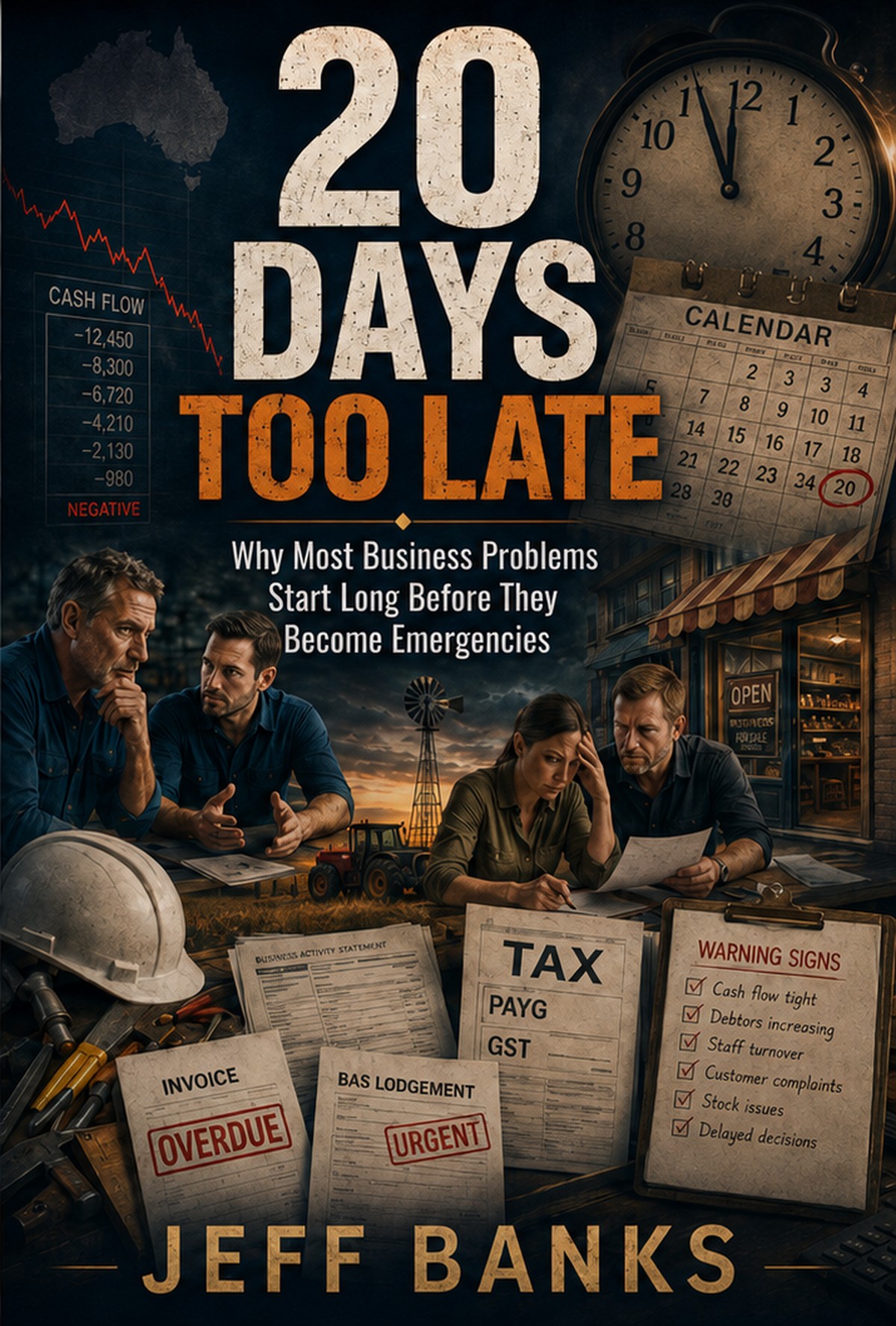
20 DAYS TOO LATE - Chapter 12 - Twenty Days To Go

20 DAYS TOO LATE - Chapter 12 - Twenty Days To Go | Travelling Around Australia with Jeff Banks

If there is a final practical message in this chapter, it is this: do not let tax planning become a once-a-year apology for not managing the business earlier. Use it as a review, a checkpoint and a prompt to ask better questions. Let it expose the patterns, not merely adjust the figures. The owner who learns that lesson becomes harder to ambush. They still face risk, because business will always contain uncertainty. They still make mistakes, because all humans do. Yet they are less likely to be surprised by their own business, and that may be one of the most valuable forms of intelligence an owner can develop.If there is a final practical message in this chapter, it is this: do not let tax planning become a once-a-year apology for not managing the business earlier. Use it as a review, a checkpoint and a prompt to ask better questions. Let it expose the patterns, not merely adjust the figures. The owner who learns that lesson becomes harder to ambush. They still face risk, because business will always contain uncertainty. They still make mistakes, because all humans do. Yet they are less likely to be surprised by their own business, and that may be one of the most valuable forms of intelligence an owner can develop.

20 DAYS TOO LATE

Chapter 12

Twenty Days To Go

There is a particular tone in a business owner’s voice when they ring twenty days before the end of the financial year. It is not quite panic, because panic usually arrives later when the assessment or activity statement turns up. It is not quite curiosity either, because genuine curiosity would have started months earlier when there was still time to shape the outcome.

It is a tone I came to recognise over many years. It was usually casual at the beginning, sometimes even cheerful, as though the whole exercise was just a normal end-of-year tidy-up. The words varied from person to person, but the meaning was nearly always the same: “I think I have made too much profit this year. What can we do about the tax?”

That question sounds simple, but it carries a lot of history. It carries the decisions made in July, August and September, when the year still looked young and forgiving. It carries the invoices raised in November and the wages paid in February. It carries the customer who should have been fired, the employee problem that was never properly addressed, the equipment bought to save tax, the drawings taken because the bank balance looked healthy, and the structure that was once sensible but had not been reviewed for years.

By the time the question arrives twenty days before 30 June, the year has already happened. The business owner may still feel as though there is time to do something clever, but most of the big levers have already been pulled. Tax planning at that point is not about creating a different year. It is about understanding the year that has already been created.

That is why this final chapter is not really about tax planning. It is about timing, attention and the uncomfortable truth that business outcomes rarely appear without warning. Tax simply becomes the final mirror, reflecting what the business has been doing all year and asking whether anyone was prepared to look before the reflection became unavoidable.

The strange thing is that tax is often blamed for problems it did not create. A tax bill can be inconvenient, frustrating and sometimes frightening, but it is rarely the first problem in the business. It is usually the last visible consequence of everything that happened before it, which is why trying to fix a business through last-minute tax planning is a little like trying to repair a roof during the storm while pretending the clouds were not visible for weeks.

I remember a business owner who rang late in June after what appeared to have been a very good year. Sales had increased, the profit and loss report looked impressive, and the business owner was worried about paying too much tax. On the surface, it sounded like a pleasant problem to have, because tax usually follows profit and profit is meant to be the point of business.

The difficulty was that the bank account told a very different story. The profit was there, but the cash was not. Debtors had grown, stock had increased, equipment had been purchased, private drawings had crept upwards, and a few older suppliers had been stretched beyond their comfort zone. The business had made money in the accounts, but it had not kept enough of it in the bank.

That conversation did not begin as a tax planning discussion for very long. It quickly became a cash flow discussion, because the business owner did not really have a tax problem. He had a timing problem, a discipline problem and a visibility problem that had been hidden by rising revenue.

The tax bill did not cause those problems. It simply revealed them. The tax office became the last creditor standing at the end of a year in which the business owner had already spent money that was never entirely his to spend.

This is one of the crueler lessons of business. A good profit can feel like success until the cash required to pay the tax has been used for something else. The money went somewhere, of course, because money always goes somewhere, but by the time the owner asks where it went the answer is often scattered across motor vehicles, stock, debtors, private expenses, loan repayments and optimistic decisions made when the year felt much easier.

That is why the best tax planning does not start twenty days before the end of the financial year. It starts when the business owner decides to pay attention to the business as it is actually behaving, not as they hope it is behaving. It starts when the numbers are treated as early warnings rather than historical records.

There are things that can still be done with twenty days to go. A business owner can review superannuation contributions, subject to the current rules, caps and cash available. They can look at bad debts, trading stock, repairs, prepayments, timing of invoices, asset purchases, trust distributions, company loans, director drawings and the relationship between accounting profit and taxable income.

Those things matter, but they are not magic. They are not secret tricks kept in a drawer by accountants for people who ring at the end of June. They are tools, and like all tools they only work properly when used for the right reason, at the right time and with a clear understanding of what problem they are meant to solve.

Superannuation is a good example. There are times when making deductible contributions before year-end can be sensible, particularly when it fits the owner’s broader retirement planning and the cash flow can support it. There are also times when making a contribution simply to reduce tax can create a new problem, because the money leaves the business and cannot easily be retrieved when wages, suppliers or the tax office require payment.

I have seen business owners become so focused on reducing tax that they temporarily forget the purpose of cash. Cash is not just an accounting balance. It is oxygen, and a business can suffocate even while making decisions that look clever on paper.

The same is true of buying assets before 30 June. There are circumstances where the purchase of plant, equipment, tools or technology makes complete commercial sense. If the business genuinely needs the item, can afford it, and the tax treatment is favourable under the rules applying at the time, then bringing the purchase forward may be reasonable.

The problem begins when the purchase is driven by the tax deduction rather than the business need. Spending a dollar to save a portion of that dollar in tax is not automatically clever. It may feel satisfying because the tax bill falls, but the bank balance falls by more, and the business owner is left with an asset that may or may not improve the business.

This is where Chapter 6 of the journey returns quietly to the table. Buying things to save tax can be useful when the thing being bought is genuinely required and the timing makes sense. Buying things to avoid the feeling of paying tax is usually just emotion dressed up as strategy.

The twenty days before year-end are full of emotion. There is the resentment of paying tax, the fear of a large bill, the temptation to do something dramatic, and the faint hope that there is an accounting answer to a commercial problem. A good adviser has to slow the conversation down, because the wrong decision made quickly in June can create a worse problem in July.

Sometimes the correct answer is uncomfortable. It may be that the business made a good profit and simply has to pay the tax. It may be that the owner has taken too much money out during the year and must now recognise that drawings are not wages, profit is not cash, and the tax office does not disappear because the money was spent privately.

There is a maturity in accepting that tax is part of business success. Nobody enjoys paying more than necessary, and no sensible person suggests that legal tax planning should be ignored. Yet there is a difference between planning sensibly and treating tax as a personal insult.

Over many years, I found that the best business owners did not necessarily love tax, but they were rarely surprised by it. They understood roughly where the year was heading. They knew whether profit was up or down, whether cash was tight or healthy, whether debtors were stretching, and whether their private drawings were becoming a problem.

They did not wait until June to discover the shape of the year. They may not have known the exact figure, but they knew the story. That difference matters, because no business owner needs perfect information to make better decisions, but they do need enough information early enough for the decisions to still matter.

A mid-year review, properly done, often removes the sting from June. It gives the owner time to adjust wages, drawings, stock levels, pricing, debt collection, staffing and capital spending. It also gives the owner time to decide whether the issue is a tax planning matter or a business management matter, because those two things are often confused.

That confusion has probably paid for a fair portion of the accounting profession over the years. A client thinks they are asking a tax question, but the answer sits somewhere in pricing, stock control, employee productivity, business structure or personal spending. The tax question is merely the doorway through which the deeper conversation enters the room.

This is why the end of the financial year is such a revealing moment. It forces the business owner to gather the loose pieces and place them on the table. The profit and loss statement tells one part of the story, the balance sheet tells another, and the bank account often provides the part nobody wants to hear.

A profit and loss statement can make a business look healthier than it feels. It can show sales, gross profit and net profit while hiding the strain caused by slow debtors, rising stock, loan repayments and drawings. It records performance, but it does not always explain where the cash went unless somebody takes the time to connect the dots.

The balance sheet is where many of those dots begin to make sense. Debtors are not just numbers waiting to become cash. Stock is not just inventory sitting on shelves. Loans are not just liabilities that the accountant insists on listing. Each figure is a decision, a habit, a promise or a delay that has found its way into financial form.

When a business owner avoids the balance sheet, they often avoid the most important part of the story. They look at turnover because turnover feels energetic, and they look at profit because profit feels like a score. They avoid the balance sheet because it asks quieter but more dangerous questions about liquidity, debt, ownership and resilience.

The end-of-year review should therefore begin with a simple question: what has changed? If debtors have grown faster than sales, there is a collection issue. If stock has increased without a matching increase in profitable sales, there may be a buying or margin issue. If loans have increased while profit looks strong, the business may be consuming more cash than the owner understands.

None of these questions is complicated, but they require honesty. That is why many business owners avoid them until they can no longer be avoided. The numbers are not difficult because the arithmetic is hard; they are difficult because they disturb the story the owner has been telling themselves.

There is always a story. Every owner has one. The business is growing, the customers will pay soon, the new employee will improve, the old customer is worth keeping, the bank will understand, the next quarter will be better, the tax bill will not be as bad as expected, and the structure that worked ten years ago is probably still good enough.

Sometimes those stories are true. More often, they are partly true, which makes them more dangerous. A completely false story is easier to challenge, but a partly true story can keep a business owner comfortable for a very long time.

That is why twenty days to go is such a powerful phrase. It suggests urgency, but it also suggests prior delay. Nobody wakes up twenty days before 30 June in a completely new business reality. They wake up in the same reality that has been building all year, only now the calendar has made it harder to ignore.

In some businesses, the issue is unpaid customer accounts. The owner has been carrying customers who pay slowly, argue often and consume too much time. The business has continued to serve them because revenue feels safer than confrontation, but by June the cost of that decision is visible in debtors, cash pressure and stress.

In other businesses, the issue is staff. A difficult employee has been allowed to continue damaging morale or productivity because the owner did not want the conflict. The wages have been paid, the standards have slipped, and the owner has absorbed the emotional cost while telling themselves that things might improve.

There are also businesses where the structure has become outdated. A sole trader has grown beyond the arrangement that once made sense. A partnership has developed unspoken tensions. A family trust has beneficiaries whose lives have changed, and a company has director loans or retained profits that nobody has properly discussed for years.

By June, these issues do not politely separate themselves into neat accounting categories. They arrive together, tangled into the year-end conversation. The owner asks how to reduce tax, but the real answer may involve debt collection, employment decisions, pricing, asset protection, succession planning and a more disciplined approach to cash.

That is not always the answer the owner wants. They may have wanted a quick deduction, a clever adjustment or a reassuring sentence. Instead, they are being invited to look at the business as a living organism rather than a set of tax labels.

The best advisers do not use year-end planning to show how clever they are. They use it to help the owner see what the business has been saying for months. In that sense, the accountant is less a magician and more a translator, taking the language of numbers and turning it back into the language of decisions.

A debtor figure may translate into, “You are too generous with customers who do not respect your terms.” A stock figure may translate into, “You are buying emotionally because empty shelves make you nervous.” A wages figure may translate into, “You have people on the payroll who are not producing value.” A drawings figure may translate into, “The business is funding a lifestyle it cannot yet support.”

Those translations can be uncomfortable, but they are useful. They move the conversation from tax avoidance to business awareness. They also remind the owner that the financial statements are not there to impress the bank, satisfy the tax office or fill the accountant’s file. They are there to help the owner understand what is happening before the choices disappear.

There is a difference between a problem and an emergency. A problem gives you options. An emergency gives you consequences. Much of business management is simply the art of dealing with problems while they are still problems.

That is the heart of this book. The business that never looked at the numbers was not doomed by the numbers. The business that chased revenue was not ruined by revenue. The business that ran out of cash was not betrayed by profit. In each case, the warning signs were present before the damage became unavoidable.

The customer who should have been fired did not suddenly become difficult in June. The employee problem did not become expensive overnight. The asset purchase did not become foolish because the accountant entered it into the books. The government did not become a business partner merely because the owner forgot that tax, GST, PAYG withholding and superannuation obligations were building in the background.

Structures do not usually fail in a single moment either. They become unsuitable quietly as businesses grow, families change, risks increase and old assumptions remain unexamined. A structure that was sensible at the beginning can become awkward, expensive or dangerous when the business becomes larger than the thinking that created it.

The same applies to the conversations owners avoid. Partners who never discuss expectations eventually argue about money. Parents who never discuss succession eventually leave confusion behind. Owners who never discuss retirement eventually discover that the business they built may not be the asset they thought it was.

Tax planning twenty days before year-end is therefore a final exam of sorts. It does not test whether the accountant knows the rules, though that knowledge certainly matters. It tests whether the business owner has been paying attention to the business long enough for the rules to be used wisely.

The first practical step is to estimate the result before the year ends. That sounds obvious, but many businesses still drift into June without a reliable picture of profit, taxable income and cash. A rough but timely estimate is usually more useful than a perfect set of accounts prepared months after the choices have disappeared.

The estimate should separate profit from cash. It should ask whether the reported profit is supported by money in the bank or trapped in debtors, stock, work in progress or private drawings. It should also identify tax instalments already paid, expected obligations still coming, and whether the business has the capacity to fund any planning action without putting pressure on ordinary operations.

The second step is to examine the obvious timing matters. Are there genuine repairs that should be completed before year-end rather than postponed? Are there subscriptions, insurance premiums or other expenses where prepayment is commercially sensible and allowed under the relevant rules? Are there bad debts that should be properly reviewed and written off where recovery is genuinely unlikely?

The third step is to consider superannuation and remuneration. Contributions may be useful, but they must be made within the current law, paid on time, and supported by cash flow. Wages, bonuses and director payments must also be considered properly, because what feels like tax planning can quickly become messy if the paperwork, timing and commercial reality do not line up.

The fourth step is to review stock and work in progress. Many owners underestimate how much profit can be sitting in stockrooms, job schedules and half-finished work. A proper review can reveal obsolete items, slow-moving lines, poor margins and operational habits that have been hiding inside the accounts.

The fifth step is to look carefully at debtors. A debtors ledger near year-end is often a character reference for the business. It shows whether terms are being enforced, whether customers are respecting the business, and whether sales are actually turning into money.

The sixth step is to review drawings, loans and private spending. This is where the conversation often becomes delicate, because the business owner may not have realised how much money has left the business for personal reasons. The accountant does not need to moralise, but somebody needs to say plainly that a business cannot fund everything indefinitely.

The seventh step is to review structure and risk, even if the changes cannot be made before 30 June. Year-end planning is not only about what can be fixed today. It is also about identifying what must be fixed before the next year repeats the same problem with larger numbers.

That last point is important. Sometimes the most valuable outcome of a June meeting is not a lower tax bill for the current year. It is a decision to run the next year differently, because the owner finally sees the pattern clearly enough to change it.

I have always thought the best tax planning meetings include at least one sentence that begins with, “Next year, we should not leave this until now.” That sentence may sound modest, but it marks a shift in responsibility. It moves the owner from reaction to management, and from surprise to preparation.

There is no shame in learning late, provided the lesson is not wasted. Many good business owners have had one painful year-end conversation that changed the way they ran their business. They did not become perfect afterwards, because business does not reward perfection as often as business books suggest. They simply became harder to surprise.

They started reviewing numbers earlier. They began watching cash rather than only sales. They questioned customers who consumed too much time. They dealt with staff issues sooner. They stopped treating tax as an annual ambush and began treating it as part of the normal cost of a profitable business.

That is a more powerful change than any single deduction. A deduction can reduce this year’s tax. A change in behaviour can improve every year after it.

The difficulty, of course, is that behaviour is harder to sell than deductions. Business owners like practical action, and sometimes practical action looks like buying something, paying something, signing something or moving money before a deadline. Behavioural change looks slower, but it often produces the greater return.

A business owner who improves debt collection may do more for cash flow than any year-end deduction could achieve. An owner who raises prices properly may do more for profitability than a last-minute asset purchase. An owner who stops carrying unprofitable customers may do more for sanity than any spreadsheet can show.

This is why the whole year matters. June is not a magic month. It is merely the point at which the year stops pretending to be flexible and begins becoming history.

The accountant can still help in June. Good advice still matters. Timing still matters. The rules still matter. Yet the most valuable adviser in the world cannot go back to August and collect the debt that should have been chased, increase the price that should have been reviewed, or prevent the purchase that should never have been made.

There is a quiet humility in that realisation. It reminds both the owner and the adviser that business is lived forward but measured backward. We make decisions in motion, often with incomplete information, and then the accounts arrive later to record whether those decisions made sense.

That does not mean the owner should be paralysed by hindsight. The purpose of reviewing the year is not to beat yourself up over every imperfect decision. It is to build a habit of noticing sooner, because noticing sooner is often the difference between adjustment and damage.

The phrase “twenty days too late” can sound harsh, but it is not meant to condemn. It is meant to wake the owner gently before the next avoidable surprise becomes expensive. Every business owner has been late to something, and every adviser has seen a client delay a decision that would have been easier earlier.

The question is not whether you have ever been late. The question is whether you keep being late to the same lesson.

If the year-end review shows a cash flow problem, then the next year needs regular cash flow reporting. If it shows slow debtors, then the next year needs better terms and firmer follow-up. If it shows tax shock, then the next year needs earlier estimates, instalment planning and disciplined reserves.

If the review shows that revenue rose but profit did not, then pricing, margins and costs need attention. If it shows that profit rose but cash did not, then working capital, drawings and debt repayments need attention. If it shows that the owner is exhausted, then the business model itself may need attention.

That last point is easy to miss because exhaustion does not appear on a tax return. It appears in the owner’s voice, health, family life and decision-making. A business can be profitable and still be consuming its owner in ways the accounts will only partly reveal.

This is one reason I have never believed business and life can be separated as neatly as textbooks imply. The business owner’s marriage, health, children, confidence, fear, pride and fatigue all walk into the office with the bank statements. They are not deductible line items, but they influence almost every decision the business makes.

Twenty days before year-end, those human realities often become visible. The owner who has avoided the numbers may be frightened. The owner who has worked too hard may be resentful. The owner who has made a good profit may still feel poorer than expected. The owner who has lost money may feel ashamed, even when the loss is explainable and recoverable.

A good conversation makes room for all of that without losing sight of the facts. Empathy does not require pretending the numbers are better than they are. Realistic advice does not require making the owner feel foolish for not seeing earlier what now seems obvious.

That balance is the heart of trusted advice. The adviser must be kind enough to understand why the owner delayed and honest enough to explain what the delay has cost. Too much kindness becomes avoidance, while too much bluntness becomes performance.

The end of the financial year is also a reminder that the government is never as far away from business as some owners like to believe. GST, PAYG withholding, superannuation, income tax and reporting obligations sit quietly in the background while the owner focuses on sales, staff and customers. They may be quiet, but they are not optional.

This is not because the government is a business partner in any warm and helpful sense. It is because the legal obligations of business continue whether the owner is organised or not. Ignoring them does not make the government more flexible; it usually just makes the eventual conversation more expensive.

The strongest businesses build those obligations into their rhythm. They do not treat BAS time as a shock, superannuation as an afterthought or income tax as an annual betrayal. They reserve cash, review obligations and accept that compliance is part of being allowed to operate.

That may sound dull, but dull habits often save businesses. There is nothing glamorous about setting aside money for tax, reviewing debtors every month, reconciling accounts, or checking margins. There is also nothing glamorous about oxygen, but the absence of it becomes interesting very quickly.

Business owners often ask for strategies, but many of the best strategies are simply habits repeated before they become urgent. Review the numbers. Protect the cash. Price properly. Act on slow payers. Deal with staff issues. Check the structure. Talk about succession. Do not wait until the calendar removes your options.

Those habits do not guarantee success. Nothing does. They simply reduce the number of surprises, and in business that is a far greater achievement than it sounds.

The businesses I admired most were not always the biggest or the flashiest. They were the ones where the owner seemed to know what was happening before everyone else did. They could still be hit by drought, recession, illness, bad debts, regulation, interest rates or the ordinary unfairness of life, but they were rarely blind to their own position.

They paid attention. That was their advantage. Not brilliance, not luck, not some secret technique hidden from their competitors, but attention applied consistently enough to notice problems while they were still small.

That is what year-end planning should teach. It should not teach the owner that accountants have clever tricks in June. It should teach the owner that June is easier when July through May were not ignored.

The final twenty days can still matter. They can clarify the result, sharpen the cash flow, identify legitimate actions and prevent avoidable mistakes. They can also create a moment of honesty, which may be more valuable than any immediate tax saving.

In that moment, the owner can ask a better question than, “How do I reduce tax?” The better question is, “What has this year been trying to tell me?”

That question changes everything. It turns the accounts from a compliance burden into a conversation. It turns tax planning from a scramble into a review. It turns the adviser from a technician into a witness who has seen the pattern and is willing to name it.

The answer might be that the business is stronger than the owner realised. It might be that profit is improving, debt is falling, cash is steady and the tax bill is simply the price of a good year. In that case, the planning conversation can be calm, practical and even reassuring.

The answer might also be that the business is fragile. It might reveal that growth has been funded by suppliers, drawings have been too high, margins are too thin, debtors are too slow, or the owner has confused busyness with progress. In that case, the tax planning conversation becomes the beginning of a much more important repair job.

Either answer is useful if it arrives in time. The tragedy is not discovering a problem. The tragedy is discovering it only after the options have gone.

That is why the second-best time is now. The best time may have been months ago, when the debtors first stretched, the margins first slipped, the employee first caused trouble, or the drawings first exceeded what the business could support. That time has gone, but the next decision has not.

A business owner cannot change the year that has just passed. They can, however, refuse to repeat it blindly. They can use the final twenty days not as a desperate attempt to rewrite history, but as a sober review of what history is saying.

This is where the title of the book comes home. Twenty days too late was never only about tax planning. It was about every ignored warning, every postponed conversation, every number left unread, and every uncomfortable truth placed gently to one side because the business owner was busy keeping the wheels turning.

Keeping the wheels turning is understandable. Most business owners are not lazy, careless or foolish. They are usually tired, committed, hopeful, distracted and trying to solve today’s problem before tomorrow produces another one.

That is why the warning signs are so easily missed. They do not arrive with sirens and flashing lights. They arrive as a slightly larger overdraft, a customer taking longer to pay, a staff member becoming harder to manage, a gross profit percentage slipping, a supplier account stretching, or a feeling in the owner’s stomach that something is not quite right.

The owner notices, but does not act. They tell themselves they will deal with it after the rush, after Christmas, after Easter, after the next big job, after the school holidays, after the bank meeting, after the financial year. Then one day they ring twenty days before 30 June and ask what can be done.

Something can usually be done. That is the hopeful part. It may not be as much as could have been done earlier, and it may not be as painless, but the act of looking honestly is never wasted.

The important thing is not to confuse the final twenty days with the whole answer. They are a doorway, not a destination. They allow the owner to see the year clearly enough to decide whether the next year will be managed differently.

If there is a final practical message in this chapter, it is this: do not let tax planning become a once-a-year apology for not managing the business earlier. Use it as a review, a checkpoint and a prompt to ask better questions. Let it expose the patterns, not merely adjust the figures.

The owner who learns that lesson becomes harder to ambush. They still face risk, because business will always contain uncertainty. They still make mistakes, because all humans do. Yet they are less likely to be surprised by their own business, and that may be one of the most valuable forms of intelligence an owner can develop.

The final chapter before the epilogue therefore ends where the book began. Business disasters are rarely born in a single dramatic moment. They are usually assembled quietly from small delays, soft excuses and warnings that were visible before they became expensive.

The antidote is not perfection. It is attention, followed by action while action is still available. That is the difference between a problem that can be managed and a consequence that must be endured.

By the time there are twenty days to go, the year has already told its story. The question is whether the owner is finally willing to read it, and whether the next year will be allowed to tell the same story again. That question belongs not only to tax planning, but to every business decision that waits patiently until waiting becomes the most expensive choice of all.

Author

Menu