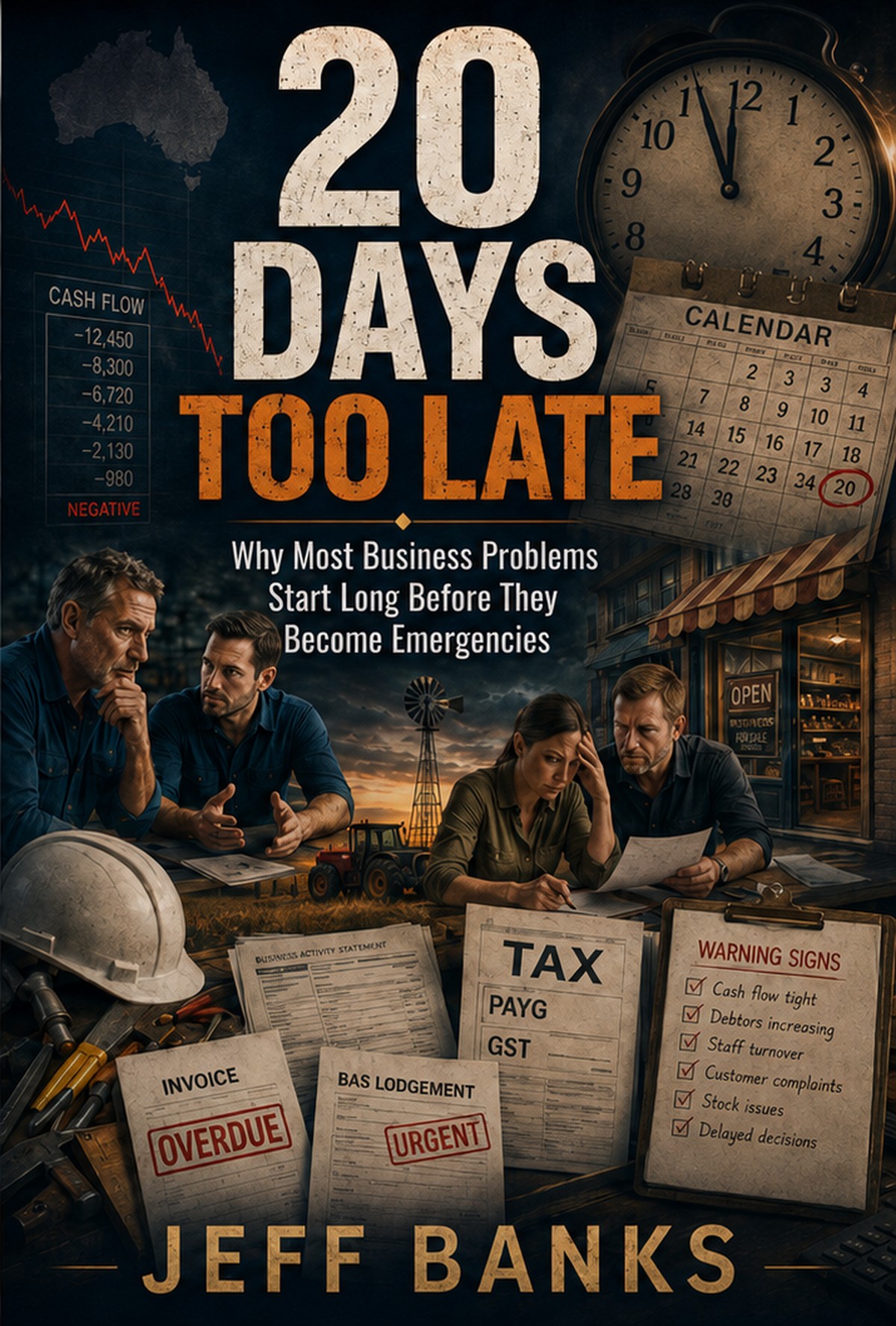
20 DAYS TOO LATE - Chapter 8 - Why Structures Matter

20 DAYS TOO LATE - Chapter 8 - Why Structures Matter | Travelling Around Australia with Jeff Banks

Structures matter because they force people to ask who owns, who controls, who benefits and who carries the risk. Those questions are rarely answered by documents alone, because behind every structure there are people with expectations, fears, loyalties, resentments and dreams.

20 DAYS TOO LATE

Chapter 8

Why Structures Matter

There is a certain look business owners get when someone first raises the question of structure. It is a mixture of impatience, mild suspicion and the faint hope that the conversation will be shorter than they fear.

I have seen it many times across a desk. The owner comes in to talk about the business, the profit, the staff, the tax bill, the bank, the next purchase, the sale they hope might happen one day or the mess they are already standing in. Somewhere in the middle of that discussion, I ask a fairly simple question: “Who actually owns what?”

It is a question that should be easy to answer. In practice, it often produces a silence longer than any accountant likes to hear.

There might be a company trading the business. There might be a family trust owning shares. There might be a property in personal names. There might be a partnership that was never properly documented. There might be a vehicle financed in the wrong entity, a loan from mum and dad, a spouse on the title but not in the business, or a business name registered to someone who left years ago and was never properly removed.

Sometimes the owner knows part of the answer. Sometimes they know the trading name, because that is what appears on the sign, the invoice and the football jumpers they sponsor. Sometimes they know the bank account name, because that is where the money appears, or disappears, depending on the week.

What they often do not know is the structure beneath the business. They do not know what sits where, who controls what, who carries the risk, who owns the assets, who has the power to sign, who has the power to sell and who will be left standing there if things go wrong.

That is not because they are foolish. Most business owners are too busy keeping the thing alive to sit around admiring legal diagrams. They did not start a plumbing business, a bakery, a farm, a retail shop or a building company because they wanted to spend their nights pondering the difference between trading entities, asset-holding entities and control mechanisms.

They started because they could do the work. They started because someone asked them to do a job, and then someone else asked, and then the ute needed signwriting, and then the first employee came along, and then the bookkeeper said they needed payroll, and suddenly a business existed where once there had just been a person with a skill.

That is how many businesses begin. They do not begin with a structure chart pinned to the wall and a carefully considered plan for risk, growth, succession and exit. They begin with work, energy, optimism and the dangerous belief that the details can be cleaned up later.

Sometimes they can be cleaned up later. More often, later arrives wearing boots and carrying a bill.

I remember a tradesman who had built a very good business from nothing. He was not flashy, and he was not the sort of person who spoke in the polished language of business magazines. He simply did good work, answered his phone, turned up when he said he would and employed people who generally followed his example.

By the time he came to see me, he had a dozen employees, several vehicles, plant and equipment, good commercial customers and a reputation that had value. He also had everything in the one entity, because that was how it had begun and nobody had ever really challenged it.

The trading business owned the equipment. The trading business had the contracts. The trading business employed the staff. The trading business had the overdraft, the vehicle loans, the supplier accounts and the tax debt that had crept up during a rough patch when a major customer took too long to pay.

The family home was not in that entity, but almost everything else connected to the business was. It was neat in the way a shed is neat when everything has been pushed to one side and nobody has opened the back cupboard for a while.

Then came a dispute. It was not a dramatic dispute at first, and it certainly did not look like something that might threaten the whole business. A job went bad, a customer refused to pay, accusations were made, solicitors became involved and the owner discovered that risk does not remain theoretical once lawyers start writing letters.

At that point, he wanted to know whether the equipment could be moved somewhere safer. He wanted to know whether the valuable parts of the business could be separated from the risky parts. He wanted to know whether the structure could be changed so that the past could not reach into the future.

That is when the phrase nobody wants to hear began circling the room. It was too late to make simple changes without consequences, because the risk had already appeared and the value had already accumulated in the wrong place.

That was not a failure of intelligence. It was a failure of timing, and timing is one of the most underestimated parts of business structure.

A good structure is not something you build after the fire starts. It is something you put in place when the skies are clear, the bank is friendly, the family is talking, the business is growing and nobody yet believes the structure matters.

That is why structures matter. They matter because they decide where the pain lands when something goes wrong, and they decide who has the power to make decisions when something has to change.

Too many business owners think structure is about tax. That is understandable, because accountants have not always helped the matter. For years, structure conversations have often been presented as clever tax planning, income distribution, asset protection or some combination of those terms that makes normal people reach for the car keys.

Tax is part of the conversation, but it should never be the whole conversation. A structure designed only around tax can become a beautiful little trap, because the business owner may save a dollar today while quietly creating a problem that costs far more tomorrow.

The better question is not, “How much tax will this structure save?” The better question is, “What is this structure supposed to protect, allow, separate, control or eventually transfer?”

That question changes everything. It stops the structure being a trick and turns it into part of the business plan.

A sole trader structure may be simple, cheap and perfectly appropriate for a small operation with limited risk and limited growth plans. It can also become dangerous when the business grows beyond the original idea, because the owner and the business can become almost indistinguishable.

A partnership can be wonderfully informal at the start, particularly between family members or friends who trust each other. It can also become a battlefield when one person wants to grow, one wants to slow down, one takes more drawings than the other and nobody can find the piece of paper that was supposed to explain what would happen if they disagreed.

A company can provide a clearer separation between the owner and the business, but a company is not a magic shield. Directors still have responsibilities, lenders often want guarantees, and a company that is used carelessly can become little more than a more expensive way to make the same old mistakes.

A trust can be flexible, useful and powerful in the right circumstances, particularly when control, asset ownership and family involvement need careful thought. It can also become a source of confusion when nobody understands who the trustee is, who controls the trustee, who the beneficiaries are and why the bank keeps asking for documents nobody has opened for years.

The point is not that one structure is good and another is bad. The point is that every structure is a set of consequences, and those consequences usually reveal themselves at the worst possible time.

I have always thought structures are a bit like fences on a farm. When the paddocks are dry, the gates swing properly and the cattle are where they should be, the fences look almost incidental. When a storm hits, a tree drops across the wire and stock wander onto the road, the quality of the fencing suddenly becomes very important.

Nobody praises the fence on the ordinary day. Everybody notices it on the day it fails.

Business structures work the same way. When things are going well, the structure feels like paperwork. When things are going badly, the structure decides whether the problem is contained or allowed to spread.

The best structures I have seen were rarely the most complicated. They were simply designed with a clear understanding of the business, the people, the risks and the likely future.

The worst structures were often either too casual or too clever. The casual ones were built on the idea that everyone trusted everyone, while the clever ones were built on the idea that someone had found a perfect answer that would never need to be questioned again.

Business has a habit of punishing both assumptions. Trust is important, but it is not a substitute for documentation, and cleverness is useful only when it still works after the facts change.

One of the great traps in business is that the structure which made sense on day one may not make sense on day one thousand. The problem is that nobody puts a reminder in the calendar to revisit the structure when the business changes.

A carpenter starts as a sole trader, because that is simple and cheap. Five years later he has employees, apprentices, vehicles, contracts, equipment finance and a spouse who signs bank guarantees without fully understanding what that means.

A husband and wife buy a small motel in a company, because the bank and the solicitor get the purchase completed that way. Ten years later the land has increased in value, the business has changed, the children have different levels of interest and nobody has separated the property asset from the operating risk.

Two brothers start a farm contracting business, because they get along and both work hard. Fifteen years later one has children coming through, the other wants to retire, the equipment is valuable, the debt is personal, and the original handshake begins to look much less romantic.

A professional practice starts with one owner and a receptionist. Twenty years later there are other professionals, recurring clients, goodwill, leased premises, key employees and an ageing founder who has never worked out whether they are building a business or simply creating a job that happens to have a letterhead.

In each case, the structure may have been fine at the start. The problem is that the business kept moving while the structure stayed exactly where it was.

That is where the “20 Days Too Late” moment often appears. It does not usually arrive as a dramatic thunderclap, and it is rarely announced by anyone wearing a name badge.

It arrives when the bank says the guarantee cannot be released. It arrives when a child says they want out of the family business. It arrives when a buyer asks what exactly they are buying. It arrives when a spouse involved in a separation asks what the business is worth. It arrives when a creditor, customer, landlord, supplier or former employee starts looking for someone to blame.

By then, everybody becomes very interested in structure. The accountant, solicitor and business adviser are suddenly asked to do in twenty days what should have been considered over the previous twenty years.

There are moments when that can be fixed. There are also moments when the answer is not the one anyone wants, because the cost of rearranging the structure after the value has grown, the debt has been incurred or the dispute has arisen may be far greater than the cost would have been earlier.

It is not always impossible. It is simply no longer clean.

Business owners often underestimate that distinction. They hear that something can technically be done, and they assume that means it can be done painlessly.

A restructure may be possible, but it may trigger tax costs, stamp duty issues, finance complications, legal documentation, commercial risk, family conflict or questions from lenders and customers. The fact that a thing is possible does not mean the business owner still has all the choices they once had.

Choices have a use-by date. That is one of the quiet lessons of business advisory work, and it applies to structure as much as it applies to cash, staff, customers and tax.

The strange thing about structure is that many owners only want to talk about it when they are trying to do something else. They want to sell, borrow, bring in a partner, buy property, protect assets, employ family, retire, separate from a spouse, resolve a dispute or deal with a tax problem.

Structure then becomes the road underneath the vehicle. If the road is sound, the journey may still be difficult, but at least the wheels have something to travel on. If the road was never properly built, every later movement becomes harder than it needed to be.

One of the simplest questions I used to ask business owners was this: “What are you trying to keep safe?”

The answer was not always obvious. Sometimes they wanted to keep the family home safe, although they had signed so many guarantees that the word safe needed careful handling. Sometimes they wanted to keep the trading business separate from the property asset, although both had been sitting together in the same entity for years.

Sometimes they wanted to protect one child from another, or one side of the family from the consequences of a business risk. Sometimes they wanted to protect retained profits from their own habit of drawing every available dollar out of the business when cash looked healthy.

That last one is more common than people admit. A structure does not only protect a business owner from others, because sometimes it protects the business owner from themselves.

Good structure creates discipline. It can separate trading cash from long-term wealth, operating risk from passive assets, family control from day-to-day management and current income from future succession.

Poor structure mixes everything together and then relies on hope. Hope is important in life, but it is a poor substitute for legal ownership, written agreements and clear records.

The trouble is that mixed-up structures often look efficient at first. One bank account is easier than three, one company is easier than a group, and a handshake is faster than a shareholders agreement.

Business owners are practical people. They like straight lines, quick answers and low costs, especially in the early days when every dollar going to advisers feels like a dollar not going to wages, stock or fuel.

I understand that instinct. I have never enjoyed watching business owners spend money on paperwork for the sake of paperwork, and I have seen plenty of unnecessary complexity sold to people who did not need it.

But there is a difference between avoiding unnecessary complexity and avoiding necessary thought. The first is sensible, while the second is expensive.

A structure should be no more complicated than the business requires. That does not mean it should be simpler than the business can safely tolerate.

There is an old temptation to treat structure like a product. Someone at a barbecue says everyone should have a trust, someone else says companies are better, someone else says partnerships are a disaster, and by the time the sausages are cooked, half the people standing around the barbecue have received legal and tax advice from a bloke holding tongs.

That is not how structures should be chosen. The right structure depends on the business, the risk, the owners, the family, the finance, the assets, the future and the likelihood that today’s arrangement will still make sense when circumstances change.

It also depends on the people involved. That is the part business owners sometimes prefer to ignore.

A structure is not just a tax and legal arrangement. It is also a map of relationships.

Who controls the bank account? Who can appoint or remove a trustee? Who owns the shares? Who can sell the business? Who makes decisions when the owners disagree? Who receives the benefit if one person dies? Who carries the debt if the business fails?

These are not technical questions dressed up as human questions. They are human questions disguised as technical matters.

I have seen families treat structure as if it were merely a form to be signed. Years later, the same family discovers that control of an entity can mean control of the family’s wealth, the family’s history and the family’s future.

That is when the polite conversations end. That is when the assumptions made around kitchen tables become arguments in solicitors’ letters.

A family business can survive a lot of things. It can survive drought, debt, bad customers, poor seasons, staff shortages, changing markets and the occasional terrible decision made by someone who thought they were being clever.

What it struggles to survive is confusion over ownership and control. When people do not know where they stand, they start defending positions instead of solving problems.

That is why succession and structure belong in the same conversation. Too many owners think succession is something to discuss when they are ready to leave, but the structure may have been quietly deciding the succession options for years.

If the land is owned in one place, the trading business in another, the debt personally guaranteed by the parents and the children paid different amounts for different levels of contribution, succession is not a conversation that can be tidied up over one afternoon. It is a knot, and the knot tightens every year it is left alone.

The same applies to professional practices, retail businesses, transport operators and building companies. If the founder owns everything, controls everything and understands everything, the business may appear strong while that person is healthy, energetic and in command.

The weakness is not visible on the profit and loss statement. It is hidden in the fact that nobody else can step into the structure without everything wobbling.

That is one of the reasons business owners sometimes receive disappointing valuations when they try to sell. They thought they had built a business, but the buyer discovers they built a structure that depends almost entirely on one person.

The owner sees forty years of work. The buyer sees customer relationships that may walk out with the owner, staff loyalty that may not transfer, systems that live in someone’s head and legal arrangements that need cleaning up before settlement.

Both may be right. The difference is that the buyer prices risk more coldly than the owner prices effort.

Structure matters at sale because buyers do not only buy profit. They buy certainty, transferability and confidence that the thing they are buying can actually be handed over.

A business that cannot be cleanly sold is still a business, but it may not be the asset the owner believes it to be. That can be a hard lesson when retirement is no longer a distant idea but a date on the calendar.

The same applies to borrowing. Banks are not sentimental about structure, and nor should they be.

A bank looks at who owns the assets, who earns the income, who owes the money and who can be pursued if repayment fails. The owner may think of the group as one family business, but the bank will look through the documents and ask why the borrowing entity does not own the asset being offered, why the guarantor is exposed, or why the cash flow sits somewhere different from the security.

Sometimes that can be explained. Sometimes it cannot, and the owner discovers that a structure built casually for convenience does not impress people who lend money for a living.

I used to tell clients that a good structure should survive three questions. It should survive the tax question, the risk question and the life question.

The tax question asks whether the arrangement produces sensible and compliant tax outcomes. It does not ask whether the arrangement produces the lowest tax at any cost, because lowest-tax thinking has led plenty of people into arrangements they later regretted.

The risk question asks what happens if something goes wrong. That something might be a legal claim, a failed contract, a bad debt, an injury, a guarantee, a relationship breakdown, a creditor problem or a director responsibility that was not understood until too late.

The life question asks what happens when real life arrives. That means illness, death, divorce, retirement, children joining the business, children not joining the business, business partners changing direction, parents ageing and owners discovering they do not want to work forever.

If a structure only answers the tax question, it is incomplete. If it only answers the risk question, it may be too defensive to support the business. If it ignores the life question, it is pretending business owners are machines rather than people.

The life question is often the most neglected because it is the least comfortable. Nobody enjoys sitting in a meeting discussing death, marriage breakdown, incapacity, family resentment or what happens if the favoured child is not the one most capable of running the business.

Yet those questions are not pessimistic. They are practical, and practical questions asked early can save families from emotional and financial damage later.

I have seen business owners insure a truck, a shed, a crop, a machine and a photocopier, then leave the control of a valuable business resting on assumptions that would not survive a serious argument. That is a strange hierarchy of concern, but it is more common than it should be.

People will insure the asset they can see. They will often fail to protect the structure holding everything together, because the danger is not visible until the wrong person asks the wrong question at the wrong time.

There is also a pride element in structures. Many owners do not want to revisit them because doing so feels like admitting the original structure was wrong.

That is rarely the right way to think about it. A structure that suited a business at the beginning may have been perfectly sensible, and changing it later does not mean anyone made a mistake at the start.

It means the business changed. Growth is allowed to require new arrangements, just as a child is allowed to outgrow a pair of shoes without anyone blaming the shoes.

The real mistake is not starting simply. The real mistake is staying simply when the business has become complicated.

I have seen small businesses grow into serious enterprises while still wearing structures designed for pocket-money beginnings. The owners then wonder why every decision has become harder, every family discussion more loaded and every adviser’s answer more expensive.

A structure review does not need to be dramatic. It does not need to involve tearing everything apart or creating a maze of entities that nobody understands.

Sometimes the review simply confirms that the current arrangement still works. That is a good outcome, because certainty has value even when nothing changes.

Sometimes it identifies small adjustments. Perhaps the business needs better documentation, clearer loan accounts, updated trustee records, a review of guarantees, a proper shareholders agreement or a cleaner separation between trading operations and long-term assets.

Sometimes it identifies larger issues. Perhaps the trading risk is sitting with valuable assets, the wrong people control the wrong entities, the succession plan is inconsistent with the legal ownership, or the tax planning strategy assumes family harmony that no longer exists.

The point of the review is not to create work for advisers. The point is to avoid surprise, because surprise is where business owners pay full retail for problems that could have been solved wholesale earlier.

There is an old saying that the best time to plant a tree was twenty years ago, and the second-best time is today. Business people love that sort of saying until it applies to something they have been avoiding.

With structures, the best time is usually before the value arrives, before the dispute arises, before the bank tightens, before the children disagree, before the sale contract is drafted and before the owner starts counting the years to retirement.

The second-best time is before the next major decision. That might be before buying premises, taking on a partner, employing family, signing a long lease, purchasing expensive plant, accepting a major contract, bringing in outside investors, acquiring another business or giving personal guarantees.

The worst time is after the event has already created the problem. That is when the structure is no longer a planning tool and becomes a rescue operation.

Rescue operations are sometimes successful, but they are rarely elegant. They also tend to cost more, take longer and involve more stress than the earlier conversation would have required.

That is the part business owners need to hear without feeling judged. The structure discussion is not about proving they should have known better, because most owners were never taught to think this way.

They were taught by experience. Unfortunately, experience sometimes sends the invoice before it sends the lesson.

The practical question for any business owner is therefore quite simple. Does your structure still match your business?

Not the business you had when you registered the name. Not the business you had when you bought the first ute, signed the first lease, employed the first apprentice or printed the first invoice.

Does it match the business you have now? Does it match the business you are becoming?

That question should be asked at least whenever the business changes in a meaningful way. Growth, debt, new assets, new owners, new family involvement, new risks, new contracts and new exit intentions are all reasons to look again.

It should also be asked when life changes. Marriage, divorce, children, illness, ageing parents, retirement plans, inheritances and changed family relationships can all turn a once-sensible structure into a future argument.

Business owners sometimes say they do not want to overthink things. I agree with that sentiment, because overthinking can become a respectable form of procrastination.

But there is a difference between overthinking and thinking before it is too late. The first paralyses action, while the second preserves choice.

The best structures are not designed to predict every possible future. Nobody can do that, and anyone who claims otherwise should probably be asked to pick next Saturday’s lotto numbers before being trusted with your life’s work.

Good structures simply allow for the obvious risks. They recognise that businesses grow, people change, debt matters, families are complicated, buyers ask questions and the government will eventually want to know what happened.

They also recognise that business and life cannot be separated as neatly as people pretend. A business structure may sit in company registers, trust deeds and legal documents, but its consequences sit around dinner tables.

When the structure is right, nobody may notice it for years. That is not a failure, but a sign that the structure is doing its job quietly.

When the structure is wrong, everybody eventually notices. They notice when money cannot be moved, assets cannot be protected, ownership cannot be explained, control cannot be resolved or the tax outcome feels like punishment for earlier convenience.

I do not believe business owners need to become experts in structures. They have enough to do without turning themselves into part-time lawyers and accountants.

I do believe they need to understand what their own structure is trying to achieve. If they cannot explain that in plain English, there is a fair chance nobody has ever properly explained it to them, or the structure has drifted away from its original purpose.

A good test is to sit with the adviser and ask for the structure to be drawn on one page. Who owns the shares? Who controls the trust? Who owns the assets? Who employs the staff? Who owes the money? Who gives the guarantees? Who receives the profit? Who decides what happens next?

If that one-page drawing cannot be explained, the structure may be too complex, too neglected or too poorly understood. None of those are good signs.

Another useful test is to ask what would happen if the owner could not work for six months. Not forever, not in some dramatic end-of-days sense, but simply six months where the business had to operate without the person who normally holds everything together.

Who could sign? Who could access the bank? Who could deal with staff? Who could talk to the accountant, solicitor, bank and major customers? Who would know where the trust deed, company records, leases, finance documents and insurance policies are kept?

Those questions are not morbid. They are the business equivalent of knowing where the spare key is before locking yourself out.

The third test is to ask what would happen if the business were sold. Could the assets be transferred cleanly? Could the contracts be assigned? Could the buyer understand what they were buying? Could the owner separate the business from personal arrangements, family arrangements or unrelated assets?

Sale exposes structure. It is one of the few moments when all the hidden assumptions are dragged into daylight and given names, values and conditions.

That is why the structure conversation belongs long before the sale conversation. A business owner who waits until a buyer appears may discover that the price is not the only issue.

The buyer may want warranties, indemnities, security, restraint clauses, staff arrangements, landlord consent, finance approval and evidence that the entity selling the business actually has the right to sell what it claims to own. That is not the moment to discover that the structure has been living on memory rather than documentation.

If all of this sounds a little dry, that is only because structures are often described badly. In truth, they are not dry at all.

Structures are about protecting a family home from business risk. They are about making sure a surviving spouse is not left in a fight with business partners. They are about ensuring children are treated fairly, even when fair does not always mean equal.

They are about giving a buyer confidence. They are about giving a bank clarity. They are about giving the business owner options before circumstances remove them.

They are about making sure the person who spent forty years building something does not lose value at the end because the legal and financial scaffolding was never updated.

That is why structures matter. Not because accountants enjoy diagrams, although some do more than they should admit. Not because lawyers enjoy documents, although nobody has yet found a way to stop them entirely.

They matter because the structure is the skeleton of the business. You may not see it when everything is moving well, but you will certainly feel it when something breaks.

The business owner who ignores structure is not always reckless. More often, they are simply busy, optimistic and focused on the next problem that feels louder.

They are chasing revenue, managing staff, negotiating with suppliers, dealing with customers, answering the bank, watching cash flow and trying to make the year turn out better than the last. In that environment, structure can feel like a tomorrow problem.

But tomorrow problems have a habit of becoming today problems. By the time they arrive, they often bring interest, legal fees, tax consequences, family tension and fewer choices than anyone expected.

That is the lesson repeated throughout this book. Most business disasters do not begin on the day they become visible.

They begin earlier, when the warning signs were quieter. They begin when a small decision is postponed because nothing bad has happened yet.

Structure is one of those quiet warning signs. It does not shout from the profit and loss statement, and it rarely appears as a red number in the bank account.

It sits beneath the business, waiting to be needed. When the day comes, it either holds or it does not.

The owner who discovers the structure problem twenty days before settlement, twenty days after a dispute, twenty days before retirement or twenty days after a relationship breakdown is not dealing with a new problem. They are meeting an old problem at the moment it finally became unavoidable.

That is why the conversation needs to happen earlier. Not because everything can be made perfect, but because earlier conversations leave room for choice.

And that brings us to the conversations business owners avoid.

Structures matter because they force people to ask who owns, who controls, who benefits and who carries the risk. Those questions are rarely answered by documents alone, because behind every structure there are people with expectations, fears, loyalties, resentments and dreams.

The next problems in business are often not found in the accounts at all. They are found in the conversations that never happened, the assumptions nobody tested and the uncomfortable truths everyone kept stepping around.

Those conversations are usually avoided for understandable reasons. They involve family, money, control, disappointment, succession, performance and the possibility that someone may not like the answer.

But business does not reward silence forever. Eventually, the conversation happens anyway, and by then it is often more expensive, more emotional and far closer to twenty days too late.

Author

Menu