

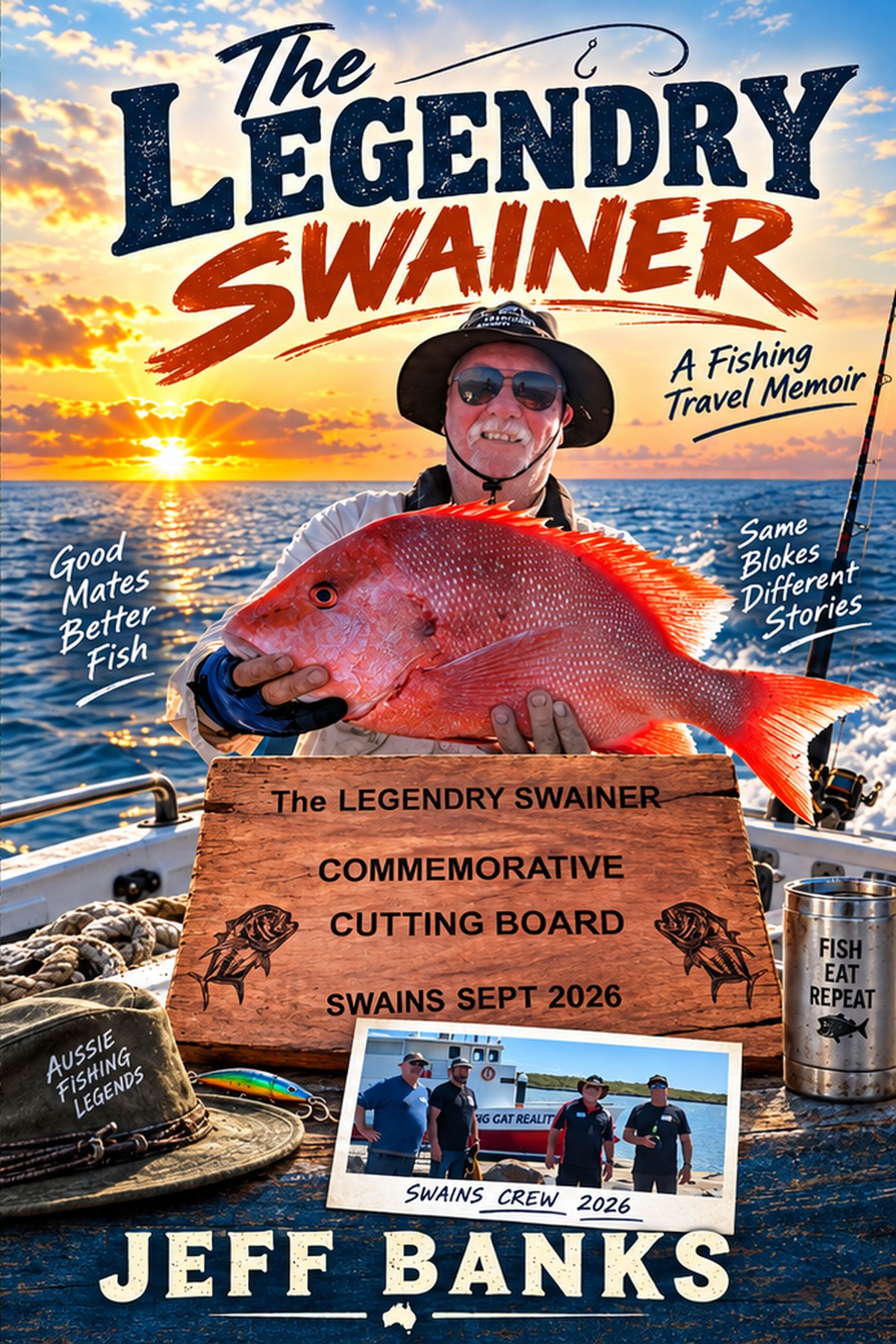
THE LEGENDRY SWAINER - Chapter 8 - Day Two - The Leaderboard

THE LEGENDRY SWAINER - Chapter 8 - Day Two - The Leaderboard | Travelling Around Australia with Jeff Banks

The irony was that while my body was protesting about the physical demands of fishing, my waistline was probably expanding. Heaven help the scales when I eventually got home, although that was one competition I was quite prepared to lose. For now, the only numbers requiring my serious attention were the ones attached to the leaderboard.

The Legendry Swainer

Four Mates, Seven Days and Far Too Much Confidence

Chapter 8 — Day Two: The Leaderboard

Somewhere between making the trophies in the Men’s Shed and carrying them all the way to Swains Reef, I had managed to convince myself they were still essentially a joke. That belief became harder to maintain once they came out aboard Big Cat Reality, because although there were a few nervous laughs at the rules, the laughter often had that slightly uncomfortable quality that suggested people were recognising something of themselves in what we had done. We had simply taken the normal competitive instincts of a group of fishermen, written them down, added some definitions and then given everybody something wooden to fight over at the end.

There were several other “competitions” running among groups on the boat, and on the surface most were beautifully simple. Biggest fish of the charter was a popular version, which sounds wonderfully uncomplicated until somebody asks whether a shark counts, whether a non-table fish counts, whether length or weight matters, whether a fish landed on heavier tackle deserves the same consideration as one caught lighter, or whether the bloke who catches a monster but cannot produce a photograph has actually caught anything for competition purposes at all. Nobody had necessarily thought about those things beforehand, but once our ridiculous set of rules, printed and laminated for the cruise, had been exposed to public examination, you could almost see the same little machinery beginning to turn elsewhere.

It was not unlike the discussions we had already been having about tackle. One bloke mentions a piece of gear somebody else has brought, another wonders why he has not packed one, and within minutes several otherwise rational men are disappearing down separate rabbit holes examining whether their entire approach to the trip has been compromised by the absence of an item they had not even considered necessary the day before. The competitions worked the same way, because once somebody pointed out a possible omission, what had looked perfectly adequate suddenly required further thought.

That was where our trophies became both ridiculous and strangely reassuring. We had already ventured down most of those rabbit holes before leaving home, considered a good deal of the minutiae that other groups were only now discovering existed and turned what should have been a simple bit of fishing fun into something approaching an administrative code. The laughter directed at us was therefore justified, but it was also accompanied by the occasional rethink from people who had just realised their own beautifully simple competition might not be quite as simple as they had assumed.

One of the other passengers suggested that somebody clearly had far too much time on his hands. Given that I had retired, designed the trophies, helped create the rules and remained unreasonably interested in keeping track of proceedings, there was little mystery about who he meant. Retirement was apparently supposed to involve travel, relaxation and perhaps finally dealing with all those jobs around the house, but that had never really been my interpretation of the word.

In the world of Jeff Banks, retirement had not created empty days so much as removed one of the larger items that used to occupy them, which left the dangerous impression there was suddenly room for everything else. I had always subscribed to the old theory that if you want something done in a hurry, give it to somebody who is already busy, largely because busy people have developed the habit of fitting one more thing into a space that sensible people would regard as already full. Retirement had not cured me of that habit; it had simply given it a larger playground.

The result was that I could now devote completely disproportionate amounts of attention to things that once would have had to fight for space between clients, deadlines and the ordinary machinery of working life. A fishing trip no longer required merely booking a berth and packing some rods. It could now support trophies, rules, scoring systems, contingency planning, equipment reviews, spreadsheets in spirit if not always in fact, and enough pre-trip discussion to suggest we were mounting an expedition rather than going away with a few mates to catch fish.

There is also something slightly misleading about the word retirement because it suggests a graceful withdrawal from activity, whereas mine has looked more like a transfer of enthusiasm from compulsory things to self-inflicted ones. The diary remains full, the projects keep arriving and every time somebody asks what I am doing, the honest answer generally involves several things that have somehow become urgent despite the fact nobody is paying me to do them. Apparently freedom does not always lead to doing less; sometimes it merely gives you more control over the nonsense that keeps you occupied.

So when the suggestion was made that I clearly had too much time on my hands, I could hardly object. The evidence was sitting there in the form of two homemade trophies and a competition structure detailed enough to create arguments before the week had properly begun. Retirement had not made me idle. It had simply allowed me to become much more efficient at being an idiot on my own timetable.

The important distinction, though, was not that we were somehow more sophisticated than everybody else. We were simply the only group that had taken the ordinary fishing tendency to overthink everything and formalised it before boarding the boat. The others were discovering their complications gradually, while we had arrived with ours laminated in spirit, if not in fact, and that probably made us look more organised than we deserved.

In reality, we were still just being idiots.

The worrying part was that the others had bought into it completely. By breakfast on Day Two, nobody needed reminding that there was a competition running, because every legal fish now seemed capable of influencing something. A fish was no longer merely something caught from the reef; it was evidence, potential points and perhaps the beginning of a dispute.

Steve had finished the previous day in front, which was particularly pleasing for him given that he was the only one of the four who had never previously Swainsed. The three veterans had spent months discussing what worked, what did not, what fish would be encountered and what equipment was required, presumably giving Steve the impression he was travelling north with people possessing highly specialised knowledge. Day One had already provided enough evidence for him to understand that our greatest qualification might simply have been that we had survived previous visits.

Day Two began more encouragingly, particularly for Steve and me. The wind had eased somewhat, although not enough to be described as friendly, and positioning the dory still required constant attention. Rather than fight it, we began working with the conditions and found a line that produced fish almost every time we drifted across it.

We would complete a drift after ascertaining a topographical anomaly worthy of investigation, give it a go, motor back to the beginning and run the same line again. Not everything was legal and the esky was certainly not filling at the rate the activity suggested it should, but there is something wonderfully reassuring about repeatedly catching fish even when many of them have to go straight back. It removes the temptation to start inventing new problems simply because there is time to think about them.

Fishermen have an extraordinary capacity to leave fish in search of fish. We can be catching regularly and still glance towards another dory a few hundred metres away with the firm conviction that whatever is happening over there must be better. For a while that morning, however, Steve and I resisted the disease and simply kept putting ourselves back over the same ground.

At one stage we found baitfish in sufficient numbers to turn proceedings into something approaching an assembly line. We were catching them two at a time and repeatedly working the same drift, with very little scientific analysis required beyond getting the line back into the water and allowing another couple of fish to make the same mistake. It was frenetic, productive and exactly the sort of action that restores confidence remarkably quickly.

Steve was having something of a turnaround after the frustrations of the previous day. I was putting us back onto fish time and again, and he was converting those opportunities often enough for both of us to begin looking rather pleased with ourselves. Wind, tide, reef structure and several thousand hungry fish may have contributed to our success, but there seemed little need to complicate the explanation while things were going well.

Then Steve hooked something considerably more substantial. The fish dug in properly, gave him a terrific fight and eventually came aboard as a Chinaman much larger than the one I had caught the previous day, somewhere around five kilograms. It was a spectacular fish to look at and exactly the sort of creature that makes Swains different from fishing closer to home.

Unfortunately for Steve, it was also completely useless to the competition. Chinaman fish were not regarded as table fish and this one had to be released, meaning a very good fish, a great fight and several minutes of genuine achievement produced absolutely nothing on the leaderboard. That was the first proper demonstration that our scoring system had no interest whatsoever in effort, difficulty or artistic merit.

The scoreboard, however, was only one version of what had just happened. Steve had hooked a solid reef fish in unfamiliar country, managed the fight, dealt with the runs and the weight, and eventually brought aboard something with enough substance to remind him that he was not merely along for the ride while three blokes with prior Swains experience compared notes. A fish like that gives you something no set of rules can properly measure, because confidence in fishing rarely arrives as a theory. It generally arrives attached to a bent rod.

For Steve, that mattered. He knew fishing, but every new piece of water has its own language and every group of fish its own habits, pressures and little tricks that only become obvious after you have been fooled by them a few times. Until then, a bloke can know perfectly well what he is doing and still spend part of the day wondering whether everybody else understands some local nuance he has somehow missed. Landing a proper fish strips a lot of that uncertainty away.

The Chinaman had shown him that the tackle was right, the knots were holding and his instincts worked here as well as they did at home. More importantly, he had felt the difference between merely getting bites and controlling something determined to do exactly the opposite of what he wanted. Once you have done that once in new country, the next big run does not feel quite as mysterious.

That is one of the quiet realities of landing a good fish. The photograph, the weight and the story all matter later, but in the moment there is a more basic satisfaction in proving to yourself that when something serious finally eats the bait, you are capable of staying with it and getting the job done. The next fish can still make a fool of you, of course, because fishing has an excellent sense of timing, but at least it has to work harder.

So while the official result was zero, Steve had gained something more useful than a few points. He had put a substantial Swains fish in his hands, understood a little more about the quarry and, perhaps most importantly, stopped looking like the new bloke discovering the place. The competition could ignore all of that if it wished, but Steve certainly did not.

I thought the ruling was perfectly reasonable. Had I been holding the fish, there is every possibility I might have argued that the rules needed to recognise exceptional circumstances, but that is one of the advantages of not being directly affected by an injustice. Impartiality becomes much easier when somebody else is suffering.

Our morning was also becoming interesting because of the buddy system Ben had explained before we started fishing independently. We were a long way from anywhere, operating little dories around reefs in wind and current, and his instructions about safety had been clear. In some areas you could operate independently, while in others you were expected to have another dory within sight and act as buddies in case something went wrong.

Trevor was supposedly our buddy for the day, with Ian also working around the same general area. That arrangement lasted until Trevor decided the possibility of larger fish somewhere else outweighed whatever enthusiasm he had for remaining near us, and before long he and Ian had steamed away in search of something more impressive. Steve and I stayed where we were, continued catching fish and remained comfortably within sight of the mother ship, so there was never any sense that we had been left in some immediate peril.

That, however, was not really the point. Ben had not introduced the buddy system because he expected every dory that separated from another by a few hundred metres to suddenly burst into flames or disappear beneath the Coral Sea. The rule existed because we were operating small boats a long way from normal assistance, around reefs, current and wind, where an engine problem, a fall, an injury or any one of a dozen unlikely events could become much more significant if nobody was close enough to notice.

Rules like that always look slightly excessive when nothing is going wrong. Seatbelts are unnecessary right up until the instant they are not, lifejackets are cumbersome while everybody remains in the boat, and having another dory within sight can feel like administrative overreach when both boats are running perfectly and everybody aboard is catching fish. The difficulty is that safety rules are designed around the moment when circumstances stop being normal, not around the many hours when everything behaves itself.

Neither Trevor and Ian nor Steve and I were in any obvious danger that morning. We all had working boats, reasonable conditions and the mother ship in the broader area, and nobody was remotely suggesting otherwise. What irritated me was the casualness with which a clearly stated arrangement could be discarded simply because something more interesting appeared to be happening somewhere else.

There is always a temptation with rules to judge them retrospectively. If nothing bad happened, then apparently the decision to ignore them was harmless and therefore, by some curious logic, justified. That is a wonderfully convenient way to assess safety because it allows every poor decision to remain a good one right up until the day probability finally takes an interest.

Ben had been clear about what he wanted from us, and it was hardly an unreasonable burden. We were not being asked to fish tied together by rope or maintain formation like a naval exercise; we were simply expected to keep a buddy within sight in the areas where the skipper thought it sensible. Given that he knew the water, the boats and the risks considerably better than any of us, it seemed a fairly modest request.

The irony was that Trevor had not steamed away because of necessity. He had steamed away because somewhere else might contain a bigger fish, which in the developing logic of our trip was apparently capable of overriding several lesser considerations, including safety arrangements and the inconvenient fact that his designated buddies were still catching fish where they were. The lure of glory had once again proved more powerful than the lure of compliance.

I was not worried about our own safety, but the selective interpretation of the instructions annoyed me. Ben had been very clear about what was expected, and the rules had been delivered to all of us in exactly the same English language. Trevor, however, possesses a remarkable ability to understand rules perfectly while simultaneously identifying which parts should be treated as flexible according to the circumstances.

There was also a certain satisfaction in continuing to catch fish while our designated buddy went searching for something better. Every fish we landed provided another little piece of evidence that perhaps remaining where the fish actually were might be a perfectly reasonable fishing strategy. Admittedly, most of what we were catching was not large enough to trouble the competition, but that detail did not need to form part of my argument.

Eventually even constant action begins to lose some of its appeal when the size refuses to improve. The next fish starts looking suspiciously like the previous fish, which itself looked remarkably similar to the one before that, and the imagination begins drifting towards whatever might be happening somewhere else. The very disease we had resisted earlier in the morning was beginning to infect us as well.

By lunchtime the weather remained manageable rather than pleasant. The wind had reduced compared with Day One but was still strong enough to affect every drift, and the combination of breeze and sun was beginning to leave its mark on exposed skin. Sunscreen was being applied properly, but the wind added an abrasive quality that made the face feel as though it was being steadily worked over with fine sandpaper.

Lunch provided a welcome break from both fishing and weather. The crew used the hour to service the dories, replenish bait and deal with all the small maintenance jobs required to send the fleet back out again, while we concentrated on homemade burgers prepared to suit each angler. There was something deeply civilised about climbing back aboard after several hours on the reef and being handed a substantial burger while somebody else looked after the boat.

Nobody was going hungry aboard Big Cat Reality. If anything, I was beginning to suspect the greatest threat to my wellbeing might not be sharks, sunburn or falling overboard but the bathroom scales waiting for me when I eventually returned home. We seemed to spend the day burning energy and the remainder of the time replacing every calorie with interest.

After lunch we headed back out expecting the wind to have followed whatever optimistic forecast had suggested it might ease further. It had not, which meant the afternoon would again be about making the conditions work rather than waiting for the conditions to become ideal. By then we were getting better at accepting Swains on its own terms rather than expecting it to reorganise itself for our convenience.

Late in the afternoon I noticed a group of birds working with enough purpose to suggest something was feeding beneath them. In a place like Swains that immediately raises the possibility of larger pelagic fish, and whatever sensible plan had existed a few moments earlier was quickly abandoned. A fisherman can spend an hour happily catching reef fish and then become completely distracted because three birds suddenly appear more excited than usual.

Steve and I broke away and trolled the edge of a pressure point along the reef. Steve saw a couple of barracouta jumping from the water and apparently chasing whatever had attracted the birds, but unfortunately they were well inside the reef where we could not safely follow. We worked the accessible edge hoping something larger might emerge and take an interest in our lures.

Nothing did, although naturally we gave the exercise sufficient time to describe it later as a carefully considered tactical decision rather than an unsuccessful detour. Eventually we returned to the starting point and went back to drifting. The wind made holding the right line difficult, but we reset repeatedly and kept working the area.

The fish began coming again, particularly grassy sweetlip. They were useful enough as bait but became an annoyance in numbers, especially when each bite initially created the hope that something more interesting had found the hook. We continued nevertheless because at least there was activity, and activity remains preferable to sitting in a dory inventing explanations for why nothing is happening.

Then Steve hooked something different. The rod loaded properly, stayed loaded and gave every indication that the fish on the other end had both weight and determination. Whatever it was, it was not planning to join us without an argument.

The atmosphere in the dory changed immediately. Conversations stopped, movements became more deliberate and I developed the traditional expertise of the fisherman who is not actually connected to the fish, offering useful observations about where it might be heading and what might happen next. Steve, meanwhile, concentrated on doing the actual work.

The fight took some time before the fish finally appeared beside us. It was a spotted trevally of around three and a half kilograms, solid enough to make Steve work for it and impressive enough that his reaction changed completely once it was safely aboard. He had nailed something substantial, and unlike the Chinaman earlier in the day, this one could go into the esky and be displayed when we returned to the mother ship.

The pleasure on Steve’s face was obvious. He runs a fishing charter and had caught plenty of good fish over the years, but this was part of his first Swains experience and another species to add to a rapidly growing list of things he had never encountered before. For the moment, bragging rights in our dory were entirely his and there was no reasonable argument I could make against them.

There was, however, an unreasonable argument available, which was naturally more interesting. One of our trophies was waiting for a GT, and while Steve’s spotted trevally was certainly a trevally, it was not a giant trevally. The possibility that close family relationships might become admissible if nobody caught the real thing had therefore entered the competition for the first time.

Steve’s fish therefore had genuine standing on the leaderboard rather than merely being a magnificent cousin to something more important. Trevally itself was a recognised scoring classification, while Giant Trevally sat separately in the rules because Trevor’s preference for chasing big fish had ensured that anything capable of pulling significantly harder deserved its own administrative attention. In other words, the spotted trevally counted, which was good news for Steve, but it did not resolve the more prestigious GT question that remained open for somebody to claim later in the week. Fishing-law jurisprudence was already becoming more complicated than the fish themselves, although Trevor could hardly complain because much of the complexity had been introduced to accommodate exactly the sort of quarry he preferred to chase.

More importantly, we had found an area producing enough fish to keep us interested and at least one fish with enough size to make tomorrow morning’s starting point obvious. After a day spent considering drifts, wind, depth, reef edges and whether somewhere else might be better, it was good to finish with one decision already made. We knew exactly where Steve and I wanted to begin Day Three.

Back aboard Big Cat Reality, the usual transformation began as catches became stories. There had been plenty of species caught among the various dories and some good fish, but nothing yet that suggested one of Swains Reef’s genuine trophy monsters had entered proceedings. There were no great Spanish mackerel dominating conversation, and tuna remained conspicuously absent from our competition.

There were, of course, stories about the fish that had not made it aboard. Ian had been broken off by something apparently enormous, placing him in a fishing category that has existed since the first line entered the water. A landed fish is burdened by evidence such as photographs, scales, measurements and species identification, while a fish that breaks the line is limited only by the integrity of the storyteller.

Ian’s fish therefore had considerable potential. Because nobody had seen it, there was no inconvenient upper limit on size and no possibility of contradicting whatever estimate might eventually emerge. It had already reached the stage where merely questioning its dimensions risked being seen as ungenerous, particularly when Ian had Trevor available as an increasingly enthusiastic advocate for the prosecution.

This was the beginning of an argument Trevor would return to with remarkable persistence whenever the leaderboard became inconvenient. If somebody other than me had hooked something impressive and lost it, the event was not necessarily a failure; it was evidence that a very large fish had been involved, that the angler had been in the right place and that circumstances rather than ability had prevented the scoreboard from reflecting the true quality of the performance. If I lost one, I suspected the same generosity of interpretation might prove much harder to obtain.

Trevor’s problem with the scoreboard was not really that it was inaccurate. His deeper concern seemed to be that it had the annoying habit of recording only fish that had actually been landed, identified and, where necessary, measured, which placed unreasonable restrictions on several far more exciting stories. A bloke could be trailing me by a few points while simultaneously having hooked three fish that, had they remained attached for another thirty seconds, would apparently have transformed the entire competition.

That distinction became increasingly important because Trevor was developing a parallel leaderboard of his own. Mine involved fish in eskies, photographs, species and numbers, while his was beginning to allow for fish lost beside the boat, fish broken off deep, fish seen briefly under the surface and perhaps eventually fish that had simply pulled very hard for long enough to deserve consideration. Under that system, almost anybody could be ahead of me provided sufficient weight was given to potential.

Ian’s unseen monster therefore became an early and useful precedent. It had no score, no confirmed species and no measurable dimensions, yet Trevor could already point to it as evidence that the official standings failed to capture the full story. From there it was only a small step to the broader proposition that whoever happened to be leading on the board might not, in fact, be the person fishing best.

That proposition would have been much easier for me to respect if I had not been the person leading.

Ben congratulated everyone on the attitude being shown during what had been a couple of difficult days. The weather had not given us ideal conditions, yet people were getting on with it, helping one another and making the most of the fishing available. It was a worthwhile acknowledgement because Swains had already demonstrated that simply getting out there and operating safely required everyone to play his part.

That made Trevor’s later contribution to the buddy-system discussion particularly entertaining. He suggested that if Steve and I were interested in maintaining the arrangement the following day, perhaps we should follow him. This was an extraordinary reconstruction of events given that he had been the one who steamed away while we remained catching fish.

I pointed out what I regarded as a fairly obvious difficulty with his version. Trevor, unsurprisingly, had an alternative interpretation and the discussion soon began acquiring the same characteristics as our trophy rules, with facts available but their meaning apparently open to negotiation. The important thing was not necessarily what had happened, but who could explain it most confidently afterwards.

The rules were not the problem for Trevor. Rules are perfectly acceptable when interpreted correctly, and in Trevor’s world correct interpretation occasionally appears to mean the version most advantageous to Trevor. I was beginning to suspect the buddy system might need its own tribunal before the week was over.

More importantly, the leaderboard had changed. Steve had started the day in front and had caught two of the more memorable fish of the day, yet the strange mathematics of our competition had allowed me to move into the lead, with Trevor close enough behind to make the position uncomfortable. Steve had discovered that spectacular fish and scoring fish were not necessarily the same thing.

I was genuinely surprised to find myself leading, and judging by the reaction around me I was not the only one. There seemed to be a certain quiet consternation that the bloke keeping the records, interpreting the rules and generally being treated as the least likely of the four to dominate proceedings had somehow worked his way to the top of the board. The natural order had been disturbed, and worse still, it had been disturbed by the person holding the pencil.

This was awkward for everyone except me. I had not arrived at Swains carrying the reputation of being the great fisherman of the group, and nobody had spent the drive north worrying about how they were going to keep Jeff under control once the fish started biting. Trevor had his confidence, Ian had plenty of experience and Steve actually ran a fishing charter, while I was the one more likely to be reminded of past mistakes whenever the conversation required a little entertainment.

Now the supposedly lesser fisherman was leading the competition he had helped administer. That created an uncomfortable combination of suspicion and disbelief, because if I had been sitting third or fourth the scoreboard would probably have been accepted as a perfectly sensible reflection of events. With my name on top, however, the same system suddenly invited closer scrutiny from people who were only now discovering a passionate interest in governance.

I could see the problem from their point of view. The record keeper is supposed to be neutral, preferably dull and ideally nowhere near first place, because once he starts winning every entry takes on a slightly different appearance. A legal fish recorded in my favour could be seen as proper administration by me and potential evidence of institutional capture by everyone else.

Naturally, I found the whole arrangement completely satisfactory. Once my name reached the top of the tally, the rules appeared extraordinarily well conceived, the scoring methodology seemed robust and no immediate review was required. Had I been running last, I am sure several constitutional weaknesses, historical inconsistencies and obvious areas for reform would have become apparent before dinner.

There was also a deeper affront buried underneath the laughter. It was not simply that I was leading, but that I was leading without fitting the expected script of who should be leading, and fishermen are no different from anybody else when reality starts interfering with a preferred narrative. Trevor, in particular, was beginning to develop alternative methods of assessing performance, most of which had the useful feature of placing greater emphasis on big fish, lost fish, potential fish and almost anything that reduced the significance of the actual numbers in front of him.

For the moment, however, the numbers were mine. I was the not-so-good fisherman, the rule keeper and the bloke in front, which made the leaderboard considerably more interesting than it had any right to be. I was under no illusion that the position would remain comfortable, but I had every intention of enjoying the discomfort it was causing while it lasted.

That was the real difference between Day One and Day Two. Yesterday we had been four blokes fishing Swains Reef who happened to have brought a couple of trophies with us, while today the trophies had begun affecting how catches were viewed, remembered and discussed. A legal fish could move the board, a non-qualifying fish could produce outrage and a lost fish could apparently remain competitive without ever being seen.

The competition was beginning to take control. Nobody had announced that this had happened, but it was visible in the way every fish was immediately assessed for more than its eating qualities and every success was measured against what the other three had achieved. The trophies had stopped being decorations and started becoming evidence.

The change in mood after dark was equally noticeable. On the first night almost everyone had wanted to fish from the big boat, still consumed by the idea that the fish of a lifetime might be swimming beneath us while we wasted precious minutes sitting down. Tonight there was considerably more enthusiasm for dinner and considerably less for feeding lines among the lemon sharks and GTs circling below.

My body was beginning to make its own contribution to that change of priorities. Two days of standing, bracing, bending, hauling and being bounced around a dory had introduced me to several muscles that apparently had not been consulted during the planning stages. The massager that had seemed one of the more questionable items while packing was rapidly becoming one of the smartest things I had brought.

I also had the exercises prescribed by the chiropractor, and both were going to receive serious attention before bed. The intention was not to achieve any great athletic recovery but merely to persuade enough parts of me to cooperate again tomorrow. At Swains, ambitions can become wonderfully modest once the fishing stops.

The bunks were functional rather than luxurious, which was entirely reasonable aboard a fishing boat. The difficulty was becoming less about getting into mine than extracting myself after several hours during which my body had apparently set in whatever position the mattress preferred. Rising from a low position was starting to become a manoeuvre requiring planning rather than something done automatically.

Dinner provided considerable compensation for all of this. We started with dumplings, moved through a substantial mixed grill and finished with cheesecake, which was not a sequence likely to appear in any recognised high-performance sporting diet. Nobody was going hungry, and the kitchen seemed determined to ensure every calorie burned during the day was restored before we went to sleep.

The irony was that while my body was protesting about the physical demands of fishing, my waistline was probably expanding. Heaven help the scales when I eventually got home, although that was one competition I was quite prepared to lose. For now, the only numbers requiring my serious attention were the ones attached to the leaderboard.

I was in front, Trevor was close enough behind to be dangerous and Steve had caught better individual fish than his score suggested. Ian, meanwhile, remained in possession of an unseen fish of potentially unlimited dimensions, which was a particularly strong position because no evidence existed capable of disproving anything he chose to say about it.

After only two fishing days, the week was developing nicely. We had catches, technicalities, disputed interpretations, a missing buddy, an unverified monster and a spotted trevally attempting to establish whether family connections might eventually qualify it for a GT trophy. There was still a long way to go, but the simple fishing trip we had planned was already disappearing beneath something far more important.

The Completely Impartial Swains Ledger — Day Two

Trophy One: Jeff leads, to the surprise of almost everyone, including Jeff.

Trophy Two: No GT yet. Steve’s 3.5 kg spotted trevally remains a cousin rather than the required article, although future eligibility proceedings cannot be ruled out.

Current challenger: Trevor, close enough behind to make Jeff’s leadership significantly less comfortable than Jeff would prefer.

Steve’s notable injustice: A Chinaman of around 5 kg, magnificent to catch and completely worthless under the table-fish requirement.

Jeff’s assessment of proceedings: Currently leading. The rules therefore appear exceptionally well drafted.

Steve’s current regret level: None. He is catching fish he has never caught before and having a ball doing it.

Biggest claim made without supporting evidence: Ian’s unidentified monster, which broke him off before any independent witness could establish inconvenient facts such as species, weight or actual existence.

Buddy-system ruling: Trevor may apparently steam away from Steve and Jeff, but Steve and Jeff should follow Trevor tomorrow if they wish to take the buddy system seriously.

Fish currently before the eligibility tribunal: One spotted trevally seeking recognition through close association with the GT family.

Friendships currently under review: All of them. The sledging is becoming increasingly personal, which probably means everybody is enjoying himself.

Author

Menu