

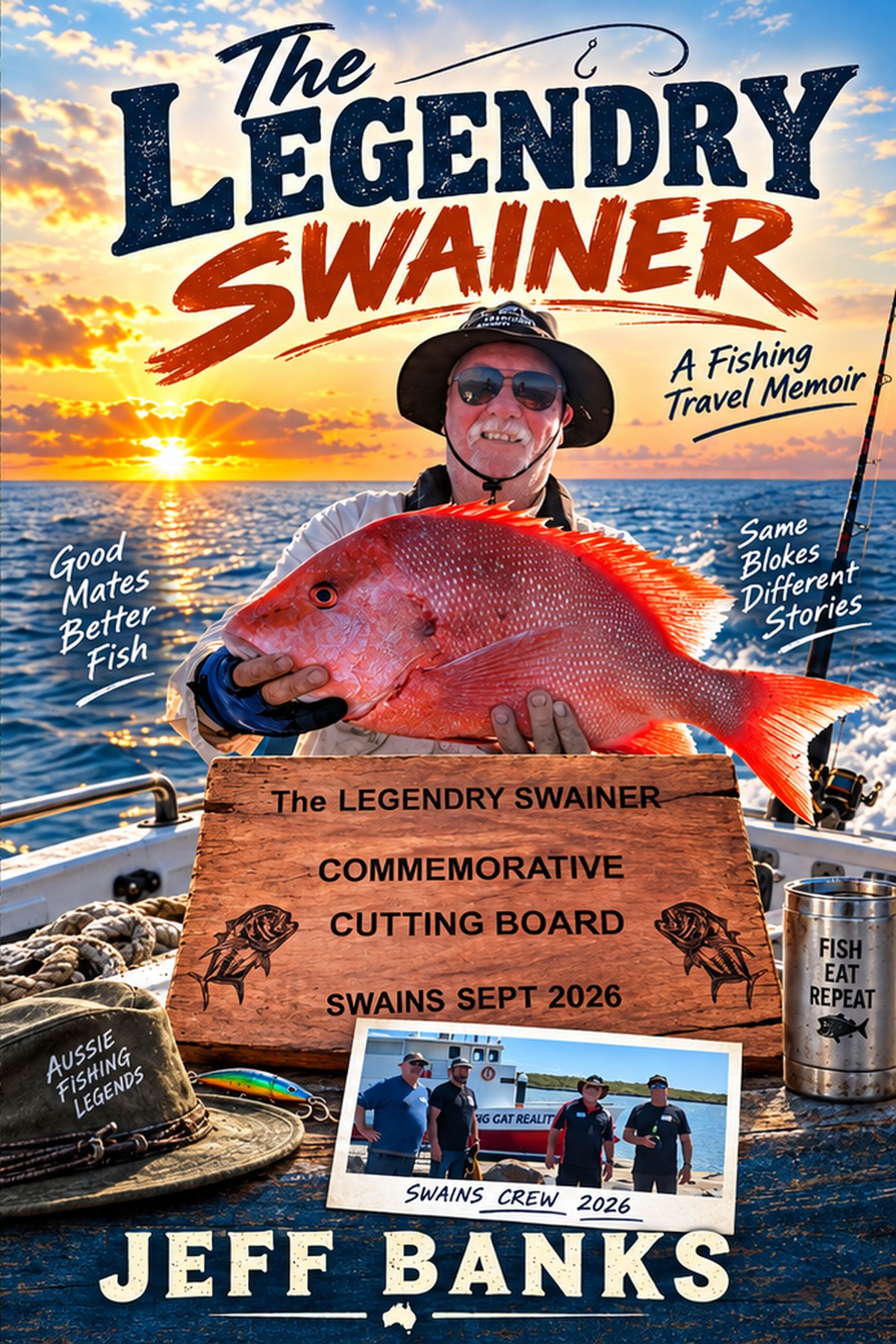
THE LEGENDRY SWAINER - Chapter 7 - Day One - Experts Until Proven Otherwise

THE LEGENDRY SWAINER - Chapter 7 - Day One - Experts Until Proven Otherwise | Travelling Around Australia with Jeff Banks

That was the first genuine dose of reality the trip had delivered. We had spent months controlling everything we could control: rods, reels, line, hooks, luggage, travel, trophies, rules, clothing and enough backup equipment to survive the collapse of several international tackle manufacturers. Now the one thing we could not control had become the biggest influence on what happened next.

The Legendry Swainer

Four Mates, Seven Days and Far Too Much Confidence

Chapter 7 — Day One: Experts Until Proven Otherwise

There is a wonderful period before the first proper day’s fishing when every fisherman on a trip such as this remains undefeated. Tackle boxes contain nothing but good decisions, carefully prepared rigs are flawless, theories remain unchallenged and every man can still explain with considerable authority exactly what he intends to do when the fish appear. Eventually, however, somebody has to put a line in the water, and that is generally where months of expertise begin colliding with reality.

Technically, even that description was already slightly dishonest because fish had been caught before “Day One” officially arrived. One of them had even counted towards the competition, although by the time we began treating the expedition with the solemnity it deserved, the first scoring fish had been caught the previous day and almost completely forgotten. This would probably not be the last occasion during the week when history was adjusted slightly to suit the current discussion.

We still had plenty of travelling to do before reaching the area where Big Cat Reality intended to settle properly, so the morning involved more steaming than fishing. That did not mean lines remained safely inside tackle boxes, because fishermen confronted with several hours of potentially fish-holding water have a very loose interpretation of what constitutes travelling. Trolling gear appeared whenever circumstances allowed, then disappeared again as green-zone boundaries and the requirements of actually getting somewhere intervened.

The wind, meanwhile, had apparently received no instructions regarding our fishing ambitions. It had been blowing, it continued to blow and there seemed no particular reason to believe it had any intention of stopping simply because four blokes had spent months buying tackle and talking about what they intended to catch. The sea already had enough movement in it to suggest that some of the beautiful mental pictures created before leaving home might require substantial editing.

Steve was not particularly troubled by any of this and somewhere during the trolling added a shark mackerel to proceedings. He already had the Spanish Mackerel sitting inconveniently beside his name from the earlier fishing, which meant the bloke who had joined the expedition as the newcomer was beginning to develop the extremely irritating habit of converting professional fishing experience into actual fish.

This was not really how the initiation was supposed to work. Steve should have spent at least a little while learning the social structure of the group before becoming competitive, but he had apparently mistaken our welcoming attitude for permission to start beating us. Worse still, he seemed to be having a magnificent time doing it.

There was plenty of time to correct the situation, of course, because seven days of fishing still stretched ahead of us. Any suggestion that Steve was genuinely leading could therefore be dismissed as statistically premature, particularly by those of us who were not leading. I was entirely comfortable with that interpretation and, being the bloke holding the pen, see no compelling reason why another one needs to be considered.

The overnight trip had already supplied a warning that Swains was going to make us earn whatever happened next. The swell had turned sleep into something considerably more theoretical than practical, with the boat moving heavily enough that at one stage the engines had to be stopped and reset. Those who were awake knew about it immediately, while those who had somehow managed to sleep through it were informed later because nobody aboard believed an unpleasant experience should remain exclusive.

The ocean outside was churning and Big Cat Reality was working hard through it. Every movement was a reminder that Swains Reef might be a fishing playground, but the Coral Sea retained complete authority over the operating conditions. Months of preparation had earned us many things, but favourable weather was apparently not one of them.

None of that destroyed the excitement, although in my case the excitement was beginning to become part of the problem. I had waited so long to get here that I was trying to fish faster than fishing actually happens, with hands, thoughts and expectations all attempting to arrive at the next moment before the current one had finished.

Before the trip, I had imagined the first proper fishing day as the point where everything would settle down. The travel would be finished, rods would come out, instincts accumulated over years would take over and the slightly ridiculous amount of preparation would suddenly prove completely justified. Instead, I found myself occasionally trying to do several things at once and discovering that fishing line has a remarkable ability to punish unnecessary enthusiasm.

That was particularly unfortunate because the dreaded word had already been introduced before we left. The word was Tangles, and it was the sort of nickname that could become tremendously funny provided it belonged to somebody else. Applied to me it carried considerably less charm, particularly because Trevor and Ian seemed to believe enough historical evidence existed to suggest it was not merely a random insult but a classification supported by precedent.

Naturally, I had rejected their evidence as selective, malicious and lacking any acceptable form of peer review. Fishing line, however, has never shown much respect for legal argument and will happily wrap itself around rods, reels, hooks, swivels, other lines and occasionally parts of the boat while sitting there waiting for witnesses.

I could feel myself becoming annoyed, although if I was being fair it was not really with Trevor, Ian or even the bloody line. The irritation was beginning much closer to home because, underneath all the anticipation, I had started trying too hard. Every cast seemed to carry the weight of proving something, every lure needed to work immediately and every little mistake suddenly felt as though it had occurred under stadium lights with three commentators waiting to dissect the replay. Fishing rarely improves when the fisherman starts trying to bully events into happening, and I was beginning to realise that I had allowed the excitement to get in front of me.

That was the part that needed settling. Months of preparation had built this trip into something enormous in my head, so by the time we finally reached the water I was behaving as though every minute needed to justify the effort that had gone into getting there. Instead of simply fishing, I was watching myself fish, judging every movement and becoming conscious of what everybody else might be seeing at exactly the wrong moment. The more conscious I became of it, the less natural everything felt, and suddenly tasks I had performed thousands of times were acquiring an entirely unnecessary degree of difficulty.

Trevor’s “Tangles” nickname would have been easy enough to dismiss if nothing had happened to support it. Mates can call you almost anything and, provided reality refuses to cooperate, the joke eventually runs out of oxygen. The difficulty was that reality had decided to help him. I had caught Steve’s line, wrapped metres of my own line around the hooks of a stickbait and generally supplied the prosecution with more evidence in the opening hours than I would have considered desirable over an entire week.

That was what rattled me more than the sledging itself. There is a difference between being laughed at over something patently ridiculous and hearing the laughter while privately acknowledging that, on the available evidence, the bastards might have a point. Trevor’s smirk was therefore more dangerous than any insult because it suggested he did not even need to keep arguing the case; I was doing enough on his behalf. The nickname had stopped being merely historical and was showing signs of becoming contemporary, and I had no intention of spending seven days producing updated exhibits.

What I needed was not another argument, a better excuse or some elaborate explanation of why each incident had technically been caused by circumstances beyond my control. I needed to settle. Take a proper breath, slow everything down and remember that I actually knew how to do this. There had been plenty of trips, plenty of fish and plenty of moments when instinct had taken over without my having to supervise every movement, but none of that was going to help while I was allowing anticipation, competition and the awareness of three smirking mates to crowd into the same few seconds before every cast.

The obvious answer was to stop fighting everything at once. I did not need to win every exchange, untangle every problem instantly or react to every comment Trevor threw in my direction, because trying to answer all of it was part of what was making me frantic. I needed to concentrate on the next cast, the next drop, the next knot and the next decision, letting each one stand on its own rather than carrying the entire reputation of Jeff Banks the fisherman on its shoulders. The excitement could remain, because that was half the reason we were there, but it could no longer be allowed to run the controls.

There was also a quieter truth in all of this that I was unlikely to volunteer to the others. I wanted to know that the fisherman I imagined myself to be had actually come north with me and had not been left somewhere back in the Man Cave surrounded by forty rods and months of confident preparation. I like to think I am capable, particularly around things I have done for years, and there is a peculiar discomfort when a simple run of mistakes begins nibbling away at that belief. It was not yet a crisis of confidence, but it was enough of a tap on the shoulder to tell me that unless I settled down, the trip might start being shaped by reactions rather than ability.

Perhaps that was the first real competition emerging for me, and it sat underneath the official one. The trophies were magnificent pieces of Men’s Shed timber whose importance had already risen absurdly beyond anything justified by their construction cost, but there was another result I wanted before we came home. I wanted to finish the week knowing that I had fished properly, made good decisions and handled myself like somebody who actually belonged in this environment rather than somebody who had arrived with an impressive amount of equipment and immediately turned five metres of line into decorative craftwork.

Once I recognised that, the solution became less complicated. Slow down, trust what I knew, stop trying to impress anybody and let the fishing come back to me instead of chasing it around the deck. If that process happened to restore my own equilibrium while simultaneously placing my foot firmly on Trevor’s competitive neck for several consecutive days, then I could see no reason why personal development and public service should not be pursued together.

Trevor soon provided a useful distraction from my own problems by being elected captain of one of the dories. I had also acquired captaincy responsibilities, which at least meant authority had been distributed without anybody undertaking an obvious assessment of whether this was sensible. Trevor surveyed the conditions and announced that his dory would not be going out because the sea was too rough for him and his crew.

This was an entirely reasonable safety decision, which was precisely why it could not be allowed to pass without comment. In the world of recreational sledging, Trevor had not merely led with his chin; he had placed it on a velvet cushion, illuminated it and supplied written directions. I felt a responsibility to make proper use of the opportunity.

I immediately questioned his commitment to his captainary obligations, a word whose grammatical legitimacy mattered far less than its usefulness. Captains, I suggested, were expected to captain, and declining to leave the mother ship merely because the ocean was behaving like an ocean seemed an alarming abandonment of responsibility. Trevor had his own views, most involving the conditions and the relative greenness of the people who would have been in his dory, but reason had already ceased to have jurisdiction.

To be fair to him, his crew were inexperienced and the conditions were ugly enough that a run into the wind and swell was going to produce a very wet and uncomfortable boat. This was highly relevant from a seamanship point of view but completely irrelevant from a sledging point of view, where the evidence clearly showed that Captain Trevor had received his first command and immediately attempted to remain tied to the mother ship. I considered it important that the distinction be preserved for future historical purposes.

Steve and I were prepared to venture out, although bravery should not necessarily be confused with superior judgment. The dories gave us the freedom we had been looking forward to, but they also put us much closer to the water that had spent the previous hours throwing Big Cat Reality around. Once away from whatever protection the reef and cays provided, the difference between an exciting sea and an unpleasant one could often be measured by the amount of salt water coming over the bow.

Driving directly into it was particularly entertaining because every rise over a swell simply revealed another opportunity to get wet. The dory would climb, drop and then meet the next lump of water with enough enthusiasm to remind everybody aboard that waterproof clothing is more a statement of intent than a guarantee. Within a fairly short time there was little point worrying about whether we might get wet because that question had been comprehensively answered.

Fishing has an extraordinary ability to make people tolerate conditions they would reject immediately in almost any other recreational activity. If somebody suggested standing fully clothed in a cold shower while repeatedly bouncing against the bathroom wall, most sensible adults would decline without further discussion. Put a fishing rod in their hands and tell them coral trout might be underneath them, however, and the proposal suddenly requires careful consideration.

I started catching undersized coral trout, which reads much more impressively on the page than the actual achievement deserved. I caught several of them, but every one failed the most important requirement by being too small to keep, which meant I was successfully demonstrating an ability to locate juvenile fish. They were beautiful little trout and perfectly cooperative, but none had apparently received the briefing concerning our scoring system.

Still, I was catching fish and that helped settle me. The movements became more familiar, the excitement stopped running quite so far ahead of the process and I began feeling more like myself. A fish did not have to count on a scoreboard to remind me that I knew which end of the rod to hold.

Steve then produced his first coral trout, although calling it a coral trout required a degree of generosity. It was about four inches long and could almost have been returned to the sea with a teaspoon, but species identification is not determined by dignity and Steve was delighted because it was the first one he had ever caught.

Professional fisherman or not, there was still something new available to him at Swains. Naturally, compassion dictated that we celebrate the milestone while ensuring nobody accidentally confused the achievement of catching a new species with any achievement involving significant size.

For a while that seemed to be the pattern of the day. Fish arrived, enthusiasm followed and then somebody measured or identified the result closely enough to discover that the competition remained largely unaffected. Months of preparation had brought us more than 100 nautical miles offshore to one of Australia’s great fishing areas, where we were becoming extremely proficient at catching things that either did not qualify or needed to grow up.

Trevor and Ian were not exactly mounting a serious assault on the leaderboard either. Their strategy appeared to involve not catching anything likely to interfere with Steve’s lead, which I considered a surprising tactical choice given the amount of discussion both had contributed before departure. Apparently they had overlooked the minor technical requirement that participation in a fishing competition eventually involved fishing and catching something.

I was happy to explain this whenever circumstances permitted because advice between mates should always be freely offered. It is particularly important to offer it when the recipient has no practical use for it and would much prefer you to shut up.

The conditions continued to dictate everything we did. We could fish around the more protected areas, but the deeper water we really wanted remained another proposition entirely. Somewhere beyond the shelter were the larger fish that had filled our conversations for months, yet getting to them meant pushing farther into a sea that was already doing a convincing impression of telling us not to bother.

There is a particular frustration in being surrounded by extraordinary fishing country while knowing that the weather has reduced the available portion of it. You can see the possibilities, discuss the possibilities and rig for the possibilities, but none of those things flatten the ocean. Swains had not moved anywhere; our ability to fish the parts we wanted simply depended upon conditions we could not negotiate with.

The forecast offered some hope that things would improve later in the week. We accepted this with the faith normally reserved for information we desperately want to believe, because the alternative was imagining the entire trip spent staring towards deeper water while remaining trapped around the protected edges. The reef would still provide fishing, but the expedition we had built in our minds depended upon eventually being able to roam.

Towards the end of the session I finally hooked something that changed the feel of the rod immediately. This was not another undersized coral trout arriving for inspection, because the fish pulled hard, stayed deep and gave me the sort of fight I had been waiting for since leaving home. For a few minutes there was no room for anything except the fish.

When it finally came up, it was a very large Chinaman fish. That created an immediate problem because a Chinaman was not the fish I had travelled all this way dreaming about and, under the normal scoring logic of our competition, it had little reason to become important.

It did not fit neatly into the species calculations we had spent so much unnecessary time constructing. Under almost any sensible interpretation it should simply have been a strong fish, a good fight and a worthwhile capture from a very difficult first day. Almost any sensible interpretation, however, was not necessarily the standard under which this expedition operated.

Nobody else had caught much of consequence during the session, although the shallow water had developed its own peculiar set of rules. One advantage was that the sharks, so often waiting farther out to collect their unofficial tax on anything worth catching, seemed less interested in us here. For once we could get a fish moving towards the boat without automatically expecting something larger, faster and considerably more entitled to remove half of it before it arrived.

Unfortunately, nature rarely allows fishermen to enjoy an advantage without immediately introducing another problem. In the shallow water we were often fishing unweighted baits, trying to let them drift naturally down through the water column towards whatever might be waiting below. The difficulty was that the local terns had apparently studied this technique as well and regarded the slowly sinking bait not as part of our fishing strategy but as an airborne catering service provided specifically for them.

The moment a bait hit the water, they would appear from nowhere, circle briefly and then dive on it with the sort of confidence we would have liked to see from the fish underneath. Sometimes the bait barely had time to start sinking before a tern had plucked it from the surface, leaving the fisherman holding a line connected to absolutely nothing useful. There was something particularly irritating about travelling all the way to Swains Reef, finally finding water where the sharks were leaving us alone, and then discovering that the birds had assumed responsibility for preventing the bait from reaching a fish.

Steve found this especially aggravating because he was already fishing with the sort of intent normally associated with somebody protecting a narrow lead in the final round of a major tournament. Every drop carried the possibility, at least in his mind, of something worthy of one of the trophies, and every tern therefore became an active participant in the opposition. A bait disappearing into a bird before it had descended three feet was not simply a minor inconvenience; it was quite possibly the theft of the fish that might have settled the entire competition.

The rest of us were naturally sympathetic, although not so sympathetic that we failed to enjoy watching Steve become increasingly offended by birds. There are only so many things a fisherman can blame when a bait never reaches the intended fish, and on this occasion the usual suspects of tide, current, sharks and poor positioning had been joined by a squadron of small white thieves operating from above.

Against that background, Steve’s miniature coral trout remained historically important only to Steve, while my own collection of trout would have benefited from another year or two of growth. Trevor and Ian had yet to trouble the scoring officials at all, so the day’s competition was beginning to resemble a contest in which everybody was waiting for somebody else to produce something sufficiently respectable to establish a standard.

Suddenly the Chinaman began looking considerably more impressive. It had size, it had fought properly and, most importantly, it had managed to reach the boat without being eaten by a shark, stolen by a tern or disqualified for being too small.

The fish therefore managed to sneak into the day’s reckoning through the administrative principle that something is generally more impressive than nothing. I was prepared to accept this interpretation because it favoured me, which remains one of the strongest foundations for accepting any sporting rule. Had Trevor caught exactly the same fish, I would almost certainly have identified several constitutional difficulties requiring immediate review.

More importantly, it was exactly the fish I needed at that point. Not because it transformed the competition, because it did not, but because it had pulled hard enough to demand that I stop thinking about myself and simply fish. During the fight there had been no room to worry about tangles, nicknames, preparation or whether anybody thought I was doing things properly.

That became the little reset I had been looking for. I did not require a trophy fish to prove anything grand, but I did need to stop allowing excitement to dictate the speed at which my hands and brain were operating. The Chinaman had forced me to concentrate on one thing at a time, which was probably an unnecessarily complicated way of rediscovering how fishing normally works.

Unfortunately, none of this removed Steve from the top of the meaningful leaderboard. He had the shark mackerel and the Spanish mackerel, including the scoring fish from the previous day that we had somehow already begun treating as ancient history. This was becoming inconvenient because Steve did not seem remotely burdened by the pressure of leadership and was simply having a terrific time.

The electric reel was helping his enjoyment as well. Its purchase had been subjected to suitable examination before the trip, particularly because Trevor and Ian already owned expensive versions and were therefore ideally qualified to criticise anybody else for buying one. Day One had done nothing to weaken Steve’s argument that the purchase had been a very good idea.

Retrieving heavy sinkers, rigs and baits from depth becomes a considerably less philosophical exercise when somebody beside you simply presses a button. After enough drops, the difference between winding manually and watching machinery do the work begins to look less like laziness and more like enlightened technological progress.

Steve’s regret level about joining us therefore remained dangerously close to zero. He had caught fish, added a new species to his personal list, justified a tackle purchase and discovered that the people who had been warning him about the trip for months were every bit as ridiculous as advertised. From his perspective, the expedition was developing nicely.

Back aboard Big Cat Reality, the first day began settling into the rhythm we would come to know. Wet gear was dealt with, fishing stories were immediately revised for accuracy according to the person telling them, and the day’s failures became available for public examination. No incident involving one of the four of us could simply finish when it happened because the post-event analysis was frequently longer than the event itself.

Another enormous dinner appeared, continuing the disturbing possibility that we might return from seven days of hard fishing heavier than when we left. Whatever energy the sea and fishing removed from us was being aggressively replaced by the kitchen, and nobody appeared interested in testing whether smaller meals might be sufficient. There are sacrifices one should not make merely because conditions are difficult.

The evening briefing moved our attention quickly towards tomorrow. Spots were discussed, species identified and possibilities laid out in exactly the language required to regenerate optimism after a hard day. The excitement level rose again almost immediately because fishermen possess a remarkable capacity to treat tomorrow as the day upon which every problem encountered today will cease to exist.

Yet the weather sat underneath everything we discussed. We could joke about Trevor’s reluctance to take the dory out, Steve’s four-inch coral trout, my tangles and Ian’s apparent decision not to trouble the fish, but none of us could sledge the wind into submission. If the swell stayed where it was, the deeper water and some of the fishing we had come all this way to experience would remain beyond practical reach.

That was the first genuine dose of reality the trip had delivered. We had spent months controlling everything we could control: rods, reels, line, hooks, luggage, travel, trophies, rules, clothing and enough backup equipment to survive the collapse of several international tackle manufacturers. Now the one thing we could not control had become the biggest influence on what happened next.

Nobody was surrendering much optimism yet because the forecasts promised improvement and we had barely scratched the surface of Swains. There was far too much ahead of us to become gloomy after one difficult day, particularly when Steve was the only bloke with a leaderboard position worth talking about and the rest of us still had six days to correct this administrative error.

Tomorrow also offered another opportunity to prove that the first day had been nothing more than reconnaissance. Trevor and Ian might even decide that physically catching fish should form part of their competition strategy, Steve’s early advantage could surely not continue indefinitely and I intended to approach the next session with considerably less rushing around inside my own head.

Most importantly, “Tangles” remained an allegation rather than a conviction. There was still plenty of fishing left in which to destroy the prosecution’s case, although I was beginning to understand that creating another bird’s nest in front of Trevor would probably be regarded as an unfortunate evidentiary development. For the moment, I could live with the risk because at least I had finished the day fishing rather than merely thinking about how I should be fishing.

The Official Position — End of Day One

Trophy One: Steve leads, courtesy of a shark mackerel and a Spanish mackerel. This is being tolerated only because nobody else has yet produced enough admissible evidence to remove him.

Trophy Two: No GTs as yet. The trophy remains safely beyond everybody’s reach, which means nobody has yet needed to claim that he does not care about winning it.

Jeff’s assessment of proceedings: Some apprehension. The “Tangles” prosecution has enough circumstantial evidence to be annoying, but the late Chinaman restored some order and the defence remains confident.

Steve’s current regret level: None whatsoever. He is catching fish, having a ball and has already produced evidence that the much-discussed electric reel was money well spent.

Biggest claim made without supporting evidence: Steve’s suggestion that both trophies are going to be his. At this stage he possesses neither trophy, but this technical detail has done little to damage his confidence.

Captaincy performance under review: Trevor. His decision not to launch in difficult conditions may have been entirely sensible, which is precisely why it will receive no protection whatsoever from future sledging.

Friendships currently under review: None formally. The sledging, however, has already reached a level suggesting the warm-up period is over.

Weather: Comfortably leading everybody.

Author

Menu