

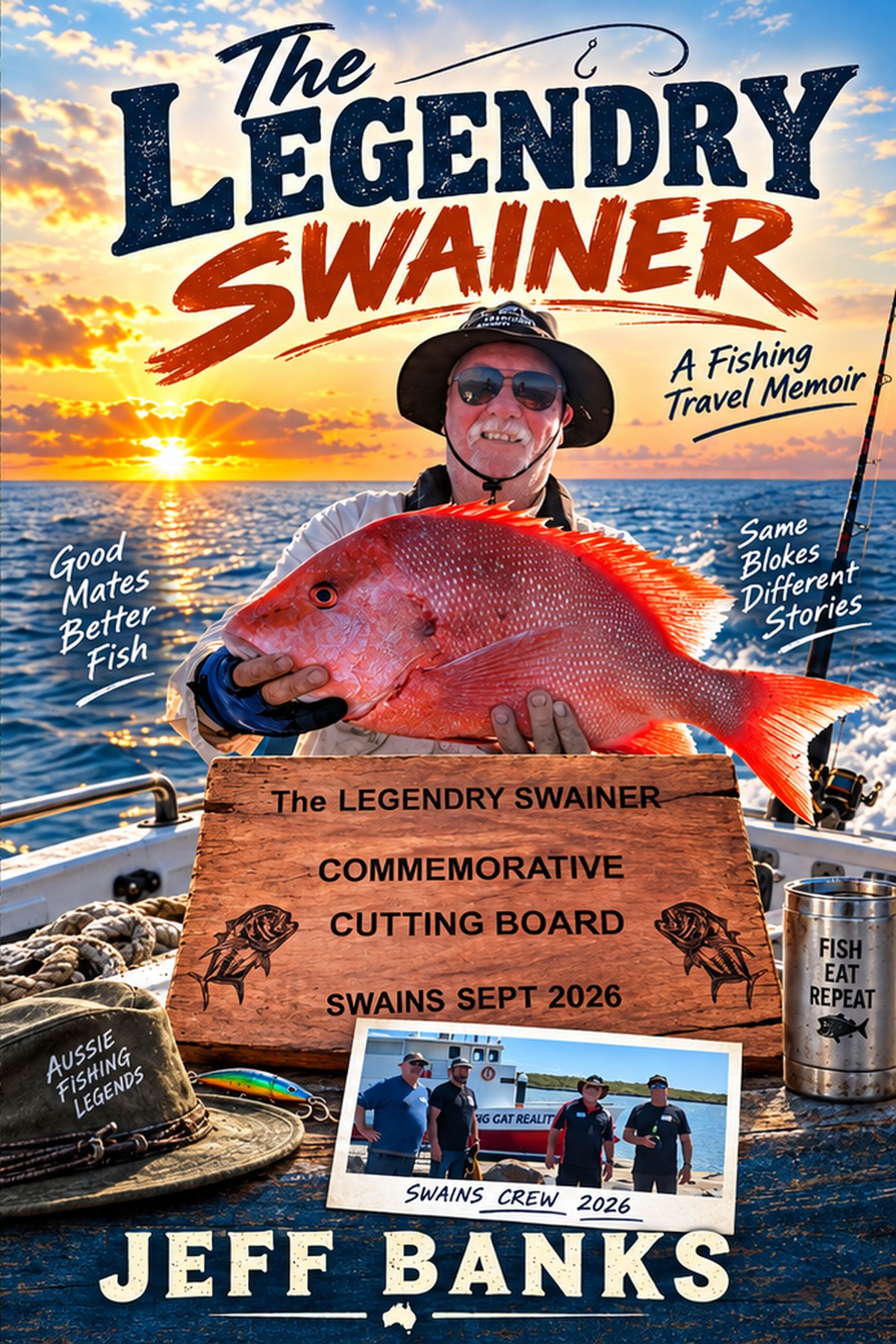
THE LEGENDRY SWAINER - Chapter 6 - Bundaberg or Bust

THE LEGENDRY SWAINER - Chapter 6 - Bundaberg or Bust | Travelling Around Australia with Jeff Banks

Steve had by now adopted a description for the four of us that showed he was becoming far too comfortable. “All the gear and no idea” was his preferred summary, which was unfair in the technical sense but increasingly difficult to contest on evidentiary grounds. Between my tangles, Ian's complete refusal so far to wet a line, Trevor's encounter with seasickness and Steve's own fish-finger Spanish mackerel, our opening performance had hardly forced the other passengers to gather around seeking professional advice.

The Legendry Swainer

Four Mates, Seven Days and Far Too Much Confidence

Chapter 6 — Bundaberg or Bust

The alarm went off at 5.30 in the morning, which is an entirely unreasonable time to be awake unless there are fish involved. Fortunately, there were going to be fish involved, although they were still several hundred kilometres and, ultimately, about 130 nautical miles away frm the coast. That was enough justification to get me moving without too much complaint, because Bundaberg had stopped being a destination on a map and had become the place where Big Cat Reality was waiting for us.

Steve had not enjoyed quite the same peaceful preparation for the day. He had slept badly, but I suspect the noises outside were only part of the problem, because by then the excitement of what lay ahead had sharpened every sense and made sleep almost optional. A sound that would normally have been dismissed as a branch moving, a door closing or somebody wandering past suddenly demanded investigation, while the mind happily supplied possibilities involving the Cruiser, the fishing gear or perhaps both disappearing before dawn. Nothing happened, of course, but that hardly mattered once the brain had decided it was on night watch. The closer we were getting to Bundaberg, the more difficult it was to switch off, and Steve’s lack of sleep probably owed as much to anticipation as anxiety, with his body apparently deciding there was little point resting when a trip he had been imagining for months was only a few hours away.

We were packed and moving by 5.50, which was a sufficiently impressive effort to convince both of us we were running like a well-drilled expedition. That confidence lasted until we missed the Sunshine Coast turnoff and found ourselves wandering through the city looking for another way to reconnect with the highway north. There is something particularly humbling about beginning a journey to one of the more remote parts of the Great Barrier Reef by demonstrating that you cannot successfully negotiate a major road interchange.

Eventually the GPS forgave us, recalculated whatever damage we had done and pointed the Cruiser in the right direction. The road opened up in front of us and, with roughly four hours to Bundaberg, the feeling inside the vehicle changed almost immediately. Yesterday had been travelling. This morning we were going fishing.

By 6.30 the first messages were going out to Trevor and Ian, not because there was anything remotely useful to communicate but because they existed and therefore needed annoying. The purpose of early-morning telecommunications between mates heading on a fishing trip is rarely the efficient exchange of information; it is to establish that you are awake, moving, possibly ahead of schedule and therefore entitled to suggest that everybody else is disorganised, soft or somehow already losing. At this stage there were no fish to compare, no catches to dispute and no trophy points to argue over, so the only available competition was sledging, and everybody appeared determined to build an unassailable early lead.

For a while there was suspicious silence from the other end, which only encouraged further effort because unanswered abuse is not regarded as a signal to stop. It is regarded as evidence that the target may be vulnerable and therefore requires more attention. Eventually Trevor and Ian returned serve and the communication lines came alive with the sort of material that would have been of absolutely no value to anybody outside our little group but was being treated inside it with the intensity of a Test match opening session.

There was no easing into this trip socially. Once somebody found an opening, the foot stayed firmly on the throat because allowing a mate time to recover would have represented an unacceptable lapse in competitive discipline. Any mistake, hesitation or poorly chosen word was immediately recycled, embellished and sent back into circulation, with no statute of limitations and certainly no sympathy available this early in proceedings. We were still hours from the boat, yet the sledging had already reached something close to fever pitch, and not one of us was prepared to reduce the pressure simply because the actual fishing had not started.

The highway was comparatively clear, which made the drive easier apart from the normal collection of motorists whose personal interpretation of road rules appeared to have been developed without reference to anybody else using the road. Chief among them was that magnificent Australian travelling institution, the driver who sits comfortably below the speed limit for kilometre after kilometre and then discovers another twenty kilometres an hour the moment an overtaking lane appears. I have never understood the psychology involved, but I suspect somewhere inside their heads a starting gun goes off at the sight of the sign saying “Overtaking Lane 500 metres”.

For the previous day much of our discussion had been about the charter itself. We had talked about service levels, how Big Cat Reality might compare with previous Swains trips, the organisation, the accommodation and what we had been told to expect. Those conversations had been useful and at times almost analytical, which was never going to survive once Bundaberg appeared on the horizon.

Now the conversation had moved to fish. Not fishing in the broad sense, but particular fish, particular lures, particular methods and particular theories about what would work when we finally reached the reef. Coral trout, red emperor, Spanish mackerel, tuna, trevally and anything else sufficiently large or impressive to interfere with somebody else’s confidence began occupying the Cruiser with us.

For Steve this was a move into genuinely new territory. He was a charter operator and had caught more than enough fish to be dangerous in any conversation, but Swains was different. There were species and sizes of fish that, until now, had lived for him mainly in photographs, stories and the occasional account from one of us that had almost certainly improved slightly during the years since the fish was caught.

There was no quiet contemplation of what might lie ahead. Instead there was the occasional twitch of a lip followed by a string of words about lures, trolling speeds, hooks, leaders, jig heads and fish that anybody listening from outside the Cruiser might reasonably have diagnosed as some form of babbling disorder. To us it made complete sense, which perhaps says more about us than it does about the conversation.

That anticipation is part of a trip like this. Long before the first line hits the water, you have already caught dozens of fish in your head, solved problems that have not yet arisen and confidently selected methods for conditions you have not yet seen. Every one of those imaginary fish behaves beautifully, bites exactly where expected and is successfully landed, because imaginary fishing has always enjoyed a considerably higher conversion rate than the real thing.

By the time we rolled into Bundaberg the excitement had climbed another couple of notches, although there was still the small matter of finding the tackle shop. Steve needed to collect the battery for his electric reel from Tackle World, a requirement that had only emerged because I had asked the seemingly obvious question of whether the reel actually came with one. There is something in the old concept of “merchantable quality” that appeals to me here, because if somebody sells you an electric reel, surely it is not unreasonable to assume that the electricity required to make it electric might be included somewhere in the transaction. Apparently not. A check revealed that Steve’s reel, like mine, arrived perfectly capable of being electric in theory but without the rather important component needed to prove it.

Trevor and Ian had avoided this particular trap because the considerably more expensive electric reels they had purchased came with batteries, allowing them to enjoy not only superior equipment but another opportunity to explain why spending more money had once again demonstrated superior judgment. Mine had required a separate battery purchase as well, so at least Steve and I now occupied the same slightly ridiculous corner of the market: owners of electric reels that had initially been sold with all the fishing capability of attractive hand-operated ornaments. The battery was waiting for Steve in Bundaberg, which sounded straightforward enough until the GPS appeared determined to provide us with a broader cultural tour of the city before allowing us anywhere near fishing tackle.

We seemed to circle enough streets to have qualified for local residency before finally finding the place, and even then we nearly drove past it because the signage was hardly screaming for our attention. This was mildly alarming because fishermen approaching a tackle shop immediately before a major charter normally possess sensory abilities similar to migrating birds. If we could nearly miss one at this stage of proceedings, perhaps the previous evening’s sleep deprivation was beginning to spread.

Trevor and Ian were already inside, naturally buying more gear. There are certain things in life that require no explanation, and finding two fishermen in a tackle shop immediately before boarding a seven-day charter is one of them. The fact they had already spent months preparing, purchasing, servicing, selecting and discussing tackle was completely irrelevant, because a tackle shop only has to contain one object they do not currently possess for an emergency requirement to be established.

Steve collected the battery he had actually come for and then immediately demonstrated his growing integration into the group by adding further tackle to the transaction. Apparently the battery had not been lonely, but once surrounded by all that equipment it was unreasonable to expect it to leave the shop unaccompanied. I looked around, considered the possibilities and performed an act of self-control of which I remain quite proud.

I had enough.

That statement should not be confused with claiming that I owned everything necessary for fishing, because no fisherman has ever reached that stage and survived the admission. It simply meant that on this particular morning I could not identify another purchase capable of overcoming whatever personal shortcomings might later prevent me catching fish. The five rods, boxes of lures, hooks, leaders, swivels and accumulated weaponry already in the Cruiser would have to do.

With the tackle shop survived, Steve and I headed for Maccas before going to the boat. We had been awake since half past five, had already demonstrated navigational fallibility and were about to begin a journey that would keep us aboard Big Cat Reality for the next week, so breakfast seemed a sensible final contribution from civilisation.

For reasons that seemed important at the time, there were no Quarter Pounders available on the menu. This may simply have been because we had arrived during breakfast service, but fishermen on the morning of a major expedition are not required to accept ordinary explanations when an omen can be manufactured instead. Perhaps this was the first indication that for the coming week nothing normally taken for granted was going to operate according to its usual rules.

The first sight of Big Cat Reality removed any lingering sense that we were still merely travelling. There she was, tied up and waiting, with people arriving, gear being shifted and the growing collection of rods, bags, boxes, eskies and personal possessions that always makes you wonder how any boat can possibly swallow the amount of equipment apparently necessary for grown adults to spend a week fishing.

There was also the first sizing-up of the other passengers. Technically they were not the opposition because the Legendry Swainer Trophy and the GT Challenge belonged to our own private lunacy, but technicalities have rarely been sufficient to prevent fishermen comparing themselves with other fishermen. Rods were noticed, reel brands registered, tackle boxes assessed and individuals quietly examined for signs that they might know something we did not.

Every new piece of gear carried by somebody else also raised the possibility that we had forgotten the one essential item on which the entire week might turn. It only takes somebody to mention a lure that had “absolutely smashed them” on the previous charter for fifteen men to begin wondering whether there is enough time for one more trip back into Bundaberg. The most dangerous words in fishing are not “rough weather ahead”. They are “you should have brought one of these”.

The reception at the boat immediately moved Big Cat Reality two points ahead in the service competition that had existed mostly inside my head. Firstly, we could drive right up beside the boat to unload, which meant there was no prolonged pack-mule exercise between vehicle and vessel. Secondly, secure parking was available on site, allowing us to leave the Cruiser without Steve spending another night listening for mysterious noises.

Steve, the owner of Big Cat Reality rather than the Steve travelling with me, was there to greet us and the organisation felt easy from the beginning. There was no sense that our arrival was an inconvenience to be processed before the real work began. People were welcomed, gear was directed where it needed to go and the whole operation had the feeling that somebody had thought about what the customer experienced rather than merely what was administratively convenient.

That mattered to me because of a phone call I had received from the business in the week before the charter. It had been one of those experiences Peter Merrett might have described as Wonderlicious, where somebody manages to make the customer feel looked after before the product has actually been delivered. There had been an easy confidence in the way they spoke about the charter, their fishermen and, importantly, the reef itself.

There had also been something approaching a promise that when it came to how management treated the fishermen and the environment we had not seen anything yet. That raises expectations, particularly in somebody like me who notices service and the absence of it far more readily than is probably healthy. By the time I stepped aboard they had already talked themselves into a fairly demanding standard, although the early evidence suggested they might actually be capable of meeting it.

Complimentary beer began to appear while gear continued moving aboard, which is one of the more reliable signs that strangers are beginning the conversion into fellow passengers. Names were exchanged, relationships established and families identified, while everybody performed that uniquely Australian social exercise of trying to work out who could safely be insulted, how quickly and about what.

The answer, in our case, was generally everybody.

Even passengers who had arrived with no knowledge of the Legendry Swainer Trophy were potential witnesses, jurors and future contributors to the atmosphere. They may not yet have realised it, but they were entering a floating community in which every lost fish, questionable knot and optimistic claim was likely to become public property. There was no formal induction into this part of the charter, although Trevor appeared more than willing to provide one.

There was also another opponent waiting, and this one did not care about trophies, reputations or fishing ability. Seasickness has a wonderfully democratic approach to boating, being equally prepared to attack beginners, experienced fishermen and anybody foolish enough to suggest publicly that he never gets sick.

On earlier trips aboard Kanimbla, a couple of Kwells on the way out had generally been enough for me. Since those days I had rarely had much trouble, apart from certain conditions when the wind followed the boat and brought fumes back across the stern. There is something about a mixture of diesel, rolling ocean and stale air that can cause even the most confident stomach to reconsider its contractual obligations.

The Kwells were therefore in the bag just in case. I have never regarded seasickness as evidence of fishing incompetence, partly because that would create a standard under which I might personally be judged and there is no value in designing rules against yourself. I also take some comfort from Andrew Ettingshausen having spoken openly over the years about his own susceptibility to seasickness despite making a career out of fishing on television, which suggests the ocean does not inspect résumés before deciding who gets crook.

Before departure there was still the temptation to drop a line over the side at the wharf. It would have been frowned upon in the normal course of things, and probably with good reason, but there remained the unresolved philosophical question of when the competition actually began. If something large and predatory happened to be lurking under Big Cat Reality while we were still tied to the dock, was a man genuinely expected to ignore it merely because the last mooring rope had not yet been detached?

The alternative was to behave like responsible passengers, unpack properly and find somewhere on the back deck where a drink and perhaps a game of cards could establish the correct tone for the afternoon. This had the added benefit of allowing the sledging to begin in real earnest, with the possibility of drawing unsuspecting passengers into it. Compared with attempting to catch a trophy fish beneath the wharf before departure, this was probably the more socially acceptable choice, although it lacked ambition.

The operators had also created a Facebook family group for the charter so photographs and information could be shared. I found this particularly interesting given that we were shortly heading somewhere with virtually no internet connection at all, but the idea was clearly to create a community around the trip before, during and after we disappeared beyond normal communications.

I had replied to the email suggesting they should perhaps be careful what they wished for. They knew nothing yet of the subject matter accumulating for this book, and voluntarily creating a permanent electronic location in which photographs and evidence could be deposited seemed an unusually trusting decision. Depending upon events, it might eventually prove either a wonderful historical archive or Exhibit A.

The obligatory safety briefing followed, and then came the serious business of establishing ourselves aboard. There was plenty of room, importantly plenty of power points, and my CPAP machine would not be living in competition with somebody else’s phone charger for electrical survival. I soon discovered that one of the much younger passengers also used a CPAP, which at least prevented mine becoming immediate evidence that I had personally dragged the average age of the charter into dangerous territory.

As part of the orientation we went around the group introducing ourselves and giving some idea of what we hoped to catch. When my turn came I offered “a 44-gallon drum with fins”, which was my preferred description of the yellowfin tuna sitting high on my bucket list. I was not asking for something unreasonable such as guaranteed success; I merely wanted a tuna requiring industrial lifting equipment and perhaps revised workplace procedures.

Among the passengers was Casey, the only woman on the trip and part of a family group of five. When she suggested she was not really a fisherperson, the reaction from her companions was immediate enough to indicate that this version of events was unlikely to survive examination. Their collective scoffing also suggested they understood the same form of affection that governed our group, which made them instantly promising company.

Later conversations with Casey produced photographic evidence of some excellent catches, making her original claim even less sustainable. She and most of her family were from Newcastle and the Hunter Valley, while there is a passenger who had travelled furthest had come from Wagga Wagga. We had travelled all that way to Bundaberg and somehow assembled a substantial group of people who, back home, were almost neighbours by Australian standards.

Trevor, meanwhile, had not wasted the settling-in period. He had found the name tags and decided that mine should not contain anything as straightforward as my actual name. Instead, he wrote “Tangles”, then proceeded to explain to anybody within range exactly why this was considered appropriate.

It was an allegation based upon historical evidence, but I still felt entitled to object to the prejudicial nature of the introduction. A man should surely be allowed to begin a new fishing charter without previous incidents being tendered immediately into evidence. Trevor’s approach was that the wider passenger group deserved fair warning, which I thought was unnecessarily community-minded of him.

Unfortunately, my defence suffered an early setback when I managed to live up to the name.

Eventually the ropes came off and Big Cat Reality began moving away from Bundaberg. Whatever argument might have existed about when the trip officially began had now been settled because the wharf was behind us, the river was opening ahead and there was no longer any realistic possibility of somebody claiming his first fish had been caught while technically still on land.

The difference from some of my earlier Swains trips became apparent almost immediately because we were able to troll on the way out. Previously the emphasis had often been on maintaining sufficient speed to get to the fishing grounds as quickly as possible, making the idea of dragging lures behind the boat somewhat incompatible with progress. Here the journey itself was apparently going to be part of the package.

That changed the atmosphere aboard considerably. Instead of everybody settling in for a long transport stage before the fishing started, rods came out and lures went into the water. We were heading for what would be around a twenty-four-hour steam to the first destination, but at least there was now the possibility that something with fins might interrupt the waiting.

There had been some thought earlier about whether a little overenthusiasm with the beer might make sleeping through part of the long trip easier. That strategy became less attractive once there was a genuine chance of hooking fish before anybody had cleared his head. A man does not spend months preparing tackle for Swains Reef only to discover his first serious strike occurred while he was explaining to the deck why he had needed one final beer before departure.

While feeding a lure out of the water under a little pressure I succeeded in collecting Steve’s line, which immediately attracted the sort of commentary Trevor had clearly been hoping for. A nickname that should have required several days to establish credibility had been independently verified before we were properly underway. There are moments in life when the best response is silence, although silence among this group merely creates additional space in which other people can speak.

My next contribution involved trying to troll a stickbait that was not particularly interested in performing the role I had assigned it. Rather than remaining obediently submerged, it bounced in and out of the water, creating enough slack and movement for the line to begin wrapping itself enthusiastically around the hooks.

I kept hoping it would sort itself out, because optimism is often another description for continuing to do something after the evidence has become inconvenient. By the time I finally brought it back in, nearly five metres of line had become sufficiently involved with the lure that removal rather than rescue was the only practical solution. Trevor’s decision to write “Tangles” on the name tag had therefore moved, in a very short period, from malicious character assassination to disappointingly strong documentary journalism.

Trevor was first to trouble the scoreboard.

His lure went off and before long a mac tuna was connected, which immediately brought the gallery to life. Support from your mates during a fish fight is one of the great traditions of recreational fishing, although in our case support usually consists of identifying every possible weakness in the technique being displayed.

Because the boat had slowed to allow Trevor to bring the fish in, the principal concern expressed by those watching was not whether he would land it but whether he could possibly hurry up. We had a very long way to travel and, according to the assembled experts, Trevor’s selfish insistence upon catching a fish was now delaying everybody else’s arrival at Swains Reef.

He eventually landed the mac tuna and became the first of the four of us on the board. This was irritating for several reasons, the main one being that Trevor being first in almost any competition creates immediate personality consequences for everybody around him. Eight points appeared beside his name and, more dangerously, confirmation appeared inside his head that months of confidence had been entirely justified.

Steve followed not long afterwards with a small Spanish mackerel. He described it as a fish finger, which was a reasonable assessment of its comparative dimensions but did nothing to remove the fact that it was still a fish and therefore still considerably better than the nothing Ian and I had produced.

The six points attached to it were open to philosophical debate. Whether fish fingers should qualify in a competition ostensibly involving grown men and serious fishing equipment was the sort of question that might eventually require clarification, but at this early stage Steve was perfectly happy to accept the points. Principles in fishing competitions tend to develop most strongly among those who have just failed to score.

I remained on zero, although not for lack of activity. I had already demonstrated an ability to catch another fishing line and then successfully converted several metres of my own line into something resembling macramé, which should surely have attracted recognition under a sufficiently broad scoring system. Unfortunately, neither achievement appeared in the species list.

Ian had taken a different strategic approach entirely and barely troubled his fishing gear. He caught up on sleep instead, which was probably necessary after what I suspected had been three weeks’ worth of work compressed into the previous week so he could justify disappearing to sea with us. It was difficult to criticise the strategy because while the three of us were already expending energy, losing line and beginning arguments, Ian was quietly increasing his capacity for the seven days that mattered.

The weather forecast was sitting in the background of all this. The following day did not look particularly attractive, but the indications were that conditions would progressively improve through the week, with the final couple of days potentially close to perfect. That forecast gave us something to look forward to while simultaneously reminding us that the sea was unlikely to provide seven days of easy fishing simply because we had spent enough money preparing for it.

The long steam also carried its own form of torture. Every mile travelled was taking us closer to fish we had been discussing for months, yet there were still hour after hour of ocean between us and the first reef where the real work would begin. Anticipation is enjoyable until it becomes sufficiently concentrated, at which point it starts resembling impatience wearing better clothes.

For the moment, though, we could troll, which was already a significant improvement on journeys where fishing had effectively been postponed until arrival. The idea that the trip out was itself part of the charter rather than merely the distance that had to be endured was beginning to make sense. We had barely cleared the beginning of the voyage and already Trevor and Steve had fish against their names.

That left Ian and me occupying the lower half of a four-man competition that had supposedly not yet become important.

Trevor’s satisfaction did not last entirely uninterrupted because another participant soon entered the contest. Seasickness arrived aboard Big Cat Reality and began selecting victims, proving once again that the ocean has an excellent sense of timing.

Trevor succumbed.

This was not something I wished upon him, because I know perfectly well how miserable seasickness can be. However, wishing a mate well and appreciating the enormous comic value of his misfortune are not mutually exclusive activities, particularly when the mate in question has spent the preceding months providing unrestricted commentary about everybody else’s weaknesses.

There is an important principle operating among long-term friends that I doubt has ever been formally documented. Sympathy is compulsory when genuine discomfort occurs, but it does not necessarily have to be delivered without an administrative fee, and in Trevor’s case that fee was going to be substantial.

He had already spent the trip north practising sledging at competition intensity. My equipment, my electric-reel considerations, my tangling history and just about every other available target had been examined whenever the opportunity arose, so his sudden retreat under the influence of a rolling sea represented the first major reversal of the expedition.

Nobody needed to manufacture material. The man who had been projecting competitive invincibility was now discovering that before Swains Reef could test his fishing ability, the Coral Sea had decided to test whether he could retain lunch.

It would have been hypocritical for me to suggest that becoming seasick somehow undermined Trevor’s standing as a fisherman. I get seasick myself and had Kwells packed specifically because experience had taught me that confidence is not a recognised pharmaceutical treatment. My position was therefore nuanced, reasonable and entirely consistent: seasickness was no reflection whatsoever upon fishing ability when it happened to me, but Trevor’s case clearly required extended public discussion.

I could even produce Andrew Ettingshausen in support of the general proposition. If a bloke can front fishing television while openly acknowledging that he gets badly seasick, then nobody aboard Big Cat Reality needed to regard the condition as a source of shame. That defence was available to Trevor at any stage, although providing it too quickly would have wasted an excellent opportunity.

The real danger for him was precedent. Every piece of sledging delivered before departure had now acquired the possibility of being returned with interest during the coming week, and the trip had not even properly reached the reef. Trevor had established the standard of debate himself, which meant complaints about future treatment were unlikely to receive sympathetic consideration from the tribunal.

I offered appropriate concern, of course. I am not an animal. I simply considered it unnecessary for concern to prevent careful observation, accurate record keeping or future reference whenever Trevor became too pleased with himself.

Several other passengers were also feeling the effects, which gave Trevor some company and prevented us pretending he had been uniquely selected by the ocean. It also changed the atmosphere aboard as the afternoon moved on and the initial excitement began colliding with the physical reality of a long offshore journey.

Eventually the route took us through green zones where trolling had to stop, allowing rods to be put aside and dinner to take over. Lamb steaks arrived, and the timing was probably fortunate because the boat had been moving long enough for everybody to begin settling into whatever rhythm his stomach was prepared to tolerate.

After dinner there was little resistance to the idea of an early night. The journey ahead was still long, the weather was not expected to be particularly friendly the following day and there was no prize for arriving at the first fishing ground already exhausted. Even the temptation to turn the back deck into a prolonged drinking session had to compete with the knowledge that rods could be back in the water whenever the route allowed.

Steve had by now adopted a description for the four of us that showed he was becoming far too comfortable. “All the gear and no idea” was his preferred summary, which was unfair in the technical sense but increasingly difficult to contest on evidentiary grounds. Between my tangles, Ian’s complete refusal so far to wet a line, Trevor’s encounter with seasickness and Steve’s own fish-finger Spanish mackerel, our opening performance had hardly forced the other passengers to gather around seeking professional advice.

Still, two of us were on the board. That mattered because the expedition had now crossed another invisible line. We had left Bundaberg, the first fish had been caught, the sledging had escaped the confines of the original four and begun involving the wider Big Cat Reality community. The people around us were changing from strangers into fellow travellers, potential witnesses and, whether they yet realised it or not, future participants in arguments about matters that no sensible adult would regard as important.

Leaderboard

Trevor — 8 points
First fish of the expedition among the four. Unfortunately also first significant encounter with seasickness, which may ultimately prove more historically durable.

Steve — 6 points
A junior Spanish mackerel, although his own description of “fish finger” should probably be entered into evidence if trophy margins become tight.

Jeff — 0 points
Not for the want of trying. Significant activity has occurred, although most of it has involved line rather than fish.

Ian — 0 points
Did not wet a line. Has instead invested heavily in sleep and may yet prove to be the only one of us employing a coherent long-term strategy.

Somewhere beyond us lay Swains Reef and the fish we had spent months imagining. There were still many hours of steaming ahead, ordinary sleep was going to require adaptation to the movement of the boat, and tomorrow’s weather promised to remind us that this was considerably more than a quiet weekend charter out of home waters.

Yet the trip no longer needed imagining. Trevor had already caught the first fish, Steve had followed him onto the scoreboard, I had successfully validated an insulting nickname within hours of boarding and Ian had sensibly slept through much of the evidence. Big Cat Reality was heading east into the night, and every mile carried us closer to the point where all the preparation, predictions and bullshit would finally have to confront actual fish.

Author

Menu