

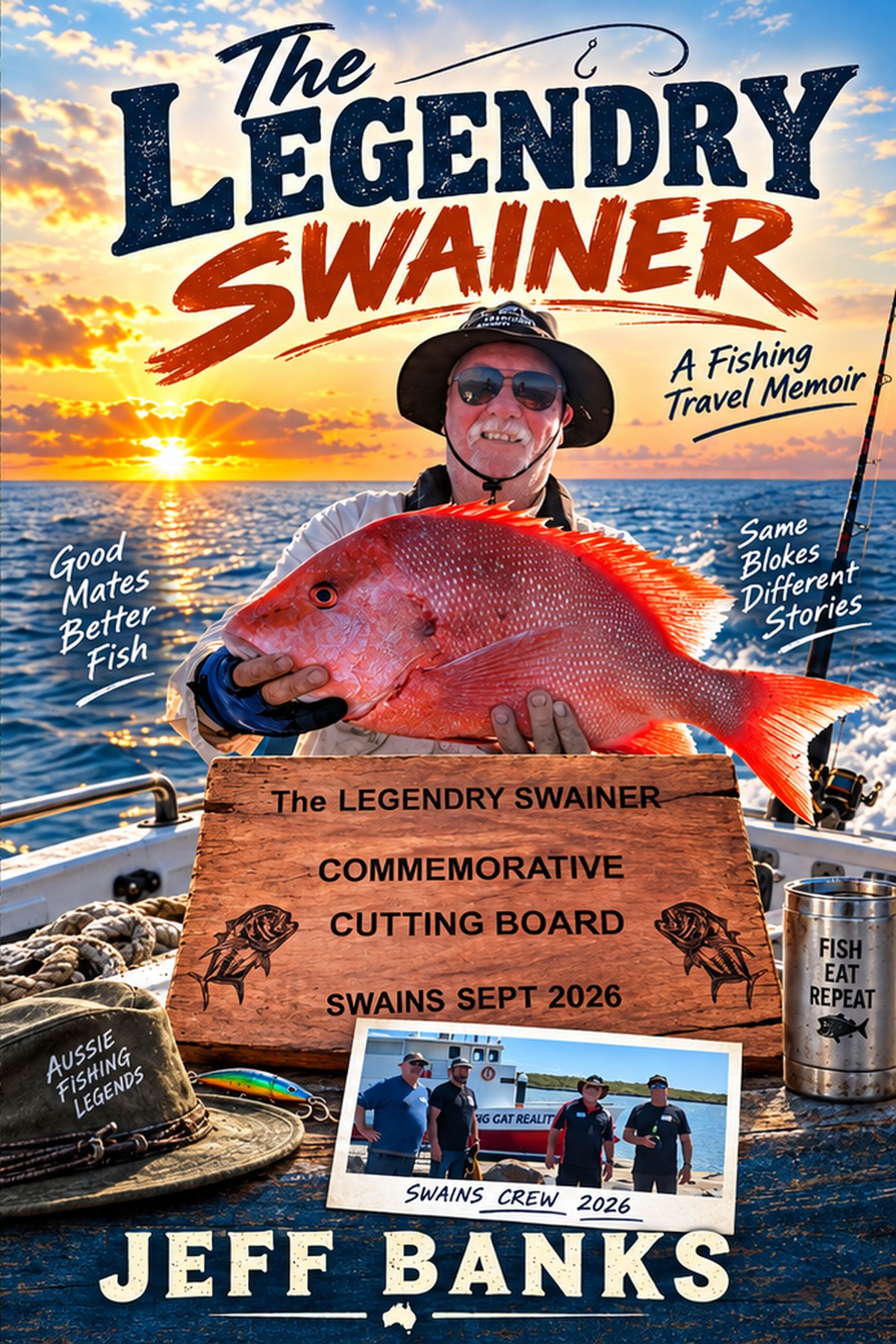
THE LEGENDRY SWAINER - Chapter 5 - North Day One

THE LEGENDRY SWAINER - Chapter 5 - North Day One | Travelling Around Australia with Jeff Banks

The drive also allowed us to consider what Steve might learn from the crew of Big Cat Reality and bring back to Forster Fishing Charters. His own operation was already above average in my view, but a good business does not become worse by watching another good business closely. Big Cat Reality was perceived, and certainly priced, as the Rolls-Royce version of the Swains operators, so there would be value in seeing how the crew managed service, routines, guests, equipment and the thousand small details that made the experience work. Peter Merrett’s Wonderlicious explores that territory of service and human connection, and seven days aboard gave Steve the chance to observe it in an environment where failure could not be hidden behind the front desk.

The Legendry Swainer

Four Mates, Seven Days and Far Too Much Confidence

Chapter 5 — North, Day One

The fishing had not officially started, but that was about the only part of the trip still awaiting permission. For weeks, Trevor’s Facebook group had been alive with photographs, accusations, equipment displays and carefully constructed attacks upon everybody else’s fishing ability, physical condition and general claim to manhood. The telephones had carried the same material to anybody reckless enough to answer them, while the airwaves on the road north merely provided another delivery system. By departure morning, we had already generated enough competitive hostility to support a week-long tournament without anybody having so much as wet a line.

Trevor had created the Facebook group as though it were an administrative convenience, although it quickly became apparent that administration was not its principal purpose. A photograph of newly purchased tackle could be posted as evidence of preparation and, within minutes, reinterpreted as evidence of insecurity, extravagance or an attempt to compensate for some other inadequacy. Steve’s contribution included photographs of what he described as his new BCF franchise, suggesting he had acquired enough gear to open a retail outlet somewhere between Forster and Bundaberg. Trevor and Ian examined these images with the restrained objectivity usually displayed by competitors who had already spent more money but did not want the comparison subjected to independent audit.

The opening legal question was not who would win, because each of us had already answered that privately and at considerable length. The real question was when the tournament began. It clearly had to start when the last mooring rope was detached from Big Cat Reality and finish when a rope was reattached seven days later, otherwise somebody might begin counting fish caught from the Bundaberg wharf, the marina pontoon or perhaps a bait freezer onshore. Rules only sound straightforward until four fishermen discover that one interpretation may advantage someone else.

There was also the possibility of a “record kingy”, inspired by an old Tooheys advertisement in which a tournament-winning fish still had newspaper dripping from it after its alleged purchase from the local fish shop. None of us was likely to attempt anything quite so blatant, although that conclusion depended upon how much the trophy came to matter and how poor the fishing became. A large kingfish presented at the right moment might raise questions, particularly if it arrived wrapped in yesterday’s sports section with a price written behind one gill. The fact that we had discussed the possibility before departure probably demonstrated integrity, because genuine cheats are generally less inclined to advertise their contingency planning.

The more realistic threat lay beneath the wharf. If something predatory was lurking near the boat and one of us happened to lower a bait while the crew were still loading, did that fish count if the final rope had not yet been released? I was silly enough to try, which made it important that the rules be settled before I found myself holding a qualifying monster and facing three retrospective constitutional amendments. My position was that the competition should begin when Big Cat Reality ceased being attached to mainland Australia, although I retained the right to develop a different interpretation if something substantial grabbed a bait before then.

There was one final packing decision waiting for me before Steve and I pointed the Cruiser north. The laptop had no practical access to the outside world 130 nautical miles east of Bundaberg, and every phone aboard would spend the following Saturday pinging itself senseless when we finally returned to range. Even so, the laptop was one of my tools of trade, and this trip required accurate records while events were still fresh enough to resist deliberate improvement. Memories would need to be written down, scores updated and fish entered before they acquired extra length through the natural ageing process.

The scoring alone justified taking it. A changing leaderboard would provide information, but its greater value would lie in identifying when a foot could be placed firmly upon somebody else’s throat. There is little point taking the lead if the other competitors are permitted to enjoy their breakfast without being reminded of it, and a properly maintained spreadsheet could turn casual sledging into an evidence-based discipline. I therefore loaded the relevant files onto the desktop so that an absence of internet could not be used to thwart either the official records or my completely impartial interpretation of them.

Getting into the spirit of excess, although always at a cost, I had also bought crimping materials and made several traces of my own. These carried various hooking arrangements and hooks sharp enough to catch my fingers and hands even if their effectiveness upon actual fish remained untested. Making your own rigs creates a particular confidence because every component has been selected, measured and assembled personally. It also ensures there is nobody else to blame when the entire construction disappears over the horizon attached to something much larger than anticipated.

My final “to do” list covered the things most easily forgotten after weeks spent concentrating on items that could impale, restrain or retrieve a fish. The laptop, medications, gifts and chargers were all written down, along with the ordinary necessities that had somehow become secondary to swivels and crimps. I then remembered the half-dozen frozen bonito in the freezer and began considering whether they should also make the journey north. They occupied valuable space, but bait is difficult to dismiss when a week’s worth of reef fish has already been mentally allocated to every available corner of the return load.

Trevor would naturally regard the bonito as community property. This was consistent with his approach to the rod holders on our Condobolin trip, where anything another person had caught, prepared or thoughtfully laid down for tomorrow could become a shared resource once Trevor required it. He had not caught the bonito, stored them or remembered they existed, but I doubted any of those technical distinctions would survive his first request for a slab. In his mind, friendship had always included an unwritten provision covering access to other people’s useful possessions.

I was less certain that a whole bonito could be treated like an extra piece of crimping material. A swivel borrowed in an emergency was one thing, while surrendering bait capable of producing a trophy fish was potentially an act of self-sabotage. I expected to fill every nook and cranny on the return journey with my own fish, and therefore any freezer space surrendered on the way north needed to be considered a personal investment rather than a charitable donation. If Trevor wanted a piece, I could perhaps throw a slab in his general direction and make him wear it before allowing him to fish with it, which would at least give me some value from the transaction.

By the time Steve and I left, the sledging had reached a level normally associated with the closing stages of an event rather than the drive towards it. Steve had joined in comfortably, which was reassuring because a man entering an established group could either spend weeks learning the boundaries or simply recognise that there did not appear to be any. His suggestions that his name might as well be engraved upon the trophies were distributed freely, along with the BCF franchise photographs and enough tackle-based propaganda to justify an inquiry into his professional intentions. He may have begun as the newcomer, but he was already behaving like somebody who understood the terms of membership.

Lead appeared to be one of those terms. Between Steve and me, we seemed likely to be carrying more than 100 kilograms of sinkers, although I was not prepared to test the figure on any scale connected with transport regulation. Trevor would have at least as much because he would regard being outdone in ballast as a personal failure, while Ian’s contribution was already travelling north in Trevor’s vehicle. If Big Cat Reality sat lower in the water than expected, the crew would not need to inspect the hull before asking whether the four trophy fishermen had come aboard.

There were no official teams in the competition, but that had not stopped temporary alliances forming before departure. Trevor and Ian had years of fishing history together and naturally presented something resembling a united front, while Steve and I were increasingly treated as the opposition whenever it suited them. Their sledging carried the familiar implication that we were comic relief rather than genuine contenders, an argument built largely upon the bells and whistles they owned and the equipment they believed we did not. In this view of fishing, success began at the cash register, and anything tried and tested without a recent price tag was clearly inferior.

Steve seemed neither concerned nor particularly interested. He intended to fish, which placed him much closer to my own view that the real contest was always against yourself and whatever was moving beneath the surface. That did not mean either of us was above wanting to beat Trevor and Ian, because philosophical detachment has its limits. It merely meant we were prepared to let them enjoy their confidence while preserving the option of becoming completely unbearable if the leaderboard moved our way.

Their assessment also ignored some inconvenient history. I had taken Trevor and Ian to places I favoured and watched both of them catch good fish, occasionally with the expression of men surprised that my advice had not caused immediate disaster. Ian had even won one of my Repeller Fishing Competitions after missing the first day’s charter, when I put him onto a large snapper capable of rescuing his campaign. I did not expect everlasting gratitude, but it might have been reasonable for the incident to survive somewhere within his assessment of my fishing ability.

The difficulty was that I had spent too many years leading with my chin. Acting the fool to fit in is an effective social strategy until everybody begins preserving the evidence and presenting it whenever competence becomes relevant. I had provided Trevor and Ian with a substantial archive, and neither man was inclined to let a previous victory interfere with a useful character reference. The fact that I could see how the process worked did not make me any less responsible for helping build it.

Still, the record contained matters worth noting. I had “won” the recent Condobolin trip with Trevor, held a Repeller Trophy and could point out that Ian had won one while Trevor had not. These were established facts, although I understood Trevor would classify them as historical curiosities lacking any relevance to the present contest. I expected to hold my own on the Swains leaderboard, and any suggestion otherwise was an opinion unsupported by the available trophy cabinet.

There was, admittedly, contrary evidence. On an earlier Swains trip, Dodger and I had completed a full morning session without contributing a single fish to the cleaning table, a goose egg of such completeness that even selective memory struggled to improve it. We later redeemed ourselves on Kanimbla with a seven-kilogram spangled emperor, but redemption is never distributed evenly among fishing mates. The good fish becomes a shared memory, while the empty session remains permanently registered against the two men responsible.

The first day’s drive gave all of these stories room to move. Steve and I were together in the Cruiser, Trevor was travelling in his own vehicle with Ian’s gear, and Ian would eventually make the journey through the comparative elegance of air travel. Phones and messages kept the vehicles connected, allowing an old claim to be challenged almost as soon as it crossed a shire boundary. Every previous fish grew slightly larger with distance travelled, while every former mistake became more accurately remembered by the people who had not made it.

Ian would probably use part of his flying time to catch up on sleep. His business demanded work at odd hours, and he would want to arrive fresh enough to hit the charter at full pace while the rest of us were still unfolding ourselves from vehicles. Flying into Bundaberg sounded luxurious, but time is one of the luxuries business owners do not always have, while a two-day drive can become a different sort of luxury when there is no telephone call important enough to turn the vehicle around. Ian’s trip would be quicker, but he would miss several hundred kilometres of essential preparation, revised history and unsupported prediction.

I had flown to fishing trips before and understood the attraction, although my own experiences had not always demonstrated aviation at its finest. On one occasion, a security officer objected to fishing line in my carry-on because it might be used to garrotte somebody. The line was only travelling with me because it had previously been packed in the suitcase and damaged badly enough to require replacement before Kanimbla could leave the berth. Apparently, preventing one transport problem had simply created a more imaginative one.

There had also been the trip when our catch left without us and the rod tubes went to another airport. Sitting back while somebody else did the driving was pleasant, but it came with the possibility that the fish, rods and fishermen might all arrive at separate destinations. From Smiths Lake, flying was technically possible without being especially practical, and driving was often quicker once the connections and transfers were considered. It also allowed the Cruiser to carry the amount of equipment four sensible men would have rejected before breakfast.

Somewhere northbound, the conversation inevitably moved to Steve’s bona fides and what he expected to place upon the cleaning table. He was the professional among us, a man who took other people fishing and was therefore expected to understand what fish did even when the fish had not been consulted. Swains would be different from his usual waters, and professional knowledge did not come with a guarantee that every reef fish would recognise his qualifications. Steve was honest enough to admit that he could be as blind as anybody else when confronted with unfamiliar water, which probably gave him an advantage over three men whose previous visits had convinced them they knew everything.

His professional standing would certainly not protect him if the fishing turned against him. A charter operator who failed to catch fish would attract much more attention than an accountant doing the same thing, and I was prepared to ensure that distinction was properly observed. Steve may have joined the trip expecting to fish with customers who had gradually become mates. He was beginning to understand that he had instead volunteered for an ongoing performance review conducted by three men with no relevant authority.

The purchase of his electric reel had at least resolved one concern for me. Steve had apparently bought it so he would not be left out, although inclusion among this group generally required acquiring something expensive and then enduring abuse for having done so. His reel meant I could use mine in deep water without being isolated as the man requiring electrical assistance, and we could both attempt to crank fish past the sharks while Trevor and Ian pretended their own expensive versions represented an entirely different philosophy. Steve was now just as bad as the rest of us, which was an important stage in his integration.

The drive also allowed us to consider what Steve might learn from the crew of Big Cat Reality and bring back to Forster Fishing Charters. His own operation was already above average in my view, but a good business does not become worse by watching another good business closely. Big Cat Reality was perceived, and certainly priced, as the Rolls-Royce version of the Swains operators, so there would be value in seeing how the crew managed service, routines, guests, equipment and the thousand small details that made the experience work. Peter Merrett’s Wonderlicious explores that territory of service and human connection, and seven days aboard gave Steve the chance to observe it in an environment where failure could not be hidden behind the front desk.

We talked about that for much of the seven-hour drive. There was no suggestion that Steve should return to Forster and copy everything he saw, because his charter business operated in different water, with different trips and different customer expectations. The value would lie in noticing what made people feel looked after, what made difficult routines appear effortless and what separated an expensive fishing trip from a memorable one. Of course, I also expected him to catch fish, because professional development would be a poor excuse when the trophies were presented.

Our first day ended at my son’s house in Logan, leaving a much easier four-hour run to Bundaberg the following morning. He had joined the peripheral sledging before we arrived, although envy supplied more of his ammunition than genuine hostility. He would have loved to be coming with us, but seasickness would have removed most of the enjoyment after the first hour. There is no great pleasure in spending seven days at Swains if your body believes every minute should be devoted to returning something to the ocean.

He had also requested some assistance from Dad and asked that I bring tools from my shed for projects he had under way. This introduced another category to a vehicle already carrying fishing gear, frozen bait, trophies, luggage, computers and enough lead to alter its suspension. Thankfully, he did not need the table saw or the lathe, because neither would have fitted without leaving Steve or several rods behind. I am not certain which option would have caused the greatest argument.

Before the evening could begin properly, we worked in the garden and moved dirt to improve the parking available to his tenant. It was not the activity Steve and I had imagined when discussing the first day of a fishing expedition, but it did provide a final burst of respectable labour before a week devoted to less defensible priorities. Photographs were taken and sent around, where the sight of us working naturally produced another wave of commentary from men who were not present to lift anything. Trevor and Ian were happy to supervise electronically, a role for which both appeared fully qualified.

The day settled into homemade pizza, a few drinks and the sort of catch-up that made Logan feel like part of the trip rather than simply somewhere to sleep. We were still a day from Bundaberg and well short of Big Cat Reality, but the adventure had already escaped the planning stage and begun accumulating incidents of its own. Photographs continued to circulate, predictions became bolder and the sledging reached another level as everybody contemplated how close we now were to having to support their claims with fish. Tomorrow we would finish the journey north, inspect the opposition and perhaps settle when the tournament officially began, preferably before I found something worth catching beneath the wharf.

Author

Menu