

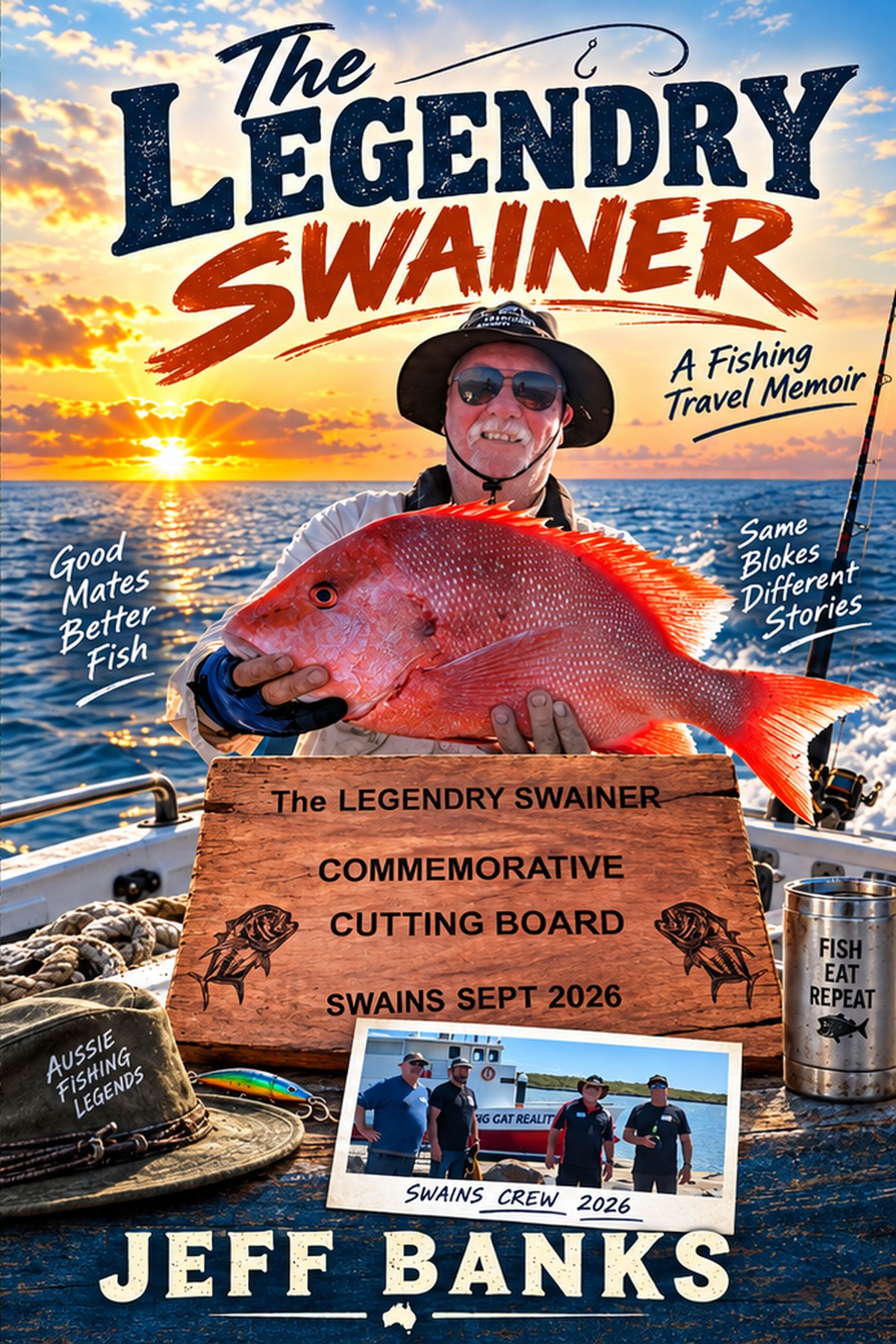
THE LEGENDRY SWAINER - Chapter 4 - The Packing Olympics

THE LEGENDRY SWAINER - Chapter 4 - The Packing Olympics | Travelling Around Australia with Jeff Banks

Eventually the packing reached the point where further improvement became difficult. My suitcase would close, the fishing gear was organised, the trophies had somewhere to travel and the essential medical bits had survived repeated audits. I still had the persistent feeling that something was missing, but by then I had checked enough times to recognise that the feeling itself had probably become part of the luggage. There is only so much certainty available before a trip, after which you have to accept that whatever you have forgotten will identify itself at the least convenient possible moment.

The Legendry Swainer

Four Mates, Seven Days and Far Too Much Confidence

Chapter 4 — The Packing Olympics

There comes a point before every serious fishing trip when preparation ceases to be preparation and becomes a competitive event in its own right. Nobody actually declares this point, because that would require admitting that four grown men are competing over who can be best prepared to compete over fishing, but everybody recognises it when it arrives. For Swains, it arrived somewhere around the fortnight-to-go mark, when suitcases appeared, tackle boxes began multiplying and perfectly serviceable fishing equipment suddenly developed previously unnoticed deficiencies. By then we were no longer merely going fishing; we were ensuring that, whatever happened when we got there, none of us could be accused of having failed through insufficient shopping.

My own signal that departure was getting close was the suitcase coming down about two weeks beforehand. This was not because I intended to pack it once and leave it sitting peacefully in the corner, because anybody suggesting such a thing clearly had no understanding of expedition logistics. The suitcase came down so it could be packed, assessed, unpacked, reconsidered and packed again, with various items promoted or relegated according to whatever concern had occurred to me since the previous inspection. There would eventually be several complete repacks, each undertaken with the confidence that this time I had finally achieved the perfect balance between carrying everything I might conceivably need and being able to close the bloody thing.

Fishing clothes were reasonably straightforward because I had accumulated a selection over the years that had moved beyond anything normally associated with fashion. Some of the shirts and shorts had reached the stage where, if placed upright beside the suitcase, they could probably have walked to Bundaberg under their own power. This made them ideal Swains apparel, because another coating of fish slime, bait, blood and whatever else accumulated during a day’s fishing was unlikely to diminish their value. There was also the possibility that certain garments might perform their final service somewhere off the Queensland coast and simply remain there, which struck me as a perfectly legitimate form of wardrobe renewal.

The difficulty was deciding how many of these treasured items constituted enough. Seven days fishing did not necessarily mean seven fishing shirts, because shirts could theoretically be worn more than once, although that theory usually became less attractive after examining one at the end of a serious day on the reef. Laundry facilities were not really the point of going to Swains, and there comes a level of fish gut saturation where washing an item seems unnecessarily ambitious when throwing it away offers the cleaner solution. I therefore packed enough clothing to cover the likely deterioration rate, plus something in reserve in case Queensland fish proved particularly enthusiastic about contributing to my appearance.

Then there were the clothes required for those sophisticated social occasions that occur after dark aboard a fishing boat. Nobody was expecting black tie, but there remained the question of whether shorts that had spent the afternoon underneath a mackerel qualified as evening wear, particularly when experience suggested that fishing did not necessarily stop simply because dinner had been served and sensible people had started thinking about bed. On a boat, darkness can sometimes bring its own opportunities, and the bloke who had changed into his clean shirt too early could discover that formal evening attire and excited pelagic fish were not especially compatible.

I had learned that lesson one night aboard Kanimbla, when what had been an otherwise ordinary evening was suddenly interrupted by the arrival of a school of Spanish mackerel. They did not arrive politely, one at a time, allowing everyone to select a rod, check a knot and agree upon an orderly fishing procedure. They arrived in the manner Spanish mackerel often seem to prefer when they find bait and decide to create havoc, and within moments the back of the boat had gone from relaxed night-time fishing, with the crew retired for the evening, to something resembling an emergency response conducted by men armed with rods.

For a while, everything that could bend was bending and quite a few things that were not supposed to break began exploring that possibility. Lines parted, tackle failed, knots were subjected to loads their creators had probably hoped never to see, and there were moments when the principal challenge seemed to be keeping enough functioning equipment in circulation to take advantage of the fish still tearing around behind the boat. Somewhere amongst the yelling, lost gear, crossed lines and frantic attempts to get another bait or lure into the water, enough Spanish mackerel made it aboard to begin filling the freezer. The whole episode had the wonderful quality of fishing madness where nobody had planned any of it, nobody was properly prepared for the speed with which it happened, and everybody knew that stopping to organise ourselves would probably result in the fish disappearing.

It became one of those nights that gets written into Swain’s lore, not because anybody sat down afterwards and formally declared it significant, but because years later it was still being dragged into conversations whenever somebody began talking about what might happen after dark. Fishing trips seem to collect nights like that, occasions where the normal rules disappear for an hour or two and everybody aboard knows, even while it is happening, that this particular piece of chaos will be retold long after the exact number of fish has become negotiable. The Kanimbla mackerel frenzy was one of mine, and as we prepared for Big Cat Reality there was a quiet expectation that somewhere during those seven days another such moment was waiting for us. It probably would not involve Spanish mackerel arriving in precisely the same way, because the best fishing memories rarely repeat themselves to order, but we trusted Swains to produce something sufficiently ridiculous, spectacular or unexpected to earn its own place in the collection.

I had seen that happen on the very first night of my very first Swains experience, when Dave the Dentist landed a Red Emperor of around forty-five pounds. That was the sort of fish capable of recalibrating expectations before the trip had properly begun, because once somebody produces a Red Emperor of that size on Night One, the imagination is given entirely too much freedom regarding what the following days might deliver. Years later I could still remember the significance of it, not merely because it was an exceptional fish but because it announced, almost immediately, that Swains operated on a scale slightly removed from the fishing most of us knew at home.

That is part of the seduction of going back. You are not necessarily expecting another forty-five-pound Red Emperor on the first night or another Spanish mackerel school to materialise beside the boat and turn the deck into organised bedlam, but you know both sorts of things have happened before. Once you have been present for one of those episodes, ordinary probability becomes surprisingly easy to ignore and every dark patch of water behind the boat begins carrying possibility. Swains teaches you that the memorable moment may arrive when everybody is ready for it, but just as often it turns up while half the crew is thinking about bed and somebody has already changed into a clean shirt.

That was why the idea of fishing after dark aboard Big Cat Reality could never be dismissed as merely something to do before turning in. Somewhere between dinner and bedtime there remained the possibility of another night entering Swain’s lore, and if it happened late enough in the trip it might carry consequences well beyond the freezer. A mackerel frenzy, a monster Red Emperor or some other completely unforeseen act of marine generosity could change the Legendry Swainer Trophy standings in minutes, leaving the bloke who had spent the afternoon believing the competition was settled to discover that Swains Reef had not yet finished counting.

That memory made the idea of late-night fishing from the back of Big Cat Reality rather more significant than simply taking a rod out in case a squid wandered past. If a school of Spanish mackerel decided to repeat the Kanimbla performance late in the trip, particularly when the scores were tight, an apparently settled Legendry Swainer Trophy could be overturned in half an hour of complete lunacy. A man who had spent six days explaining why he held an unassailable lead could suddenly find himself watching somebody else drag fish after fish over the side while desperately searching for the one lure he had confidently decided not to bring.

It therefore followed that evening clothing had to be selected on the assumption that at any moment it might become fishing clothing again. There was little point changing into something respectable if a shout from the stern could have me back on deck with a rod in my hand before I had finished whatever drink was supposed to mark the end of the day’s serious activity. The Legendry Swainer Trophy would not recognise bedtime, dinner arrangements or the fact that somebody had already showered, and none of us was likely to decline a chance to change the final score merely because we had put on a clean shirt.

Squid complicated matters further because, apart from being useful, occasionally cooperative and capable of becoming very important if the scoreboard was close, they possessed their own method of punishing anyone who had dressed too optimistically. A squid dragged over the stern could turn a freshly changed shirt into abstract art before its owner had time to reconsider his wardrobe choices. After the Kanimbla experience, I knew better than to regard darkness as the end of the fishing day, so whatever qualified as my night-time apparel needed to be comfortable, expendable and preferably already familiar with stains.

Shoes required similar strategic consideration. There were shoes for travelling, shoes for the boat and the theoretical possibility that some other form of footwear might become necessary in Bundaberg before or after the trip, although none of us was heading north in pursuit of the Queensland nightclub scene. Every extra pair took up space that could otherwise be used for something genuinely useful, which in my case increasingly meant things that had absolutely nothing to do with clothing. This is where packing becomes difficult, because the suitcase may be called a suitcase but nowhere in the legislation does it say it has to be filled predominantly with suits, or indeed with clothes of any description.

The obvious Australian answer to footwear is usually a pair of thongs, because they are light, take up almost no room and can be worn in circumstances ranging from collecting the mail to attending events that probably deserved greater sartorial effort. Unfortunately, a fishing deck is not necessarily one of those circumstances. During the day there are hooks, sinkers, knives, fish spikes, slippery surfaces and enough dropped pieces of terminal tackle to make bare toes considerably more vulnerable than their owner might prefer. A thong offers some protection from hot decking and absolutely magnificent ventilation, but it does very little when a heavy sinker lands on your foot or somebody discovers a treble hook at ankle height.

There is also the small matter of fish. A coral trout or sweetlip flapping about the deck might offend dignity, but a Spanish mackerel, barracuda or any other toothy customer introduces a different level of discussion altogether. Large pelagics do not generally come aboard, examine the footwear arrangements and agree to remain politely still while somebody removes the hooks. They arrive green, angry and equipped with teeth designed for purposes that do not include respect for human toes.

That mattered just as much after dark as it did during the day. Night festivities aboard Big Cat Reality might begin with a drink, a yarn and the entirely reasonable assumption that the fishing was finished, but Swains had already taught me that assumptions of that type could become obsolete very quickly. If a school of mackerel, a decent shark, a rampaging barracuda or some other toothy terror suddenly appeared behind the boat, there was every chance that glasses would be put down, rods would be grabbed and whatever happened to be on our feet would instantly become fishing footwear.

The danger was that thongs seemed perfectly adequate right up until the precise moment they were not. It is difficult to maintain competitive dignity while trying to fight a good fish and simultaneously keep your toes away from a set of jaws travelling unpredictably across the deck. Worse still, any injury caused by choosing thongs over proper footwear would produce not merely pain but a lengthy tribunal involving the other three, all of whom would have developed strong opinions about what I should have been wearing.

So proper boat shoes had to make the cut, even if they occupied more suitcase space than seemed reasonable. They offered grip, protection and at least the comforting illusion that if something with teeth arrived beside my feet, I had made one sensible decision before the chaos began. Thongs could still come along for showers, cabins and those quieter moments when nothing dangerous was expected to happen, although on a Swains trip the phrase “nothing dangerous was expected to happen” probably deserved an asterisk.

The two trophies had to go somewhere, and I was hardly going to leave those behind after the effort that had gone into creating them. They had begun life as an offcut of timber from the Men’s Shed, which I regarded as both economical and entirely appropriate. Others had questioned why I had not used a “proper” piece of timber, although I struggled with the concept that a piece of timber ceased to be proper simply because somebody had previously cut something else from the other end of it. The offcut was the required size, it was available and, most importantly, it was about to be transformed into sporting silverware of such significance that its origins would soon become completely irrelevant.

There is something wonderfully Australian about constructing a trophy from material somebody else thought was too good to throw away but not quite important enough to have a planned use. A proper piece of timber, whatever that meant, would have required selecting it, buying it and probably treating the whole exercise with a degree of dignity that our competition had not yet earned. An offcut carried exactly the right pedigree for two trophies whose material value would be insignificant while their eventual emotional value could potentially destroy a friendship for several hours. Once they were finished, nobody would be discussing the timber anyway; they would be far too busy discussing who deserved to take them home.

Unfortunately, trophies occupy space, as do the other necessities that had begun elbowing my fishing shirts aside. My CPAP machine was not negotiable, because sleep is useful and breathing while doing it has developed into one of my preferred habits. The massager also found its way onto the list, because seven days in a small boat pulling on fish has consequences for a body that no longer responds to physical abuse with the enthusiasm it once did. By the time those two items joined the trophies, my suitcase was beginning to look less like holiday luggage and more like a travelling medical clinic with an awards cabinet attached.

Then came the ordinary niceties of life, or at least the things regarded as ordinary until space becomes scarce. Toothbrush, toothpaste and the usual toiletries seemed reasonable enough, but shaving gear presented a genuine philosophical question. I could shave regularly, carry the equipment and preserve some resemblance to civilisation, or I could allow the stubble to grow and argue that it represented an additional layer of sun protection. There was very little scientific support for the second proposition, but it had the considerable advantage of requiring me to pack less.

Sun protection itself was not open to similar interpretation. The one thing nobody wanted was to get roasted on Day One and spend the remaining six days fishing while every movement stretched skin that had already announced its objection to sunlight. Sunscreen, hats and suitable clothing therefore had priority, even if that meant some less essential item had to make way. Getting sunburnt on the first day of a seven-day fishing trip would not merely be uncomfortable; it would provide the other three with six full days to explain exactly why it had happened.

Medications were another category where the normal rules of minimalist packing did not apply. Lures could theoretically be borrowed, shirts could be sacrificed and toiletries could be improvised if necessary, but medication was one area where arriving at sea and saying, “I knew I’d forgotten something,” lacked comic potential. Those items were checked, rechecked and positioned somewhere I could not possibly overlook them. Naturally, having made them impossible to overlook, I would later look at them again to make sure I had not overlooked them.

That was the problem with the entire packing process. Every successful check created a short period of satisfaction followed by the nagging suspicion that the check itself had distracted me from something else. I could stand over the open suitcase, see clothing, shoes, toiletries, medication, trophies, CPAP and massager all sitting where they should be, and still have the unmistakable feeling that the single item capable of ruining the trip was currently resting comfortably at home somewhere outside my field of vision. The only rational solution was a complete repack, although the fact that I performed this process more than once possibly weakened the argument that rationality was involved.

Fishing gear should have been easier because most of it effectively packed itself. Rods, reels, tackle bags and the established equipment were known quantities, and I had spent enough time thinking about Swains to have a reasonable idea of what I intended to use. Unfortunately, reasonable ideas are extremely vulnerable during the final fortnight before a fishing trip. The closer departure gets, the more likely a fisherman is to remember something he once saw on television, heard in a tackle shop or watched somebody use successfully on a completely different species three thousand kilometres away.

Trevor and Ian operated at a higher level entirely. Between them, they appeared to be preparing not simply to fish Swains Reef but to commercially harvest a significant portion of Queensland’s marine resources should the opportunity arise. Their tackle supply was helped by the fact that they had a mate who owned a BCF franchise, which meant savings were available whenever they bought something. The obvious financial response to this was to keep buying things until the accumulated savings became enormous, regardless of the less attractive number representing how much money had actually left their pockets.

The phone conversations alone could have supported a minor tackle industry. One method would be discussed, then another, followed by the possibility of doing something entirely different if the conditions suited it, which naturally required a different selection of lures, hooks, leaders, sinkers or terminal tackle. A bloke somewhere had apparently caught fish using something, somebody else reckoned another technique worked better and Trevor had heard enough to know there was no reason he could not reproduce the method himself. More importantly, once he understood the principle, there was clearly no reason he could not improve upon it.

This should not be mistaken for an accusation that Trevor knew nothing about fishing, because he knew plenty. His particular gift was an ability to hear about a fishing method and move rapidly past the experimental stage to the point where successful execution had become almost inevitable. There might be tides, weather, current, fish behaviour and several other factors beyond his immediate ascertainment, but those were environmental details rather than fundamental objections to the proposition that he had worked it out. Ian, having spent enough years fishing with him to understand the process, was frequently invited along for the intellectual journey whether he had applied for a ticket or not.

The beauty of these discussions was that nobody could actually prove anything until we reached Swains. In the meantime, every theory remained undefeated, which made the final days before departure a golden age of fishing certainty. New lures had not yet failed, new rigs had not yet tangled and carefully selected techniques had not yet encountered fish displaying the irritating independence for which wild animals are occasionally known. We were operating in that wonderful period where every purchase remained a potential masterstroke because reality had not yet been given the opportunity to interfere.

Ian’s decision to fly into Bundaberg added another layer to the Packing Olympics because his baggage limitations ceased to matter in the normal way. Trevor was driving separately and transporting Ian’s fishing gear with him, which removed much of the unpleasant discipline normally imposed by airline scales. Heavy items, particularly sinkers, could head north by road without Ian having to stand at an airport counter explaining why his suitcase appeared to contain materials intended for civil engineering. This was an excellent arrangement for Ian and a progressively more interesting one for Trevor as additional gear was discussed.

Every phone call had the potential to alter the cargo manifest. Something could be added because it might be useful, substituted because somebody had heard something better, or doubled because one was clearly insufficient if the fishing became exceptional. Sinkers presented their own special contribution because they are wonderfully simple pieces of fishing equipment whose principal characteristic is weight, which becomes particularly noticeable when enough of them are placed in somebody else’s vehicle. Ian could therefore arrive in Bundaberg by air with the serenity of a man who had outsourced gravity.

Trevor, of course, had his own gear to carry as well. The result was that one vehicle would be transporting enough rods, reels, tackle and associated equipment to make a passing observer wonder whether two men were going fishing or opening a temporary branch of BCF on the Queensland coast. This was not over-packing according to either of them, because everything had a purpose and any object for which a theoretical purpose can be identified immediately becomes necessary. The test is not whether you will actually use it; the test is whether there exists any imaginable circumstance in which you might bitterly regret leaving it at home.

I understood this principle perfectly, which is how I found myself needing to sneak into BCF for a couple more lures. “Needing” may be carrying a heavier grammatical burden than the circumstances justify, but the lures were there, I was there and Swains was approaching. I already owned lures capable of catching fish, including several that had presumably been purchased on previous occasions under almost identical logic. None of that addressed the possibility that these particular lures might be the ones the fish wanted this time.

There is a small but important insecurity buried underneath all this preparation. Nobody wants to be the bloke standing on a boat hundreds of kilometres from home while the other three produce the one item he had considered buying and decided he probably would not need. It does not matter that he has seventeen alternatives, because the missing eighteenth item instantly becomes the reason everybody else is catching fish. Fishermen can carry thousands of dollars’ worth of tackle and still feel desperately under-equipped because somebody beside them has opened a packet containing something slightly different.

That insecurity is made worse by mates, because sympathy is not the first service offered when somebody discovers he has forgotten something. Assistance will usually come, and equipment will normally be shared, but there will be an administrative fee payable in ridicule before the transaction is complete. Nobody in our group was going to allow another bloke to borrow the very thing he had deliberately left at home without first establishing why this represented a failure of planning, judgment and possibly character. It was therefore cheaper emotionally to buy the item beforehand, even if the only evidence supporting its necessity was fear of what Trevor might say if I did not have one.

The opposite side of that insecurity was our extraordinary confidence that, having prepared properly, success would follow. We had all been to Swains before, we owned the gear, we had discussed the techniques and we were approaching the trip with the rose-coloured-glasses certainty available to men who had not yet encountered the actual conditions. There would undoubtedly be factors beyond our ascertainment, possibly quite a few of them, but those factors had not yet presented themselves and could therefore be safely ignored. On the information presently available, there appeared to be very little standing between each of us and possession of the trophies.

This created a fascinating mathematical problem because there were two trophies and four men, at least three of whom were perfectly capable of privately regarding themselves as likely winners. Nobody needed to say this too loudly because false modesty performs an important social function before a fishing competition. We could all insist the trip was about having a good time, catching fish and enjoying the company while quietly making sure the tackle required to humiliate the others was packed safely in the car. Friendship and competition are not opposites when fishermen are involved; sometimes competition is simply friendship with measurements.

The trophies made this impossible to ignore. They were only pieces of timber from the Men’s Shed with enough work applied to turn them into something worth fighting over, yet already they had begun influencing the way we thought about the week. Every extra lure, sinker, leader and rod had acquired another potential purpose because it might contribute to bringing one of those pieces of timber home again. The fact that I had helped create them possibly made me no more sensible about their importance, although I was prepared to argue that it gave me a legitimate appreciation of their craftsmanship.

Eventually the packing reached the point where further improvement became difficult. My suitcase would close, the fishing gear was organised, the trophies had somewhere to travel and the essential medical bits had survived repeated audits. I still had the persistent feeling that something was missing, but by then I had checked enough times to recognise that the feeling itself had probably become part of the luggage. There is only so much certainty available before a trip, after which you have to accept that whatever you have forgotten will identify itself at the least convenient possible moment.

At least one important logistical matter had been handled in advance. We had pre-ordered the bourbon, thereby protecting ourselves from one of the more serious supply-chain risks associated with spending a week at sea with fishermen. This appeared to be a particularly sensible piece of planning because tackle could fail, weather could change and fish could decline to cooperate, but there was no obvious reason to compound those difficulties by running short of bourbon. We had ordered enough, and surely four responsible adult men could manage that resource sensibly over the course of the trip.

By the final days, the rods were ready, bags were packed, Ian’s mobile tackle warehouse was heading north with Trevor and my own couple of absolutely necessary last-minute lures had joined everything I had previously considered sufficient. We had spent weeks discussing techniques, quantities, contingencies and equipment until preparation itself had become evidence of competence. The only remaining difficulty was that very soon we would have to leave the safety of theory and actually go fishing, at which point the reef would be allowed to express an opinion on all this expertise.

For the moment, though, every lure was still the right lure, every rig was still going to work and every one of us could imagine the trophies travelling home in his possession. Nothing stood between us and glory except several days of travel, seven days on Swains Reef, three other blokes with exactly the same idea and all those factors beyond our ascertainment that we had not yet bothered to count. We were packed, we were ready and, most dangerously of all, we were confident.

Author

Menu