

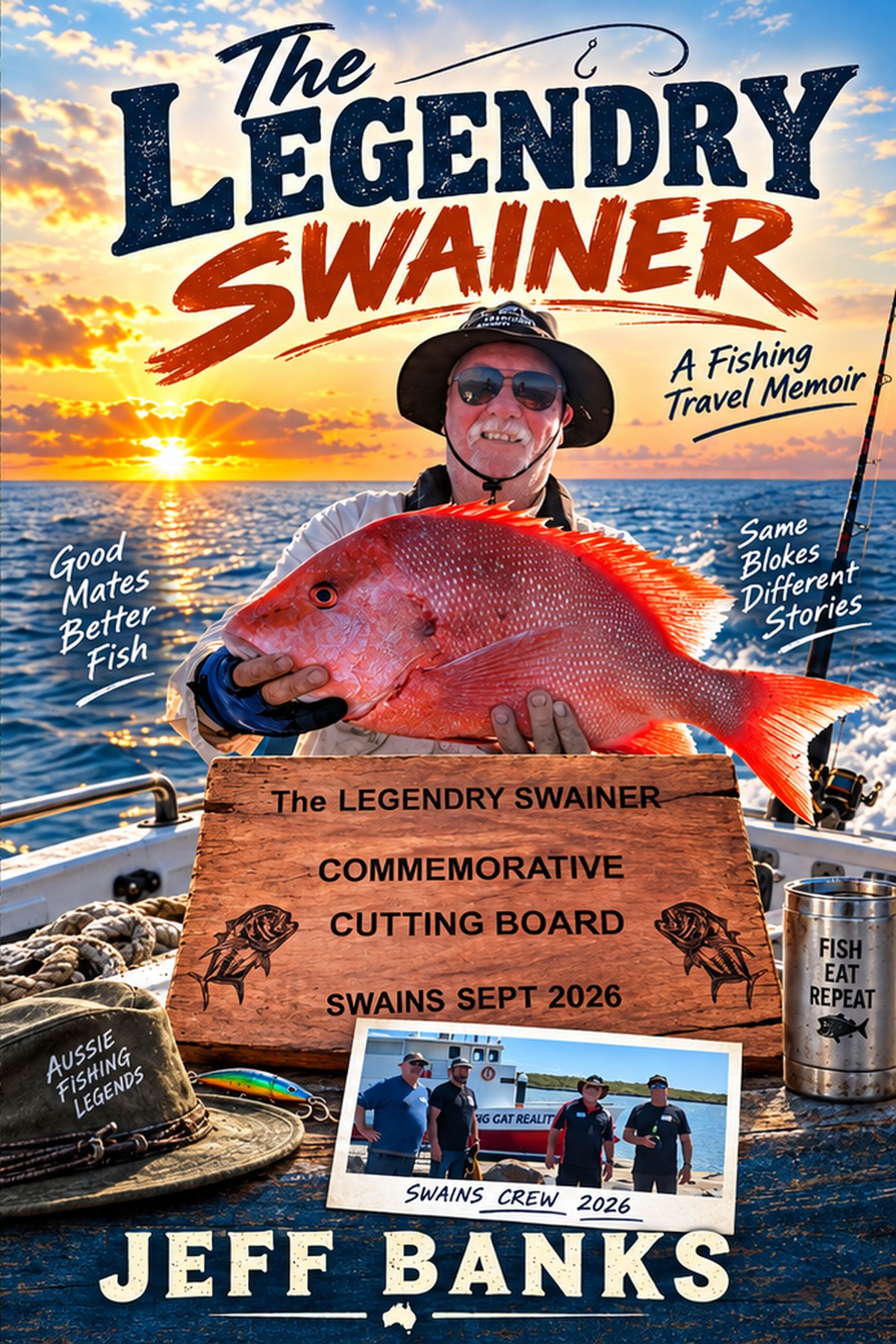
THE LEGENDRY SWAINER - Chapter 3 - Preparation in Nine-Tenths of the Madness

THE LEGENDRY SWAINER - Chapter 3 - Preparation in Nine-Tenths of the Madness | Travelling Around Australia with Jeff Banks

The idea of training for fishing sounds ridiculous until you have spent a day doing it properly. From the outside it can look like a man standing still holding a rod, but the boat moves, the gear weighs something, the sinkers keep coming back and the fish have an annoying habit of refusing to consider your age before they pull. I wanted enough stamina to keep going when the others were still going, because there are few stronger fitness incentives than knowing Trevor and Ian will be present if you stop first. Pride may not be recognised by exercise physiologists as an energy system, but among old mates it is capable of remarkable things.

The Legendry Swainer

Four Mates, Seven Days and Far Too Much Confidence

Chapter 3 — Preparation Is Nine-Tenths of the Madness

I had finished packing a month before we were due to leave, which should have placed me in the enviable position of being able to sit back and watch everybody else panic. Instead, it gave me four extra weeks in which to become convinced that something important had been forgotten. I would walk into the Man Cave, look across the piles of carefully assembled gear and feel that faint irritation at the back of the mind that says there is one item missing, even though it refuses to identify itself. The more thoroughly I checked, the more certain I became that whatever I had forgotten was probably the one thing that would become essential somewhere beyond Bundaberg.

This is one of the peculiarities of preparing for a serious fishing trip. Completing the packing does not bring peace; it simply moves the fisherman into the checking phase, followed by the rechecking phase and, if there is sufficient time available, the phase in which perfectly sensible decisions made three weeks earlier are reopened for review. A written list provides only temporary comfort because it is entirely possible to forget to write down the thing you have forgotten. By the end, you are no longer checking the gear so much as interrogating your own memory.

There are more than forty rods in my Man Cave, and I appreciate that this number can trouble people who do not fish. To them, a rod is a rod, and therefore forty rods suggest either a serious weakness for retail therapy or the possibility that I am quietly preparing to open a tackle shop from home. Fishermen understand that the question is not how many rods you own but what each one is required to do. Once species, line class, lure weight, depth, casting, trolling, bait fishing, reef fishing and the possibility of taking people with you have been properly considered, forty begins to look less like excess and more like a responsible response to complexity.

My own position is strengthened by the fact that I rarely prepare solely for myself. Over the years I have taken family and friends who arrive with great enthusiasm, a hat if I am lucky and an expectation that somewhere in the vehicle there will be a complete fishing outfit with their name temporarily attached to it. That means I have long operated on the principle that one fisherman requires enough equipment for three, because the other two often discover their requirements at the boat ramp. When redundancy is then added to that equation, duplication stops being indulgence and becomes logistics.

Only four rods were going to Swains, however, and their selection had been approached with a seriousness normally associated with representative teams. They lay across the pool table in the Man Cave with their accompanying reels, separated from the general clutter and waiting to be loaded into the Cruiser on the night before departure. I had looked at the other rods, considered sentimental favourites and reviewed the claims of outfits that had performed well elsewhere, but Swains did not offer positions for past service. These four had to survive a week of heavy work, salt, boats, deep water and fish that might be quite capable of explaining any weakness in the equipment more efficiently than I could.

Each rod and reel was therefore serviced and prepared as though it was about to enter a seven-day mechanical examination. Drags were checked, line was inspected, connections were reviewed and anything that looked even slightly suspect was replaced before it could become evidence in a later prosecution by Trevor or Ian. A mechanical failure at sea is disappointing in its own right, but a mechanical failure witnessed by close mates comes with a second penalty because the incident can be preserved and replayed long after the damaged part has been replaced. I had no intention of providing them with material that could have been removed with ten minutes of maintenance at home.

Unlike Trevor and Ian, I had not found it necessary to seek something greater than what I already owned. This distinction was important to me because it allowed me to observe their upgrading with the detached superiority of a man who had already spent his money years earlier. I did, admittedly, replace my stocks of heavy-duty hooks and swivels, but those were consumables and therefore belonged in an entirely different accounting category. A new reel is an acquisition; a box of new hooks is simply the cost of doing business, and I was prepared to defend that position for as long as nobody asked to inspect the total value of the receipt.

The hook replacement was completely justified anyway. There seemed little point in travelling all the way to Swains, finally connecting with the fish we had spent months imagining and then discovering that the weakest part of the system was a hook that had been rusting gently in a tackle box since a previous government. Heavy-duty swivels received the same treatment because anything expected to sit between me and a trophy fish was entitled to a clean start. The old ones had performed adequately, but past performance does not guarantee future results, which is a principle I am happy to apply to tackle whenever it assists a purchase.

The lures were already sufficient, which is a dangerous thing for a fisherman to admit because the word “sufficient” can disappear the moment he enters a tackle shop. Rather than buying more, I went through what I had and replaced trebles where necessary, making certain that the lures most likely to be used were ready for the sort of strike we had all been dreaming about. Every shiny new hook was another small statement of intent, and every one also removed a future excuse if the fish of the week came unstuck. If I lost something important, I wanted the failure to be impressive rather than attributable to laziness in the Man Cave.

Then there was the popper. I had owned the ridiculous thing since my first Kanimbla trip, and although it had occasionally seen the water, it had never encountered anything that could reasonably be described as pelagic prey. It was large enough to make some of the whiting I normally caught look like bait and heavy enough that throwing it all day would probably require the fitness program I had supposedly begun for other reasons. For years it had occupied tackle-box space while waiting for an opportunity grand enough to justify its purchase, and Swains finally looked capable of providing one.

I liked the idea of that old popper having a purpose after all those years. Somewhere on the reef there might be a giant trevally arrogant enough to see this absurd lump smashing across the surface and decide that the only reasonable response was violence. If that happened, every previous occasion on which the lure had achieved nothing would be reclassified as preparation. If it failed again, I could always continue carrying it until another future expedition allowed the argument to be reopened.

This is how fishing tackle survives rational examination. The item that has never caught anything is not useless; it is unfulfilled, and those are very different things when you are trying to justify why it still occupies premium space in a bag. Fishermen are also masters of prospective necessity, which is the belief that one day a combination of weather, tide, species and opportunity will arise in which the strange thing purchased years ago becomes absolutely indispensable. The fact that this day may never come is not evidence against the purchase because the whole point of preparation is to be ready if it does.

Outsiders struggle even more with duplication. They see two rods of similar length and assume one must be unnecessary, whereas the fisherman immediately sees a primary outfit, a backup outfit and perhaps the beginning of a third outfit in case someone else turns up unprepared. The same logic applies to reels, leader, hooks, swivels, line and almost anything else capable of being broken, lost, cut off or handed to a family member who did not think to bring it. Redundancy through duplication is therefore not excess; it is a highly developed system designed to ensure that other people’s lack of preparation does not interfere with my fishing.

The range of fishing we undertake makes the argument even stronger. Hundred-pound line would be comic overkill in a place where whiting the size of my largest popper are the intended target, yet the same line can suddenly look rather delicate when a reef fish is determined to find coral before you find the boat. A fisherman who chases whiting one weekend, cod the next month and offshore reef fish later in the year will accumulate equipment in much the same way a tradesman accumulates tools. The fact that the tradesman’s tools usually earn him money while ours pursue a supposedly free dinner is a detail best left out of the comparison.

The free-dinner argument should never be subjected to formal accounting. Once boats, fuel, tackle, servicing, accommodation, bait, ice, replacement hooks, special trips and the occasional purchase made because a mate knows a bloke at BCF are included, the fish would need to arrive home wearing jewellery to make the exercise economically convincing. Fortunately, fishing has never depended upon economic logic for its survival. If dinner were genuinely the objective, the seafood shop would be faster, cheaper and considerably less likely to require a hundred-pound leader.

Trevor and Ian, meanwhile, were discussing upgrades. This was impressive because between them they already possessed virtually everything associated with the sort of fishing we were about to do, but apparently “everything” is not a fixed quantity in the tackle world. A reel that had been perfectly satisfactory on the previous trip could become strangely inadequate once a newer model was discussed, particularly if the other bloke had shown interest in buying it. The approach of Swains had created a technological arms race in which neither man was willing to admit there was a race.

Their tackle lived largely at Ian’s place near Forster, so a dedicated weekend was required to inspect and select what would accompany them. They would be travelling through later and could have picked the gear up on the way, but that would have denied them the opportunity to examine it in advance, debate the merits of various combinations and reconsider purchases while there was still time to make them. Preparation at this level cannot be rushed simply because the equipment is already owned. It must first be rediscovered, discussed and promoted back into active service.

That weekend also produced one of the better pre-trip statistics, although it had nothing to do with fish. Ian won seven meat trays, which is the sort of raffle performance that would normally attract an inquiry if there were anything worth investigating beyond astonishing luck. Trevor managed to add another two, so the pair were able to live very well while deciding which rods and reels were essential for surviving seven days surrounded by multitudes of meat and what was in the $50 vege tray. There was something wonderfully appropriate about two fishermen preparing to fill eskies with reef fish while eating their way through nine meat trays won without either of them having to cast at anything.

The seven trays became Legendry almost immediately because that is what happens when ordinary events fall into the hands of people preparing for a fishing trip. By the time Swains arrived, the meat haul had already acquired the status of a story, and Ian’s role in it was beginning to resemble a demonstration of competitive excellence rather than an unusually successful raffle. Trevor’s two trays were not enough to challenge the title but were sufficient to ensure he had participated in the glory. Even before the boat left Bundaberg, we were finding things to keep score about.

Trevor possessed another advantage that demanded constant vigilance because he had a mate who owned a BCF franchise. A fisherman with a mate in the tackle trade is in roughly the same position as a bloke with a mate who owns a pub, except that the pub generally sends you home carrying less than the tackle shop does. The dangerous phrase is “mate’s price”, because once a discount is attached to an expensive reel the purchase is no longer regarded as spending. The fisherman concentrates entirely on what he saved and can eventually convince himself that failing to buy the reel would have amounted to a financial loss.

This also introduced another form of one-upmanship. It was not enough for Trevor to have a new reel; there was the possibility that he might have the new reel at a price unavailable to the rest of civilisation, supplied through a relationship that gave the purchase its own little story. Ian could hardly be expected to stand by and allow such a development to pass without examining his own equipment, and I was certainly not above asking detailed questions while pretending to have no interest in upgrading anything myself. Mateship is generous in many ways, but fishing tackle creates temporary exceptions.

The electric reels provided the best evidence of how quickly principles can be revised when ownership changes. I had bought mine for one of Steve’s charters and was effectively berated for it, with Trevor and Ian treating the purchase as confirmation that I had entered a new geriatric phase of fishing. There was considerable discussion about electricity doing the work, old blokes avoiding effort and the possibility that I had taken the first step towards requiring assistance to get from the car park to the boat. I defended myself by pointing out that deep-water fishing with heavy sinkers could be draining over a long charter day, but logic had very little chance while the other two were enjoying themselves.

The next charter produced a remarkable development in fisheries science. Trevor had an electric reel, Ian had an electric reel and both had managed to purchase versions more expensive than mine, which apparently transformed the technology from a symbol of decline into an advanced tool for efficient deep-water fishing. The same arguments I had used about heavy sinkers, repetitive retrievals and conserving energy now returned to me as though newly discovered by independent research. I did not need to argue because having both of them standing there with electric reels was a far more satisfying answer than anything I could have said.

I still maintain that the electric reel makes perfect sense for what we intended to do. In deep water the work is not confined to fighting fish, because every unsuccessful drop still requires a heavy sinker, bait and line to be hauled back from somewhere a long way below the boat. Do that repeatedly across a long day and the energy disappears even before something substantial finally takes the bait. If an electric motor preserves enough strength to keep fishing properly into the afternoon, I am prepared to endure whatever accusations of geriatricity are still available, particularly now that my two principal accusers own more expensive versions of the same apparatus.

Steve, of course, occupied a completely different category when it came to fishing gear because he did not merely have a mate with access to a tackle shop. He owned a fishing charter boat, which is roughly the next stage in the evolutionary process after having a mate who owns a pub or a BCF franchise. A charter operator cannot sensibly rely upon twelve customers arriving with the right rods, reels, terminal tackle and enough understanding to match all of it together, so Steve had accumulated the equipment required to protect a boatload of people from their own optimism. If somebody arrived with nothing more useful than a hat and a packed lunch, Steve could still put a rod in his hands and make him look temporarily prepared.

This meant his available tackle was not measured in the same way as ours. Trevor and Ian could argue about whether another reel was required, while Steve could reasonably point to racks of outfits and explain that most of them existed because somebody, somewhere, would eventually turn up for a charter having misunderstood what “bring your own gear” meant. He needed equipment for different depths, different fish, different methods and different levels of customer enthusiasm, along with enough redundancy to survive breakages, tangles, dropped rods and the occasional guest who could destroy something simply by looking at it with sufficient concentration. When you are responsible for perhaps a dozen unprepared fishermen at once, duplication stops requiring explanation and begins looking like occupational health and safety.

That should theoretically have made Steve immune to the sort of pre-Swains purchasing disease affecting the rest of us. He already had an entire charter business from which to choose, and if there was an outfit suitable for the trip there was every chance he owned several versions of it before we had even thought about going. The problem was that owning a charter boat does not necessarily cure a fisherman of wanting new tackle; it merely provides him with a far more sophisticated argument for why the purchase might be required. Where Trevor had a mate’s price and I had risk management, Steve had the most dangerous phrase available to any businessman who also enjoys fishing: tax deductible.

That expression opens a rabbit hole so deep even a giant trevally might struggle to reach the bottom. A new reel is one thing when bought for personal recreation, but once a man owns a charter operation there is always the possibility that the same reel could be used professionally, demonstrated to clients, kept as backup equipment or somehow contribute to the income-producing activities of the boat. At that point the purchase begins shedding its recreational appearance and taking on the dignified language of business equipment, which is a transformation I could appreciate professionally even while reserving the right to sledge Steve mercilessly for attempting it.

Naturally, tax deductibility does not make something free, a point I have spent a substantial portion of my working life explaining to people who become strangely excited whenever an accountant mentions a deduction. Spending a dollar to save a fraction of a dollar in tax remains spending a dollar, but this simple arithmetic becomes much less persuasive when the object under discussion is a very nice fishing reel. Once the reel can be described as potentially useful to the charter business, the argument stops being about whether Steve wanted another toy and moves into the much more respectable territory of asset acquisition.

I was therefore prepared to grant Steve a little latitude because his position genuinely was different. He needed enough gear to accommodate people who arrived unprepared, enough backup gear to deal with the damage those same people might create, and enough variety to adapt when the fishing changed during the day. What I was not prepared to grant was unlimited immunity, because the moment he began explaining that some particularly attractive new piece of tackle was really “for the business”, the accountant in me was entitled to examine the evidence while the fisherman in me quietly wondered whether I should buy one too.

There was also a philosophical difficulty in having Steve choose from his charter collection for Swains. If he simply selected proven gear from the boat, he could claim professional discipline and years of practical testing, which gave him an irritatingly sensible advantage over three men still capable of becoming emotionally attached to a lure because of what it might someday catch. On the other hand, if he disappeared down the same tackle-shop rabbit hole as the rest of us, we could welcome him properly into the madness and ask whether the newest acquisition was genuinely required for charter operations or merely another item whose deductibility had made resistance unnecessarily difficult.

That left Steve in perhaps the strongest preparation position of all four of us. He had experience, choice, redundancy on an industrial scale and a legitimate commercial reason for owning far more tackle than any private fisherman could defend without eventually changing the subject. Yet beneath all those respectable explanations remained the same basic weakness afflicting the rest of us: show a fisherman a slightly better version of something he already owns and there is always a chance he will begin constructing the case before he has even checked the price.

Then there was the taxman. At Swains, getting a good fish to bite is only one part of the transaction because sharks are perfectly willing to impose their own assessment before the catch reaches the surface. There are few things more dispiriting than feeling a solid fish coming up from depth, only for the pressure to change dramatically as something much larger decides to collect the revenue. What arrives at the boat can sometimes be less a trophy fish than a demonstration of how quickly ownership rights are renegotiated in the ocean.

Speed therefore matters, which gave the electric reels another respectable argument. The faster a good fish can be moved through dangerous water, the less time the taxman has to notice that lunch is passing overhead. Whether this actually saved enough fish to justify all the equipment was something Swains would eventually tell us, but in preparation every theory still enjoys perfect conditions. Nothing has failed yet when you are standing in the Man Cave.

There was also a less comic truth behind my enthusiasm for conserving energy. I was finding the longer charter days harder than they once were, particularly when heavy gear and repeated deep drops turned the afternoon into an argument between determination and whatever reserves remained in the body. That was one reason I had put myself on a fitness regime before the trip, because seven days on the water would expose any weakness more effectively than a single local charter. I did not need to become an athlete; I merely wanted to remain functional long enough to avoid becoming the oldest piece of equipment requiring assistance.

The idea of training for fishing sounds ridiculous until you have spent a day doing it properly. From the outside it can look like a man standing still holding a rod, but the boat moves, the gear weighs something, the sinkers keep coming back and the fish have an annoying habit of refusing to consider your age before they pull. I wanted enough stamina to keep going when the others were still going, because there are few stronger fitness incentives than knowing Trevor and Ian will be present if you stop first. Pride may not be recognised by exercise physiologists as an energy system, but among old mates it is capable of remarkable things.

All of this would already have made preparation entertaining enough, but somewhere during the tackle discussions we decided the trip required trophies. One trophy might have provided a harmless bit of interest, yet we somehow arrived at two, which was the moment a fishing holiday began developing the administrative structure of organised sport. The trophies would have little monetary value, but that was irrelevant because their true value lay in the right to possess them in front of the other three. Bragging rights do not depreciate like normal assets; if properly maintained, they can increase in value every time the story is retold.

The first competition was easy to devise because it addressed a shared hole in the records of the core three. Trevor, Ian and I had all been to Swains before, but those trips had concentrated mainly on filling eskies with quality table fish such as coral trout, mackrell and red throat emperor. When that sort of food is available, giant trevally tend to take a back seat because catching something enormous only to release it can seem unnecessarily energetic when dinner is swimming nearby. As a result, none of us had properly set out to chase, hook and land a serious GT.

The GT Challenge Trophy

The GT Challenge would fix that omission in one concentrated day of madness. One day of the trip would be set aside exclusively for chasing giant trevally, with the normal obsession over table fish suspended while we threw large lures at fish capable of turning expensive tackle into a brief anecdote. The winner would be the angler who landed the biggest GT, determined by length and weight, and we hoped the result would be clear enough to avoid outside adjudication. Given the personalities involved, that hope was already optimistic.

I had taken responsibility for producing the GT Trophy at the Men’s Shed. My plan was a plaque shaped like a giant trevally, with suitable wording that would recognise the winner while also ensuring the losing three received an appropriate reminder whenever they saw it. I hoped to have it finished before departure, although the fact that the physical trophy was not yet complete did nothing to reduce the seriousness with which we discussed winning it. We were effectively competing for a piece of timber still partly in my head, which tells you most of what you need to know about the state of preparations.

The attraction of the GT Challenge was its simplicity. There would be no accumulated points, no species tables and no debate about whether one fish was more desirable than another because the entire competition rested on one question: who caught the biggest GT? Length and weight would settle it, and if those measures somehow produced an apparent tie we would presumably call upon common sense. The only concern was that common sense had already been given very little administrative responsibility elsewhere in the trip.

The second trophy was more difficult because we wanted it to reward performance across the week. Simply declaring the best fish the winner sounded easy until we considered what “best” meant, and then the whole idea began to resemble the sort of subjective judging that would keep us arguing halfway home. A large coral trout, a great red throat emperor and some unusual trophy fish could each produce persuasive cases, depending largely upon which one had been caught by the person making the argument. This required an analytical solution, and unfortunately for everybody else an accountant was available.

The Legendry Swainer

My proposal was to turn the daily catch into numbers. The basic system gave a fisherman five points for every legal-sized target species fish landed during the day, with a further one point per kilogram for the largest fish of each target species he caught. Quantity would therefore matter, but quality still had a role, and the system would reward the bloke who consistently put useful fish into the boat rather than the one who caught a single standout and spent the remainder of the week telling us about it. I thought it was elegant, which naturally meant Trevor thought it deserved immediate ridicule.

The spreadsheet became the symbol of the whole exercise. Trevor treated the idea of applying accounting to recreational fishing as though I had personally removed the joy from the sport, while at the same time paying very close attention to how the points would work. The Dumbing It Down joker in me could appreciate the contradiction because ridicule is often simply the preliminary stage before somebody asks for a copy of the rules. By the end of the discussion, Trevor had agreed to the structure and was already sufficiently invested to start examining its weaknesses.

That led to the target-species law. If every legal fish counted, somebody could theoretically spend an evening catching a procession of minor species, building a magnificent score from fish that nobody particularly wanted to put in the esky. The fact that all of us immediately recognised this as a realistic risk showed how well we knew one another. We therefore limited the five-point rule to nominated target species, protecting the integrity of a competition whose integrity had become important astonishingly quickly.

The rule also acknowledged the real purpose of most of our Swains fishing. Coral trout, red throat emperor and the other recognised table fish were what we had traditionally travelled there to bring home, so it made sense that they should carry the scoring system rather than every legal creature unfortunate enough to take a bait. This was presented as sensible fisheries logic, although it also prevented strategic point farming by anyone whose competitive instincts overcame his culinary standards. We were designing anti-cheating provisions before anybody had caught a fish.

Then squid complicated the legislation. Squid could not be dismissed as meaningless bait fish because they were perfectly respectable on the table, yet they also had the useful ability to be cut up and returned to the water attached to a hook. That gave them a dual role no ordinary target species could claim, moving from potential dinner to fishing equipment within minutes if circumstances required. Their status needed special consideration because a good squid was simultaneously something to eat, something to score and something that might later help catch the fish that scored even more.

The trophy itself became The Legendry Swainer, a name grand enough to disguise the fact that the underlying mechanism was a spreadsheet. Winning a weekly points competition sounds administrative, but becoming the Legendry Swainer sounds like an achievement that should be announced by trumpets and recorded somewhere on a wall. The title immediately gave the whole system more importance than it deserved, which was exactly what we needed. A meaningless contest only becomes truly satisfying once everybody agrees to behave as though history is watching.

The Legendry Swainer also ensured that every qualifying fish would carry consequences. A coral trout was no longer merely a coral trout; it was five points, perhaps a weight bonus and possibly the difference between quiet satisfaction and having Trevor explain the standings over dinner. A lost fish could now damage more than pride, while a shark taking one near the boat might create a completely new category of grievance. The spreadsheet had converted ordinary fishing misfortune into competitive injury.

This was where the gamesmanship began to develop properly. Every tackle discussion could now contain an element of intelligence gathering, because asking what lure somebody intended to use might be friendly conversation or an attempt to determine whether you needed to buy one before departure. Trevor’s BCF connection became strategically interesting, Ian’s collection at Forster became an armoury and my ancient oversized popper was promoted from tackle-box curiosity to potential GT-winning secret weapon. Steve’s professional experience sat over all of it like an inconvenient fact we would need to deal with if he started winning.

Steve had fallen into the competitions with remarkably little resistance. He might originally have joined the Swains trip almost on a whim after listening to us talk about it on his boat, but by the time trophies and rules were being discussed he was no longer simply the charter operator dragged along for the ride. He followed suit quickly enough to suggest that our madness had not corrupted him so much as given an existing competitive tendency somewhere useful to live. That was good news socially and potentially terrible news for the rest of us.

His professional status created a particular problem for future sledging. If one of the core three won, the result could obviously be presented as proof of superior preparation, skill and mental strength, but if Steve won there was an irritatingly logical explanation involving the fact that he actually made a living taking people fishing. We would therefore need to be careful not to allow professional expertise to become an unfair advantage in a competition partly created by amateurs. I felt certain that, if required, we could develop suitable arguments about privileged knowledge, occupational familiarity and the need for handicapping.

The early psychological warfare was subtle because none of us wanted to admit it had begun. A new reel could be displayed casually, a lure recommendation could be dropped into conversation and somebody could mention a technique with the apparent generosity of sharing information while watching carefully to see whether the others already knew it. Nobody was hiding anything, of course, but neither was anybody volunteering quite enough to remove all suspicion. The trip remained weeks away and we were already trying to work out whether our mates had secret weapons.

My own preparation continued in that atmosphere. Bags were packed, opened, rearranged and packed again because an item placed perfectly three weeks earlier could suddenly appear to belong somewhere else once I imagined needing it quickly on the boat. Spare leaders were added, followed by spare hooks, spare swivels, spare line and the various backups required to support the principle that no single failure should be allowed to end a method of fishing. Eventually the distinction between sensible redundancy and preparing for the collapse of civilisation became difficult to identify.

At least the transport arrangements gave the Cruiser some chance of survival. Only Steve and I would be making the full road trip in it, which meant we did not have to accommodate the combined tackle collections, clothing and personal requirements of all four men inside one vehicle. Trevor was making his own way to Bundaberg in his own vehicle and would take Ian’s gear with him, while Ian had adopted the most civilised approach of all and was simply flying in. This arrangement reduced the packing problem considerably, although “reduced” is a relative term when two fishermen are involved and one of them owns enough charter equipment to outfit a small expedition.

Steve’s presence meant the Cruiser still had every opportunity to become heavily loaded. My carefully packed gear looked quite reasonable when sitting alone in the Man Cave, but once it was placed beside the belongings of a man who could legitimately justify enough fishing equipment to cater for a dozen unprepared charter guests, perspective began to shift. The vehicle did not need to resemble a mobile branch of BCF, but there remained every possibility that by the time we finished loading it, a casual observer might assume we were heading north to open one.

Trevor, meanwhile, had the separate responsibility of transporting Ian’s gear, which seemed appropriate given that so much of it had already been inspected, discussed and selected during their Forster weekend. Ian would therefore arrive in Bundaberg by air with the serene efficiency available only to a man whose fishing tackle was travelling hundreds of kilometres by road without him, leaving Trevor to discover just how elastic Ian’s definition of “only the necessary gear” might become once it was actually loaded. There was a certain elegance to the arrangement from Ian’s point of view, although it did raise one unresolved question in the weeks before departure: if he somehow managed to repeat the Legendry seven-meat-tray performance before we left, would any of us actually agree to pick him up from the airport if he arrived with another refrigerated mountain of raffle winnings? I suspected there would be limits to friendship somewhere between collecting a mate and discovering he also expected transport for half a butcher’s shop, particularly when the original seven trays had already become sufficient grounds for irritation. The greater danger was that Ian, knowing exactly how much the story annoyed us, might regard another seven-tray event not as a logistical problem at all but as an opportunity to arrive in Bundaberg grinning like a man who had just won a second trophy before the fishing had even started.

For Steve and me, space would still impose limits that common sense had failed to achieve. Every item loaded into the Cruiser had to justify the room it occupied, although fishermen are remarkably gifted at constructing justifications once the alternative is leaving something behind. A spare reel might never be touched, an extra lure box might remain unopened and half the backup gear could complete the entire trip without earning its passage, but the possibility of needing any one of those things was enough to keep it in contention. The real danger was not taking too much; it was arriving at Swains and discovering that the one thing left in the Man Cave was precisely the thing required.

Through all of this, my four selected rods remained stretched across the pool table waiting for the final night. I checked them every time I went into the Man Cave, partly because I liked looking at them and partly because their presence reassured me that the core of my preparation was complete. Four rods, four reels, serviced and ready, represented certainty in a process that otherwise kept generating new questions. Then I would turn away and the nagging feeling would return that somewhere among everything else was the missing thing I had not yet remembered.

That feeling is probably responsible for a significant percentage of tackle-shop turnover. A fisherman who knows exactly what he needs is relatively safe, but a fisherman who merely suspects he may need something can wander aisles for a long time and discover several solutions to problems he had not possessed when he walked in. I resisted reasonably well, although “reasonably” is a flexible term when judged against a Man Cave already holding more than forty rods. The important point was that I did not need another major piece of equipment, which left me free to criticise anybody who did.

By the final stages of preparation, we had everything that could sensibly be controlled. The rods were serviced, reels ready, hooks new, swivels replaced, trebles upgraded, lures selected, electric reels charged and backups accumulated to a level that should have satisfied even the most pessimistic interpretation of Murphy’s Law. Trevor and Ian had conducted their own equipment review, enjoyed the benefits of nine meat trays and explored the opportunities made possible by BCF connections. Steve had professional knowledge, and I had an oversized popper with a very long record of not catching GTs.

The only uncontrolled element was the fish. We could select the tackle, debate the methods, train our bodies, produce trophies and devise scoring systems, but somewhere beneath the water the intended participants remained completely unaware that their cooperation was required. They could ignore the expensive lure, eat the bloke’s bait beside us, find the reef before we stopped them or allow a shark to settle the matter on their behalf. Preparation can reduce many uncertainties, but fishing retains enough of them to keep tackle shops profitable and fishermen humble, at least temporarily.

The trophies made that uncertainty more exciting because we had added consequences to it. We were no longer simply wondering whether we would catch fish at Swains; we were wondering who would catch the biggest GT, who would accumulate the most Legendry Swainer points and who would be left explaining why the outcome failed to reflect his actual ability. The tangible trophies might eventually sit on a shelf, but the real prize was the right to bring the result up whenever the losing men became too pleased with themselves. That sort of reward can remain valuable for years.

Somewhere at Swains there was a giant trevally with no knowledge of the wooden plaque I hoped to finish at the Men’s Shed. It knew nothing about Trevor’s mate at BCF, Ian’s Forster arsenal, Steve’s professional experience or the ancient popper whose entire career I had suddenly reframed as preparation for this moment. The coral trout and red throat emperor were equally ignorant of the spreadsheet that would convert them into points once brought aboard. The fish had no idea what we had organised on their behalf, which was probably just as well.

By the time departure approached, we had managed to turn a seven-day fishing trip into something far more elaborate. There had been expenditure, equipment reviews, fitness preparation, secret weapons, raffle glory, rules, eligibility provisions, trophy construction, scoring formulas and enough competitive suspicion to keep four intelligence agencies busy. Nobody had yet caught a single fish, but the games had already begun. Preparation may be nine-tenths of success in some fields, but in ours it had become nine-tenths of the madness.

Author

Menu