

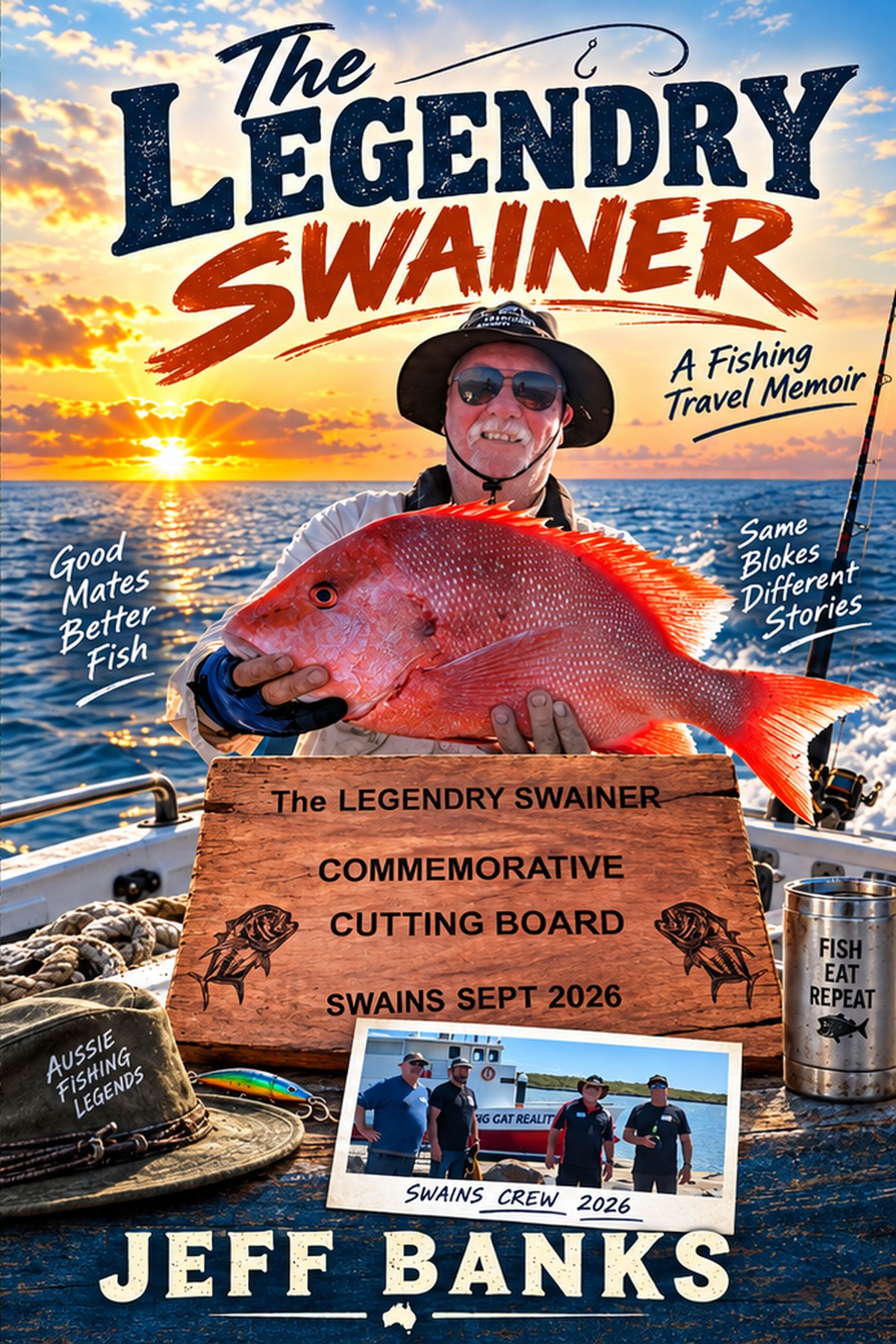
THE LEGENDRY SWAINER - Chapter 2 - And Then There Was Steve

THE LEGENDRY SWAINER - Chapter 2 - And Then There Was Steve | Travelling Around Australia with Jeff Banks

There is something slightly fascinating about bringing a new person into an established friendship group. Trevor, Ian and I already have years of history beneath conversations that make perfectly good sense to us but may require explanatory notes for anybody else. Names appear without introductions, old incidents are revived without warning and accusations can refer to events that happened so long ago nobody can now establish whether the original offence occurred anything like the way it is remembered.

The Legendry Swainer

Four Mates, Seven Days and Far Too Much Confidence

Chapter 2 — And Then There Was Steve

There are probably safer ways of making friends than taking three fishermen out in your boat and repeatedly putting them onto fish. There are certainly safer ways than listening to those same three fishermen discussing another fishing trip, showing interest in it and then allowing the conversation to reach the point where somebody says, in effect, “You should come.” Steve managed to do all of those things, which suggests that professional knowledge of the ocean does not necessarily extend to recognising danger when it is sitting behind you discussing Swains Reef.

We had not gone looking for Steve as a fourth member of anything. In fact, we had not really gone looking for Steve at all, because in the earliest version of the expedition the fourth man was supposed to be Dodger, which, with the benefit of hindsight, should probably have been regarded as a provisional booking rather than a confirmed passenger.

Dodger had already earned his place in the story long before Swains came up. He had arranged us fishing, provided us with plenty of fish and considerably more entertainment, although not always for reasons directly connected with anything swimming beneath the boat. He was also a previous Kanimbla adventurer, so he had already demonstrated a willingness to disappear with this general collection of lunatics on the sort of expedition that seems like a magnificent idea while being discussed and becomes progressively more questionable as departure approaches.

The problem was that Dodger was also Dodger, and Dodger has always possessed a small streak of what Australians politely describe as being a bit of a “gunna”. He was gunna do this, gunna organise that, gunna come along, gunna sort something out and, in fairness, quite often eventually did exactly what he had said he was gunna do. The difficulty lay in establishing whether any particular “gunna” had reached the advanced stage where the rest of us should begin treating it as an event rather than an expression of general goodwill towards the future.

So when the Swains trip began taking shape, Dodger was going to be there. That was understood, at least in the broad philosophical sense in which many things involving Dodger are understood, and for a while the core group consisted of Trevor, Ian, me and the theoretical presence of our fourth fisherman. Somewhere between the proposition and the practicalities, however, Dodger discovered that life contained other commitments, and those commitments eventually took precedence.

I should be fair to him here, although there is no particular reason the others will be. His reasons were perfectly sound, entirely defensible and probably the sort of responsible decisions mature adults are expected to make when balancing fishing against the other demands of life. Unfortunately, none of that provides immunity from sledging, particularly when the alternative explanation is much more entertaining and can be reduced simply to, “Dodger was gunna come.”

That version has the enormous advantage of fitting comfortably into a single accusation. We do not need to explore competing obligations, timing, family considerations, work or any other facts that might interfere with a perfectly good prosecution when the essential evidence is that his name had once been attached to the trip and his backside would not ultimately be attached to a seat on Big Cat Reality. In the court of fishing mates, that is usually sufficient for conviction.

His previous Kanimbla experience only makes the case worse. He had already been away with us before, so unlike some innocent outsider he could not claim ignorance of the likely consequences. Dodger knew the personalities involved, knew how quickly minor events could become lifetime references and knew that withdrawing from a future adventure would provide material capable of surviving longer than some of the fishing gear we were buying for it.

There was also a pleasing irony in Dodger being the man who disappeared from the original plan, because he had also been the bloke who had originally arranged our previous charter fishing. When that charter operator sold his boat and closed down the operation, the arrangement Dodger had put together disappeared with it, thereby creating a vacancy in our fishing lives that Trevor apparently considered required immediate rectification. Trevor is not a man inclined to allow a shortage of available fishing opportunities to correct itself through market forces, particularly when there are boats somewhere that have not yet had us aboard.

That was how Trevor found Steve, although “found” probably understates the degree to which Trevor simply took over. Dodger had traditionally been the one who organised our charter fishing, and I detected from time to time that he was not entirely delighted to discover Trevor had apparently assumed the portfolio without waiting for a resignation letter. The previous charter arrangement had disappeared, there was a fishing problem to be solved and Trevor, never one to allow consultation to delay decisive action, went looking for another boat.

I suspect Dodger regarded this as less succession planning and more a small corporate raid. One minute he had been the bloke who arranged these things, the next Trevor had sourced Steve, organised the fishing and was behaving as though responsibility for marine procurement had always rested naturally with him. Dodger never exactly issued a formal objection, but there were moments when the tone suggested he had noticed that Trevor had moved into his office, rearranged the furniture and started answering the phone.

Trevor, naturally, would have seen no takeover at all. There had been a charter; the charter had ceased to exist; fishermen still required fishing; therefore somebody needed to arrange another charter. The fact that the somebody turned out to be Trevor merely demonstrated, in Trevor’s mind at least, the efficiency of the system.

This gave us the added pleasure of watching Dodger occasionally react to Steve’s boat as though he had been invited to inspect the work of the contractor who had replaced him. He continued to come fishing with us and fitted comfortably into the days, but there could be just enough mock indignation around the edges to remind Trevor that charter organisation had once been Dodger territory. Naturally, the rest of us were far too mature to encourage this perceived slight at every available opportunity.

Dodger nevertheless continued to provide useful entertainment whenever he joined us on Steve’s boat. His thought processes did not necessarily follow the same navigational channels as those used by what might loosely be called a normal fisherman, and Steve appeared to enjoy observing the process rather than attempting to correct it. If there were six perfectly logical ways to approach a fishing problem, Dodger could usually be relied upon to discover a seventh, then explain why the other six had been unnecessarily constrained by conventional thinking.

Steve’s reaction to all of this probably helped him fit in more quickly than anything else. He did not treat Dodger as the eccentric customer who required management; he listened, watched and seemed genuinely interested in where the latest piece of reasoning was going. That was important because with Dodger the destination could be perfectly sensible even when the route there appeared to have been plotted by somebody refusing to use the main roads on principle.

The annoying thing, particularly when we had committed ourselves to sledging him, was that Dodger was rarely inept in the simple sense of not knowing what he was doing. Quite often there was a perfectly reasonable thought buried somewhere inside the process, and occasionally the bastard would even turn out to be right. By then, however, we had usually invested far too much intellectual capital in proving him wrong to permit inconvenient evidence to interfere with the argument.

A sound conclusion has never been allowed to get in the way of a good sledge, and Dodger had provided far too much material over the years to be granted exemptions merely because the facts supported him. If anything, being right after arriving there by a route none of us understood simply made matters worse, because it allowed him to explain the whole thing again with the satisfied air of a man wondering why the rest of us had found something so obvious difficult to grasp.

Meanwhile Trevor had his new charter operator, Dodger had apparently lost his unofficial position as Minister for Fishing Arrangements, and the rest of us had acquired another subject that could be reopened whenever conversation became dangerously civil. Somewhere inside that small transfer of power, Steve entered the wider group, unaware that accepting Trevor’s business had placed him at the centre of a jurisdictional dispute nobody had formally declared.

The eventual irony was even better. Dodger had started as the man who arranged our fishing and was originally gunna be the fourth man at Swains, while Trevor’s apparent takeover of the charter portfolio introduced us to Steve. By the time Dodger’s perfectly sensible reasons removed him from the trip, the bloke Trevor had found to replace one fishing arrangement was quietly moving towards replacing Dodger in another altogether.

We could hardly blame Trevor for that, although there is absolutely no reason ever to tell Dodger so. From his side of the ledger, Trevor had taken over the charters, imported a new skipper and eventually managed to have that skipper occupy the vacant fourth position on the biggest fishing trip we had planned. Viewed selectively enough, it was less organisation than a hostile takeover, and selective viewing is one of the foundations upon which good fishing sledging has always depended.

His withdrawal from Swains therefore deserves to be recorded accurately. Dodger had legitimate reasons for not coming, made what was almost certainly the sensible decision and should be congratulated for properly arranging his priorities. Having now placed that on the record, we can safely ignore it for the remainder of the book and continue referring to him as the bloke who was gunna come to Swains.

That was the vacant chair Steve eventually occupied. He did not know he was auditioning for it when Trevor first dragged Ian and me onto his boat, and I doubt Dodger realised he was creating the opportunity when he withdrew from the expedition. Somewhere between one man responsibly deciding he had other things to do and another man listening a little too enthusiastically to three customers talking about Swains Reef, the fourth position changed hands.

In retrospect, Dodger may have made the cleverer decision. He remained safely at home with his sound reasoning, his previous Kanimbla credentials and the absolute certainty that three of his mates would ridicule him for not coming, while Steve voluntarily stepped forward to discover what a full week trapped with us might actually involve. One man became the target from a comfortable distance; the other was about to place himself directly within casting range.

Trevor, being Trevor, was not going to allow the disappearance of a charter boat to interfere with his fishing programme. Somewhere in the course of his investigations he had found Steve, and before long Ian and I had been dragged along to see whether this replacement could meet the required standard. Trevor’s idea of market research has always been pleasingly straightforward: if somebody owns a boat and claims to know where the fish are, we should probably test the proposition personally.

Steve’s operation was different from the beginning. Unlike our previous charter experience, his boat sat almost in seclusion, away from much of the bustle one might normally associate with arriving for a day’s charter fishing. There was something appealing about it, although I am not sure whether that was because of the location itself or because fishermen are naturally attracted to anything that looks as though somebody else has not already discovered it.

Then there was Steve himself. There was no performance attached to being the skipper, no carefully cultivated impression that we were fortunate to have been granted access to the bridge of HMS Something Important, and certainly no suggestion that his customers should remain silent while the professional went about professional business. Steve talked to you, listened to you and, more importantly for our purposes, gave every indication that he enjoyed the same ridiculous business of fishing that had brought the rest of us aboard.

That mattered because there are charter operators and there are charter operators. Some seem to spend the day reminding you, directly or otherwise, that they are the experts and you are merely the people who have paid to be transported around while demonstrating why they are the experts. Steve never seemed interested in that division, although he had every right to make it because he clearly knew what he was doing.

His most useful quality from our point of view was that he found fish. This may appear to be a fairly obvious requirement for somebody running a fishing charter, but fishermen who have paid for charters will understand why I mention it separately. Steve had an irritating habit, irritating only because it made the rest of us look better than we perhaps deserved, of taking us to places where fish existed in useful numbers and frequently useful sizes.

That creates a particular type of loyalty among fishermen. We can forgive a bloke many things if he regularly puts us over fish, and Steve did not appear to require much forgiving anyway. He was affable, patient and sufficiently relaxed to allow a day on his boat to become something closer to four or five blokes fishing together than customers being managed by a charter operator.

Ron, helped considerably with that atmosphere. He was Steve’s deckhand, a mate of his and, inconveniently for the neat separation of my various worlds, also an occasional golfing partner of mine. This meant there were already enough overlapping relationships aboard to ensure that nobody could establish too much authority without somebody else knowing something potentially damaging about them.

Steve and Ron worked together without turning the operation into a show. Lines became crossed because fishermen cross lines, knots became necessary because fishermen break things, and tangles appeared with the regularity usually reserved for taxes and Trevor offering an opinion. Through all of it Steve seemed to regard these things as part of fishing rather than evidence that the customer should have taken up bowls.

That was particularly useful whenever Dodger came along. Even without being the charter operator anymore, Dodger retained his capacity to reinterpret the accepted principles of fishing, and Steve never appeared to treat that as a defect requiring correction. He would watch, listen and deal with whatever emerged, which I eventually realised was a much more important qualification for travelling with us than simply knowing how to catch fish.

Steve likes to listen. It is one of those characteristics that becomes more noticeable the longer you know somebody because so many people who appear to be listening are actually waiting for the noise in front of them to stop so they can begin talking again. Steve seemed genuinely interested in how people thought, what they struggled with and, when the subject wandered away from fishing, what they did with the rest of their lives.

That was how business began sneaking into the fishing conversations. I have never been particularly good at keeping parts of my life in separate boxes, and a day on a boat offers plenty of time for conversation between bites, moves and the occasional period when everybody agrees the fish have suddenly become much less intelligent than they were half an hour earlier. Steve would ask questions and I would talk about some of the business and marketing ideas I had picked up, particularly through Business Blueprint.

There was a blank page quality about him that I liked. I do not mean that he knew nothing, because that would be both inaccurate and insulting, but rather that he did not appear to regard the way he had always done something as sufficient proof that it must continue to be done that way forever. If I threw an idea at him, he did not immediately begin constructing the reasons it would not work.

For someone like me, that is dangerous encouragement. Give me a person prepared to discuss a business problem and I can happily start moving imaginary pieces around the board while everybody else is still deciding whether there is actually a game being played. Steve would listen, question things and consider possibilities, which made the conversations interesting even when we were supposedly there for the far more serious purpose of trying to catch fish.

His charter business at Forster carries an unavoidable complication because the sea does not read appointment books. Customers may have booked, tackle may have been prepared and Steve may be perfectly willing to work, but the weather retains the final right of veto. A business where the product can be cancelled by wind, swell and common sense creates some fairly obvious difficulties when the household bills continue arriving according to a much more dependable timetable.

Consequently, Steve also works at Bunnings. Every so often I would wander into the store for something I had convinced myself I required and discover him restacking shelves, looking for all the world like a man whose body had reported for employment while his mind remained somewhere offshore. These encounters became another part of the friendship because neither of us seemed particularly committed to making them brief.

Steve could turn the item nearest us into a perfectly legitimate reason for standing there talking. A box of screws, a power tool or some household knick-knack could apparently require several minutes of detailed consideration while we discussed fishing, business or whatever else seemed preferable to his returning to the task for which Bunnings was actually paying him. To anybody watching, it probably appeared that I was receiving unusually comprehensive customer service from a staff member deeply committed to ensuring I understood the full implications of purchasing a packet of cable ties.

I understood the attraction. There is work that absorbs you and work that you do because work needs doing, and Steve’s enthusiasm whenever the conversation turned towards the boat made the distinction fairly obvious. Bunnings was dependable in a way the weather could never be, but nobody was likely to mistake shelf stacking for the reason his eyes lit up when the subject turned towards fishing.

By then Steve had become one of the boys without anybody formally deciding that he had. There had been no application process, no committee meeting and, surprisingly given the participants, no rules drafted to determine eligibility. We simply kept fishing with him and the dividing line between charter operator and customer gradually disappeared.

That was how Swains entered the conversation. Trevor, Ian and I had already been there, which gave us the confidence peculiar to people who have survived something once and therefore assume they possess meaningful expertise. We had been Swainsed before and, like most returning fishermen, our memories had become selectively efficient at retaining the fish and quietly reducing the prominence of everything we had done badly.

The subject began flowering aboard Steve’s boat rather than arriving as a grand proposal. Someone mentioned Swains, someone else added a memory, and before long the three veterans were discussing what another trip might look like. Steve listened because Steve listens, asking enough questions to make it obvious that this was no longer merely a story about something three customers had done years before.

For Steve, there was also a professional angle. He was running a charter fishing business in Forster, so going aboard Big Cat Reality and seeing how another fishing operation worked could, with sufficient accounting dignity applied to the proposition, be regarded as business research. He could observe the operation, see what elements might augment his own charter business and gather ideas from an experience operating on an entirely different scale.

Naturally, this also meant it could potentially be tax deductible. I am an accountant and therefore cannot be expected to watch a perfectly good fishing trip wander past without at least examining whether the taxation system might like to participate. There are moments in professional life when all the years of training suddenly justify themselves.

The argument was not entirely mischievous either. Steve genuinely wanted to see what the Big Cat Reality experience involved and whether there were ideas he could bring back to his own operation. The fact that the research would involve travelling to Swains Reef and fishing for a week was merely one of those fortunate commercial circumstances that occasionally reward the genuinely inquisitive businessman.

That was probably the moment he became vulnerable. A sensible man might have listened to three previous Swains travellers discussing another expedition and recognised that his safest course was to wish them well, perhaps make a few tackle suggestions and then return to the security of his own boat. Steve instead started imagining himself coming with us.

The transition happened so naturally I am not certain any of us could identify the precise moment when “that would be interesting” became “I might do that” and then somehow became “Steve’s coming.” Fishing trips have their own momentum once enough men begin imagining the fish they might catch. Practical obstacles that would stop ordinary decisions become minor administrative matters when a reef several hundred kilometres offshore has entered the conversation.

From our perspective, the addition made perfect sense. Here was a professional fisherman who knew boats, knew tackle, knew fish and had demonstrated repeatedly that he was good company. There was no obvious downside, which should perhaps have warned Steve that we had not yet explained everything.

He knew Trevor and Ian, of course, and he knew me. He had fished with us often enough to understand the sledging, the arguments and the general refusal to allow anybody’s success to pass entirely without examination. What he had not yet experienced was those same characteristics trapped together for the better part of a week with trophies involved.

A day charter provides natural safety barriers. Eventually the boat returns, everybody gets off and the people who have been subjected to Trevor, Ian and me are allowed to go home. A seven-day Swains trip removes that protection and replaces it with communal living, repeated fishing sessions and enough accumulated evidence for every mistake to remain available for later prosecution.

Steve may have been the professional fisherman, but professionally he was entering dangerous territory. He could tell us why a particular technique worked, where a fish might hold and what we should be doing differently, but none of those qualifications would save him if he gave confident advice and then failed to catch anything himself. The three amateurs would immediately become an expert review panel, despite the inconvenient fact that none of us possessed his credentials.

That was one of the things I was looking forward to most. Steve had spent years watching customers do strange things with fishing gear without apparently regarding their mistakes as personal failings, and I wondered how long that generosity would survive when the customers were no longer customers and there was a trophy at stake. Patience is a magnificent quality, but I have always suspected competition provides a more reliable laboratory for measuring it.

Then the teams were decided, adding another layer to something that already had quite enough layers. Steve and I would be paired together against best mates, Trevor and Ian in the teams event, which created a combination I found immediately attractive for several completely objective reasons. Steve was a professional fisherman, I was obviously capable of taking instruction when it suited me, and Trevor and Ian had been mates for long enough to begin blaming one another almost immediately if things went badly.

Trevor and Ian being paired together was also entirely natural. They had fished together everywhere from Swains to barra impoundments and the Darling River, and they possessed that dangerous level of familiarity where each knew exactly how the other operated and exactly which button to press if the operation failed. Steve and I were the new combination, although I preferred to think of us as the emerging strategic alliance rather than two blokes thrown together because the other two had already chosen each other.

For Steve it represented another small change in status. He was no longer the skipper taking three regulars fishing and he was not simply the fourth bloke filling out the numbers on someone else’s trip. He was now my teammate, which meant his successes would become evidence of our combined excellence while any failures would require a more careful allocation of responsibility.

I have no doubt Steve will adapt quickly to that arrangement. His ability to listen will be useful, although he may discover that listening to my explanation of why something has gone wrong is not always the same as receiving information. His professional experience should also prove valuable, particularly once I have had sufficient opportunity to explain to him how we should use it.

There is something slightly fascinating about bringing a new person into an established friendship group. Trevor, Ian and I already have years of history beneath conversations that make perfectly good sense to us but may require explanatory notes for anybody else. Names appear without introductions, old incidents are revived without warning and accusations can refer to events that happened so long ago nobody can now establish whether the original offence occurred anything like the way it is remembered.

Steve has already seen enough of that world to be comfortable around it. He has laughed with us rather than merely at the appropriate places for a customer, survived Dodger’s contribution to several days on the water and joined conversations that had very little to do with whatever charter fee had originally brought us aboard. The difference now is that there will be no wheelhouse authority protecting him from full membership.

I am looking forward to getting to know that Steve, which will start with the drive to Bundaberg. Two days in the Cruiser, filled by seven days at sea, has a way of stripping away the version of ourselves we present during shorter encounters, especially when everybody is tired, somebody else is catching fish and the same three or four faces keep appearing at breakfast. We know Steve the charter operator, Steve behind the wheel and Steve patiently untangling whatever his customers have managed to weave beneath the boat, but a week on Big Cat Reality should introduce us to a few more versions.

I am particularly interested in what happens when the professional becomes merely another fisherman. On his own boat Steve decides where we go, when we move and, within reason, how the day operates, while at Swains he will surrender much of that control and become one more bloke trying to make the most of whatever opportunity is placed in front of him. That might be liberating for him, although being paired with me probably introduces some limitations to the concept.

By now he has heard enough stories about our previous Swains trip to believe he knows what he is joining. Trevor and Ian will have supplied their versions, I will have supplied the accurate version, and somewhere among the three accounts Steve may have assembled something resembling the truth. What none of those stories can properly explain is what happens when the competition starts again and yesterday’s friends discover today’s fish has altered the standings.

That is when Steve will really join the group. Catching fish with us was the introduction, talking business filled in some of the spaces and the conversations in Bunnings confirmed there was a friendship away from the boat, but Swains will remove the last traces of customer and skipper. He is coming aboard as one of four, and worse still for him, as one half of a team expected to defeat Trevor and Ian.

I suspect he thinks his professional experience gives us an advantage. I certainly intend to encourage that belief for as long as it remains useful, because confidence is important in any team and there will be plenty of time later for an independent inquiry if events do not meet expectations. Steve may know fish better than any of us, but he is about to discover that fish are only one of the things he needs to understand.

The three men he is joining have already developed rules that were never written, precedents nobody agreed upon and standards of evidence that change according to who caught the fish. We have old scores, older stories and enough shared history to make almost any current incident vulnerable to something that happened years before. Steve has not merely signed up for seven days on Swains Reef; he has walked voluntarily into the middle of all of that and, unless I have badly misjudged him, will very quickly start contributing some ammunition of his own.

The professional fisherman probably believes he is going to Swains to see how Big Cat Reality operates, learn something for his business and enjoy a week chasing fish beyond his normal waters. All of those things may even happen, which will make the trip entirely defensible from a business perspective and leave his accountant in a state of professional satisfaction. What Steve has not yet discovered is that he has also joined three men who can turn a fishing trip into a competition, a competition into a constitutional crisis and a constitutional crisis into a story that will be retold for years.

That part of the research will not be tax advice. It may, however, prove to be the most educational part of the trip.

Author

Menu