

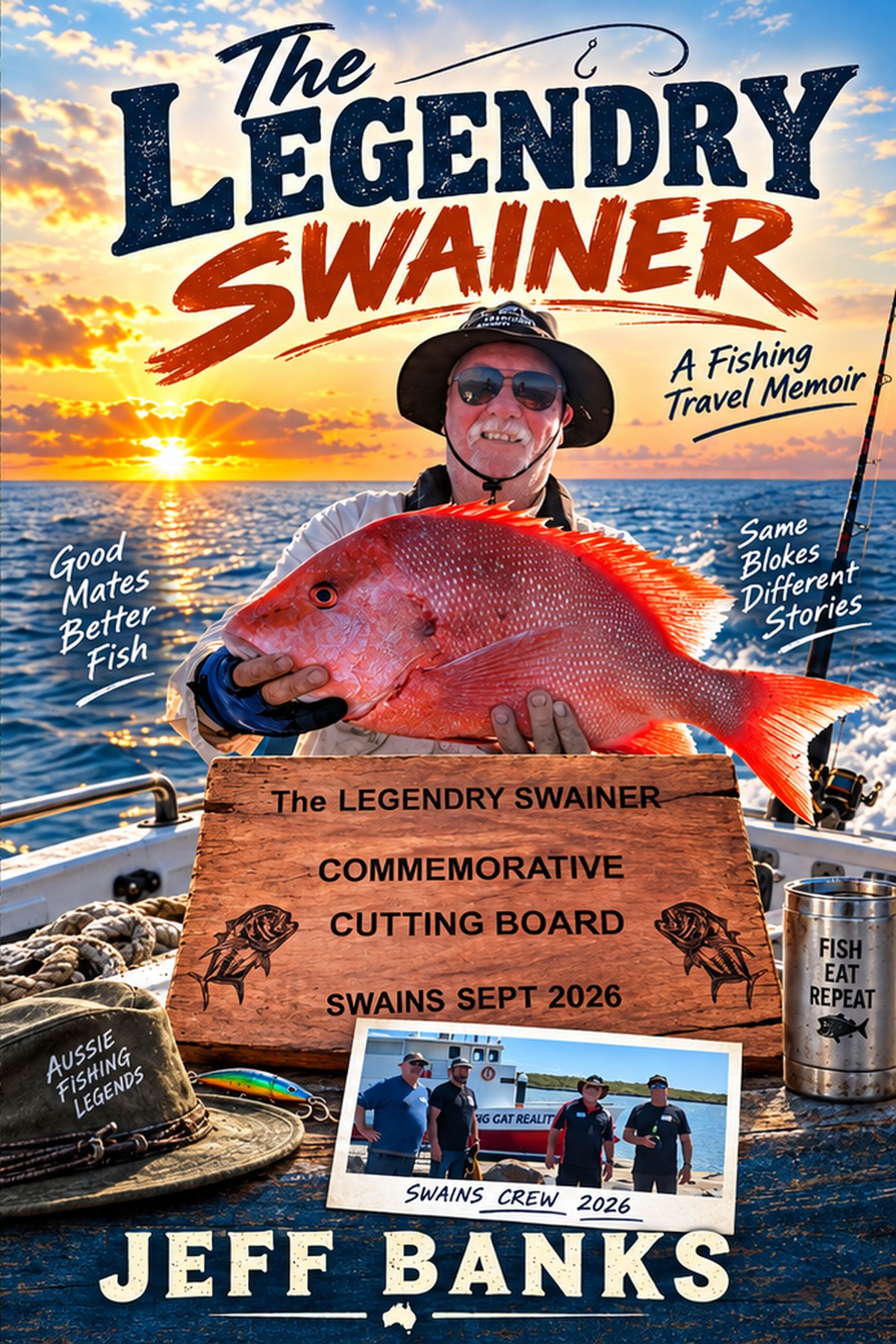
THE LEGENDRY SWAINER - Chapter 14 - Epilogue - So When Are We Going Again

THE LEGENDRY SWAINER - Chapter 14 - Epilogue - So When Are We Going Again | Travelling Around Australia with Jeff Banks

Perhaps that is also why trips such as this become increasingly important. As we get older, there are more reasons not to do things, more comforts available at home and considerably more information being supplied by various parts of the body about activities they no longer consider appropriate. The answer cannot always be to listen to them, because eventually the safest possible life would involve remaining in a comfortable chair and looking at photographs of things we once did. I am not ready for that yet, particularly when there are still fish at Swains Reef apparently unaware that I have plans for them.

The Legendry Swainer

Four Mates, Seven Days and Far Too Much Confidence

Chapter 14 — Epilogue: So, When Are We Going Again?

There is a point after every fishing trip when normal life is supposed to resume. The gear gets washed, the rods return to wherever rods live between adventures, photographs begin circulating and the trophies find homes where their owners can look at them with an entirely appropriate level of pride, or where the losers can pretend they have forgotten they exist. Clothes that survived the week are washed with varying degrees of success, fish are distributed, stories are retold and eventually everybody is expected to get on with whatever it was they were doing before Swains Reef took over their lives.

That should be the end of it. Four grown men have spent months preparing for a week at sea, driven halfway up Queensland, lived aboard Big Cat Reality, fished themselves into physical disrepair, contested two trophies with an intensity completely unrelated to their monetary value and then endured the drive home while conducting the first revision of history. Sensible people would allow a respectable period to pass before considering doing anything similar again.

Unfortunately, somebody eventually says, “You know what we should do next year…” and three other supposedly intelligent men start listening.

The skipper had already planted the seed while we were aboard Big Cat Reality. There is, apparently, a ten-day version of what we had just done, which sounded magnificent when discussed from the relative comfort of the deck and considerably less magnificent whenever I attempted to get my tired and battered body into or out of the bunk. Seven days of sport fishing had demonstrated that enthusiasm and physical capability are related concepts but are not necessarily the same thing, and another three days might have required somebody to lower me into one of the dories using the boat’s crane.

The ten-day version can therefore remain one of those wonderful ideas best enjoyed in theory. Another week, however, is a completely different proposition, because apparently the lesson I have taken from being bruised, cramped, tired and repeatedly reminded that I am no longer twenty-five is that seven days is perfectly reasonable. There is nothing remotely contradictory about that conclusion, provided nobody examines it too closely.

Trevor, Ian and Steve have fewer domestic complications surrounding the decision than I do. In our household Robyn and I are much more focused on togetherness, and disappearing for another fishing expedition therefore involves a little more consideration than simply locating an available week on the calendar and announcing that the tides look favourable. That does not mean I will not go again, because I am already fairly certain that I will, but it does mean the decision involves slightly more sophisticated negotiations than those conducted over a fishing trophy.

Perhaps that is also why trips such as this become increasingly important. As we get older, there are more reasons not to do things, more comforts available at home and considerably more information being supplied by various parts of the body about activities they no longer consider appropriate. The answer cannot always be to listen to them, because eventually the safest possible life would involve remaining in a comfortable chair and looking at photographs of things we once did. I am not ready for that yet, particularly when there are still fish at Swains Reef apparently unaware that I have plans for them.

We were extraordinarily lucky with the weather. The skipper described the conditions we enjoyed as something like a one-week-in-three occurrence across an entire season, and the further I get from the trip the more I understand what that meant. We went all the way to the Outer Swains and experienced conditions that allowed us to fish places that might easily have been inaccessible during a less accommodating week, and there were sessions when the fishing was almost impossible to describe without sounding as though the storyteller had begun improving the facts.

That will not stop us trying, of course. Fishing stories are living organisms and should never be expected to remain exactly the same size for very long, particularly once the people involved have been separated from independent witnesses. Fortunately, photographs exist, although experience has shown that evidence among four mates is rarely as conclusive as the legal profession might hope.

The Highs

The first high was the team aboard Big Cat Reality. There are fishing charters and then there are operations where the people running them understand that catching fish is only part of what makes a trip work, and these blokes clearly understood the difference. We are accustomed to Steve fussing around on his own charter boat, finding fish, sorting problems and generally making sure the people paying him have a good day, so the crew of Big Cat Reality were always going to be judged against a fairly useful benchmark.

They were in Steve’s league. Almost.

That assessment is, naturally, completely independent and has nothing whatsoever to do with the fact that Steve was one of the four judges. What Big Cat Reality does is also very different from Steve’s charter operation, because looking after twenty people living aboard a large vessel for a week while operating several smaller fishing boats creates an entirely different set of challenges. The important point is that the organisation worked, the crew worked hard and the whole operation felt as though the people involved wanted us to have a great week rather than merely survive one.

The food deserves its own place among the highlights because there was plenty of it and it was consistently excellent. Anybody who managed to lose weight during the trip was either cheating or had misunderstood the arrangement entirely, because meals appeared with sufficient regularity and generosity to make hunger almost impossible. Talking to the cook revealed that he had been doing the job for around five years, yet there was nothing jaded about what came out of the kitchen and, despite certain snoring-related attacks on his sleeping arrangements, he continued feeding us magnificently.

Then there were the people. Any trip involving twenty holidaymakers could produce almost anything once everybody is confined to the same vessel for a week, but the little communities that formed aboard Big Cat Reality became part of the experience rather than an obstacle to it. There was our group of four, the other groups who had arrived with their own competitions and friendships, the crew, and assorted individuals who gradually became familiar because fishing boats have a way of removing much of the normal distance between strangers.

The fish were another obvious highlight, although “highlight” may be understating it considerably. We caught shitloads of them, and there was quality among the quantity rather than endless numbers of fish nobody particularly wanted to see again. I did not manage the mythical forty-four-gallon drum with fins that fishermen apparently expect to encounter whenever they travel a considerable distance from shore, but I did catch a Red Emperor and a Coral Trout good enough to travel home whole as trophy fish for future banquet purposes.

There were also those sessions when everything simply came together. Fish arrived one after another, rods bent, somebody was calling for a net or trying to get a line back down and there was barely enough time to appreciate one capture before something else demanded attention. Those are the periods that remain in the mind because they are what all the preparation, travelling, tackle discussions, weather watching and unnecessary purchasing are supposedly aimed towards producing.

The greatest high, though, was probably the four of us. That sounds dangerously close to becoming sentimental, so it should immediately be recorded that we spent much of the week insulting one another, questioning each other’s fishing ability and attempting to find legal arguments that would improve our own position in competitions that nobody outside our group particularly cared about. Somewhere inside all that nonsense, however, four blokes had a bloody good week together.

Steve had started the trip as the newer member of a group with a great deal of existing history between Trevor, Ian and me. By the end there was no qualification required, because he had been exposed to enough of our stupidity to become fully entitled to participate in it. There was no ceremony marking this development and certainly no formal declaration of mateship, which is probably exactly as it should be.

The Lows

The bunks win this category comfortably. They did everything technically required of a bunk because they provided somewhere horizontal to sleep, but getting my increasingly reluctant body into and out of mine became an event requiring planning, flexibility and occasionally a degree of optimism unsupported by recent evidence. Younger bodies may consider the design entirely satisfactory, although younger bodies are responsible for a great many opinions that change eventually.

By the end of the week, muscles were protesting, fingers were sore and various joints had developed independent views about sport fishing. None of this was catastrophic and none of it outweighed the enjoyment, but the accumulated effect explained why the ten-day option sounded better when discussed before the trip than after seven days of actually doing it. There comes a stage when another magnificent fishing session has to be weighed against the possibility that somebody may need to unfold you afterwards.

There were lost fish, missed opportunities, sharks taking their compulsory taxation payments and periods when the fish displayed an irritating lack of respect for carefully constructed plans. Equipment occasionally failed to perform according to its owner’s expectations, although the equipment was not always given a right of reply, and various fishermen made decisions that were obviously sensible at the time but became less convincing when subjected to discussion by the other three. Those things felt important in the moment, but they are already becoming some of the better stories.

That is probably the problem with trying to identify the lows of a trip like this. Time begins interfering almost immediately, sanding the edges off the discomfort while leaving the good parts increasingly polished, and even the disasters become useful once everybody is safely home. A fish that broke somebody off is frustrating at Swains Reef but potentially hilarious several weeks later, particularly if it happened to Trevor or Ian and there are independent witnesses available.

The skipper told us to remember the week because conditions like ours were rare, and he was right. We had the weather, the fishing, the crew, the food and the company, and there were moments out there that were simply brilliant. There is no reason to diminish any of that by pretending every fishing trip will be the same, because part of what made this one special was knowing how easily the weather alone could have produced a very different experience.

Somewhere around the end of a great trip there is usually an expectation that a person should have learned something profound. Perhaps I discovered something about ageing, friendship or the importance of continuing to have adventures while we are still capable of having them, and perhaps the two trophies taught us a valuable lesson about how quickly supposedly mature adults can become obsessed with utterly meaningless sporting contests. If that was the lesson, however, I am confident all four of us have already ignored it.

The gear has been washed and packed away. The photographs are there, the trophies have their owners and the fish have started appearing on dinner tables, while the stories are already undergoing the small improvements required before they can properly enter folklore. Normal life has resumed, at least until somebody begins discussing tides, available dates and whether the next trip should involve exactly the same format or perhaps something just slightly more ambitious.

So will I go again? Absolutely, and the fact that my body currently possesses a detailed list of reasons why this is a bad idea merely confirms that very little was learned at Swains Reef. The only real question remaining is the one that should probably end every successful fishing trip: so, when are we going again?

Author

Menu