

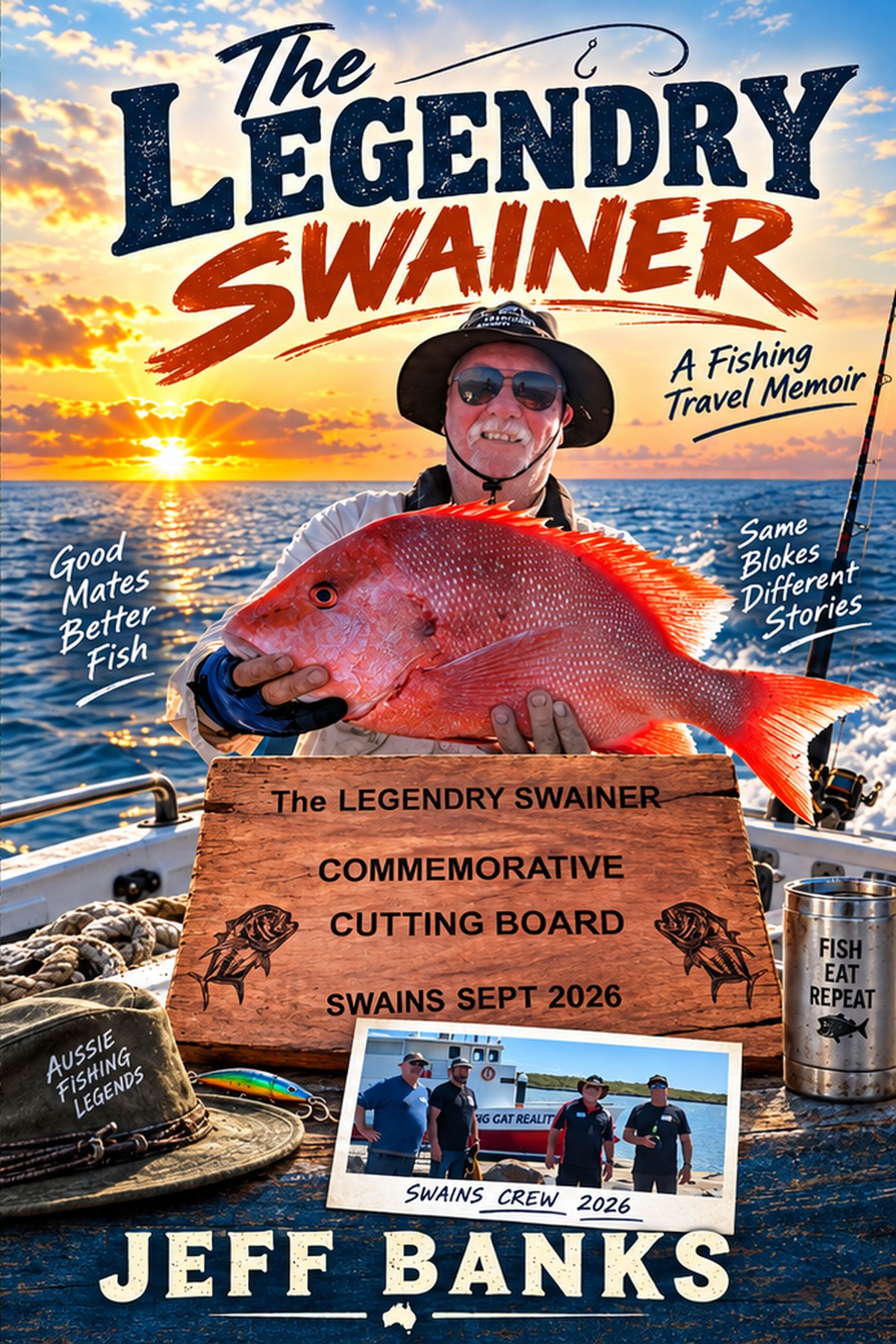
THE LEGENDRY SWAINER - Chapter 13 - The Longest Drive in Australian History

THE LEGENDRY SWAINER - Chapter 13 - The Longest Drive in Australian History | Travelling Around Australia with Jeff Banks

My body is less enthusiastic about the achievement. A week of being bounced by swell, bracing against boats, hauling fish, twisting, reaching and climbing in and out of bunks has been followed by eleven hours sitting almost motionless behind a steering wheel, and everything now seems to hurt in a different way. The recliner therefore becomes less a piece of furniture than the final destination of the expedition.

The Legendry Swainer

Four Mates, Seven Days and Far Too Much Confidence

Chapter 13 — The Longest Drive in Australian History

Everyone is up early, which seems particularly unreasonable given that, for the first morning in a week, there is no fishing to be done. Part of it is habit, after seven days in which mornings have begun before the body had been properly consulted, but there is also the knowledge that Steve and I have an enormous drive ahead of us. A day like this is best attacked by taking large chunks out of the distance while everyone is still reasonably alert, because there will inevitably come a point later in the afternoon when the kilometres seem to get longer, the conversation becomes less energetic and tiredness starts demanding considerably more attention than it did at breakfast.

Strangely, though, neither of us is particularly desperate to leave. The body has other ideas and is providing a fairly comprehensive list of reasons why seven days of fishing, bouncing around in boats, leaning over gunwales and hauling against fish and swell has probably been enough, but the rest of me is not quite ready to concede that the trip is finished. For months Big Cat Reality had been something we were preparing for, then suddenly it became our entire world for a week, and now the simple act of carrying bags off the boat is beginning to dismantle it around us.

There is plenty to do before the Cruiser can even point south. Seven days of life aboard Big Cat Reality has to be squeezed back into bags that somehow seemed considerably larger when we arrived, with clothes carrying combinations of fish guts, bait, salt and substances better left unidentified being pushed into garbage bags before disappearing into suitcases. Breakfast still has to be eaten, bar tabs settled and the catch sorted and distributed, after which trays of fillets, rods, tackle, bags and everything else we brought north must be transferred ashore and packed into the Cruiser with enough care that we can still find the things we need somewhere between Bundaberg and Forster.

That creates the contradiction of the morning. We know we need to get moving because there is no sensible advantage in donating the freshest hours of the day to a Bundaberg car park, yet every job completed brings the trip another small step closer to being over. Eventually the fish will be packed, the last bag will find a space in the Cruiser and there will be nothing left to do except drive away, which is precisely what the aching body wants and, after a week like this, perhaps the one thing the rest of me is in no great hurry to do.

The two trophies also have to make the journey ashore. Only one of them will return home in my luggage, which is disappointing from the point of view of symmetry, but both will at least be travelling south in the Cruiser. I am prepared to accept that as a satisfactory outcome, particularly as the trophy actually accompanying my clothes happens to be the one I regard as the more important one, an entirely objective assessment that may or may not be shared by the bloke carrying the other.

The deck of Big Cat Reality has become a moving warehouse. Rods, tackle bags, clothing, eskies and assorted personal belongings are being shifted from cabins and storage areas into organised piles from which they can eventually be transferred ashore and then into cars. Somewhere amongst all this we still have to settle bar tabs, eat breakfast and wait for the great fish distribution, because nobody is leaving Bundaberg without ensuring that seven days of effort has been converted into the appropriate quantity of fillets.

Ben, the skipper, gathers everybody together for what we expect will be the normal end-of-trip farewell. Instead, he is remarkably generous about the group, talking about the way everyone handled themselves during the week and suggesting that we had made the trip enjoyable for the crew even though, unlike us, they had actually been working. It is a nice thing to hear because twenty fishermen living in close proximity for a week could presumably make themselves memorable for many reasons, and not all of them would be suitable for inclusion in a farewell speech.

Then comes the number. Ben tells us that the recorded catch for the trip was 500 fish, which sounds extremely impressive until he adds the little piece of information that renders our achievement somewhat less heroic. A Garmin group, which he describes as containing professional fishermen, had previously managed about 1,300 fish on a trip aboard Big Cat Reality.

There is an immediate temptation to search for mitigating circumstances. Different weather, different tides, different reefs, perhaps an unusually cooperative generation of fish who had subsequently warned their descendants about Garmin employees. Unfortunately, the simpler explanation is that a full boat of enthusiastic recreational fishermen has just been informed that the professionals caught more than two and a half times as many fish as we did, and there is not much available in the way of accounting treatment that can make 500 equal 1,300.

Still, we have our fish, and the trophies of the week appear amongst the first of them to be sorted. My red-throated emperor goes into the appropriate tray, while the coral trout that has spent the week masquerading as evidence of Steve’s superior fishing ability makes its own appearance. I have accepted the official result, naturally, although acceptance and wholehearted endorsement are two entirely different concepts and there is plenty of road between Bundaberg and home on which the finer points can be reconsidered.

The crew then begins distributing the remaining fillets. Someone calls out the different species and portions are worked around the twenty trays so everybody leaves with an even share rather than the trip descending at the final hurdle into a fish-market version of Lord of the Flies. Soon the trays disappear towards waiting eskies, where ice will preserve the spoils while their owners begin the much less glamorous business of getting themselves home.

Before Steve and I leave, though, there is one final piece of unfinished business. Separately, and without any discussion between us, we both decide to leave substantial tips for the crew, which probably says as much about the week as anything either of us could put into words. It also happens to be Ryder’s birthday, and while neither of us knows precisely what form the celebrations might take later, we both suspect we have made the evening’s possibilities considerably more ambitious.

The reason for the tips goes well beyond simply having caught fish. The methodology aboard Big Cat Reality had been first rate, from the way the tenders were managed to the way the fishing day was organised, but methodology by itself is only a plan. What makes the plan memorable is performance, and Ryder, Riley, Jack and Ken had performed all week in a way that made every transition seem almost effortless. Boats appeared when they were needed, fishermen were moved around safely, gear was handled, problems were solved and the entire operation flowed with the sort of precision that becomes easy to take for granted precisely because nobody ever seems flustered.

That seamlessness mattered even more when we thought about the environment in which they were working. We were twenty fishermen carrying rods, hooks, sinkers, knives, tackle and assorted levels of coordination, being transferred between a mother ship and smaller boats on open water, often with swell moving beneath us and excitement doing nothing to improve anyone’s judgment. Yet at no stage did I feel that safety had become an inconvenience to be worked around, and perhaps most impressively, Ryder, Riley, Jack and Ken seemed to do all of it with smiles on their faces all the time.

That is the part of service people sometimes miss. The system can be excellent, the equipment can be right and the procedures can be polished, but eventually somebody still has to deliver the experience, and these blokes did. Steve and I were not tipping a process; we were tipping the people who had made the process work, who had made the difficult look routine and who had helped turn seven days of fishing into the week we were now so reluctant to leave behind.

So the money changed hands without ceremony, which was probably the right way for it to happen. Ryder, Riley, Jack and Ken had earned it, and if Ryder’s birthday celebrations later that night happened to become a little more enthusiastic than originally planned, Steve and I were perfectly comfortable accepting some responsibility for that outcome. After seven days of being looked after with skill, safety and good humour, it seemed an entirely appropriate final contribution to Big Cat Reality.

For Steve and me, that means one very long day in the Cruiser. The rough calculation is eleven hours of driving, divided into three stages: about four hours to my son’s place, another four to Coffs Harbour and then roughly three more to home, with Steve dropped at Forster along the way. On paper it looks manageable, which is another example of paper having absolutely no understanding of what seven days at sea does to a body.

The first leg is relatively easy, apart from the first hour being spent in a pea-soup fog. There is something mildly insulting about finally returning to dry land after a week of navigating reefs and swell only to discover that somebody has removed most of the visibility from the highway. We settle into the drive, although “we” is perhaps overstating Steve’s contribution because, once comfortably installed in the passenger seat, he spends a considerable portion of the first leg asleep and snoring with the confidence of a man who has delegated responsibility for both navigation and survival.

His ability to sleep is impressive given that I am still buzzing from the week and trying to process everything that has happened. The radio is going, the Cruiser is eating up the kilometres and beside me Steve occasionally stirs just long enough to establish that we are still heading south before returning to whatever dream requires that level of respiratory accompaniment. After seven days of early starts, boats, swell and fishing, I cannot really blame him, although sympathy is easier to maintain when you are not the bloke staring into fog while your passenger demonstrates how comfortable the seat apparently is.

It also means that the first stages of fishing history are being assembled with remarkably little opposition. This is the fascinating part of any trip because facts are at their most vulnerable shortly after the rods have been packed away, and with Steve unconscious for much of the opening session there is nobody immediately available to challenge whatever conclusions I might be forming. The winner can begin developing a coherent explanation for why victory was always likely, while everybody else’s mitigating circumstances remain temporarily unrepresented.

Fish that escaped start gaining weight, fortunate catches acquire tactical sophistication and decisions made seven days earlier are subjected to analysis that would have been considerably more useful had any of us possessed it seven days earlier. Lost opportunities can now be attributed to tide, position, tackle, bad luck or advice supplied by somebody else, while successful decisions become evidence of foresight and sound fishing judgment. By the time Steve wakes properly, several aspects of the week are already in danger of becoming settled history, and he has only himself to blame for sleeping through the first sitting of the inquiry.

I am not immune from the process. In fact, owning the keyboard gives me an advantage that should probably concern the others far more than it does, because history is usually kinder to the bloke writing it. My fish were, naturally, products of preparation, persistence and sound judgment, whereas certain other fish caught during the week benefited from positioning, chance, sympathetic currents and possibly a temporary lapse in concentration by the fish concerned.

The stop at my son’s house is therefore welcome for reasons beyond merely breaking the journey. We unload some fish for them even though my son himself does not eat it, which seems a curious genetic failure given the week I have just spent accumulating the stuff. His partner, however, looks at the fillets with considerably greater enthusiasm, and we leave her a worthwhile supply together with firm instructions that they need to be skinned before cooking.

Sitting in an ordinary house again feels strangely luxurious. There is no swell underneath the chair, nobody is yelling about a bite and there is little chance of a sinker suddenly appearing from somewhere at head height, yet the body has not entirely accepted that the moving part of the trip is over. Every now and then there is the faint sensation that the room has shifted beneath me, not enough to make me reach for anything, but enough to remind me that after a week aboard boats the world can continue rolling long after the water has disappeared.

It is a peculiar phenomenon because it seems to arrive most clearly in the moments when everything else becomes still. Sitting quietly for a minute, standing in a hallway or even taking the sort of reflective pause available only when sitting on a toilet, there can be that brief suggestion that the floor has moved and the body instinctively compensates for a swell that does not exist. For seven days every movement had required some allowance for what the boat might do next, and apparently the brain is reluctant to abandon a system that has kept you upright simply because someone has replaced the deck with bathroom tiles.

There is something slightly amusing about finally reaching solid ground and then discovering that solidity is, for a while at least, partly a matter of opinion. The eyes can see a perfectly stationary room while the body remains convinced there is another small roll coming from somewhere, and for a second you find yourself subtly adjusting your balance against absolutely nothing. After spending a week learning to move with the sea, perhaps it is unreasonable to expect the body to trust land again immediately.

Unfortunately, we cannot remain there long enough for everything inside me to stop swaying because there are still many hundreds of kilometres between us and our own beds. The strange luxury of stationary chairs, proper toilets and floors that are making every effort not to move has to be surrendered, and before long Steve and I are back in the Cruiser pointing south. At least the road is supposed to move beneath us, which makes it considerably easier to understand.

Long-distance driving after a week like this becomes an exercise in managing tiredness rather than simply covering kilometres. The radio is going, Steve and I talk, and from time to time the conversation is interrupted because my passenger has quietly disappeared into sleep. I cannot particularly blame him, although there is something slightly unfair about watching somebody nod off beside you when you are the one required to keep the vehicle between the white lines.

When Steve is awake, one of the more interesting conversations of the day develops from something neither of us expected to spend much time discussing on a fishing holiday: service. He has spent the week aboard somebody else’s charter operation after years of running his own, and inevitably the comparison begins to form between what Big Cat Reality does, what he does and the different ways each operation creates an experience for its customers. The boats are different, the scale is different and the fishing itself is different, so there is little value in trying to decide which operation is better, but there are enough common elements for Steve to start measuring his own product against what we have just experienced.

We bounce around the things that actually matter once the brochure promises and fishing photographs are stripped away. Food, organisation, communication, safety, the way problems are handled, how customers are spoken to, whether somebody notices when a fisherman needs help and, above all, whether the people running the operation appear to genuinely want their guests to have a good day all come into the discussion. Steve begins to recognise that many of the things he does almost automatically on his own boat are the same things we have been admiring all week aboard Big Cat Reality.

That realisation gives him a visible sense of satisfaction. He has not spent the week discovering some secret formula that everybody else understands and he has somehow missed; if anything, the experience has reinforced his belief that the product he already offers is a very good one. There are always things that can be adjusted and improved, but the important lesson for him is that his instincts about what people want from a charter have been sound, and that in many areas the service he provides stands up very comfortably beside what we have just experienced.

There is also a rather convenient piece of evidence arriving in real time. Between periods of snoring, Steve is working through emails on his phone from people wanting to arrange fishing trips with him in the weeks ahead, answering questions, locking in dates and generally organising the very business we are discussing. It is difficult to become too consumed by doubts about the appeal of your product while customers are simultaneously trying to book it.

There is something almost reassuring in that contradiction. One minute Steve is asleep beside me with the phone resting somewhere near his lap, and the next he is awake enough to reply to another enquiry and arrange another charter before drifting back towards sleep. The marketplace, apparently, has no interest in waiting for him to complete a detailed post-trip review of his business model before continuing to endorse it.

For Steve, the week therefore becomes less about discovering what he should be doing differently and more about confirming that much of what he already does is right. Big Cat Reality has shown him another very professional way of delivering a fishing experience, but rather than diminishing his own operation, the comparison seems to strengthen his confidence in it. His boat may be smaller and his charters operate in a very different environment, yet the things that ultimately matter to customers, being looked after, being safe, being put in the best possible position to catch fish and feeling that the bloke running the boat actually cares whether they enjoy themselves, are things Steve already understands very well.

He had almost been dragged along for the ride when this trip first came together, but he is heading home with more than fish and stories from Swains Reef. He has had the rare opportunity to spend a week as the customer rather than the operator and to look back at his own business from the other side of the counter. The conclusion seems to please him greatly: there are things he can still improve, but there is no need to tear up the playbook, particularly while the booking emails continue arriving between bouts of snoring.

By Coffs Harbour, however, philosophical discussions about service standards are beginning to lose ground to the basic desire to get home. The body has worked out that fishing has finished and apparently sees no further reason to cooperate. Muscles that tolerated bouncing around in boats, leaning over gunwales and wrestling fish from the bottom now object to sitting in a padded car seat, which seems an unreasonable time to develop standards.

The last run takes us towards Forster and Steve’s place. By now we have gone well beyond discussing what happened and have started discussing what might happen next time, which is proof that the human brain is remarkably efficient at suppressing discomfort once another fishing trip becomes theoretically possible. Different tackle will be taken, certain methods reconsidered and, no doubt, every mistake from this week will never be made again, except for those that inevitably will.

Then, as if the trip needs one final reminder that preparation and organisation are concepts rather than guarantees, Steve realises his container of sinkers is still aboard Big Cat Reality. This is not a handful of sinkers casually left in a corner but an esky-sized collection of lead that is now sitting several hundred kilometres behind us. Almost immediately he starts working through the logistics of retrieving it, eventually arriving at the possibility that friends involved in transport might somehow collect it from Bundaberg and work it south towards Forster.

I drop Steve home and continue the final part of the journey, congratulating myself on having successfully returned both man and most of his belongings. That satisfaction lasts until I unload the Cruiser and find his glasses sitting in the centre console. Apparently, after a week of watching four grown men search constantly for fish, tackle, rods, lures and each other’s weaknesses, the expedition is going to conclude with me driving back to Steve’s place tomorrow because he has misplaced the one item that helps him see properly.

Eventually everything of mine is out of the Cruiser. The rods and tackle can wait for serious attention, the clothing can begin whatever decontamination process is appropriate, and the fish has survived the long haul south. The trophies are home as well, including the one that will provide evidence for years to come that, whatever alternative histories eventually emerge, there was at least one matter decided aboard Big Cat Reality that can still be supported by physical evidence.

My body is less enthusiastic about the achievement. A week of being bounced by swell, bracing against boats, hauling fish, twisting, reaching and climbing in and out of bunks has been followed by eleven hours sitting almost motionless behind a steering wheel, and everything now seems to hurt in a different way. The recliner therefore becomes less a piece of furniture than the final destination of the expedition.

I settle back, begin catching up on the week’s gossip from the world we left behind and feel the tiredness finally take control. There will be time later to clean gear properly, distribute photographs, examine results, reconsider trophy decisions and allow several fish to achieve the additional size they will undoubtedly acquire through repeated telling. For the moment, however, the fishing is finished, the Cruiser is home and the four of us have survived the thing we spent months talking about.

Trips like this do not come along every week, and perhaps that is part of why we make so much of them when they do. The trophies will eventually gather dust and the precise tally of fish will blur, but the arguments, the disasters, the magnificent catches, the insults and the pieces of completely unreliable history will be recycled whenever enough of us are in the same room. Somewhere inside all that revisionism will remain the simple fact that four mates went away fishing together, and for one very good week nothing much outside that small world really mattered.

Author

Menu