

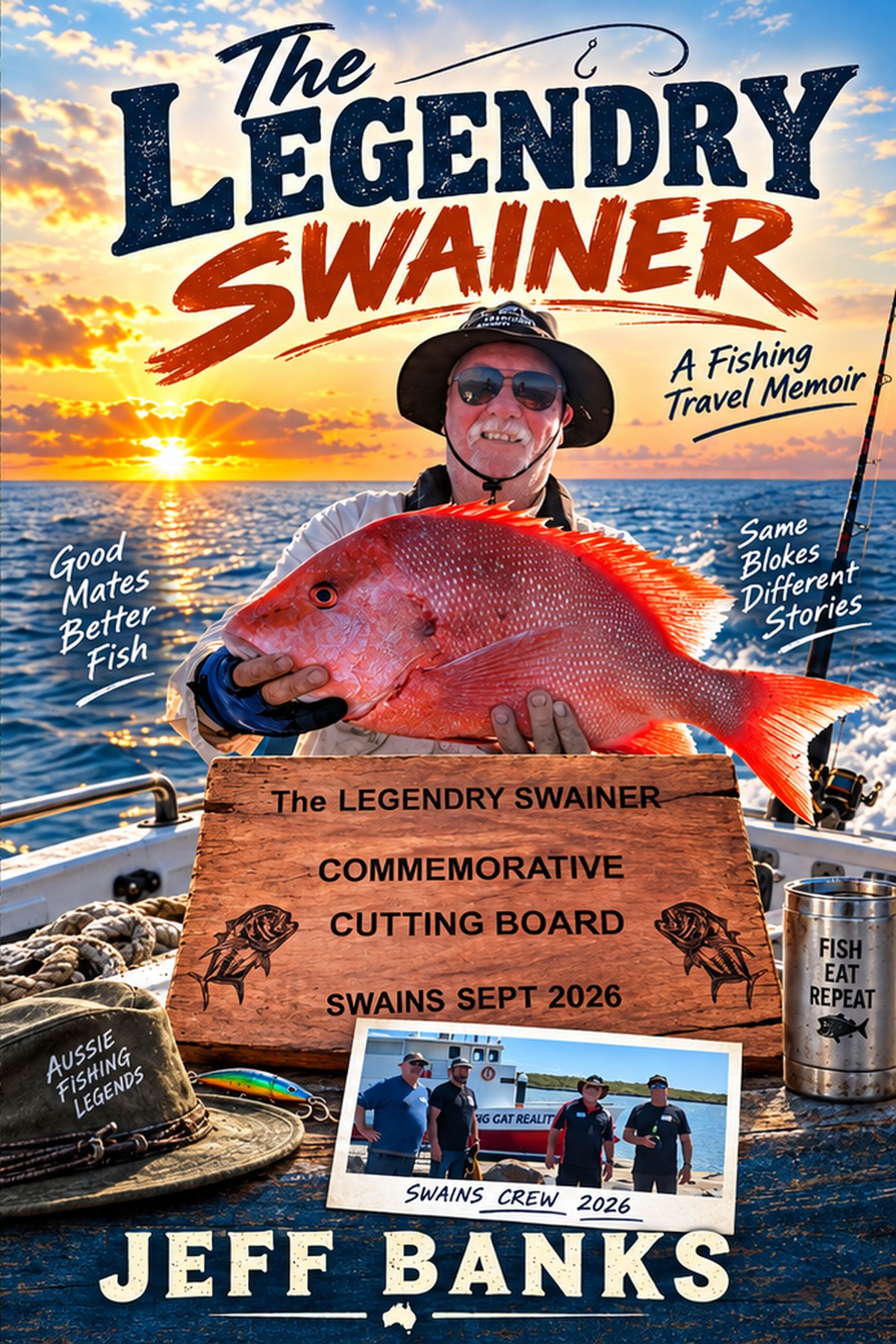
THE LEGENDRY SWAINER - Chapter 12 - Day Six - Judgement Day

THE LEGENDRY SWAINER - Chapter 12 - Day Six - Judgement Day | Travelling Around Australia with Jeff Banks

For nearly a week our world has been reduced to weather, reefs, meals, dories, knots, rods, fish and the ongoing responsibility of ensuring that no mate becomes too pleased with himself. Tomorrow the phones will work properly, roads will replace water and all the ordinary things we temporarily left behind will begin reclaiming their positions. Tonight, however, there are trophies to settle, evidence to review and one last opportunity for the defeated parties to establish that the result would have been entirely different if only several fish that escaped had displayed a little more respect for the rules.

The Legendry Swainer

Four Mates, Seven Days and Far Too Much Confidence

Chapter 12 — Day Six: Judgment Day

Ten hours of steaming overnight has carried Big Cat Reality south and, when morning arrives, we are sitting near Heron Island. There is one more day of fishing ahead of us, although by now the word fishing disguises quite a lot of other things, including getting dressed, getting into a dory, getting out of a dory and attempting to persuade various parts of the body that they still belong to the same bloke. The bunks have done their job perfectly well for six nights, provided the person using them is considerably younger and capable of folding himself through angles no longer readily available to me.

I discover this while trying to get out of mine and cramping badly enough to bring the entire operation to a temporary halt. There is something undignified about being defeated before breakfast by a piece of bedroom furniture, especially when you know there are fish outside waiting to provide another form of humiliation later. I eventually extract myself, with the comforting knowledge that I only have to perform this manoeuvre once more before Big Cat Reality and I cease sharing sleeping arrangements.

The body may be ready to go home, but the competitive part of the brain has no such intention. This is Judgment Day, the final opportunity for anybody to alter the trophy positions and, more importantly, the last chance for Trevor to prevent the entirely proper result that appears to be unfolding. At the time we leave the mother ship for the first session I am comfortably in front, by at least five fish, and the mathematics are beginning to look extremely attractive from where I am sitting.

There is an interesting point in any competition between mates when winning remains desirable but stopping one particular bastard from winning becomes almost as satisfying. I suspect we have reached that point, although I am fortunate enough to be operating from the much healthier position of actually being in front. The bloke behind begins calculating what might happen if he catches this, that and something else, while the bloke in front suddenly discovers a deep respect for the rules, established scoring procedures and the importance of maintaining the integrity of the competition.

Naturally, I have always respected the rules. Any suggestion that my enthusiasm for strict interpretation has increased in direct proportion to the size of my lead would be a malicious attack on the independence of the person who devised much of the scoring system, maintained the records and is now apparently going to win it.

Trevor’s problem, as I see it, is Trevor. He likes the big fish and, with one day remaining, I cannot imagine him suddenly abandoning that philosophy and beginning a systematic assault on ordinary table fish simply because those fish happen to carry points. He will chase glory because that is what he does, while Steve and I have spent much of the week building totals one perfectly respectable fish at a time, with trophies and monsters considered desirable but not compulsory.

This is not merely fishing strategy. It is disciplined accumulation, which sounds so much better when an accountant says it and becomes even more persuasive when the accountant happens to be leading. The difficulty is that the fishing ground has now changed beneath us, and what worked further out on the reef cannot simply be carried south and applied without thought.

For three days on the outer reef there had been a sense of transition, of reading country we had not fished before, adjusting to depths, current, structure and the behaviour of fish that seemed perfectly willing to rewrite whatever theory we had brought with us. Out there, mistakes could still be filed under learning. Here at Heron Island, with the trophy on the line and only one day remaining, that luxury has disappeared, because the topography is different, the water has to be read again and the rules governing how we fish it have changed with it.

The bottom contours, reef edges and likely holding areas all need to be interpreted afresh rather than approached as though we are still fishing yesterday’s water. The wind has also decided to become part of the examination, affecting how the dory sits, how quickly we move across a patch and how accurately a bait can be presented where we think the fish ought to be. Positioning suddenly matters more, drift matters more and choosing where to begin each run becomes another small decision capable of producing either fish or a prolonged explanation about why there should have been fish.

That is where experience is supposed to earn its keep. We have had several days to remember what Swains demands of us, to shake off the early-trip enthusiasm, rediscover patience and relearn the difference between simply dropping a bait and actually fishing the ground in front of us. Now, on the final day, I do not particularly want a transitional period while I work Heron Island out, because transitions are considerably easier to tolerate when there is no trophy sitting at the end of the afternoon.

The competition therefore adds an extra layer to every decision. Trevor can continue chasing the one fish capable of changing everything at once, while Steve and I can keep trying to understand the ground, adjust to the wind and accumulate the fish that are actually available. Somewhere between reading the bottom, managing the drift and deciding when to move, expertise needs to come to the fore, because today there is no tomorrow available to prove that we had finally worked it out.

Bill joins Steve and me again, but today there is an important difference that has very little to do with available rod holders or how much room can be manufactured in a dory already carrying enough fishing gear for a small tackle shop. Yesterday Bill had effectively appeared and we had made space for him; today we had asked him to come with us. He was no longer another passenger looking for somewhere to fit into the day’s fishing, but somebody we wanted in our boat, and without anybody needing to announce it, that changed his place within the little world Steve and I had developed during the week.

There was no sense that Bill now needed to work out where he belonged or whether he should sit quietly while the established occupants carried on around him. The invitation had already answered that question, and almost immediately the quieter version of Bill from the previous day began disappearing. He started talking more, joining the sledging rather than merely listening to it and, most importantly, demonstrating that anything sent in his direction could be returned with interest, which is generally the point at which a bloke ceases being company and starts becoming one of the crew.

Before proving himself conversationally, however, Bill chooses the more effective method of demonstrating that he belongs: he starts catching our fish. While Steve and I are still engaged in the preliminary business of establishing that there must surely be better fish somewhere else, Bill begins putting tuskfish into the boat with irritating regularity. One follows another and, for a while, the bloke we had specifically invited to join us is showing up both the professional charter operator and the bloke currently leading the most prestigious fishing competition nobody outside our four-man universe has ever heard of.

There was something rather fitting about it. Yesterday we had been making room for Bill in the dory; today Bill was making himself completely at home in it, catching fish, contributing to the noise and, in the early stages at least, making Steve and me look as though we had come along chiefly to provide him with transport. Before either of us had properly got into gear, Bill had already boated several good tuskfish and was building the sort of early lead that demanded recognition whether we wanted to give it or not.

Recognition, naturally, came in the only form available to us. Somewhere between another solid tuskfish hitting the deck and Steve and me still trying to establish our own rhythm, Bill acquired the title of Tusk Master, a distinction bestowed with exactly the amount of respect you would expect from two blokes being shown up in their own dory. The title was immediately accompanied by the obligatory suggestions that he had found a private school of fish, was using information withheld from the rest of us or had somehow negotiated a personal arrangement with the local tuskfish population.

Bill seemed perfectly happy with the promotion and, importantly, capable of carrying the sledging that came with it. He was no longer simply catching fish while we watched; he was answering back, enjoying the attention and behaving like somebody who knew he had earned the right to make our slow start part of the morning’s entertainment. Steve and I eventually found our own gear and began contributing properly, but by then the damage had been done and the Tusk Master had been established.

That was probably the clearest sign of how much had changed since the previous day. Bill was not trying to fit in anymore, because he already had. Somewhere between the invitation, the early run of tuskfish, the nickname and the first properly returned sledge, he had moved from being the extra bloke in the boat to one of the blokes entitled to make the others uncomfortable.

Eventually Steve and I begin contributing, and the morning settles into a steady collection rather than anything spectacular. Between us we put together a dozen or more tuskfish, several hussars and, courtesy of Steve, a small red-throat emperor. None of it is going to create the sort of photograph that dominates somebody’s fishing wall for the next twenty years, but from my position every legal fish entering the esky has a quiet beauty all of its own.

This is where Trevor’s philosophy and mine diverge rather conveniently. He can continue hunting something magnificent while I continue catching things that count, and I am perfectly prepared to let history decide which is the more sophisticated approach. History, it should be remembered, is generally written by the winners, particularly when the winner is also the bloke with the score sheet.

Every now and then we look towards Trevor and Ian’s boat with the concentration of people who are definitely not concerned about what anybody else is catching. At this stage of the competition you can identify a dangerous fish from several hundred metres away simply by watching body language, although there is also a remarkable capacity to downgrade anything caught by the opposition before actually seeing it. Nobody on their boat appears to be doing enough to disturb me greatly, and the comfortable feeling I carried away from Big Cat Reality remains intact.

Ian does manage a decent trevally during the morning, which produces the inevitable suggestion from Trevor’s camp that Steve’s position in the second trophy might suddenly be under threat. This theory survives until Steve gets a proper look at the fish. His reaction contains less fear than amusement, and the scoffing that follows makes it clear that, in his professional opinion, a recount will not be necessary.

Steve’s fish from earlier in the trip remains well ahead. Ian’s trevally is a good fish, certainly good enough to be admired under normal circumstances, but normal circumstances ceased to exist several days ago and it is therefore assessed solely on whether it can remove a trophy from somebody else.

Bill, meanwhile, has found his voice. Whatever uncertainty there might have been about how he would fit into our boat disappears as he begins giving at least as much as he receives, which makes the morning considerably better. There is always a moment when somebody stops being the additional bloke in the boat and becomes part of the conversation, and Bill seems to have reached it without any ceremony beyond catching more tuskfish than was socially desirable and learning that none of us possesses a protected status.

By lunchtime we are back aboard Big Cat Reality, and another sign that civilisation is approaching appears on the phone. After days of either no service or service of little practical use, messages begin arriving in numbers, evidence that the world has continued operating without consulting me. There are enough of them to suggest that several people believe their matters have remained important during my absence.

I ignore them.

That decision requires no philosophical examination and certainly no apology. This week has been mine, removed from ordinary obligations by distance, water and the complete inability of most people to reach me, and I am not surrendering the final few hours because a mobile tower has suddenly re-established diplomatic relations. Whatever is contained in those messages can survive until I am properly back, because at the moment there is still a competition to win and, more importantly, one last afternoon on the water with my mates.

The afternoon should, by the demands of good storytelling, produce something dramatic. Trevor should mount a heroic comeback, Ian should suddenly discover a school of trophy fish, Steve should face a last-minute challenge and I should spend the closing minutes desperately protecting a lead while the fate of the Legendry Swainer hangs on the final drop. Unfortunately, nobody explained any of this to the fish around Heron Island.

For Trevor and Ian the afternoon is a complete bust. They catch nothing, which is precisely the sort of tactical error I have been hoping Trevor might make all week, although there is plenty of discussion afterwards about fish that were hooked, fish that departed and particularly impressive things that may have been attached to lines before those lines ceased being attached to them. The alleged size of a fish lost at sea enjoys tremendous freedom because there is no corpse available to contradict the evidence.

There are big bust-offs, apparently, including at least one that might have altered the competition had things gone differently. This is perfectly possible, just as it is perfectly possible I might have hooked something even bigger had I dropped my bait three metres to the left at precisely 2.17 in the afternoon. Fishing competitions have traditionally been cruel towards hypothetical achievement, and our rules contain the wonderfully uncomplicated principle that if it is not in the esky, it does not count.

Steve, Bill and I continue along our less glamorous tuskfish path. The fishing is still slow compared with some of the sessions we have enjoyed further north, but fish are arriving and the total is moving in only one direction. Steve adds a large red-throated emperor during the afternoon, another very good fish on a day when good fish are proving difficult enough to find.

There is no great final flourish. No screaming reel provides the closing scene, nobody produces a last-drop miracle and Trevor does not return to Big Cat Reality carrying the fish required to wipe the smile from my face. After six fishing days, countless drops, numerous species, sharks, tangles, bust-offs, tactical masterstrokes, tactical disasters and enough revised versions of events to occupy a small historical society, the competition simply runs out of time.

The numbers decide the Legendry Swainer, which is exactly how numbers should behave when they are producing the correct result. My calculation has me as the only person to pass 200 points, and however much room might exist for minor adjustment in the final reckoning, there is not enough room to create a serious argument about the winner. Trevor has spent too much time chasing glory, Ian has been caught in the same strategic orbit, and Steve and I have accumulated table fish with the sort of boring persistence that eventually becomes very difficult to beat.

Ian brings up the rear, only just, and is not slow to identify Trevor’s obsession with trophy fish as a contributing factor. There is some justice in the complaint because fishing alongside a man committed to chasing monsters can be inconvenient when your own score would benefit from catching almost anything with fins and legal dimensions. Trevor, I suspect, will eventually produce a more sophisticated analysis in which his approach was correct but cruelly unsupported by the available fish.

I am equally capable of producing my own preferred analysis, of course, and mine has the considerable advantage of ending with me holding the trophy. History, after all, has rarely been compiled by the bloke who finished second, and as both winner and custodian of the official records I now find myself in the enviable position of being able to preserve events with all the objectivity they deserve. The better fisherman won, which is a conclusion supported by the strongest evidence available in any competition: my name is at the top and Trevor’s isn’t.

Trevor may wish to challenge the methodology, question the scoring system or raise concerns about the unfortunate concentration of power in the hands of one competitor, but these are really administrative matters for people further down the table. Losers have been questioning official records since somebody first scratched a result onto a cave wall, and I see no compelling reason to overturn centuries of sporting tradition simply because Trevor has suddenly developed an interest in governance. Any appeal will therefore be heard fairly, considered carefully and dismissed in the order received.

More importantly, this result does not exist in isolation. Coming on top of the recent Condobolin proceedings, I now have what might reasonably be described as a foot on Trevor’s throat, at least in the highly mature world of fishing sledging, and that changes the tone of future conversations considerably. For years he has been able to reach comfortably into the historical record whenever fishing ability is discussed; now I have begun editing the record myself, and I intend to be an enthusiastic archivist.

The sledging from here will therefore carry a slightly different weight. Trevor can still talk about the one that got away, the fish that would have changed everything and the superior strategy cruelly denied by circumstance, but every such submission now comes with the minor inconvenience of recent evidence. I will not need to say much, which is perhaps the most satisfying part of all, because sometimes the most effective response is simply to ask whether he would like to discuss Condobolin first or Swains.

The second trophy is Steve’s, although Trevor makes one final attempt to manufacture uncertainty where very little really exists. Ian has landed a decent trevally during the morning and, under normal circumstances, it would have received the admiration it deserved. Trevor, however, is now operating in the final hours of a losing campaign and decides that Ian’s fish should be promoted from respectable catch to possible trophy challenger.

Ian does not need to make the case himself because Trevor is more than happy to do it for him. Somewhere in the process of looking at the fish, looking at Steve and then apparently looking for any remaining avenue through which the result might be disturbed, Trevor begins suggesting that perhaps Ian’s trevally is closer to Steve’s earlier fish than everybody else seems prepared to admit. It has the unmistakable feel of a man grasping at straws, except in this case the straw has fins and belongs to his best mate.

Steve’s reaction is magnificent because there is almost no sign that he regards the proposition as serious. He looks at Ian’s fish, then at the suggestion being made on its behalf, with the disdain of a man whose professional standards have just been personally challenged. There is no anxious measuring, no worried examination and certainly no sense that he believes the trophy is in danger; instead there is a scoff that manages to dismiss Trevor’s argument, defend his own fish and question how far competitive desperation has now descended.

Importantly, the problem is not Ian’s fish. It is a perfectly good trevally, and Ian has every right to be pleased with it, but Trevor’s attempt to elevate it into the same conversation as Steve’s established trophy fish is where the absurdity begins. Steve seems almost offended on behalf of the fish he caught earlier in the charter, as though its proven credentials are being cheapened simply by being asked to stand beside this late entry for comparison.

The more Trevor presses the point, the more Steve’s disbelief grows. His own fish has already been landed, admired and accepted as the benchmark, and now Trevor is effectively asking everybody to revisit the standard because Ian has produced something that is merely in the same broad category of respectable fishing. By then Steve’s expression suggests that, if this is the best alternative evidence available, he is perfectly comfortable with the tribunal proceeding directly to judgment.

Ian, meanwhile, is left in the slightly unusual position of having his fish argued into a contest he did not really create. Trevor is the instigator, Steve is the offended champion and Ian’s trevally has become the exhibit being passed around as though it might overturn the result if examined from a sufficiently imaginative angle. It does not, and once the two catches are viewed in proper perspective, the attempted challenge collapses under the weight of its own optimism.

Steve’s earlier fish remains comfortably superior and the trophy stays where it belongs. Trevor can continue arguing the merits of Ian’s trevally for as long as enthusiasm permits, but Steve’s reaction has already delivered the verdict: Ian caught a good fish, Trevor found a straw to grasp at, and neither circumstance was enough to turn a respectable catch into a trophy winner.

By the time we finish, there is less triumphal behaviour than I might have imagined several days earlier because tiredness has begun imposing its own form of moderation. Hands are sore, muscles have stiffened, sleep has been compromised and the thought of a proper bed has acquired an attraction no fish could entirely overcome. Yet there is also an awkward contradiction sitting underneath all of that fatigue: the body is more than ready to stop, while none of us is particularly enthusiastic about the trip actually being over.

For nearly a week our world has been reduced to weather, reefs, meals, dories, knots, rods, fish and the ongoing responsibility of ensuring that no mate becomes too pleased with himself. Tomorrow the phones will work properly, roads will replace water and all the ordinary things we temporarily left behind will begin reclaiming their positions. Tonight, however, there are trophies to settle, evidence to review and one last opportunity for the defeated parties to establish that the result would have been entirely different if only several fish that escaped had displayed a little more respect for the rules.

As for me, I have no intention of making too much of winning the Legendry Swainer while the result is still fresh. The trophy will simply be taken home, given its proper place in the Man Cave and hung where everybody can admire it, although I confess the positioning may be chosen with one particular future visitor in mind.

Trevor’s next visit should therefore be especially enjoyable. He will walk into the Man Cave already carrying the recent Condobolin result somewhere in the back of his mind, and there, waiting patiently on the wall, will be the Legendry Swainer as a further reminder that the historical record has recently become rather unkind to him. There will be no need for me to say much because good trophies, like good evidence, generally speak quite well for themselves.

That is where the real value of the bragging rights begins. They can remain largely in reserve until Trevor becomes a little too expansive about fishing ability, starts revising the events of the week or decides that one of his bust-offs deserves retrospective consideration. At that point I will merely have to glance towards the wall, perhaps allow a small smile to develop, and let him feel the foot on his neck become just that little bit heavier.

The Completely Impartial Scorecard — Judgment Day

Trophy One — The Legendry Swainer: Jeff, with daylight occupying second place. There had been considerable pre-trip concern that allowing the creator of the rules to maintain the records might create an appearance of bias, and it is pleasing to report that those fears have now been completely vindicated.

Trophy Two: Steve. Ian’s morning trevally briefly generated excitement in the Trevor-Ian camp, until Steve saw it and demonstrated through the ancient adjudication technique of scoffing that there was no case to answer.

Jeff’s assessment of proceedings: The better fisherman won. Trevor may have alternative views, but defeated competitors have been questioning official results since sport was invented and there is no reason to treat this particular outbreak differently.

Trevor’s likely assessment of proceedings: Trophy fish matter more, except where the competition rules inconveniently say otherwise. Further submissions may be lodged at any time and will receive the consideration they deserve.

Ian’s assessment of Trevor’s strategy: Catching table fish occasionally might have been useful. Spending the week attached to a bloke constantly searching for the fish of a lifetime has apparently come with consequences.

Steve’s current regret level: Surprisingly high that we are going home. He came along almost on a whim and now has a trophy, several new stories and three more people prepared to remind him indefinitely of every mistake made along the way.

Bill’s status: No longer simply the extra bloke in the boat. He caught fish, found his voice and proved perfectly capable of giving as much as he received.

Biggest claim made without supporting evidence: The afternoon bust-offs that might have changed everything. Unfortunately for the claimants, fish escaping underwater remain ineligible for both points and retrospective greatness.

Most important rule rediscovered on the final day: If it isn’t in the esky, it doesn’t count.

Friendships currently under review: All intact. Happily, today was the last fishing day before somebody tested that finding more thoroughly.

The final actual scoreboard

Jeff – 204

including 7 Coral Trout,

9 Red Throat Emeror,

17 Tusk Fish,

1 cracking Red Emperor,

1 7kg Cod

and 2 “others” – even without the 2 others still won

Trevor – 182

including 12 Coral Trout,

8 Red Throat Emperor,

11 Tusk Fish,

1 Spanish Mackerall,

2 Mac Tuna

Steve – 140

including 3 Coral Trout,

8 Red Throat Emperor,

9 Tusk Fish,

1 Spanish Mackerall,

2 Shark Mackerall,

3 Trevally

Ian – 137

including 7 Coral Trout,

6 Red Throat Emperor,

9 Tusk Fish,

2 Trevally,

1 Cod

Author

Menu