

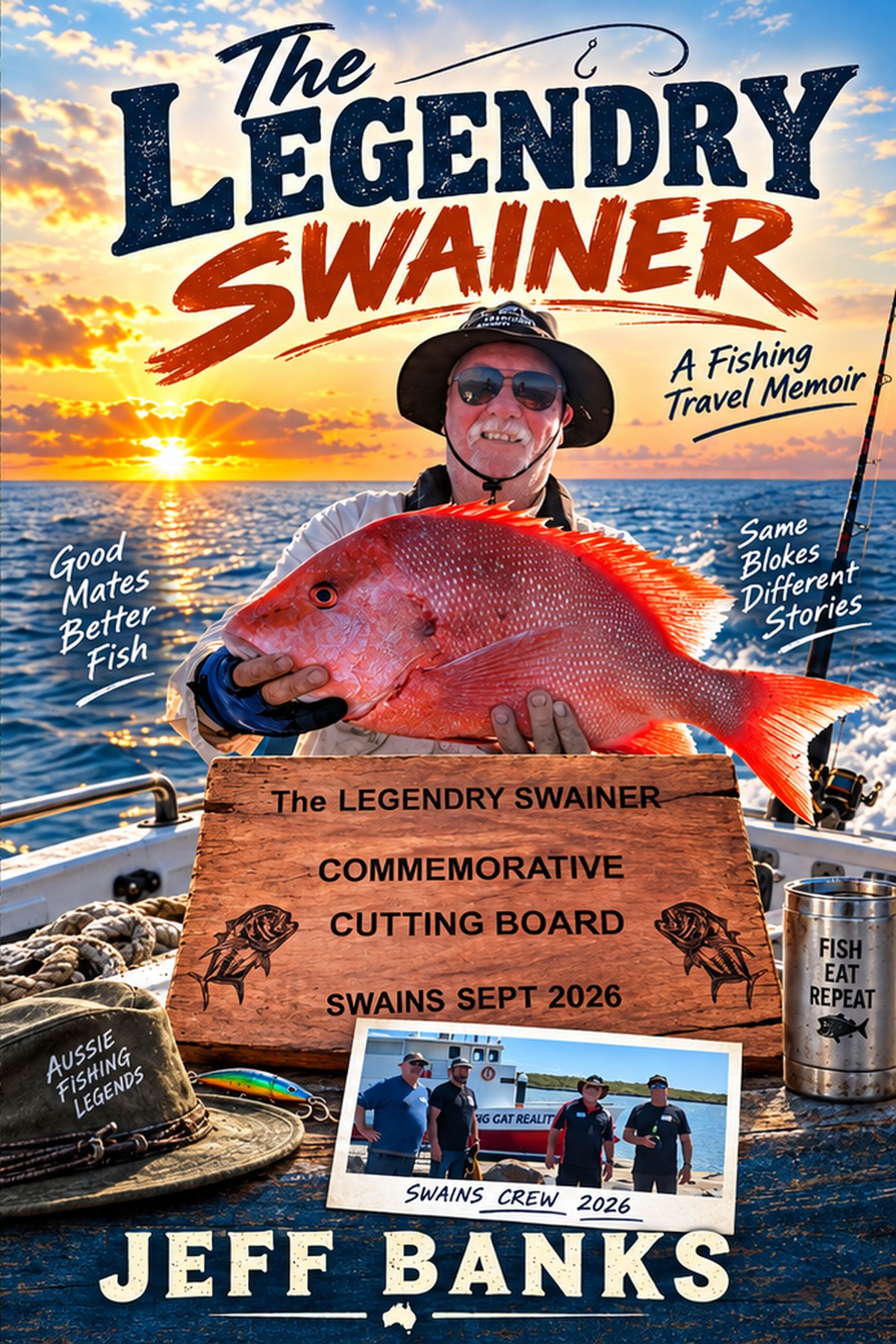
THE LEGENDRY SWAINER - Chapter 11 - Day Five - Last Day Out Wide

THE LEGENDRY SWAINER - Chapter 11 - Day Five - Last Day Out Wide | Travelling Around Australia with Jeff Banks

It may even have been the best result of the day, although I am reluctant to overstate that point while leading Trophy One by a considerable margin. There are priorities in life, after all, and on the eve of the final fishing day mine had become increasingly clear.

The Legendry Swainer

Four Mates, Seven Days and Far Too Much Confidence

Chapter 11 — Day Five: Last Day Out Wide

By Day Five, somebody was always going to become intolerable. The trophies had been designed as a joke, introduced as a joke and carried all the way to Swains Reef as physical proof that four grown men could invest far too much time in something of almost no consequence. Somewhere along the way, however, the joke had acquired a leaderboard, the leaderboard had acquired strategy and the strategy had acquired the sort of importance normally reserved for Test cricket selections and federal elections.

Unfortunately for everybody else, the person becoming intolerable was me. A very good Day Four had moved me into a position from which I could begin pretending the competition was largely settled, provided nobody examined the arithmetic too carefully or pointed out that we still had two days of fishing remaining. This was a wonderful position from which to narrate events because every fish I caught could now be described as the product of sound planning, while any fish caught by somebody threatening my lead could be subjected to a much more rigorous examination of luck, positioning and statistical probability.

There was still plenty to achieve, particularly for Steve, who remained disturbingly enthusiastic despite having spent nearly a week discovering that being a professional fishing charter operator offered no protection whatsoever from abuse. One of the species he particularly wanted was a Coral Trout, and the only woman on the trip was also still waiting to break that particular duck. Coral Trout were therefore high on the unofficial agenda, although my own interest in them had recently become more sophisticated because they also happened to score points.

We were preparing to head out when another complication walked up and introduced himself as Bill. Nobody had mentioned Bill, nobody had suggested we would be acquiring another fisherman and, until that moment, Steve and I had been operating our tender as though every available rod holder had been allocated by international treaty.

Bill’s arrival therefore produced an immediate reconsideration of how many rods two fishermen genuinely needed for one day’s fishing. It was a question that would have been much easier to answer had somebody asked it before we had brought most of them downstairs and arranged them in the boat with the confidence of men who assumed they knew exactly who was travelling with them.

There was a reason Bill had appeared. He was travelling with a family group, but the numbers did not work neatly enough for everybody to fish together, so he had become something of a floating member of the fleet. Casey had filled a similar role with Trevor and Ian the previous day, while Bill had already spent time with those two and, if Trevor’s account was to be accepted without cross-examination, had apparently spent much of it creating tangles, complications and sufficient disruption to threaten the orderly conduct of a fishing expedition.

That was the Bill being delivered to us, at least according to Trevor. His advance briefing contained enough warnings about tangles and general incompetence that Steve and I could reasonably have expected Bill to arrive carrying several rods permanently knitted together, and Trevor seemed almost relieved that somebody else would now have the opportunity to experience him. The fact that this transfer occurred while I was leading the competition and Steve was becoming increasingly dangerous raised an entirely separate possibility that, in the interests of sporting integrity, could not simply be ignored.

Perhaps Trevor had not merely lost a passenger. Perhaps he had unloaded one.

From my increasingly suspicious position at the top of the leaderboard, the strategy was almost elegant. Trevor and Ian could remove from their tender a fisherman Trevor regarded as a liability while placing that same alleged liability directly into the boat containing two of the people he needed to beat. If Bill tangled our lines, occupied valuable rod holders, crossed us up during a good drift and generally reduced our fishing efficiency, Trevor could remain several hundred metres away expressing disappointment at our misfortune while benefiting handsomely from it.

There was, naturally, no real evidence that Trevor had engineered any of this, which has never been an insurmountable obstacle when constructing a convincing fishing conspiracy. All we actually knew was that Bill had fished with Trevor, Trevor had formed a fairly unflattering view of his capabilities and Bill was now standing beside our tender just as we were preparing to leave. In a normal world that might have been coincidence, but by Day Five nobody involved in the trophy competition was operating entirely in a normal world.

Trevor’s assessment of Bill also told us something about Trevor. He likes fishing to unfold according to a plan, preferably his plan, and while he will ask what everybody else thinks, the consultation process tends to work most efficiently when everybody eventually agrees with the conclusion he had already reached. A fisherman who does something differently, tangles at the wrong moment or requires assistance can therefore move very quickly from fellow passenger to operational problem.

Steve and I consequently received Bill with two competing possibilities in mind. Either Trevor had correctly identified a man capable of turning our tender into a mobile macramé workshop, or he had just handed us a perfectly competent fisherman who had failed to meet Trevor’s unusually exacting standards. There was only one sensible way to find out, although I remained alert to the possibility that every tangle from that moment forward might need to be entered into evidence under the heading Trevor’s Attempted Sabotage.

Trevor will ask what you think and listen carefully enough to create the appearance of consultation, which is important in any modern organisation. The process works beautifully provided you eventually arrive at the answer Trevor had before he asked, because otherwise further consultation may be required until you do.

Steve and I operate a little differently. Steve has spent years taking paying customers fishing, which means he has developed the apparently radical belief that the person beside him might benefit from some assistance rather than a performance assessment, while I have always found it difficult to leave somebody outside a group once they are standing there. Steve is the consummate service provider, almost a devotee of Peter Merrett’s Workalicious philosophy without, as far as I know, ever having read it, and between us the decision was made almost instantly.

Bill was with us, so Bill was one of us. That did not mean he understood us immediately, because there is a settling-in period required when somebody enters an established sledging relationship and discovers that what sounds remarkably hostile from the outside is often merely two blokes saying good morning.

Bill spent the first part of the trip working out whether Steve and I actually disliked each other. Before long he recognised that most personal attacks were simply conversational punctuation and that silence was probably more worrying than abuse, because by now the sledging had become part of the way we worked together rather than something that interrupted it. A suggestion about changing a rig might arrive wrapped inside an observation about the other bloke’s competence, and a warning that somebody’s line was drifting the wrong way could easily include an assessment of his eyesight, intelligence and prospects of ever becoming a useful fisherman.

Underneath all of that nonsense, though, Steve and I had developed a surprisingly deliberate way of fishing together. We had spent enough time in the dory by then to understand that tangles were often created long before two lines actually crossed, so we tried to remove the problem at source rather than simply complain after it happened. We talked about what weight we were using, how quickly the current was moving, where each bait was likely to sit beneath us and whether one bloke dropping something completely different into the water was about to turn three separate fishing lines into a communal knitting project.

One of the simplest strategies was also one of the most effective: wherever practical, everybody used the same weight sinker. That meant three baits dropped at roughly the same time tended to descend at roughly the same rate and respond similarly to the current, rather than one racing towards the bottom while another drifted halfway towards New Caledonia. It did not make tangles impossible, because fishermen are wonderfully inventive when it comes to defeating even the best systems, but it removed one of the more obvious causes before we ever started blaming one another.

Position in the dory mattered just as much. We worked out who should fish from which part of the boat, where each line was most likely to travel and how the dory itself needed to sit in relation to the wind, current and reef so the drift carried us where we wanted to go. Steve’s experience was particularly valuable there because he understood what the boat would do before it did it, but it never became a case of him issuing instructions while the rest of us obeyed. We would look at the drift, talk about whether we needed to change our angle, shift somebody forward or aft, alter the weight or reposition for another run, and then make the adjustment together.

That had become one of the quiet differences in the way Steve and I operated. Discussion had largely replaced telling, even when one of us clearly knew more about a particular part of what was happening, and that created an environment where changing something did not automatically imply somebody had been doing it wrong. If the drift was poor, we changed the drift; if the weights were mismatched, we matched them; if somebody’s line was repeatedly crossing another, we moved him or changed the setup rather than beginning with a prosecution case.

Bill therefore walked into a dory where much of the supposed tangle problem had already been anticipated. We did not simply put him wherever there happened to be space, hand him a rod and then wait to see whether Trevor’s prediction came true; we fitted him into the way we were already fishing, explained what we were doing and why, and adjusted things as the conditions changed. All of this occurred while Steve and I continued insulting one another with increasing enthusiasm, which may initially have made the whole arrangement look considerably less organised than it actually was.

More importantly, Bill did not appear to be the tangle merchant we had been warned about. Lines went down together, sinkers behaved in broadly the same way, everybody occupied a position that made sense and the dory drifted more or less through the water the way we had planned. There was no immediate reconstruction of the maritime version of the Gordian knot, and Trevor’s evidence was beginning to look increasingly circumstantial.

I was still prepared to reserve judgment, of course, because one orderly drift does not establish innocence beyond reasonable doubt. But the possibility was beginning to emerge that Trevor had not unloaded a hopeless fisherman onto us at all; he may simply have delivered Bill into a system where people talked through what they were doing, adjusted around one another and saved the shouting for the far more important business of sledging.

The morning soon provided that opportunity because we found Coral Trout, and we found plenty of them. Not one reluctant specimen appearing after an hour of searching, but a succession of them, and by the time the session had run its course we had eight Coral Trout in the boat along with a collection of other fish carrying various degrees of trophy significance.

Eight was not a number requiring interpretation, although I was quite prepared to provide one if necessary. Four of them were mine, a statistic I mention only because accurate historical records matter and because somebody has to preserve the facts before jealousy begins interfering with collective memory.

Steve finally burst his Coral Trout bubble and then apparently decided there was little point stopping at one. He finished with three, producing the expression of somebody who had arrived at Swains with a professional fishing reputation and was now relieved to have secured evidence that he did, in fact, know how to catch one of the reef’s signature fish. Bill completed the eight with one of his own, meaning every fisherman in our tender had contributed and, more importantly, every fisherman had something with which to annoy somebody on another boat.

Steve was chuffed, and rightly so. There is something about catching a species you have specifically wanted that survives all the competition surrounding it, and for a while his three trout were simply three very good fish rather than numbers requiring comparison with my four. I allowed that period of pure enjoyment to continue for a respectable length of time before reminding myself that four remained mathematically superior to three.

Bill, meanwhile, had fitted in almost seamlessly. The tangles we had been warned about failed to materialise, he listened when Steve suggested something and he gradually began returning the sledging instead of merely receiving it. By mid-morning he had worked out the central rule of our tender: if somebody said something unkind while smiling, the correct response was not offence but escalation.

The real turning point came when he lost his first rig to the bottom. There was no post-mortem, no lecture about what he had done wrong and no suggestion that Trevor’s earlier warnings had suddenly been vindicated. Steve simply re-rigged him the way we had been fishing, using the same sort of setup, the same thinking about sinker weight and the same approach that had been working for us all morning.

The results were almost immediate. Bill’s bait began fishing “properly”, the line behaved more like ours and before long he was into fish, including the Coral Trout that removed any lingering suggestion that he was somehow the weak link in the boat. Whatever Trevor had seen on his day with Bill, we were not seeing it.

More importantly, Bill no longer felt like somebody who had been added to our dory because the numbers elsewhere did not work. He was fishing the same way we were, moving with the same rhythm, listening when it mattered and giving back as much sledging as he received. By then there was no Steve, Jeff and the bloke Trevor had unloaded on us; there were simply three fishermen working the same drift and taking equal opportunities to make one another’s day unnecessarily difficult.

That change mattered because the whole boat became easier. Advice was not being handed down from somebody above the other two, it was being exchanged, tested and altered as we went, and Bill responded exactly the way Steve and I had. Once he was rigged the way we were and treated the way we treated each other, he was as much one of us as either of us.

In fact, the only real problem Trevor had created by sending Bill our way was that he had strengthened the opposition. What had looked suspiciously like an attempt to unload a handicap onto the leading boat was beginning to resemble one of the poorer strategic decisions of the competition.

Perhaps the difference was simply environment. Trevor is a very good fisherman and nobody in our group doubts that, but he also has a powerful belief in doing things the way he believes they should be done, particularly when a fishing result might ultimately form part of the historical record. A bloke learning beside Trevor can therefore find himself operating under conditions somewhere between recreational fishing and a supervised competency assessment.

Those of us who know him accept it because that is part of the package. We understand the confidence, the stubbornness and the extraordinary network of experts Trevor somehow has available to support virtually every opinion he has ever formed, even when nobody else has met these people. Somebody new to him might reasonably wonder why a morning catching fish had suddenly started to feel like a workplace appraisal.

Bill seemed happier with our version of management, and the fish appeared equally comfortable with it. During the day we discovered that some of his rigging was, in our completely impartial opinion, less than optimum, and once he lost the existing arrangement Steve and I moved in.

There are moments on a fishing boat when assistance is offered and other moments when assistance occurs whether the recipient has formally requested it or not. Bill suddenly found himself being re-rigged by committee, with Steve and me improving matters according to a consensus reached principally between Steve and me.

The new arrangement went over the side and almost immediately Bill began getting better results. That was satisfactory for several reasons, not least because Bill caught his Coral Trout and proved he could fish perfectly well when given the opportunity. It also demonstrated the quality of our advice, which is an important consideration whenever advice has been delivered with complete confidence and another boat containing Trevor remains somewhere within radio range.

Then Bill hooked something we never saw, and in some ways that made the whole episode better. The rod loaded up so heavily at times that the obvious first thought was that he had simply buried the rig into the bottom, particularly when whatever was down there stopped moving and allowed him to lean against what felt like an immovable object. We had all been there before, hanging grimly onto a rod while somebody beside us politely avoided pointing out that the reef itself rarely loses a fight.

The sounder, though, was telling a different story. There were flashes of movement on the screen beneath us, marks appearing and shifting where a snag should have remained stubbornly fixed, and every now and then the rod would come alive again as whatever Bill was connected to decided it had somewhere else to be. That was enough to change the conversation from whether he was actually hooked to a fish into the much more entertaining question of what sort of fish could behave like that.

By then Bill was not the bloke Trevor had unloaded onto us, nor was he the extra fisherman we had needed to squeeze into an already full dory. He was one of us, and when the rod bent we reacted exactly as we would have if Steve or I had been holding it, clearing where we needed to, watching the line angle, watching the sounder and offering advice in the same helpful manner we always did, which naturally meant every useful suggestion came with an unnecessary personal observation attached.

There were moments when Bill gained a little line and moments when whatever was below simply took it back. At other times it seemed to sit stubbornly beneath us, enough to make the bottom theory briefly attractive again, only for another flash on the sounder or another powerful movement through the rod to restore the fish to life. None of us could see it, none of us could identify it and therefore none of us had any reliable basis for estimating its size, but the evidence underneath the boat was becoming considerably harder to dismiss.

That uncertainty made the fight more enjoyable rather than less. The trophies briefly stopped mattering because we were all caught up in the simple question of whether Bill could get whatever it was far enough from the reef for us to finally see it, and the three of us were working the dory together rather than worrying about whose fish might ultimately score what. For a few minutes it was simply Bill hanging on, Steve and me watching everything around him and all three of us becoming increasingly invested in discovering what had decided to eat his bait.

Eventually the line parted and the load disappeared so suddenly that Bill almost went out the opposite side of the dory. One moment he was leaning back against something capable of bending the rod towards the water and the next there was nothing there at all, leaving him scrambling for balance while Steve and I enjoyed the spectacle with precisely the level of sympathy expected from close companions.

The fish was gone, but the look on Bill’s face remained. There was disappointment, certainly, but underneath it was the grin of somebody who had just spent several minutes attached to something powerful enough to make the whole boat pay attention, and by then nobody was questioning whether he could fish. We never saw what was on the other end, but the sounder had given the story rather more substance than the usual tale of the monster that got away, even if the absence of a photograph still left plenty of room for future growth.

That was probably the moment Bill became completely one of us. He had caught fish with us, been re-rigged by us, learned to return the sledging and now had his own legitimate Swains story about the fish nobody saw, supported by just enough electronic evidence to make disbelief considerably more difficult than Trevor might have preferred.

The afternoon did not match the morning’s Coral Trout procession, but it certainly was not empty. A very large Cod came aboard courtesy of your narrator, and as trophy leader I had reached the stage where even fish I might once have admired purely for their size were first subjected to an immediate points assessment. Competition does strange things to appreciation, particularly when the competition is going well for you.

We also repeated another developing feature of the trip by arriving near boats already fishing an area and somehow creating concern that we might be imposing. There would be a little territorial uncertainty, somebody would move away or indicate that perhaps the ocean was insufficiently large to accommodate one more tender, and shortly afterwards we would catch something worthwhile.

This did not necessarily prove that our fishing methods were superior, but that was one possible interpretation and therefore clearly the one deserving greatest consideration. It also did nothing to reduce my growing belief that the day was unfolding almost exactly as it should, which was becoming increasingly unfortunate for anybody hoping I might remain modest.

Between the four Coral Trout, the Cod and the other scoring fish from the day, my position in Trophy One had moved from promising to the sort of lead that causes a man to begin discussing mathematical inevitability while desperately hoping nobody else has retained a calculator. I was not yet measuring a space on the mantelpiece, but only because the trophy had travelled north with me and I already knew how large it was.

That is one of the problems with leading. You begin wanting the competition to finish immediately while simultaneously needing everybody else to understand how comprehensively you would have won had it continued for another week. Modesty becomes increasingly difficult when the available evidence keeps producing exactly the wrong encouragement.

Trophy Two was proving less cooperative. Steve was sitting in a strong position largely because nobody seemed capable of producing the GT required to upset him, which meant the absence of a fish was beginning to acquire almost as much strategic importance as catching one.

This is where fishing competition enters a more advanced phase. You can find yourself standing beside a mate secretly hoping the next fish he hooks is merely excellent rather than the particular excellent fish he needs, while outwardly offering every encouragement expected of a lifelong sporting companion.

By now ambition had become tangled with prevention. We all wanted to catch more, but there were moments when what somebody else failed to catch could produce almost equal satisfaction. This was clearly not what the early explorers of Swains Reef had in mind, but they had neglected to bring trophies and therefore could hardly be expected to understand.

The afternoon session was shorter than we might otherwise have wanted because Big Cat Reality needed to get underway. We had a timetable to meet, which meant fishing finally encountered an authority even we could not debate, and we headed back with enough time to have the tender recovered and stowed properly.

With the tender aboard, the last day out wide was finished and the mood began to change. There is always a different atmosphere when the smaller boats disappear onto the deck and the mothership begins moving again, because the day stops being about the next drop and becomes about food, stories and the increasingly creative reconstruction of everything that nearly happened.

The gear was put aside and attention gradually transferred to the evening. Prawns and other delicacies appeared before dinner, providing exactly the sort of hardship we had been forced to endure since leaving Bundaberg and ensuring nobody was in danger of returning home lighter than when we started.

Then the fire alarm went off while the only woman on the trip happened to be showering. Calls were made for people to assemble, confusion briefly replaced the usual evening nonsense and for a moment there was the awkward possibility that an emergency evacuation might require somebody to make an entrance under circumstances no passenger would willingly choose.

Fortunately, it was a false alarm and normal service eventually resumed. She was spared an emergency appearance, the rest of us returned to whatever we had been doing and the incident joined the growing collection of stories that would improve considerably once nobody was required to take them seriously.

Dinner naturally produced the daily parliamentary sitting on fish. There were discussions about catches, fish lost, fish that should have been caught, fish that would certainly have been caught had something beyond the fisherman’s control not intervened and fish that existed only as a brief bend in a rod before disappearing forever.

Size estimates were offered with the traditional fisherman’s hand movements, although the hand not demonstrating dimensions was often required for more important duties associated with the evening. Every conversation seemed to involve somebody explaining how close they had come to something exceptional, which is one of the great comforts of fishing because the fish not landed remains gloriously immune from measurement.

Trevor had material of his own. During the afternoon he had confidently called a fish as a Wahoo, a specifically named fish for scoring purposes, only for the fish to arrive and reveal itself as a barracuda, a species identification error that might have passed quietly on another boat but had absolutely no chance of escaping on ours. By Day Five, however, I was no longer prepared to regard such matters as innocent mistakes without at least considering the influence of trophy pressure.

Trevor was chasing, I was leading and the available fishing time was disappearing quickly. Under those circumstances, perhaps even a man of his considerable experience could find his judgment becoming slightly optimistic, with every silver flash beneath the boat briefly promoted to something carrying greater competitive significance. Desperate times call for desperate measures, and when a trophy is slipping away, there may be only a very small distance between identifying the fish you actually have and identifying the fish you desperately need it to be.

Of course, there was also the more sinister interpretation. Perhaps Trevor had reached the stage where merely catching a barracuda was no longer enough and the fish needed to be verbally upgraded before it reached the boat, if only to give the rest of us a few anxious moments while we wondered whether the leaderboard was about to change. I am not suggesting deliberate deception, because that would be a serious allegation requiring evidence, witnesses and preferably an independent tribunal, but I was leading and therefore had an obvious responsibility to remain alert to all possible threats to sporting integrity.

The fish itself eventually settled the matter by arriving in a form even Trevor could not reasonably classify as a Wahoo. That should have ended the discussion, although by then the damage had been done because Steve and I had another small piece of evidence suggesting trophy fever was beginning to affect people in different ways. Whether Trevor’s judgment had simply been clouded by ambition or whether this was part of the same emerging strategic mindset that had somehow resulted in Bill being transferred to our boat was impossible to prove, but with the final day looming I was no longer prepared to dismiss coincidence quite as readily as I once might have.

He had also suffered the more legitimate pain of a double Red Emperor episode in which his fishing partner became tangled while two fish were being fought. The larger of the pair was ultimately lost, which meant the episode immediately acquired the additional significance reserved for fish that disappear before anybody can produce a tape measure.

We knew that one hurt because Trevor’s analysis became sufficiently detailed to establish precisely where responsibility lay. There was the tangle, the partner, the larger fish and the horrible knowledge that the one disappearing was apparently the one he most wanted, which meant there were enough components for the event to remain under investigation well into the evening.

If necessary, further evidence could be taken tomorrow. Nobody doubted Trevor would remain available to present it, particularly if any listener showed signs of reaching a conclusion inconsistent with his own.

Somewhere during all of this the cards came out again, which meant I was now entering my second evening of competitive activity after the rods had been put away. The first game had begun with me watching from the outside, Trevor advertising me to the table as some sort of card-counting menace and the younger blokes responding to that warning by inviting the supposed shark into the water. I had then made the situation considerably worse by winning the first round before eventually demonstrating that unfamiliarity with the finer points of Yani could still overcome whatever mystical powers Trevor believed I possessed.

This time there was already some history. I was no longer simply the older bloke standing nearby trying to work out what they were playing, because several of them had seen enough the previous evening to have formed opinions about how much of Trevor’s warning had been nonsense and how much might require continued observation. My early success the first time had left just enough doubt to make the second game interesting, even though my later elimination should probably have provided all the reassurance they needed.

Trevor’s card-counting accusation therefore no longer needed a formal introduction. It had become part of the background, and when I showed interest in the game again there were looks around the table suggesting that everybody remembered perfectly well what had happened last time. I had acquired the peculiar advantage of being treated as dangerous despite having already supplied substantial evidence that I was capable of making mistakes like everybody else.

The more confident members of the group were especially interested in the rematch. There was an element of wanting to understand what I was watching, what I remembered and whether there really was something behind Trevor’s claims, while I now had the advantage of at least knowing the basic mechanics of the game before sitting down. That did not suddenly make me an expert, but it removed the excuse of complete ignorance and made every decision look slightly more deliberate than it had the night before.

The result, inconveniently for anybody hoping the first evening had been a statistical accident, followed a remarkably similar path. I again started well enough to create some unease, enjoyed a period where the cards and my growing understanding of the game combined rather nicely, and managed to remove some opposition before the weaknesses in my still-developing knowledge caught up with me. There were again moments when the table looked at me as though Trevor might know something they did not, followed eventually by moments that confirmed he had probably exaggerated substantially.

That was what made the second game better than the first. There was now a story attached to it, with the younger blokes trying to establish whether I really did possess some sinister ability to remember cards while I was mostly trying not to repeat the same rookie errors that had brought me undone previously. I could feel myself becoming more comfortable with the nuances, but there remained enough I did not know for somebody more experienced to punish the wrong decision when it mattered.

In the end I again did well without winning, which was probably the ideal result for keeping the mythology alive. Had I been eliminated immediately, Trevor’s card-counter story would have died of natural causes; had I swept the table, I might have found myself searched before being allowed near the cards on the final night. Instead I achieved exactly the sort of ambiguous result that allows a fishing boat story to survive: enough success to make people suspicious, enough failure to prevent anybody proving anything and another evening where the competition continued long after the fishing had stopped.

If he was looking for Rain Man, he had instead acquired a bloke trying to remember what happened next. That did not stop him studying me, and it certainly did not stop me enjoying the fact that Trevor had managed to make everybody suspicious before I had even picked up a hand.

Then I won the first round as I had last night, which created an immediate and thoroughly unjustified unease around the table. The truth was considerably less impressive than the result because the cards had fallen my way and, during the round, I had already made a couple of rookie mistakes while trying to understand nuances the others took for granted.

Unfortunately, victory is terrible at communicating humility. Trevor’s earlier warning suddenly looked a little more credible, while my attempts to explain that luck had played a considerable role probably sounded exactly like something an experienced card counter would say to keep his victims comfortable.

The game continued and I began understanding more of what was happening. At one point I eliminated several of the original group in one fell swoop, a result produced by enough luck to make even my own claims of strategic brilliance difficult to sustain.

Their expressions suggested, however, that Trevor’s card-counter theory was now developing a small body of supporting evidence. The more confident player seemed particularly interested in solving me, which was entertaining because there was not nearly as much to solve as he imagined.

Eventually the game restored the natural order and not long afterwards I was eliminated after falling into the same sort of rookie mistake I had been making while learning. Any carefully cultivated air of mystery disappeared with me, and the younger blokes were free to reconsider whether Trevor had been warning them about an international gambling mastermind or simply amusing himself at my expense.

Either way, it had been a fun evening. Fishing had finished hours earlier, yet the competitive nonsense had merely changed venue, which probably said as much about us as anything that had happened during the day.

Bill had begun the morning as an unexpected extra passenger who forced us to reconsider our rod allocation. He ended it looking forward to fishing with us again tomorrow, and we were equally pleased to have him because somewhere between the Coral Trout, improved rigging, bust-offs and sledging he had stopped being the bloke placed on our tender and become part of its crew.

There was something satisfying about that, particularly because it had happened without anybody making a ceremony of it. He had simply fished with us, laughed with us, taken a little abuse, returned some of his own and discovered that being part of the group required no qualification beyond being prepared to join in.

It may even have been the best result of the day, although I am reluctant to overstate that point while leading Trophy One by a considerable margin. There are priorities in life, after all, and on the eve of the final fishing day mine had become increasingly clear.

Tomorrow would settle everything, at least according to the theory under which fishing competitions are supposed to operate. In practice there was still one full day available for Trevor, Ian, Steve or even the fish themselves to interfere with the entirely satisfactory state of affairs I had created, and history suggested none of them could be trusted.

The Completely Impartial Scorecard

Trophy One: A four-Coral-Trout morning, a very large Cod and assorted scoring fish have propelled me well into the lead. Independent verification of the phrase well into is neither sought nor required.

Trophy Two: Steve remains in the box seat, helped considerably by everybody else’s continued inability to catch the GT needed to threaten him.

Jeff’s assessment of proceedings: I am exactly where a man fishing as well as I am should expect to be. This opinion has been independently reviewed by me and found to be reasonable.

Steve’s current regret level: Virtually nil. Three Coral Trout have burst the bubble rather comprehensively.

New recruit assessment: Bill began the day as an unexpected passenger and finished it as one of us. No evidence supporting the alleged tangle epidemic was detected.

Best equipment intervention: Re-rigging Bill after his original setup disappeared. Subsequent results confirm our advice was brilliant and absolutely nothing to do with improved fishing conditions or chance.

Biggest claim made without supporting evidence: Trevor’s mid-afternoon Wahoo, subsequently identified by the fish itself as a barracuda.

Matter currently before the tribunal: Trevor’s lost larger Red Emperor during the dual-fish tangle. Responsibility has already been provisionally allocated by Trevor.

Person currently becoming unbearable: Me. At this stage I see no compelling reason to change.

Friendships currently under review: None. We have acquired Bill instead.

Author

Menu