

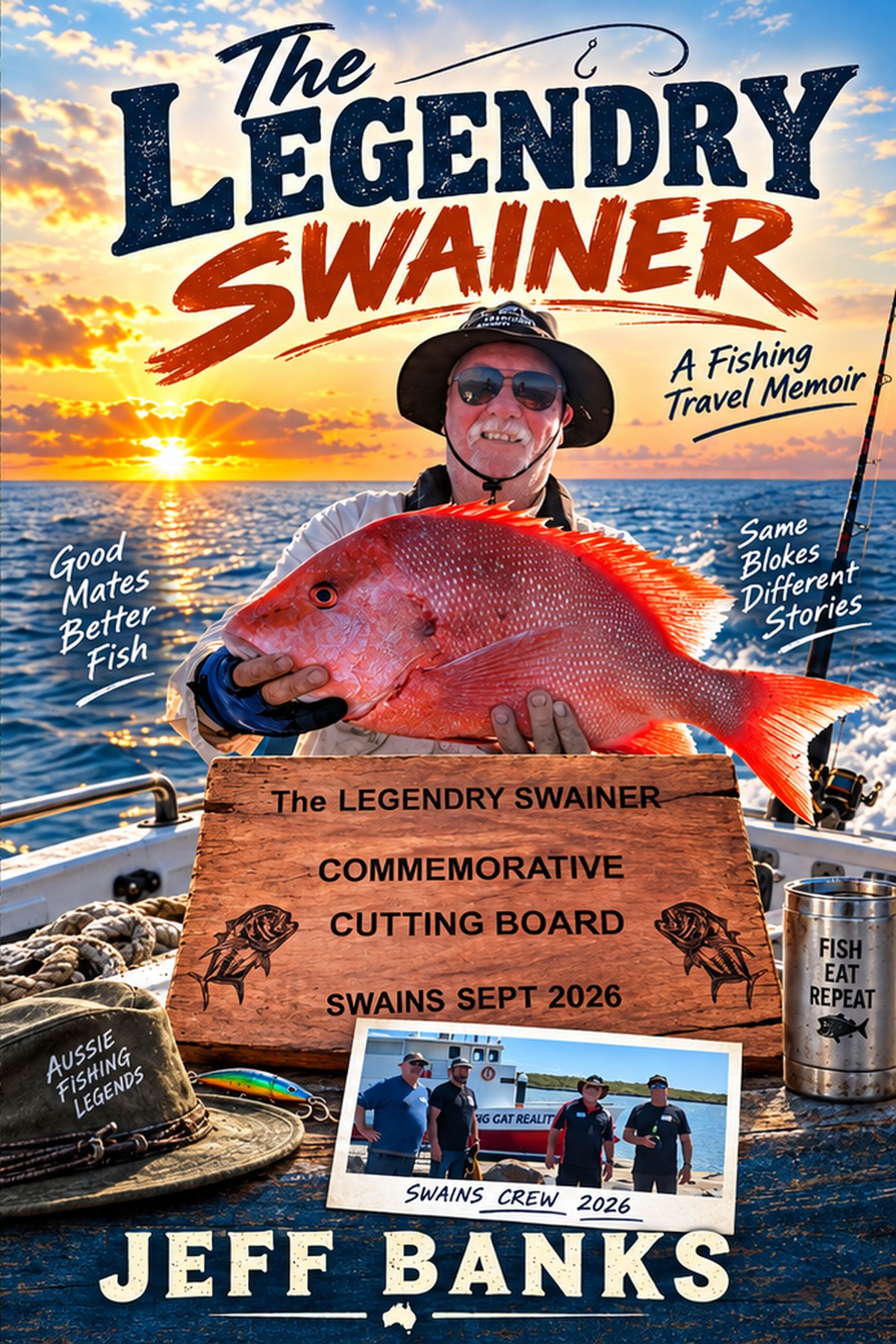
THE LEGENDRY SWAINER - Chapter 10 - Day Four - Cabin Fever at Sea

THE LEGENDRY SWAINER - Chapter 10 - Day Four - Cabin Fever at Sea | Travelling Around Australia with Jeff Banks

It also showed how quickly the little society aboard Big Cat Reality was forming. Twenty-four hours earlier I had been a bloke standing beside somebody else's card game; now I knew who was noisy, who was quiet, who understood the game and who was capable of punishing an error before you had finished regretting it. The same thing was happening everywhere aboard the boat, with fishing, meals, cabins and evening card games gradually turning a collection of passengers into people with histories, reputations and increasingly usable material against one another.

The Legendry Swainer

Four Mates, Seven Days and Far Too Much Confidence

Chapter 10 — Day Four: Cabin Fever at Sea

By Day Four, Big Cat Reality had ceased being merely the boat that carried us to the fishing and had become a small floating suburb with its own routines, alliances, noises, grievances and standards of acceptable behaviour. Personal space had disappeared somewhere beyond Bundaberg, sleeping arrangements had become matters of public interest and, most importantly, everybody now knew just enough about everybody else to become dangerous.

The first casualty of communal living was the cook, which struck me as a particularly poor strategic development. Apparently the combined nocturnal efforts of my deckie Steve and an older gentleman sleeping nearby had reached such proportions that the man responsible for feeding us had been driven from his bed and forced to seek refuge on the poop deck. Both offenders were suitably apologetic when the circumstances became known, but there are some people aboard a boat you simply do not want harbouring unresolved resentment, and the man controlling breakfast, lunch, dinner and everything edible in between sits very high on that list.

The cook took it all remarkably well, which was fortunate because culinary revenge at sea offered possibilities none of us particularly wanted to contemplate. There were still several days to go and the quality and quantity of food being produced had become an important part of our daily existence, so the idea of having him tired, irritable or considering rationing as a disciplinary measure was deeply concerning. Steve could apologise as much as he liked, but if dessert suddenly disappeared from the menu I knew exactly where the preliminary inquiry would begin.

Sleeping aboard a boat full of fishermen has never been an activity likely to feature prominently in wellness brochures. There are engines, generators, doors, footsteps, toilets, people getting up during the night and, apparently, men capable of producing respiratory sound effects impressive enough to alter another person’s accommodation arrangements. The dormitory with its bunks were buried down in the bowels of the catamaran, which meant that any nocturnal requirement involving the bladder first required you to extract yourself from bed, negotiate the confined cabin and then climb a steep set of stairs to reach the main deck where the toilets, and therefore freedom, finally waited.

The bunk itself did nothing to assist the process. Limited headroom and even less room to move meant getting out required a mixture of rolling, twisting, folding and controlled falling, all while trying not to injure something important before the real journey had even begun. By Day Four, with muscles stiff from fishing and joints no longer interested in sudden requests for flexibility, the simple act of removing yourself from bed had become a contortionist routine performed under increasing urinary pressure.

The stairs then presented the second stage of the challenge. There was an assistance bar running down only one side, useful enough provided you happened to be on the correct side and had managed to get a hand onto it before balance became theoretical. The other side offered little in the way of comfort until you were almost at the top, where another bar finally appeared to assist with the last heave onto the main deck.

That final bar took on an importance wildly out of proportion to its size. By the time you reached it, half awake and fully aware that the bladder had lost patience with the pace of proceedings, it felt less like a handrail and more like the final rope being thrown to a mountaineer. One last pull and you emerged onto the main deck into the comparative freedom of open space, level footing and, most importantly, toilets that were now only a few urgent steps away.

By then nobody could reasonably pretend that any personal habit remained private, because life aboard Big Cat Reality had progressed to the stage where everybody’s peculiarities were becoming community property. Snoring could relocate the cook, midnight footsteps could announce somebody else’s urinary timetable to half the boat, and the nightly climb from bunk to toilet had become a small endurance event in which success was measured less by speed than by arriving with dignity still mostly intact.

That was also true of the fishing. The four of us might have begun the trip with our own little competition and our own carefully created trophies, but the wider boat now knew enough about what we were doing to have opinions, offer advice and, most dangerously, contribute to the sledging. Our private stupidity was becoming public entertainment, and once other passengers and crew realised how seriously we were taking trophies of almost no intrinsic value, there was really no prospect of containing the outbreak.

The fishing itself had produced plenty of fish without yet giving us the sort of specimen that could dominate the retelling of the week. Eskies had been filling, numbers had been accumulating and the leaderboard had certainly moved, but somewhere in the back of our minds remained the thought that Swains Reef owed us something bigger. We had caught enough fish to be happy, yet happiness and satisfaction are not necessarily the same thing when four competitive fishermen know there are Red Emperor somewhere below them.

The deckies had given us an idea about an area that might produce one or two of those Reds, which was all the encouragement required for optimism to undergo its usual uncontrolled expansion. Better rigs were prepared, leaders checked and baits discussed with increasing seriousness as though the fish had agreed to attend the appointment. Stiff muscles and aching fingers suggested we had already spent several days being shaken around in small boats, but expectations were nevertheless climbing again because fishermen possess an extraordinary capacity to regard yesterday’s discomfort as irrelevant when today’s possibility appears.

The weather gave those expectations considerable encouragement. Conditions were superb, and the skipper suggested that we were enjoying one of perhaps only two or three weeks in a year when things could be this good. Coming from a man who spent his working life out there, that was enough to make us believe the reef was about to open the vault and start distributing prizes.

Of course, the sharks had not been informed of this arrangement. They continued to collect their share throughout the morning, arriving with the efficiency of an organisation that had studied our fishing methods and identified several weaknesses in the supply chain. There were enough victories for us to keep putting fish into the boat, but there were also enough sudden weight changes and severed opportunities to remind us that hooking a fish at Swains was often only the first stage of negotiations.

Around our first position there were bust-ups everywhere, with mackerel and other pelagics working the surface and providing the sort of visual distraction that normally makes a fisherman immediately question whatever technique he is currently using. Trolling was an obvious option and probably a very tempting one, but we had come with a plan to bottom fish and, for once, resisted the urge to abandon it simply because something exciting was splashing twenty metres away. Whether that constituted discipline or stubbornness could be determined later according to the day’s results.

Steve produced a good Shark Mackerel, which created one of those small administrative complications our competition was increasingly good at manufacturing. Under the scoring system it was actually one of the species capable of earning points, which meant it could not simply be admired briefly and then carved up for bait. Before any knife touched it, the fish had to be weighed, photographed and properly entered into the record because, for Steve, this was not merely bait; it was desperately needed currency.

By this stage Steve was bringing up the rear on the leaderboard, and the source of the points had become far less important than their existence. A Shark Mackerel might not have been the glamorous route back into contention, but points acquired through a less fashionable species still appeared in exactly the same column as points earned through something far more impressive. Competitive dignity is remarkably flexible when the arithmetic begins to turn against you.

Only after the necessary evidence had been collected was the Shark Mackerel permitted to begin its second career. It was cut into bait and proved extremely effective in its new employment, which gave the whole episode a wonderfully efficient Swains logic: first score from the fish, then use the fish to catch another fish and, with luck, score from that one as well. Steve was not in a position to waste any part of the opportunity, and if the same fish could contribute twice to his recovery effort, all the better.

There is something brutally practical about fishing at Swains, where one respectable fish can move in a matter of minutes from competitor, to photographic evidence, to bait because something larger might prefer eating it. Sentiment has a very short life once the hooks are ready, and Steve’s need for points ensured this particular fish had completed every possible administrative duty before being introduced to the knife.

The major tactical development for our boat was the elevation of the electric reels from convenient equipment to weapons of choice. In deeper water they removed much of the endless grind of retrieving heavy sinkers, baits and sometimes fish from the bottom, while the faster recovery also reduced the amount of time a hooked fish spent travelling through shark territory. Nobody was proposing that pressing a button represented the pinnacle of sporting purity, but after several days of winding substantial amounts of line from substantial depths, philosophical objections to electricity were becoming noticeably less energetic.

There is, of course, a wonderfully selective approach to technology among fishing purists. Sounders and fish finders have long since been accepted as perfectly normal equipment, even though their entire purpose is to tell us where the fish are hiding and therefore remove a substantial part of what earlier generations might have called finding them. In my experience they also possess an impressive capacity to lie incessantly, regularly displaying what appears to be an underwater metropolis of fish directly beneath the boat while every bait we send down returns completely untouched.

Yet somehow this particular form of electronic assistance has passed all the necessary moral examinations. Nobody looks accusingly at the sounder and suggests that real fishermen should switch it off, study the seabirds, smell the current and rely upon instinct handed down through generations. The machine can announce that there are fish sixty metres below us, identify the depth, show the bottom structure and occasionally suggest the approximate size of what is swimming there, and all of that has apparently become part of fishing’s accepted traditions.

The electric reel, by comparison, remains the Johnny-come-lately still being asked to prove its credentials. Apparently it is perfectly acceptable for electronics to help locate the fish, but once the fish has been found there remains some lingering belief that human virtue is best demonstrated by manually winding several hundred feet of line back to the surface over and over again. Where the precise sporting boundary sits between an electronic machine telling you where to drop the bait and another electronic machine helping you retrieve it has never been entirely clear to me, although I suspect the answer changes according to whether the person arguing the point happens to own an electric reel.

By Day Four I was becoming increasingly comfortable with my position on the matter. We were fishing deeper water, the sharks were collecting an unreasonable percentage of anything that spent too long travelling upwards, and my shoulders had already demonstrated sufficient commitment to traditional fishing methods. If technology could shorten the journey between hooking a decent fish and getting it into the boat, I was prepared to allow progress its opportunity.

They suited me particularly well that day. With the bait down deep and the reel able to recover quickly, I hooked the sort of fish that immediately changed the atmosphere in the boat, because there was weight there and enough of it to suggest this was not another routine addition to the esky. The fish stayed attached, the sharks stayed close enough to remain a concern and I concentrated on getting whatever was below me through the danger zone before the reef’s tax department could make another deduction.

At that particular moment, any lingering philosophical concern about whether an electric reel represented proper fishing disappeared remarkably quickly. The sounder had supposedly told us there were fish below, the reel was now helping me bring one towards the surface and, provided something large and toothy did not intervene, I was entirely prepared to regard both pieces of technology as legitimate members of the team. Purity could be debated later, preferably after the fish was safely aboard.

When the Red Emperor finally came into view, the excitement moved into another category. It was the trophy-sized fish we had been waiting for, a magnificent Red that had made it all the way from the bottom despite the sharks and was now coming over the side instead of becoming another story about what might have been. For all the competition and sledging, there are fish that deserve a few moments simply to be admired, and this was one of them.

Naturally, those few moments had limits. Once the fish had been properly appreciated, the completely separate matter of what it did to the competition immediately required attention, because a trophy fish is both a magnificent creature and, under our particular rules of engagement, evidence. I was now in the extremely pleasant position of being able to appreciate its beauty while simultaneously calculating what damage it had done to everybody else’s prospects.

Steve, meanwhile, was discovering the other side of fishing competition. At home, in his own environment and aboard his own charter boat, finding fish was almost part of his identity. He seemed able to read water, tide, structure and movement in a way that made the rest of us look as though we were merely dropping bait into the ocean and hoping something charitable happened to be passing underneath.

I had watched him do it often enough to know there was nothing accidental about it. Steve understood where fish should be, why they might be there and, just as importantly, when a patch of water that looked promising to the rest of us was not worth wasting time on. There were days aboard his boat when he seemed less like a charter operator and more like some sort of fish whisperer, moving a few hundred metres, adjusting an angle or changing depth and then watching rods suddenly bend as though the fish had been waiting for his instructions.

Out here, though, the roles had shifted slightly. In our dory I was doing the driving and spending a lot of time watching the sounder, trying to make sense of the coloured shapes, bottom contours and suspicious-looking marks that the machine insisted were worthy of our attention. Given my previously expressed view that sounders lie with remarkable confidence, this required a certain amount of interpretation rather than blind faith, but I was beginning to get a feel for what the screen was telling me and, perhaps more importantly, what parts of it were worth ignoring.

I would work the dory over an area, watch the bottom rise and fall, look for the sort of structure and markings that suggested something might actually be holding there, and then position us for the drop. On more than one occasion the result was almost immediate, with baits reaching the bottom and rods loading up soon afterwards. There is a particular satisfaction in putting a boat onto fish when the bloke sitting beside you normally makes his living doing exactly that, because suddenly the apprentice is being judged by someone whose opinion actually carries some weight.

Steve noticed it too. He began commenting on the way I was positioning us and interpreting what was appearing on the screen, and coming from him that approval meant rather more than a casual compliment from someone who simply happened to be catching fish beside me. I was never going to claim that four days at Swains had somehow transformed me into his professional equal, because that argument would have collapsed the moment we returned to his home waters, but for a while at least I had acquired a little status in the eyes of the fish whisperer.

That made the fishing on our boat even more enjoyable. Steve still had the knowledge, experience and instinct that came from years of putting other people onto fish, but on this particular day I was the bloke holding the wheel, reading the sounder and making the calls about where we should drop. When those calls kept producing fish, I allowed myself to enjoy the small reversal enormously, especially because the scoreboard had chosen exactly the same moment to become completely indifferent to Steve’s professional qualifications.

He kept catching smaller grassy sweetlip that were useful enough as bait and respectable enough in ordinary fishing circumstances, but they were not doing much for a man who had joined a competition where useful fish and scoring fish were two entirely different currencies. The irony was becoming difficult to ignore: Steve could recognise that I was doing a pretty fair job of putting us on the fish, while the fish themselves appeared determined to reward me more generously for finding them.

He was not without success. Both morning and afternoon produced respectable Red Throat Emperor for him, including fish large enough to make worthwhile contributions to the boat and to restore some faith that the next drop might finally deliver the specimen he wanted. The problem was that between those successes came a collection of sharks, lost opportunities and one prolonged battle with something substantial that stubbornly refused to provide identification.

That fish had all the hallmarks of something serious, probably a large cod, and it buried Steve in the coral more than once. Each time he managed to coax it free and resume the fight, which only increased the anticipation because every recovery created another opportunity to imagine what might eventually appear below the boat. After all that effort it finally broke free without ever showing itself, leaving Steve with the fisherman’s least satisfying trophy: a detailed description of something nobody else had seen.

There are few things more irritating than losing a large fish when other men have been watching the fight closely enough to form opinions about it. Sympathy is available, but it is generally rationed and accompanied by technical analysis that becomes less charitable with each retelling. Steve’s problem was not simply that he had lost a monster; it was that he was now surrounded by witnesses who could spend the rest of the day examining why.

By lunchtime the large esky on the boat deck was full, which meant the crew had another serious filleting session ahead of them simply to create room for what we hoped to catch during the afternoon. The amount of work going on behind our fishing was easy to overlook when we were concentrating on ourselves, but the young deckies seemed permanently in motion, clearing, cutting, stacking, organising and then getting everything ready for us to go out and start filling things again. We were creating an impressive amount of employment for people who already had plenty to do.

The cook was doing much the same thing from another direction. Anyone who managed to lose weight during this trip could only have achieved it through deliberate resistance, because food appeared at every possible opportunity and always in quantities suggesting the kitchen had received inaccurate information about the number of people aboard. The meals were substantial, consistently good and increasingly important as fatigue accumulated, although the prospect of seafood night had been sitting above everything else since we first read about it.

Before we could reach that particular feeding event, there was still an afternoon’s fishing to be done. We returned to the same general business of dropping baits into deep water and hoping our share came back before the sharks collected theirs, and once again the electric reels justified their inclusion. Whatever aesthetic arguments might once have existed about winding fish manually were finding it difficult to compete with the practical pleasure of watching several hundred feet of line return without having to personally retrieve every inch.

The afternoon was good to me again. Another trophy-quality Coral Trout came aboard, and I added several Tusk Fish to those I had already caught in the morning, which was excellent fishing and even better accounting for the trophy competition. There are moments when numbers become enjoyable in their own right, particularly when they are your numbers and the people beside you are required to hear about them.

Steve’s afternoon continued in much the same frustrating pattern. He managed another large Red Throat Emperor and therefore could hardly claim he was having a bad fishing day, but by then the standard had been distorted by what was appearing elsewhere in the boat. A perfectly respectable fish can lose some of its shine when the bloke beside you has just landed a trophy Red, which is one of the less attractive but entirely predictable consequences of competitive friendship.

At one stage a Spanish Mackerel decided to participate in proceedings by taking one of our catches in much the same manner as a shark. Unlike the sharks, however, it had the decency to hang around the boat afterwards, clearly visible and close enough to create the immediate belief that we should be able to catch it. This is one of fishing’s great traps, because a fish you can see always looks infinitely more catchable than a fish somewhere beneath several metres of water.

Steve removed the sinker from his line and threw a bait towards it, which the Spanish Mackerel disposed of with considerable enthusiasm. By the time that little transaction had occurred I had managed to rig a bait with wire trace, partly because Spanish Mackerel possess teeth that make ordinary leader material more of a temporary arrangement than a solution. I dangled the bait in front of it, the fish took it and for a few glorious moments I thought I had outsmarted the situation completely.

The celebration was premature. The mackerel took the bait but not the hook, gave me enough of a run to raise expectations and then swam away carrying nothing more than another small piece of our dignity. It remained an excellent idea in principle, which is the category into which quite a lot of fishing eventually falls.

Steve had heard someone at lunch suggest that when it came to bait the appropriate philosophy was to “go big or go home”. He responded with the enthusiasm of a man who had become tired of catching fish that did not meet his competitive requirements, taking the entire side of an undersized fish and sending it towards the bottom. There was nothing timid about the presentation, and whatever was down there was either going to eat it or require planning permission to move it.

The result was almost immediate, producing one of Steve’s better Red Throat Emperor and providing considerable support for the theory. It also gave him renewed reason to believe that brute-force bait selection might be the path out of his competitive difficulties, although by then he had another strategy quietly developing. If he could not dominate the primary trophy, there was still the multi-species contest, and Steve had begun collecting different species with the determined air of a man studying an alternative route to silverware.

His position in the Trevally contest was particularly interesting. Nobody had yet produced a GT, and Steve had the only respectable Trevally on the board, meaning he could potentially collect a trophy through a fish that might otherwise have attracted considerably less attention. This was precisely why we had invented rules, categories and trophies in the first place: every fish needed the opportunity to become disproportionately important.

By this stage the competition had also begun affecting the way other people aboard viewed us. Crew and passengers knew who was doing well, who was struggling, what constituted a scoring fish and which of us was most likely to insist that an apparently casual discussion actually required a ruling. What had started as four men entertaining themselves had expanded into a floating sporting competition with a growing body of unofficial commentators.

That wider involvement suited the boat. A week like this creates its own little society because everyone fishes, eats, sleeps and tells stories within the same limited space, and after a few days there is no longer much separation between your fishing day and everybody else’s. A fish brought back to the main boat is inspected, a lost fish is discussed, an unusual catch becomes communal knowledge and any particularly ridiculous mistake has almost no prospect of remaining within the boat in which it occurred.

The young deckies, Ryder, Riley and Jack, were central to all of it. They bounced around the boat clearing behind us, helping where required and preparing things for whatever came next, all while developing enough knowledge about the passengers to understand exactly when an innocent observation might cause maximum damage. We had arrived believing the principal sledging contest involved four people, but the membership qualifications were clearly being relaxed.

By dinner the day had already been substantial, yet Big Cat Reality still had one of its advertised highlights to produce. Seafood night arrived with a smorgasbord featuring several of the species we had been catching, turning the results of the week’s fishing into the evening meal and giving us another reminder that bringing fish aboard was only part of the experience. We had spent days assessing fish by size, species, trophy value and their ability to escape sharks; now we were invited to assess them with knives and forks.

Nobody needed much encouragement. The food was excellent, there was plenty of it and the cook, despite the previous night’s forced relocation, appeared to have resisted every opportunity for retaliation. Given the circumstances, I regarded that as evidence of considerable professionalism and another reason why Steve should continue apologising whenever an appropriate opening presented itself.

By then fatigue had begun settling over everyone in that pleasant way it does after a full day on the water. Fingers were sore, muscles complained when asked to perform tasks they had accepted without protest on Day One, and movements around the boat had become a little more deliberate. Yet the conversations kept going because somebody had caught something, somebody had lost something larger and somebody else had an opinion about both events.

The day had given me exactly the sort of fishing result I had been waiting for, including the Red Emperor that would now become one of the defining fish of my trip. I was entitled to be pleased with myself, and because this was a competition among mates I was also entitled to make sure nobody overlooked the fact. The principal difficulty with becoming pleased with yourself in this company was that three other men regarded excessive satisfaction as a condition requiring immediate treatment.

Steve, on the other hand, had reached the stage where his ability to hook large unseen creatures was becoming part of his reputation. There is nothing wrong with hooking monsters, of course, but competitive fishing has an inconvenient administrative requirement that they eventually arrive at the boat. Until that happened, his claim that he could hook them but could not land them was beginning to sound less like explanation and more like a personal mission statement.

There was another matter starting to simmer away as well. Trevor’s boat had increasingly become a three-man operation, and the arithmetic of that arrangement was beginning to irritate those of us operating with two. Nobody had yet convened a formal inquiry into whether this represented an unfair allocation of manpower, fishing knowledge, bait-changing capability or general opportunity, but the issue had been noticed, which in our particular system meant it was already halfway towards becoming a constitutional crisis.

That was probably the greatest change by Day Four. We were no longer four men simply going fishing each day; we were part of Big Cat Reality, with the crew, passengers, cook, deckies and skipper increasingly woven into the stories we would later tell. Everybody now had enough information to laugh at everybody else, which might not be the conventional definition of community but aboard a fishing charter it seemed to work perfectly well.

That widening circle extended beyond fishing as well. The previous night I had stood watching a card game long enough for Trevor to wander past and helpfully advise the players that allowing me anywhere near the table might be unwise because, according to his version of history, I was a card counter. I had not touched a card at the time, but the warning had changed the way several of them looked at me, rather like people who had been happily swimming before somebody casually mentioned there might be a shark nearby.

Apparently the warning had not been sufficient to deter them, because that night I was invited to join the game. The three players I had watched the previous evening were back, with another two joining them, both around the same age as the original trio and clearly men who had spent enough time around cards to understand that enthusiasm and competence were not necessarily the same thing. From their point of view, the shark Trevor had warned them about was no longer circling outside the game; they had apparently decided to invite it into the water and see whether it actually had teeth.

I won the first round, which was enormously satisfying and, with hindsight, probably the worst possible result for my long-term prospects. It lulled me into that dangerous little pocket of confidence where early success starts whispering that perhaps you have understood the table more quickly than everybody else, while simultaneously sending a few ripples through the opposition because Trevor’s warning suddenly looked slightly less ridiculous. Nobody panicked, of course, but there was enough tightening of attention around the table to suggest the harmless spectator from the previous evening had now been reclassified.

Cards are full of those little reversals. Early success gives you information, but it also gives everybody else information about you, and people who know the game begin adjusting while the bloke who has just won can make the mistake of believing the original conditions still apply. Nuances matter, hesitation matters and patterns matter, but so does recognising when the other players have begun studying you with exactly the same enthusiasm you had been applying to them.

The game settled into something much more serious after that opening round, although serious in this context meant six grown men concentrating intensely on an activity with no meaningful financial consequence. Andrew remained the boisterous presence he had been the previous evening, sitting to me left, looking to take full advantage of any novice errors I made, while David was much quieter and less inclined to advertise what he was thinking. I managed to remove both of them from proceedings, which did absolutely nothing to discourage the developing theory that Trevor might have unleashed something undesirable upon the table.

Unfortunately, predators can still swim into nets. I eventually made two mistakes, neither of them catastrophic in isolation but both sufficiently exploitable by a man we had come to know as Big Red Tony, who needed no invitation to turn an opening into a problem. He capitalised on both, and before long the alleged shark had been hauled out of the water and placed rather firmly on the deck.

There was probably a useful lesson in that, although I had no intention of examining it too deeply at the time. I had arrived at the table carrying Trevor’s entirely unsolicited reputation, won early enough to give it some credibility, disposed of Andrew and David and then provided Tony with enough evidence to demonstrate that card counters, sharks and supposedly dangerous spectators can all still make ordinary mistakes. Trevor, naturally, required none of that nuance; I suspected the only part of the story likely to survive intact was that he had warned them.

It also showed how quickly the little society aboard Big Cat Reality was forming. Twenty-four hours earlier I had been a bloke standing beside somebody else’s card game; now I knew who was noisy, who was quiet, who understood the game and who was capable of punishing an error before you had finished regretting it. The same thing was happening everywhere aboard the boat, with fishing, meals, cabins and evening card games gradually turning a collection of passengers into people with histories, reputations and increasingly usable material against one another.

The reef remained magnificent around us, the weather had given us one of those rare weeks the skipper said did not come often, and the eskies were filling almost as quickly as the crew could empty them. Yet among all that abundance, my immediate concern remained reassuringly ridiculous: I had trophy fish, I was back in front and, despite having just been reminded at the card table that early leads can disappear remarkably quickly, I intended to enjoy the position for as long as the others were unable to do anything about it.

The Completely Impartial Scorecard — Day Four

Trophy One: Jeff back in the lead, assisted considerably by Red Emperor and an increasingly useful collection of Tusk Fish.

Trophy Two: Steve looking increasingly difficult to dislodge if nobody can actually catch a GT.

Fish of the Day: Trophy-sized Red Emperor, with the narrator reserving the right to argue which one deserves precedence.

Jeff’s assessment of proceedings: Extremely chuffed, particularly with the combination of trophy fish and numbers. Any suggestion of smugness is rejected as malicious commentary from competitors.

Steve’s current regret level: Rising. Large fish continue to be hooked without completing the administrative requirement of entering the boat.

Biggest claim made without supporting evidence: Steve’s developing position that he can hook monsters but simply cannot land them.

Bait philosophy of the day: Go big or go home, preferably by dropping half the local ecosystem over the side on one hook.

Technology previously open to ridicule but now enjoying widespread approval: Electric reels.

Most dangerous person to annoy: The cook, particularly if your snoring has forced him onto the poop deck.

Expansion of the sledging circle: Crew and other passengers now sufficiently informed to participate without invitation.

Friendships currently under review: The increasingly common appearance of three men in Trevor’s boat has been noticed. No formal proceedings have commenced, but the file remains open.

Author

Menu