

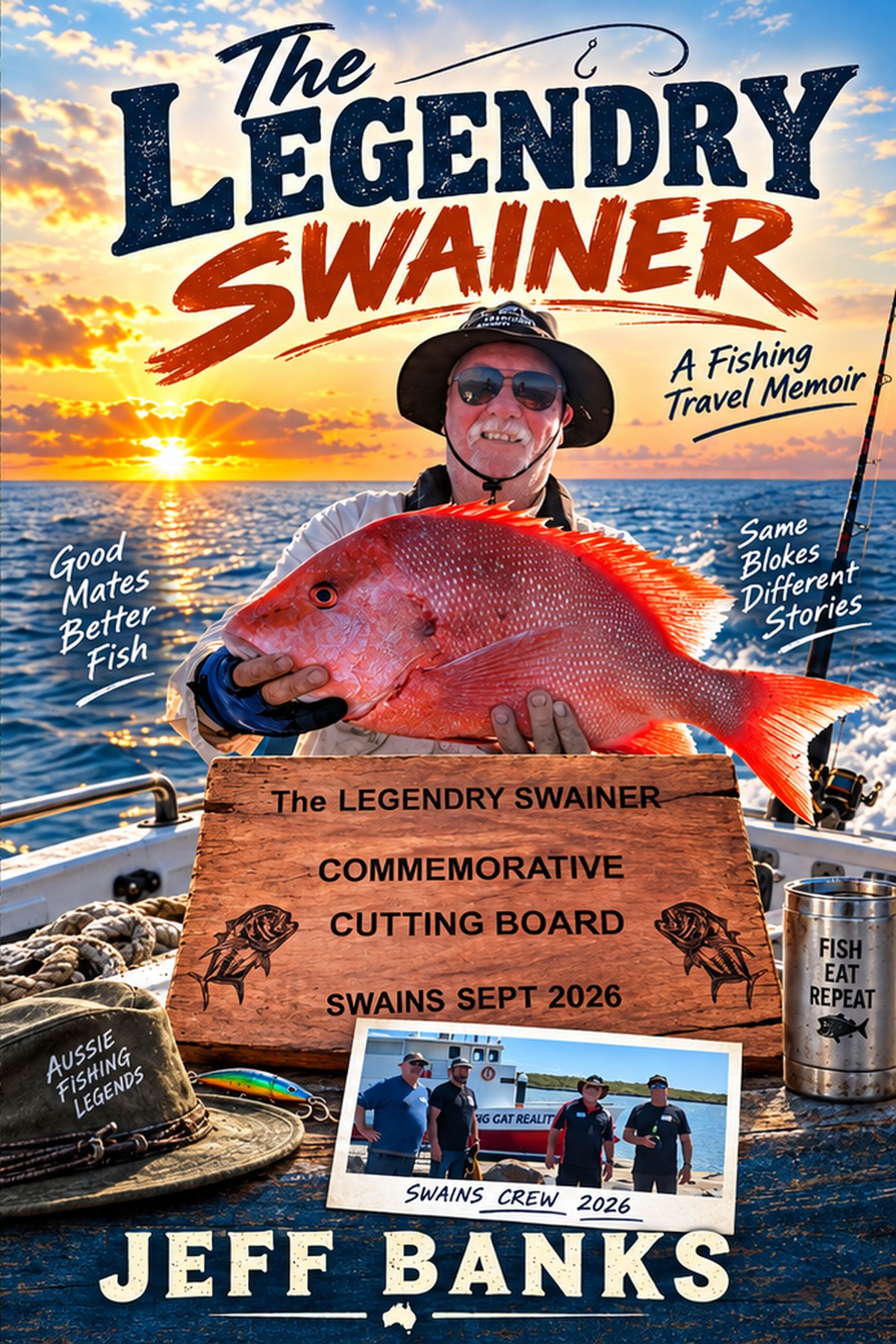
THE LEGENDRY SWAINER - Chapter 1 - Three Men Who Should Know Better

THE LEGENDRY SWAINER - Chapter 1 - Three Men Who Should Know Better | Travelling Around Australia with Jeff Banks

For Trevor, Ian and me, another Swains trip was probably inevitable from the moment somebody raised the subject. Ian did not require much incentive to find water, Trevor was close enough to retirement to be thinking about the things he still wanted to do, and I have never been particularly skilled at walking away from an adventure once it has become possible. We had all been there before, which gave us memories, confidence and the dangerous assumption that previous experience would count for something.

The Legendry Swainer

Four Mates, Seven Days and Far Too Much Confidence

Chapter 1 — Three Men Who Should Know Better

There is a certain confidence that comes from having done something before, particularly when sufficient time has passed for the uncomfortable parts to fade and the successful bits to improve in the retelling. Fishermen are particularly good at this. A previous trip can contain seasickness, broken tackle, missed fish, exhaustion, questionable decisions and several hours when nobody could buy a bite, yet within a few years it will have become one of the great expeditions of the modern age and compelling evidence that another one should immediately be organised.

Trevor, Ian and I had all been to Swains Reef before, although never together. That distinction would prove important because each of us consequently arrived with experience, opinions and enough personal history to believe our own version of how Swains should be fished deserved greater weight than the views of the other two. None of us was a novice, which removed the useful possibility that one man might quietly accept the advice of the others, and all three of us had fished aboard Kanimbla and thoroughly enjoyed the experience. We therefore knew enough to be dangerous and, more importantly, enough to be certain that whatever happened next could probably be improved by our involvement.

There is also a particular danger when three men who like fishing reach an age where they have acquired some disposable income, a reasonable collection of tackle and absolutely no reduction in the desire to prove something to one another. In younger years there might have been mortgages, children, businesses and other practical considerations standing between an idea and its execution. Those things had not vanished entirely, but age had provided a new argument: if we were going to do these things, perhaps we had better get on with them. That sounds wonderfully mature until you realise the thing we were getting on with involved spending a substantial amount of money travelling hundreds of kilometres north so we could stand on boats and argue about fish.

Trevor and Ian were the most obvious starting point because they had been getting one another into this sort of trouble for years. They had fished together at Swains, chased barramundi through the northern Queensland impoundments and gone looking for Murray cod in the Darling River around Louth. Ian owns a property on the river near Forster, which provides another excuse for the pair to gather around water whenever fishing alone is insufficient justification, and both possess a longstanding affection for water skiing. Give either of them a boat, a body of water and the faint possibility that something recreational might become unnecessarily competitive, and the weekend is largely organised.

I came into Ian’s orbit through Trevor at Caradon Ski Park on the Hawkesbury, which seemed appropriate because Ian has always struck me as someone who regards boats primarily as objects that should be driven faster. Trevor works in and on boats and consequently understands rather more about why they behave as they do. Ian understands that there is a throttle, that pushing it further tends to produce more speed, and that this is generally preferable. Somehow the two philosophies have coexisted for years without either man finding it necessary to concede that the other might have a point.

Fishing fits easily into their friendship because neither requires much encouragement to wet a line. The destination almost does not matter provided there is water, tackle and some possibility of producing a fish large enough to make the other man unhappy. They have enough shared fishing history to maintain a library of accusations, failures and disputed achievements, any of which can be retrieved without notice when current events require supporting evidence. That is one of the advantages of an old friendship: you never need to create new ammunition when there is already a perfectly serviceable stockpile accumulated over several decades.

Ian is a man who has all the toys, although describing them collectively as toys probably understates the scale of the department. He has worked hard, built successful businesses and earned the right to enjoy the proceeds, and enjoy them he does. There is nothing half-hearted about Ian’s recreational life because half-heartedness would suggest there might still be something in the catalogue he had not considered purchasing. He works hard and plays harder, an expression sometimes used loosely about people who work until five and then order the expensive wine, but in Ian’s case there is enough evidence to support the description.

His fortieth birthday probably provides as good an introduction as any. Some men facing forty buy a sports car, some start running, and others quietly begin reading the medical section of the newspaper with an interest they had previously reserved for football. Ian bought himself hair replacement therapy and his wife a boob job, then held a James Bond-themed birthday party complete with real fireworks to celebrate and announce the presents they had given themselves. Subtlety was not invited, although I suspect if it had arrived it would have been issued a tuxedo and told to enjoy the show.

The story is Ian in concentrated form. There is the confidence to do something because he wants to, the willingness to spend money on enjoying life and the complete absence of any requirement that the occasion be understated merely because other people might have handled forty differently. Yet underneath the toys and spectacle is a man who has fought hard for his successes and is extremely good at what he does. He and Trevor are both business owners, both driven, and both have had periods where drive and direction have not necessarily been the same thing, but success has not simply fallen into Ian’s lap no matter how much some of us may occasionally prefer that explanation.

Luck, however, does appear to maintain an unusually friendly relationship with him. Ian recently attended the meat raffle at the Bowlo and came home having won seven trays, which surely moves beyond luck and starts raising questions about whether the random-number generator had been compromised. He has also been known to sit at a poker machine and produce a positive financial result often enough for those of us observing to regard it with suspicion. Some might suggest luck is his superpower, although I have personally witnessed enough losing sessions to know the cape occasionally gets caught in the door.

This is important information when travelling on a fishing trip with him because fishermen have a complicated relationship with luck. When we catch a good fish ourselves, it is generally the result of preparation, lure selection, positioning, experience, patience and an almost spiritual understanding of what the fish was considering at the precise moment it attacked. When Ian catches one, there is always the meat raffle to consider. Statistical evidence must be respected, particularly when it helps explain why someone else has just caught the fish you wanted.

Trevor is different, although not so different that the two have ever struggled to find common ground near water. I knew Trevor first, and our history stretches back to a distressed business that came into my professional life after a new client walked into my Potts Point office on Valentine’s Day in 1988. Trevor was then the husband of one of the people working in that business, which is a suitably indirect beginning for a relationship that would wander through accounting, business, families, boats, fishing, baseball, road trips and enough shared experiences for him eventually to become the travelling companion at the centre of another of my books.

There are people who enter your life through some grand moment and others who simply keep appearing until one day you discover there is thirty or forty years of history sitting behind you. Trevor belongs firmly in the second category. Enough explored more of that history and forced me to reconsider some of my own narrow definitions of friendship, but on a fishing trip none of that needs to be announced with a violin playing in the background. Trevor is a mate, which in our world means I am entitled to say things about him that would probably end a newer relationship before morning tea, while he enjoys exactly the same privilege in return.

He works with his hands in a physically demanding form of self-employment, and there comes a stage in life when the body begins submitting formal objections to jobs the mind still considers perfectly reasonable. Trevor is somewhere around that stage. Retirement is close enough to be visible but apparently not close enough to prevent tomorrow’s job from still appearing on the schedule, and the years of manual work have begun leaving reminders that there was always going to be an invoice attached. Like me, he carries more weight than the medical profession would ideally recommend, but neither of us has yet accepted that this should prevent us doing anything we have already decided would be enjoyable.

There is a difference between recognising your physical limitations and allowing them to interfere with a fishing trip, and neither Trevor nor I has shown much enthusiasm for the second part. We can discuss weight, fitness, sore joints and advancing age with impressive intellectual honesty while simultaneously loading enough fishing equipment into a vehicle to suggest we are preparing to establish a permanent settlement. The fact that somebody younger, lighter and possibly more sensible might question the exercise simply proves they do not understand fishing. Age may bring wisdom, but fortunately it has not yet brought enough to stop us.

Trevor also likes people to know that he knows people. I do not think he sets out to impress anyone, and he probably does not realise how often a name or connection enters a conversation as evidence that he has some personal route into whatever subject is being discussed. Occasionally it makes him appear more insecure than he really is because there is a decent, capable bloke underneath who does not need any of the supporting cast he sometimes assembles around himself. Pointing this out to him directly would, of course, be completely inappropriate, which is why I have chosen the more sensitive approach of putting it into a book.

His loyalty to family is considerably easier to see. Divorced now, he remains fiercely connected to his children and until recently coached his two oldest in softball, often playing catcher in mixed teams alongside them. Trevor will get behind the plate willingly for his children, which is evidence either of paternal devotion or a disregard for personal safety that should have been investigated years ago. He was rather less enthusiastic about catching to me when we played baseball, insisting I threw too heavy a ball, an accusation I continue to regard as recognition of velocity rather than criticism.

This is the sort of disputed interpretation upon which our friendship has been built. I remember throwing hard; Trevor remembers his hand hurting. Both statements may technically be true, but only one contributes meaningfully to my preferred version of events. Fishing has allowed us to maintain this tradition because every day near water presents new opportunities for factual disagreement.

Then there is me, which becomes slightly more difficult because I own the keyboard and therefore have access to powers the others may eventually consider should have been regulated. Dumbing It Down examined the habit I developed of hiding ability behind the joker, allowing humour to make observations acceptable and sometimes reducing the apparent expertise so the room remained comfortable. Fishing with Trevor and Ian provides a rather different laboratory for that habit because neither has shown the slightest interest in keeping me comfortable. In their company, any attempt at modesty is generally treated as suspicious and any display of confidence as an invitation.

They enjoy sledging my tackle, my fishing knowledge and, whenever circumstances permit, my actual prowess. I own too much gear, according to people who also own too much gear, and I have too many opinions, according to two men who have never allowed absence of evidence to interfere with one of theirs. My reels, rods, knots, rigs, lure choices and methods can all be reviewed without notice by a committee that has neither been appointed nor asked to report. There is no appeal process because any attempt to present further evidence merely extends the hearing.

The joke truly is though, they own more!

The difficulty for them is that somewhere beneath the noise there is a scoreboard, and I have an inconvenient habit of occasionally performing rather well on it. I once took Ian out in my boat during one of the Repeller Cup fishing weekends and dropped him almost directly on top of the snapper that would win the competition. I deserve considerable credit for this because navigation, local knowledge and boat positioning are clearly important fishing skills, although Ian may point out that he was the man who actually hooked and landed the fish. My response is that it was the only fish he caught for the day, which restores the argument to its proper perspective.

Ian might call that selective accounting, but an accountant is entitled to present relevant information. The fact that I put him on the winning fish is relevant, as is the fact that the remainder of his day produced a score suggesting the winning snapper had accidentally wandered beneath the boat at precisely the wrong moment. Had I caught it, the event would almost certainly have demonstrated my deep understanding of structure, tide, bait movement and snapper behaviour. Because Ian caught it, further investigation remains warranted.

Trevor has also been supplied with evidence that quietly contradicts the official view of my fishing ability. Years ago, I went to Narooma with Trevor, his then wife and a mate to chase estuary flathead, and the weekend produced the sort of photographs fishermen enjoy because metre-plus flathead look magnificent when held correctly. They all caught metre-plus fish, which provided the obvious headline, ended up on the charter operator’s brochure for years to come and ensured I was in no danger of becoming the centre of attention. I sat quietly toward the back of the boat and accumulated fish until, by the end, I had caught more than the other three combined.

This created a serious problem in the interpretation of results. They had the glamour fish while I had the numbers, and every sporting code eventually discovers that trouble begins when nobody agreed beforehand about the scoring system. I was perfectly content to let them enjoy their metre-plus flathead because magnanimity comes naturally when you have already decided privately that you won. Had they caught more fish as well, I am sure quality would have remained the only measurement that mattered.

That is where Trevor, Ian and I sit as this story begins. We like fishing, we have done enough of it to possess confidence, and each of us has enough evidence from the past to support almost any position we might choose to adopt in the future. We also know one another well enough that nothing good is ever permitted to remain uncomplicated for long. A great fish will be admired, photographed and congratulated before somebody examines the rig, position, tide, luck, boat angle or divine intervention that made the achievement less impressive than first reported.

Trevor and Ian have the deeper shared fishing history, while I have always occupied a slightly different position. I am Trevor’s mate and long-time accountant, Ian became a client as well as a friend, and professional relationships have gradually blurred into boats, fishing trips and the sort of conversations for which no file note would ever be appropriate. There are situations where I have advised them on serious business matters and others where the most important subject before us has been whether one man’s fish was genuinely larger than another’s. I would like to think I bring the same commitment to evidence in both circumstances, although the standards may become flexible when I am personally holding the fish.

The sledging is constant because that is one of the languages of the group. To an outsider some of it might sound unnecessarily harsh, but an outsider has not heard the same stories recycled for years or watched the slight pause when one of us realises he has just given the other two something that may never be allowed to die. There are mistakes you make in life that disappear quietly with time, and there are mistakes you make while fishing with mates. The second group enters permanent storage.

Affection among men of our generation is not always particularly articulate, but it can be extremely practical. Trevor and Ian will help each other launch a boat, tow something, repair something, rig something or solve a problem while providing a detailed running commentary on why the other bloke was an idiot for needing the assistance. I fit comfortably into the same system. Help is available without much discussion, but dignity is not included in the service.

This may be why fishing suits us. It offers enough periods of genuine cooperation to establish that we are mates and enough individual moments of success or failure to ensure nobody becomes sentimental about it. Someone holds the net while another lands the fish, then immediately explains that the fish would have been lost without superior net work. Someone supplies a lure and later claims partial ownership of whatever it catches. Generosity is everywhere, but so is the invoice.

Against this established mess we eventually added Steve. Compared with the rest of us, Steve remained something of a mystery because our relationship with him had grown almost entirely through fishing. He owned the charter boat we liked to fish from out of Forster, possessed the easy nature required to spend long days with paying customers carrying sharp hooks, and seemed able to slide naturally into our conversations without appearing alarmed by any of us.

We knew he was married but had never met his wife, and we were not even completely sure whether there were children somewhere in the background. That lack of biographical information did not concern us because men can apparently spend entire days together on a boat discussing tides, bait, engines, weather, tackle, other fishermen and the precise location of yesterday’s bite without discovering basic information about each other’s families. What we did know about Steve was the thing that mattered in the environment where we knew him: he could fish.

There was also something slightly annoying about the way he demonstrated it. On days when the paying customers were struggling, Steve could wander forward into a section of his own boat largely inaccessible to the rest of us, drop a line and somehow produce a fish. It was as though the fish had been provided with a diagram of the vessel showing the area where passengers could not comfortably reach them, and Steve alone had been supplied with the corresponding map.

I always suspected there was more purpose to it than showing off. A charter operator wants people going home with fish, and if things are difficult, finding one himself at least confirms they are there and can sometimes change the mood of the boat. Nevertheless, understanding the professional reasoning does nothing to reduce the irritation of watching a bloke catch one from the part of the vessel where you cannot stand. Expertise is much easier to admire when it is not happening fifteen metres away while your own bait remains untouched.

Steve joined the Swains plan almost casually. The idea had been flowering through conversations aboard his boat, Trevor, Ian and I, along with another long term mate Dodger, discussing another run north with the confidence of men remembering previous trips rather than the discomfort of actually paying for the next one. Steve listened, the idea grew, and somewhere along the way the charter operator became the fourth fisherman. I am still not sure whether he fully understood what he had agreed to at that point.

He knew each of us, certainly, but knowing three men individually is not necessarily adequate preparation for spending an extended period with all three operating as a unit. There are compounds made from perfectly harmless ingredients that become unstable when combined, and Steve was about to receive the practical demonstration. He would arrive with genuine professional fishing experience, which gave him an obvious advantage, but he would also be entering a social environment where professional qualifications simply provide a higher starting point from which to fall.

The destination gave all four of us something else in common. We had each Swainsed before at different times, and all of us had experience aboard Kanimbla, an operation we regarded highly and had thoroughly enjoyed. Big Cat Reality was supposedly another level above that, which created both anticipation and a slightly dangerous set of expectations. If the cost was any guide, the fish should probably have been lining up at the stern wearing name tags.

Of course, cost has never entered into a binding agreement with fish. You can buy the best tackle, travel on the best boat, cross hundreds of kilometres of ocean and arrive at one of Australia’s most famous reef systems only to discover that the fish have not received the brochure. That uncertainty is supposedly part of what makes fishing attractive, although fishermen spend astonishing amounts of money trying to remove as much uncertainty as possible.

For Trevor, Ian and me, another Swains trip was probably inevitable from the moment somebody raised the subject. Ian did not require much incentive to find water, Trevor was close enough to retirement to be thinking about the things he still wanted to do, and I have never been particularly skilled at walking away from an adventure once it has become possible. We had all been there before, which gave us memories, confidence and the dangerous assumption that previous experience would count for something.

More importantly, we were going there together for the first time. Ian and Trevor brought decades of friendship and fishing history, I brought my slightly odd position as mate, accountant and fellow offender, and Steve was about to discover whether the easiest part of joining us had been saying yes. Somewhere ahead lay Bundaberg, Big Cat Reality, seven days of fishing and two trophies whose objective importance was negligible.

That last point would not survive long. Put four competitive fishermen on the same trip, give them something to win and then provide several uninterrupted days in which every success can be measured against somebody else’s, and perspective does not merely disappear; it packs its bags and stays home. We were three men who should have known better, plus one charter operator who was about to learn that knowing how to catch fish and knowing what to do with us were two entirely different professional skills.

Author

Menu