

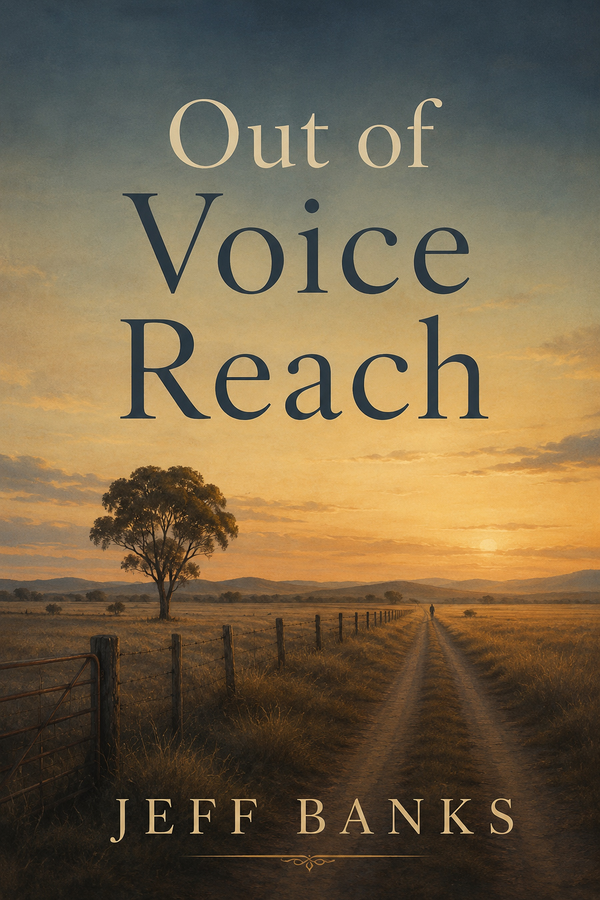
OUT OF VOICE REACH - Foreword

OUT OF VOICE REACH - Foreword | Travelling Around Australia with Jeff Banks

This book is for anyone who has ever wondered why success did not feel like arrival. It is for anyone who has ever been praised for coping while quietly wishing someone would ask what the coping was costing. It is for anyone who has stood close enough to hear the laughter but far enough away to wonder whether stepping in would be welcomed.

OUT OF VOICE REACH

A life spent trying to belong

Foreword

This book began with a phrase I had carried for most of my life without knowing it was a phrase. Out of voice reach was how I first understood distance, not as something measured on a map, but as something felt in the chest.

I grew up seven miles from the nearest settlement and beyond shouting distance of the nearest farm. That sounds almost romantic now, in the way childhoods in the country can be made to sound once enough years have passed, but at the time it was simply where we were, and where I was.

There was space everywhere, but not always company. There was sky, paddocks, work, weather, animals, machinery, dust, silence, and the kind of independence children are often praised for later, usually by people who were not there when the independence was being learned.

This is not a book about hardship in the grand dramatic sense. I was not raised in a war zone, a famine, or some tragic tale designed to make readers reach for tissues before the end of Chapter Two, though I would not object if anyone felt suitably moved along the way.

It is, instead, a book about something quieter. It is about growing up nearby but not quite included, present but not quite central, capable but not always seen, successful in some ways yet still carrying the old suspicion that the circle had closed just before I arrived.

That feeling followed me further than I expected. It went with me to school, into sport, into work, into business, into family life, into friendships, into community roles, and eventually to the edge of retirement, where I found myself with more time to hear things I had spent years trying not to listen to.

I had spent much of my life achieving. That is a respectable word, and a useful disguise. It looks good from the outside, especially if the invoices are paid, the children are launched, the clients are helped, the meetings are attended, and the polite public version of yourself keeps turning up on time.

But achievement does not always bring belonging. Sometimes it becomes the ticket you keep handing over at the gate, only to find the bloke on the other side has moved the entrance while you were looking down for your wallet.

This book is not written from bitterness, although hurt has its say. It is not written as an accusation, although some absences still have names. It is not written as a neat recovery story either, because life rarely arranges itself into those tidy arcs unless someone has been meddling with the truth.

I have lived a fortunate life in many ways. I know that, and I do not want to pretend otherwise. I have loved and been loved, worked hard, raised a family, built things, lost things, laughed at things that probably were not funny enough to justify the laughter, and kept going when stopping would have been easier.

Still, there are questions that wait patiently. They sit quietly in the back paddock of the mind, not demanding attention, just remaining there until one day you have fewer distractions and they begin to look a bit larger than you remember.

For me, the biggest of those questions was belonging. Not whether I belonged to a place on paper, or to a family by blood, or to a profession by qualification, but whether I had ever felt truly inside the circle rather than standing just near it, nodding as though I knew the words to the song.

Writing this has meant returning to places I thought I had left behind. Some of them are real places, with roads, fences, classrooms, sports fields, suburbs, offices and caravan parks. Others are emotional places, and they are harder to leave because they do not require fuel to get back to them.

There is humour here because there has to be. Without humour, memory becomes too self-important, and life has a way of puncturing self-importance with admirable efficiency. If you cannot laugh at yourself occasionally, retirement will give you plenty of spare hours to practise looking solemn, and nobody needs that.

There is also sadness here, because pretending otherwise would make the book dishonest. Depression has been part of the landscape, sometimes in the distance and sometimes parked right across the driveway. I have not always understood it, but I have learned that ignoring it does not make it polite enough to leave.

I have written this from the edge of full-time retirement, which is a strange ledge to stand on. People talk about retirement as though it is a holiday brochure, all caravans, beaches, grandchildren, golf, and finally getting around to cleaning the shed. There may be some of that, but there is also the unsettling business of asking who you are when work no longer answers first.

For many years I knew myself through usefulness. I could solve things, organise things, carry things, fix things, advise people, take responsibility, and generally insert myself into problems with the confidence of a man who believed he was helping and the occasional blindness of a man who probably was. Usefulness is a fine quality, but it can become a hiding place.

When the noise begins to settle, you find out what has been standing behind it. That is not always pleasant, but it can be honest. This book is one attempt to look at that honestly, without turning the past into either a complaint or a performance.

I have tried to write in the voice I actually have, not the voice I might choose if I were trying to impress a committee. It is reflective because I am looking back. It is conversational because I have never had much patience for unnecessary polish. It is Australian because that is the soil it grew from, even when the soil was dry, and it is understated because some things become less true when they are over-explained.

I do not expect every reader to have grown up on a remote property, or to have lived the particular pattern of my life. But I suspect many people know something of standing slightly outside the circle. They may have felt it in a schoolyard, a family gathering, a workplace, a marriage, a town, a club, a church, a business, or even in a room full of people who would have been surprised to hear they felt alone.

That is the odd thing about loneliness. It is not always the absence of people. Sometimes it is the absence of being known.

Out of Voice Reach is a story about distance, but not only the kind that can be driven. It is about the distance between who we appear to be and who we are trying not to be. It is about the distance between achievement and peace, between competence and comfort, between being useful and being wanted.

It is also about survival, though not in the dramatic film-trailer sense. More in the ordinary daily sense, where a person gets up, does the next thing, makes a joke, pays the bill, answers the phone, keeps the appointment, and hopes no one looks too closely at the cracks in the plaster.

I do not offer this book as wisdom from the mountaintop. I have never been especially comfortable on mountaintops, and I would probably be wondering how to get the caravan up there anyway. What I offer is a record of noticing, and perhaps a late willingness to admit that what we survive quietly still shapes us loudly.

If there is a thread running through these pages, it is not that I was excluded everywhere I went. Life is rarely that simple, and people are rarely that cruel on purpose. The thread is that I often carried exclusion with me, like an old coat I had outgrown but kept wearing because it was familiar.

Writing the book has not magically taken the coat off. I am suspicious of any story that claims one revelation fixes a lifetime. But it has helped me see the coat for what it is, and perhaps that is a start.

This book is for anyone who has ever wondered why success did not feel like arrival. It is for anyone who has ever been praised for coping while quietly wishing someone would ask what the coping was costing. It is for anyone who has stood close enough to hear the laughter but far enough away to wonder whether stepping in would be welcomed.

It is also for the younger version of me, the boy out beyond voice reach, learning silence before he had words for loneliness. He did not know then that the distance would follow him. He did not know either that one day he would sit down and write back to it.

That is what these pages are, in the end. A reply across the paddocks, across the years, and across all the places where belonging nearly happened.

Not a shout, exactly. More a voice finally carrying far enough.


About the Author

Jeff Banks is an Australian writer, retired tax accountant, husband, father, not yet grandfather, and occasional reluctant philosopher, although he would probably argue that most of the philosophy came from having too much time to think and not enough sense to leave some questions alone.

Raised on a grazing property seven miles from the nearest settlement, Jeff grew up with distance as part of ordinary life. What took longer to understand was that distance was not only geographical, and that the feeling of being nearby but somehow outside the circle could follow a person through school, sport, work, family, community, and even into retirement.

His working life was spent largely in tax, small business, advice, responsibility, problem-solving, and the familiar Australian habit of keeping going because there was always something else that needed doing. Along the way he built a life that looked capable from the outside, while privately carrying many of the doubts, silences and emotional bruises explored in this book.

Jeff writes in a plain, reflective and conversational style, shaped by country beginnings, business life, family experience, humour, depression, and the slow realisation that usefulness is not the same thing as belonging. His work is not written from a pedestal, or from the safe distance of someone pretending to have solved everything, but from the more honest place of still working it out.

Out of Voice Reach is his attempt to look back without either polishing the past or prosecuting it. It is a book about loneliness, achievement, resilience, retirement, memory, and the lifelong search for somewhere that feels less like standing near the fire and more like being invited to sit beside it.

Author

Menu