

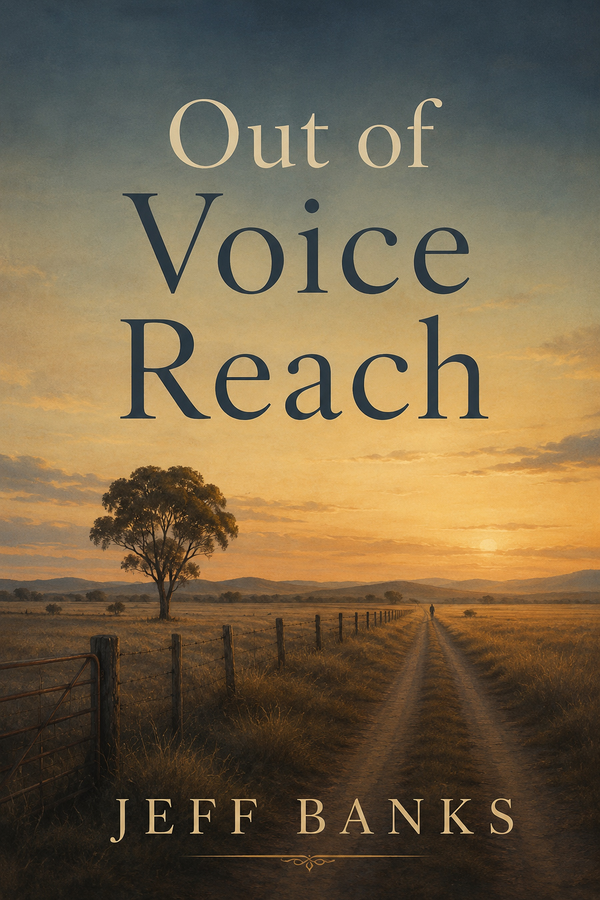
OUT OF VOICE REACH - Chapter 9 - Night School

OUT OF VOICE REACH - Chapter 9 - Night School | Travelling Around Australia with Jeff Banks

In the end, night school did not bring me fully inside the circle. Nothing has ever done that as cleanly as I once hoped. But it moved me closer to my own voice, even if I could not hear that at the time. It taught me that effort could repair some things, though not all things, and that a life can be rebuilt from disappointment without pretending disappointment never happened.

OUT OF VOICE REACH

A life spent trying to belong

Chapter 9 – Night School

Night school had a particular smell to it, or at least that is how memory has decided to keep it. It was not the smell of ambition, despite what people might like to say afterwards when the story has been cleaned up for respectability. It was the smell of old classrooms, dust, ink, tired bodies, chalk, damp coats when it had rained, and whatever dinner had been eaten too quickly before everyone found their way into another room under fluorescent lights.

By day I was trying to become useful in an accounting office. By night I was trying to become qualified enough for people to stop wondering whether I had any right to be there in the first place.

That is the part often missed when people talk about second chances. They make them sound generous, as though life hands you a fresh sheet of paper and says, “There you go, have another go.” My experience was that second chances came with the old writing still showing through underneath, especially if the first version had included a failed HSC, a missed university opening, and the quiet embarrassment of knowing that the path others seemed to take as a matter of course had not opened for me.

I had not arrived in Sydney with a plan so much as a need to go somewhere. I had left home for the big smoke after the sort of disappointment that does not simply bruise the ego but changes the way you hear your own name. There had already been the Air Force rejection before the HSC, and that had carried its own sting because it seemed to confirm something I had been trying not to believe. Then came the HSC itself, with marks that looked less like a result and more like a verdict, and I found myself standing at the edge of a life I had not properly imagined.

Coming from the land, I had been raised among practical expectations. You worked, you did what needed doing, and if something broke you did not stand around discussing your feelings about it unless you wanted the sheep to write in and complain. There was a certain comfort in that, but there was also a trap, because when the thing that broke was inside you, the same rule seemed to apply. You got on with it, or at least you looked as though you were getting on with it, which in my family and in many families of that time was considered close enough.

Sydney was not waiting for me with open arms. Sydney did not know I had been good at school once, or that I had played sport well, or that I had lived seven miles from the nearest settlement and had already spent a fair portion of my life trying to close the distance between myself and other people. Sydney was simply large, busy, impatient, and full of people who seemed to know where they were going, even when I suspect many of them were only pretending.

I had gone there because my cousin Phil invited me down, and because sometimes an invitation is enough when you have run out of better ideas. I remember the practicalness of it all, the Saturday paper, the Sydney Morning Herald spread out like a map of possible lives, and the job advertisements sitting there in neat columns as though choosing one was a simple administrative task. I rang a few accountants, arranged an interview, and within days I had fallen into accounting, which is probably the most honest description of the start of my professional life.

People like origin stories to be more deliberate than that. They prefer the young man with a clear goal, a shining ambition, and perhaps a well-pressed shirt that suggests destiny has at least been consulted. I was not that young man. I was a country boy with bruised pride, a need to earn money, and a habit of trying to make myself valuable before anyone had the chance to decide I was not worth keeping.

Accounting suited parts of me before I understood why. It had rules, structures, balances, ledgers, and the strange comfort of numbers that either worked or did not. There was a discipline to it that appealed to someone who had always tried to be better as a way of getting inside the circle. If you could reconcile the figures, lodge the return, find the error, or explain the position clearly enough, then perhaps you could also justify your own position in the room.

Of course, it was not quite that simple. Nothing important ever is, despite the number of people who make a living pretending otherwise. The work gave me a way forward, but it also introduced a new form of distance, because I was surrounded by people who seemed to carry credentials as naturally as I carried doubt.

I had missed the university route. That fact mattered more than I wanted it to, because Australia has always been fond of saying it respects practical experience while quietly checking who went where and what letters they are entitled to place after their name. I had come from a grazing property, from an outlying school, from a childhood spent outside the immediate reach of neighbours and towns and easy belonging. Now I was in offices where people spoke the language of qualifications, articles, institutes, certificates and career paths, and I was once again learning the geography of being nearby but not quite included.

TAFE became the bridge, or perhaps the plank, because bridge sounds too grand for what it felt like at the time. I enrolled in accounting, partly because it was sensible and partly because the partners saw that it might give me a better grounding than waiting for some more polished opportunity to appear. George and Bruce sent me to night classes, and I was grateful for it, though gratitude did not make the evenings shorter or the days any less tiring.

The routine was simple enough to describe and harder to live. Work during the day, study at night, and somewhere between the two try to eat, wash, travel, think, and remember that you were still meant to be a young man with some sort of life outside obligation. The hours between six and nine belonged to textbooks, not teammates, and the fluorescent lights became another kind of paddock fence, marking where I could and could not go.

Sport had been my earlier language of belonging. At primary school it had given me relief from the awkwardness of being the child from somewhere else, even when most of the other children were related to one another and I was expected to fit by proximity rather than feeling. At secondary school, representative sport had given me status of a sort, though even then it was a conditional visa. You were accepted while you performed, admired while you contributed, and judged again the moment you seemed to be getting above yourself.

By the time I was working and studying, sport was no longer simply sport. It was the road not taken, the life not quite lived, the proof of something in me that had once been visible to others. Cricket and rugby league still mattered, not because I imagined myself some destined champion denied by cruel fate, but because they had been among the few places where I had felt my body knew what to do before my mind could get in the way.

There is a particular grief in letting go of something before you are ready. It is not always dramatic, and there is rarely a ceremony for it. No one turns up to say, “Today we acknowledge the end of this young man’s sporting possibilities, and we thank cricket nets and football boots for their service.” More often, you simply miss training because there is a lecture, then miss another because there is an assignment, then find that the team has kept moving without you.

I still played where I could. That was the stubbornness in me, or perhaps the unwillingness to accept that one identity had to die in order for another to survive. I played cricket, and later found myself around Sydney University Cricket Club, a place that carried its own strange irony because I had never gone to Sydney University and yet there I was, involved with its club, trying once again to belong inside an institution that was adjacent to me rather than truly mine.

That sort of belonging can be awkward. You can wear the colours, do the work, attend the meetings, help keep the thing functioning, and still feel a small voice inside asking whether someone will eventually look up from the table and realise you came in through the side door. It was not that anyone necessarily said it. Sometimes the cruelest exclusions are not spoken at all; they are simply absorbed from glances, assumptions, pauses, and the old class system that pretends it does not exist in Australia while quietly pulling up a chair at every important table.

John Grimble introduced me into that cricket world, and I was good enough to be useful. That phrase, useful, appears often in my life, and I do not think that is accidental. Usefulness became the compromise I offered the world when I was not sure I could ask for affection, acceptance or ease. If I could do the job, balance the books, fill the position, take the catches, bowl the overs, make the numbers work, or fix the mess, then perhaps I could stay.

At Sydney University Cricket Club I was not simply a player. I became Treasurer, which in hindsight feels almost inevitable, because even in places where I was trying to hold on to sport, accounting found me and put a ledger in my hand. There were late payments, dealings with the University hierarchy, and all the little tensions that sit beneath the surface of amateur sport when everyone wants the romance of the game but someone still has to pay the bills.

I helped run the Club’s finances through a practice trust account, alongside Max Bonnell, and there was a certain satisfaction in making a complicated thing workable. It gave me standing of a kind, though standing is not the same as belonging. I could talk to officials, chase money, sort out accounts, and help the machine keep turning, yet part of me remained the country boy looking across the room at the people who seemed born knowing the rules.

There were moments when cricket reminded me of what might have been. I had come from park cricket at A Grade level, and I was above average, which is a modest phrase but probably more honest than most sporting descriptions. I was never going to build a life on romantic exaggeration, and in any case there are enough men in pubs across Australia who were apparently one selection meeting away from immortality before work, injury, marriage, selectors, weather, or bad luck intervened.

Still, I could play. I knew enough about myself to know that. I also knew that the game was moving on without asking whether I was ready to give it permission. Cricket nets did not wait for night school to finish, and rugby league training was not rescheduled because a young accountant needed to understand ledgers, taxation, audit work and the professional language that might one day make him acceptable.

Rugby league slipped away in much the same manner. There were opportunities around Kingsgrove Colts and St George Sub Districts, and there was the old feeling of possibility in the body, that sense of running into space and finding for a moment that the noise in your head had been replaced by instinct. But lectures and work took precedence, and perhaps I let them because professional justification began to feel more urgent than sporting enjoyment.

That is one of the traps of being someone who has spent too long trying to prove himself. You begin to mistrust anything that does not look like progress, even if it is the very thing keeping you alive inside. Sport had once given me solace, but solace did not pay rent, build a career, or explain to a room full of qualified people why I should be taken seriously. So I chose the thing that looked responsible, and told myself the other thing could wait.

It did not wait, of course. Youth is generous in many ways, but it is not patient forever. The legs that might have trained three nights a week were sitting in classrooms, and the evenings that might have been spent at nets or on a paddock under lights were spent with textbooks, exercises, lectures and the dull ache of trying to stay awake after a full day’s work.

I do not want to overstate the tragedy of it, because that would be dishonest. Plenty of people have given up more than cricket practice or football training in order to build a life. But there is a quiet sadness in recognising that some possibilities do not end because you fail at them; they end because another responsibility becomes louder. In my case, study and work spoke with the voice of survival, and sport could not compete with that.

There was also pride in the study, even if I rarely admitted it cleanly at the time. TAFE was not second-best in the way some people might imagine, because it gave me a grounding that was practical, detailed and connected to the work I was actually doing. I was learning by day and learning again by night, and the two fed each other in a way that suited someone who had never been especially comfortable with theory floating too far above the ground.

Accounting, at its best, is not just numbers. It is evidence, discipline, explanation and consequence. It asks you to justify a position, support a claim, reconcile a difference, and understand that a small error ignored long enough can become a much larger problem. Looking back, I can see why it appealed to a young man who felt he had been trying to reconcile himself from childhood.

The trouble was that I also began to treat myself like an account that would not balance. If I worked harder, studied longer, performed better, helped more, volunteered again, said yes when I should have said no, then perhaps the debit column of not belonging would finally be matched by the credit column of usefulness. That is not how human life works, but I did not know that then, and to be fair I am not sure I have fully learned it even now.

The professional world had its own schoolyard. It was more polite, better dressed, and less likely to settle matters by picking teams in front of everyone, but the same feelings could be found underneath. There were insiders and outsiders, those who had the expected background and those who had to explain themselves, those whose confidence seemed inherited and those of us who had to construct ours out of results.

I learned quickly that competence could open doors, but it did not always make you feel at home once you were inside. That had been true at school and on sporting fields, and it remained true in accounting offices. Being good at something could make people notice you, rely on you, and even respect you, but respect is a different animal from belonging. Respect can stand at a distance and nod; belonging pulls out a chair and expects you to sit down.

I was often noticed before I was known. That had been the pattern since childhood, when academic ability made me visible in ways that were not always comfortable and sport made me useful in ways that were not always secure. In the office, the same pattern repeated itself with new clothing. If I could produce the work, understand the system, speak clearly enough, and keep the pressure contained, I was valuable. Whether I was truly part of anything was another matter.

There is a loneliness in professional striving that people do not often admit. The public version is all progress, ambition, discipline and upward movement, while the private version can be a young man travelling home after class wondering whether any of it will be enough. Enough for what, I could not always have said. Enough to erase the HSC result, perhaps. Enough to answer the Air Force rejection. Enough to prove that leaving the land had not been an act of failure dressed up as courage.

At night school I sat among others who were also tired, also trying, and also hoping that the hours would eventually add up to something larger than exhaustion. Some were there with clear purpose, some because employers had sent them, and some because life had narrowed their options and education was the remaining opening. I did not always know which group I belonged to, which was fitting, I suppose, because belonging had never been my simplest subject.

There were evenings when the work made sense and I felt the quiet pleasure of mastering something. There were other evenings when I looked at the page and felt only the weight of all the distance that had brought me there, from the farm road to the school bus, from the outlying school to the secondary school twenty miles away, from representative jumpers to office shirts, from cricket whites to the ordinary clothes of a young man trying not to look lost. Memory does not keep those evenings in tidy files. It keeps them in fragments, and perhaps that is more honest.

I can still picture the movement from day into night. Leaving work with the head still full of someone else’s accounts, travelling to class, sitting down again, and trying to summon the concentration that youth can sometimes find simply because it has not yet learned how unreasonable the demand is. There were no great declarations. There was just the stubborn act of turning up.

Turning up has been underrated in my life. It is less glamorous than courage and less marketable than motivation, but it has probably saved me more often than either. I turned up to school when I felt outside it, turned up to sport when acceptance depended on performance, turned up to work when I was not sure I belonged there, and turned up to night school because absence would have felt like agreeing with every verdict I had ever feared.

It would be tempting to write this chapter as the moment I found myself. That would be tidy, and tidy stories have a way of selling better than true ones. The truth is that night school did not cure the ache of not belonging, and professional progress did not magically transform me into someone comfortable in his own skin. It gave me tools, not peace.

Still, tools matter. A man without tools can stand for a long time beside a broken fence feeling philosophical, but the sheep will not be impressed. Accounting gave me tools, and TAFE sharpened them. Work gave me practice, and responsibility gave me a reason to keep going when pride alone might not have been enough.

The lost sporting possibilities stayed with me, though not always as regret. Sometimes they felt like another version of myself walking a parallel road, carrying a cricket bag or football boots instead of ledgers and textbooks. He was not necessarily happier, that other me, and he may well have found his own ways to feel outside the circle. But I think of him sometimes, not with bitterness, but with the tenderness one reserves for a life that almost happened.

There is a particular kind of mourning that comes with growing up. It is not only the loss of childhood, but the loss of all the selves you can no longer become. The representative athlete, the university student, the Air Force recruit, the farm boy who might have stayed closer to the land, the young man who might have played more and worried less, all of them gradually step aside so the person who must pay rent and build a future can pass through.

I do not think I understood then how much of my professional striving was built on fear. Fear of being exposed as less than others assumed, fear of being dismissed as the country boy who had come too far without the right papers, fear of wasting the second chance I had not been formally granted but had taken anyway. Fear is not always dramatic. Sometimes it wears a tie, carries a folder, and stays back late to make sure no one can find fault.

The professional world rewarded that, of course. Workplaces are very good at admiring the habits that slowly wear people down, provided the results arrive on time. If you are willing to take responsibility, solve problems, hide exhaustion, and call it character, there will always be someone ready to call you reliable. I became reliable early, perhaps because reliability seemed safer than asking to be understood.

Night school fed that reliability. It taught me discipline, but it also reinforced the idea that my place had to be earned again and again, not simply held. I could not rest on natural ability, as I may have done too easily at school. I could not rely on sport to carry me into a group, as it sometimes had. I had to build a professional self one evening at a time, with the anxious care of someone constructing a bridge he was not fully convinced would hold.

There were good people along the way, and it would be unfair to pretend otherwise. George and Bruce saw something useful in sending me to class, and not every professional gate was locked against me. Some people offered encouragement in their own restrained way, which in accounting usually meant giving you more work because they believed you could do it. It was not exactly a cuddle, but in that world it counted for something.

I met people through study and work who shaped the years that followed, including Clare at TAFE, and life kept moving in the way life does when you are too busy to realise how quickly the scenery is changing. There would be relationships, children, houses, practices, responsibilities, mistakes, achievements, and eventually the heavy collapses that come when too many boxes have been stacked badly for too long. But at that stage I was still in the building phase, still believing that enough effort might make the structure sound.

Looking back from the edge of retirement, I can see the innocence in that belief and the danger in it. I built much of my life on the assumption that usefulness would protect me from exclusion, depression, failure and loneliness. It did not, at least not permanently. But it did give me a way to survive long enough to learn that survival and belonging are related but not the same.

Retirement has a way of sending you back into old classrooms. Not literally, though I have sat in enough seminars in later life to know that fluorescent lighting remains one of civilisation’s more subtle punishments. I mean emotionally. When the work begins to loosen its grip, when clients no longer need you in quite the same way, when the phone rings less for professional emergencies and more for matters you cannot fix with a spreadsheet, you are left sitting again with the old question of who you are without the proof.

That question began long before retirement. It was there in the classrooms at night, in the offices by day, in the sporting commitments missed because another lecture had to come first. It was there when I stood near institutions I had not properly entered and tried to make myself indispensable enough that no one would ask too closely how I had arrived. It was there in the ledger of my own life, where I kept trying to make achievement equal acceptance.

I do not regret night school. That would be too easy, and too ungrateful. It gave me a profession, a language, a discipline, and eventually a way to help people through some of the more confusing parts of their financial and business lives. It also gave me the strange authority that comes from having learned things the hard way, which is not always efficient but does tend to stay with you.

But I do regret, a little, the young man who thought every choice had to be justified by productivity. I regret that he could not always see play as worthy, rest as necessary, or belonging as something other than the reward for exceptional effort. I regret that cricket and rugby league became luxuries he felt he could not afford, because even now I know there are parts of a person that are only kept alive by the things that seem impractical.

Perhaps that is why the memory of night school is not simply heavy. There is sadness in it, yes, but also affection for the stubbornness of that young man who kept turning up. He did not know what he was building, and he certainly did not understand what it would cost him. But he understood, in his own unsophisticated way, that failure did not have to be the final entry.

The farm had placed me out of voice reach before I had words for what that meant. School had taught me that achievement could bring attention without necessarily bringing closeness. Sport had offered belonging that lasted only while I was useful to the team, and the professional world was now teaching me a similar lesson in cleaner shoes. Night school was where all those lessons met under fluorescent lights, with textbooks open and the evening slipping away.

I was trying to become an accountant, but I was also trying to become acceptable. I was trying to prove that the boy from the outlying school, the failed HSC candidate, the rejected Air Force hopeful, the country kid who had come to Sydney without a proper map, could still find a place among people who seemed to have started closer to the centre. That may not be the noblest reason to study, but it was a powerful one.

In the end, night school did not bring me fully inside the circle. Nothing has ever done that as cleanly as I once hoped. But it moved me closer to my own voice, even if I could not hear that at the time. It taught me that effort could repair some things, though not all things, and that a life can be rebuilt from disappointment without pretending disappointment never happened.

There are still evenings, even now, when I think of those classrooms and the young man sitting there after work, tired but present, watching the lecturer fill the board while some other version of him might have been at cricket nets or football training. I want to tell him that he was not wrong to keep going, but that he was worth more than the work he could produce. I am not sure he would have believed me, because I am not always sure I believe it myself.

Still, he turned up. Sometimes that is where the whole story rests, not in triumph, not in belonging, not in the neat closing of a circle, but in the simple refusal to disappear. Night school was not glamorous, and it was not a clean rebirth. It was a tired young man under hard lights, trying to learn enough to stay in the room, while somewhere outside in the dark another road quietly closed behind him.

Author

Menu