

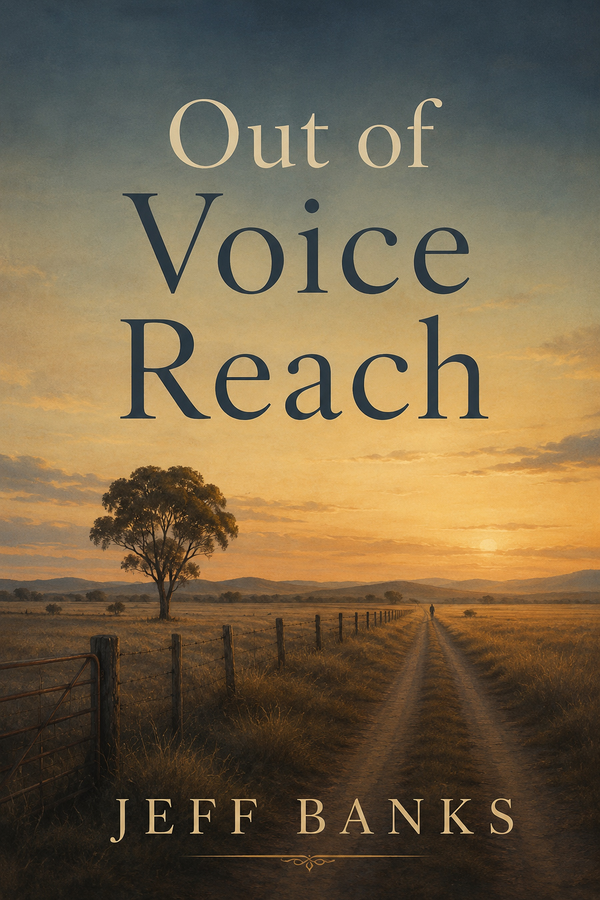
OUT OF VOICE REACH - Chapter 7 - Sydney Without a Map

OUT OF VOICE REACH - Chapter 7 - Sydney Without a Map | Travelling Around Australia with Jeff Banks

Sydney did not give me a map. It gave me another version of the old lesson, which was that belonging cannot always be earned by being better, braver, quieter, tougher or more useful. Sometimes you can do everything expected of you and still feel outside the circle. Sometimes the world you enter belongs so completely to other people that your first task is not to conquer it, but simply to stand there long enough to stop disappearing.

OUT OF VOICE REACH

A life spent trying to belong

Chapter 7 – Sydney Without a Map

I do not remember arriving in Sydney with any great sense of adventure. That is probably because adventure is what other people call it when they are watching from a safe distance, preferably after the difficult parts have been edited out.

For me, Sydney was not an adventure. It was a size, a noise, a rush of people who seemed to know where they were going, and a set of rules nobody had thought to explain to the boy from out past the edge of town. I had grown up measuring distance in miles of road, school bus routes, paddocks, fences, creek crossings and the stretch of country between one human voice and the next. Sydney measured distance differently. It measured it in train platforms, street numbers, suburbs, timetables, office hours, locked doors, traffic lights and the cold knowledge that nobody was particularly looking for me.

That was the first shock, I suppose. Not that I was alone, because I knew something about being alone. I had grown up with it as a kind of background weather, something always present, sometimes harsh and sometimes almost comforting because at least it was familiar. The shock was that Sydney was full of people and still managed to make loneliness feel larger than it had ever felt on the farm.

Out there, being out of voice reach had a simple meaning. You could stand in the yard and call as loudly as you liked, and unless the wind was in a particularly generous mood, nobody on the next place would hear you. It was practical isolation, almost geographical honesty. Sydney was different, because there were voices everywhere, but none of them seemed to be calling to me. I could stand among thousands and still feel further away from help than I ever had seven miles from town.

I had come for employment, which sounds neater than it felt at the time. Employment has a proper adult sound to it, the sort of word that suggests a young man stepping firmly into the world with polished shoes, a sensible haircut and a confidence he may or may not deserve. I had some of the outward parts of that, or at least enough to pass inspection from a distance. What I did not have was a map for how to live inside a place that did not slow down long enough for a newcomer to ask where he fitted.

Work was supposed to solve things. That had already become one of the dangerous beliefs of my life, though I would not have had the language for it then. Work gave structure, and structure gave purpose, and purpose could be mistaken for belonging if you did not look too closely. It was a lesson I had already learned through school and sport, long before I had a job. Be useful, be competent, do the thing well enough, and for a little while someone may let you stand inside the circle.

The trouble was that employment did not ask whether you belonged. It asked whether you turned up, whether you understood instructions, whether you learned quickly, whether you kept your head down, and whether you could make yourself presentable enough to be accepted as another young man trying to make his way. Those were easier questions to answer. I could work. I could learn. I could apply myself with the kind of grim determination that looks admirable from the outside and feels like fear when you are the one carrying it.

There was comfort in the routine, even if it was not a warm comfort. A workplace has its own geography, and once I began to learn it, I could at least pretend the ground beneath me was steady. There were times to arrive, things to do, people to answer to, and small rules that could be collected and studied until I stopped looking quite so lost. I had always been good at systems, even before I knew that was what they were. Give me a set of expectations, however poorly explained, and I would try to master them because mastery had long been my substitute for ease.

But outside work, the map disappeared. The city did not become mine just because I had somewhere to be during the day. When the working hours ended, I stepped back into a place that belonged to everybody else, or at least seemed to. People went home to families, flats, friends, girlfriends, pubs, routines and suburbs that sounded like places from a language I had not yet learned. I went back to accommodation that did what accommodation is meant to do, which is provide a bed, a roof and a door, but not necessarily a home.

The Salvation Army home was one of those places that could be described in simple words and still not properly understood. It was shelter, and shelter mattered. I do not write about it with contempt, because there is nothing contemptible about a place that gives people somewhere to sleep when they need it. The Salvos have caught plenty of people over the years who were slipping through the cracks, and at that time I was probably closer to a crack than I wanted anyone to know.

Still, being grateful for a bed did not mean feeling at home in it. The place had its own sounds, its own smell, its own parade of men and stories and silence. Some people were there because life had gone wrong in ways that were visible. Others, like me perhaps, were there because life was supposed to be going right, but the inside of it did not feel that way. I had employment, which made me respectable enough on paper. I also had the strange sensation of being stranded in a city where respectability did not provide companionship.

I think that was one of the hardest parts to admit, even privately. I was not destitute in the way people usually mean the word, and I was not without ability, prospects or pride. In fact, pride was part of the problem. Pride can keep a young man upright, but it can also stop him putting up his hand and saying he has no idea what he is doing. It can make him tidy his shirt, polish the surface, and pretend the inside is not rattling loose.

There were cousins in Sydney at the start, and their presence must have softened the first blow. Family, even when not intimate, can create a little bridge between one world and another. A cousin’s place, a familiar surname, a remembered connection from the wider web of relatives can make a city feel less like a foreign country. It does not necessarily make you belong, but it can give you somewhere to stand while you work out what comes next.

Then they left. I do not want to over-dramatise it, because people leave places all the time and usually for perfectly ordinary reasons. They had their own lives to live, and no life should be required to organise itself around my uncertainty. But when they left, something practical became emotional. The little bridge was gone, and suddenly Sydney was not just big. It was big without anyone in it who automatically knew I existed.

That is a peculiar kind of stranded. It is not like being broken down on the side of a country road, where at least the problem is obvious and some passing vehicle might stop if the driver is decent. This was more invisible. I could walk down a street looking normal, employed, capable and young, while inside I was trying to work out how a person could be surrounded by human life and still feel as though he had been misplaced.

I had been an outsider before, of course. Primary school had taught me that being related to half the district did not guarantee acceptance. Secondary school had taught me that coming from the outlying school carried a mark that achievement could not quite erase. Sport had offered belonging, but it was always conditional on performance and always vulnerable to the next selection, the next match, the next whisper that perhaps I thought I was better than I was. Sydney simply changed the scenery. It took the old feeling and put it on a much larger stage.

In the country, people know enough about you to judge you properly, or at least they think they do. They know where you are from, who your parents are, what school you went to, whether you can play, whether you are a worker, whether you have tickets on yourself, and whether your family has ever done anything useful or embarrassing enough to be remembered. Sydney offered the opposite cruelty. It did not know me at all. Nobody had enough information to reject me personally, which should have been a relief, but instead it made me feel strangely erased.

There is comfort in being known, even when being known comes with labels. I would not have said that then, because I was too busy trying to escape some of those labels. The farm boy, the outlying school boy, the good student, the representative player, the one who kept striving because stillness would have been too revealing. I thought perhaps the city might offer a clean start. What it offered instead was anonymity, and anonymity is only freedom when you already know who you are.

I did not know who I was. Not really. I knew what I could do, which is not the same thing. I knew I could work, study, push, compete, behave, endure and keep putting one foot in front of the other. I knew how to be useful. I knew how to make competence look like confidence. But when the day ended and usefulness was no longer required, I was less sure what remained.

That is where the Salvation Army home sits in my memory, not as a dramatic fall but as a quiet exposure. It revealed how thin the covering was between the person I presented and the person underneath. During the day, employment gave me a role. At night, the role came off, and I was another young bloke in a place that was not mine, listening to the unfamiliar movements of other lives through walls and corridors.

There is a kind of education in that. Not the education of classrooms, examinations or certificates, but the education that comes when life quietly removes your props. I had been used to measuring myself by achievement, and in Sydney achievement had not yet accumulated enough to protect me. I was at the beginning again, which should have been exciting according to the usual script. Instead, it felt like being dropped into someone else’s world with no instructions and being expected to act grateful for the opportunity.

Perhaps I was grateful, in some ways. I had work, and work meant wages, and wages meant the possibility of movement. I had escaped the narrowness of earlier places, or at least I thought I had. There is a hunger in young people from the country that is hard to explain, because it is often mixed with resentment and longing at the same time. You want to leave, but you do not necessarily want to be cut loose. You want the larger world, but you are offended when the larger world does not pause to recognise what it cost you to arrive.

Sydney did not pause. It surged. Trains came and went with ruthless confidence. Streets crossed other streets without apology. People stood on platforms as though born with the knowledge of which line to catch, which exit to use, which direction to walk when they surfaced above ground. I watched and copied. That became another skill, and I have done a fair bit of it over the years. When you do not instinctively belong, you learn to observe the people who appear to.

Observation can save you, but it can also separate you. It places a pane of glass between you and the room. You see how people speak, laugh, move, spend money, order meals, share jokes and make plans without seeming to wonder whether they are entitled to be there. You gather the information and try to use it, but the very act of gathering reminds you that you are not moving naturally. You are translating.

I suppose that is why the title of this chapter has stayed in my head as Sydney Without a Map. I may have had maps in the literal sense, or directions scribbled somewhere, or instructions from someone who assumed a street name meant the same thing to me as it did to them. But I did not have the map that mattered. I did not know how to turn employment into belonging, a bed into a home, relatives into a network, or a city into a place where my voice might carry.

The old habit, naturally, was to try harder. That habit had served me well enough to become dangerous. If school made me feel separate, I would be better at school. If sport gave me a brief place, I would run harder, train harder, play harder, and chase the next level. If work was now the doorway into adult life, I would become good at work. The answer was always more effort, because effort was the tool I trusted.

But effort could not make Sydney love me. It could not make a hallway feel like a kitchen table, or a crowded street feel like a familiar road home. It could not make cousins stay, or create the easy intimacy of people who already had their group. Effort could help me survive, and survival is no small thing. It just could not answer the quieter question of whether surviving was the same as living.

There were probably moments of humour, because there usually are, even when life is not feeling particularly generous. I imagine I looked like what I was: a country-bred young man trying to appear worldly while privately astonished by things city people treated as ordinary. There is something faintly ridiculous about thinking you are mature because you have left home, only to discover you do not know how to belong anywhere after work finishes. The city does not care about your representative honours, your school marks or whether you could ride a horse. It has its own tests, and I was sitting them without knowing the syllabus.

That is not to say the country had prepared me for nothing. It had given me endurance, and endurance is a useful, if sometimes overrated, gift. It had taught me to get up, keep going, make do, read weather, read people, and not expect the world to arrange itself kindly around my feelings. It had also taught me to hide hurt behind performance, which was less useful but deeply ingrained. Sydney did not create that pattern. It simply gave it room to grow.

Looking back, I can see the depression in the corners of the picture, though I doubt I would have named it then. There was heaviness, certainly, and a kind of inner drag that made ordinary tasks feel larger than they should have been. There was the old self-questioning, the voice that asked what was wrong with me, why I could not simply be like other people, why belonging always seemed to require qualifications I did not possess. I could still function, which is one of the misleading things about depression. Functioning convinces others, and sometimes yourself, that nothing serious is happening.

I have spent much of my life being able to function. That may sound like a blessing, and in many ways it has been. It allowed me to build, work, provide, contribute, organise, advise, lead, fix and carry more than I should have carried. But functioning can also become a disguise so effective that even the wearer forgets it is a disguise. In Sydney, I was learning how to appear all right in a world where I was anything but settled.

There is a difference between being independent and being unsupported. At the time, I may have confused the two because independence sounds noble and unsupported sounds a bit too close to failure. Country people, or at least the country people I grew up around, were not always fluent in the language of needing help. You got on with it. You did not make a fuss. You certainly did not announce that the city was too big, the bed too impersonal, the future too unclear, and the silence after work too loud.

So I got on with it. That sentence could probably be carved into the headstone of half the people I grew up among, and not always as a compliment. Getting on with it is admirable until it becomes the only emotional strategy you possess. It moves you forward, which matters, but it does not necessarily heal anything. Sometimes it just carries the wound to a new address.

The cousins leaving became part of that wound, not because they had done wrong, but because their departure exposed what I had been relying on. A person can be braver when he knows someone familiar is nearby. Even if he rarely calls on them, the knowledge itself steadies him. Take that away, and the same street looks different. The same job feels thinner. The same bed becomes a reminder rather than a refuge.

I can see now how much of my life has been shaped by these removals. A bus route changes, and suddenly the distance to school is different. A school changes, and the old standing has to be earned again. A team changes, and the place you thought you had in it becomes uncertain. A cousin leaves Sydney, and the city that was difficult becomes something colder. None of these events alone explains a life, but together they form a pattern. Each time, I learned again that belonging could not be assumed.

Perhaps that is why I clung so fiercely to competence. Competence was portable. You could take it from the farm to school, from school to sport, from sport to work, from one town to another, from one stage of life to the next. It did not require anyone to like you first. It did not require warmth. It only required effort, discipline and the willingness to be judged by output rather than need.

The danger, of course, is that competence can become a lonely country of its own. People come to rely on you before they come to know you. They trust the function and miss the person. They assume strength because you keep delivering, and sometimes you encourage that assumption because it is easier than explaining the truth. I was learning that in Sydney, though I would spend decades perfecting it.

There were no grand speeches in those days, no cinematic moment where I stood on some railway platform and declared I would make it. Life is rarely that considerate. More likely, I simply woke up, went to work, found my way back, ate what I could, spoke when necessary, and kept my private panic folded neatly where no one would see it. That is how many turning points happen. They do not announce themselves. They become visible only years later, when you realise you were being shaped while you thought you were merely getting through.

Sydney did not defeat me. I should say that, because it is true. I found ways to manage it, as I have found ways to manage most things put in front of me. But not being defeated is not the same as feeling at home. A person can survive a place and still carry the marks of what that survival required. Sydney taught me that being in the middle of everything could still leave you outside the circle.

It also taught me that loneliness changes costume. On the farm it wore dust, distance and the long silence between houses. At primary school it wore the awkwardness of related children who were still not quite my people. At secondary school it wore the stigma of being from somewhere smaller, further out and easier to dismiss. In Sydney it wore a work shirt, city shoes and the appearance of adult progress. It looked respectable, which made it harder to name.

That respectability mattered to me more than I care to admit. I wanted to be seen as capable, not needy. I wanted to be the young man who had gone to Sydney for work, not the young man who had found himself sleeping under a charitable roof and wondering how everyone else seemed to know the rules. Pride kept the story tidy. It always does. Pride is a skilled editor, removing the lines that make us look frightened.

Yet those lines are the truth of it. I was frightened, not in the immediate sense of danger, but in the deeper sense of not knowing whether I could make a life in a place that did not recognise me. I was frightened of failing, of being found out, of needing more than I could admit, and of discovering that leaving did not cure the feeling of being outside. That is a hard lesson for a young person. You think geography will change the self, and sometimes it only gives the self a different background.

When I look back now from the edge of retirement, Sydney has become more than a city in memory. It has become one of the early rehearsals for the question I still circle around: who am I when the roles fall away? Back then, the role was employee, newcomer, country boy trying to pass, young man trying not to look lost. Later the roles would become accountant, business owner, adviser, organiser, father, husband, committee man, problem-solver and the person people rang when something needed doing. The costumes changed. The fear beneath them was often the same.

Retirement threatens to remove the map again. That is why this memory still matters. I thought Sydney was the foreign country, but perhaps every stage of life becomes foreign when the tools that once protected us no longer work quite the same way. The city asked me to find myself without the familiar roads. Retirement asks something similar, though the roads now are internal and the traffic quieter. It is a strange thing to reach this age and realise the young man in the Salvation Army home is not as far away as time suggests.

I wish I could go back and tell him something useful. Not something sentimental, because he would not have trusted that, and rightly so. I would not tell him everything would be fine, because fine is too simple a word for the kind of life that followed. I might tell him that being stranded is not the same as being finished. I might tell him that not knowing the map does not mean there is no road, only that some roads have to be learned by walking them badly at first.

I might also tell him that his voice did carry, even when he could not hear it coming back. That is harder to believe when you are young and alone in someone else’s world. It is harder still when you have spent a lifetime mistaking usefulness for proof of worth. But perhaps the voice was there all along, not loud, not polished, not always steady, but there. It was there on the farm beyond calling distance, on the bus, in the schoolyard, on the sporting field, in the workplace, in the Salvation Army home, and in the city streets where nobody knew my name.

Sydney did not give me a map. It gave me another version of the old lesson, which was that belonging cannot always be earned by being better, braver, quieter, tougher or more useful. Sometimes you can do everything expected of you and still feel outside the circle. Sometimes the world you enter belongs so completely to other people that your first task is not to conquer it, but simply to stand there long enough to stop disappearing.

I did stand there. Not elegantly, perhaps, and not with the confidence I may have tried to project. I stood there because standing there was what I knew how to do. I went to work, came back, endured the evenings, learned the streets, copied the rhythms, and slowly became less obviously lost. That may not sound like triumph, but not every important survival looks triumphant from the outside.

Some chapters of a life do not end with arrival. They end with a person still not knowing quite where he belongs, but a little more aware of what the search is costing him. Sydney Without a Map was one of those chapters. It did not solve the loneliness. It taught me that loneliness could follow me into the crowd, put on a respectable shirt, and walk beside me as though it had every right to be there.

Author

Menu