

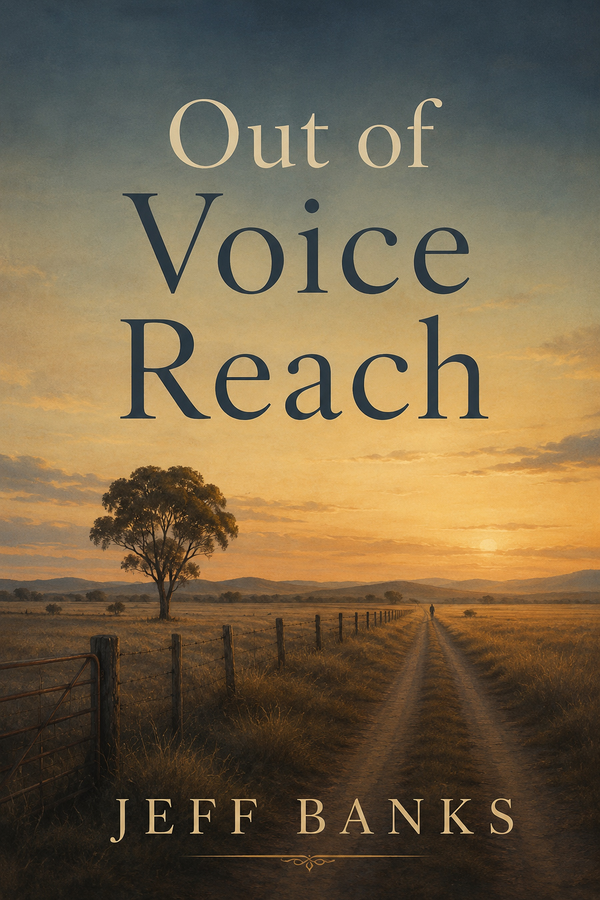
OUT OF VOICE REACH - Chapter 5 - Representative Honour

OUT OF VOICE REACH - Chapter 5 - Representative Honour | Travelling Around Australia with Jeff Banks

I would like to say I rose above it all, but that would be too neat and not entirely true. I absorbed it, worked around it, used it, hid from it, and sometimes let it drive me harder than was healthy. That is less noble, perhaps, but far more honest.

OUT OF VOICE REACH

A life spent trying to belong

Chapter 5 – Representative Honours

There is a particular feeling that comes with being handed a representative jumper when you are young. It is not quite pride, though pride is certainly in there somewhere, and it is not quite relief, though relief may be the first thing you feel if you have spent enough time wondering whether anyone has noticed you at all.

For me, it was always more complicated than that. The jumper, the cap, the team list, the announcement over the schoolyard or around the ground, all seemed to say that I had earned my place, but they never quite promised that the place would be kept for me once the game was over.

That is the strange thing about honour when you are a boy from out beyond the usual edge of town. It can arrive in the same breath as derision, and sometimes from the same people. One moment you are being told you are good enough to go further, and the next you are being reminded that you have gone too far.

I do not remember ever setting out to become some grand sporting figure, because that would make it sound more deliberate and heroic than it was. I was just a boy who learned early that being good at something gave me a temporary pass into places where I otherwise felt as though I was standing near the door, waiting to see whether anyone would wave me in.

Cricket gave me one of those passes. Rugby league gave me another. Horse riding came from another part of life altogether, from the property, the paddocks, the work and the dust, but it too became part of the same pattern, because even the things that should have connected me to where I came from had a habit of making me feel set apart.

I had already learned at primary school that ability was a two-edged thing. In the classroom it came easily enough, which sounds like a blessing until you discover that children are not always kind to those who make the work look simple. Being clever did not make me belong, and in some ways it made the distance worse, because the more I could do, the more I seemed to become something to be measured against rather than someone to sit beside.

Sport was different, or at least I wanted it to be different. In sport there was usefulness, and usefulness had a warmth to it that marks on a page did not. A good run, a clean catch, a tackle that stopped a bigger boy, a horse handled well, all of those things could quieten the noise for a little while, because they gave people a reason to include you without having to say too much about it.

That suited me. I was never looking for speeches, because boys from farms were not raised on speeches unless someone had died, won something serious, or was in trouble. I wanted the small things instead, the nod, the place on the team, the sense that my name belonged on the sheet and that nobody had to make room reluctantly.

Representative cricket in the Southern Tablelands should have felt like a triumph. Perhaps part of it did, and I should not pretend otherwise, because there is no honesty in polishing hurt until it removes every trace of happiness. I was proud to be chosen, and I knew what it meant to be considered good enough to step beyond the little circle I came from.

But stepping beyond the circle was never simple. To represent one town, one district, one area, meant leaving another behind, and it also meant returning with a label that did not sit comfortably with everyone. You would think success might soften people, but often it only gave them something new to sharpen.

There was always some comment waiting. Sometimes it was dressed up as a joke, which is the Australian way of saying something unkind while keeping one foot close enough to the escape hatch. Sometimes it was a raised eyebrow, a little smile, a question about who I thought I was now, as though a child could be blamed for accepting a place he had been offered.

That sort of thing gets dismissed as harmless, particularly by those who were never on the receiving end of it. They say it toughens you up, and perhaps it does, but not always in ways that are useful. A hide can grow thick and still leave the inside bruised, which is a poor bargain when you are only trying to work out where you fit.

Cricket had its own quiet cruelties. It is a game that can expose you without looking as though it is doing anything dramatic at all. You stand alone in a field with the ball coming your way, or you walk out to bat with everyone watching, and for a boy who already felt watched for the wrong reasons, that was a test before the real test had even begun.

Still, I loved parts of it. I loved the clean sound of bat on ball, the patience required, the idea that a game could turn on small acts of concentration rather than pure strength. Cricket rewarded those who could stay with themselves, and perhaps that suited a boy who had spent a fair bit of time doing just that.

Yet even there, belonging was conditional. You belonged if you performed, if you made runs, if you bowled well, if you did not embarrass the people who had selected you. It was a kind of acceptance with an expiry date, and I knew even then that the warmth of it could fade quickly if the scoreboard turned against you.

Rugby league was another world again. Where cricket tested the private nerve, football tested the body in public, and there was no hiding from it. In Western Division colours, or even on the way towards that level, there was a harder kind of recognition attached to the game, because rugby league in the bush has always had a way of measuring boys as though they were already men.

I found something in that too. There is a simplicity in a tackle that life rarely offers, because for one moment at least the job is clear. You either stop him or you do not, and nobody asks you afterwards whether you felt emotionally included in the process.

That is probably why I liked it, though I would never have said it like that at the time. I liked the certainty of effort, the way pain could be turned into something almost respectable, and the way fear had to be managed quickly because the next play was already coming. There was no time to sit with the old ache of being outside the circle when someone bigger was running straight at you.

But football had its own form of judgement. It rewarded toughness, and I could do toughness, or at least I could do the performance of it well enough to pass. What it did not reward was sensitivity, uncertainty, or the private wondering that followed me around more faithfully than most friends ever did.

So I learned to carry both. I carried the representative honour, and I carried the comments that came with it. I carried the pride of being chosen, and the discomfort of knowing that being chosen did not always make me liked.

Horse riding added another layer, because that came from the part of life that should have been most natural to me. I was a child of a grazing property, and horses were not decorations or weekend amusements in that world. They were part of the work, part of the rhythm, part of the way a person learned balance, patience, courage and the occasional humility that comes from landing in the dirt.

There is nothing quite like a horse for reminding a boy that confidence and arrogance are not the same thing. A horse will let you know the difference quickly enough, and often in front of people, which is not always ideal for the dignity of the rider. Still, if you learned to sit properly, listen through the reins, and respect the animal beneath you, there was a kind of quiet partnership in it that I understood better than many human arrangements.

Accolades in horse riding came from that world of dust, yards, saddles, boots and the smell of sweat and leather. They should have settled me more firmly into the identity I was supposed to have, the farm boy, the capable one, the one who belonged out there because out there was where he came from. Instead, as with so much else, it became another way of being noticed without necessarily being known.

That is not to say people were always cruel. They were not, and memory can become unfair if it only keeps the thorns and forgets the hands that helped pull you through the fence. There were people who encouraged me, teachers who saw ability, selectors who took a chance, teammates who accepted me in the practical way boys often do, by passing the ball, throwing the ball back, or expecting me to do my job.

But encouragement did not erase the other side. It did not erase the snigger when the outlying school boy was named, or the suggestion that I had somehow been lucky, favoured, or full of myself. It did not erase the odd loneliness of standing in a representative team and still feeling as though I was visiting someone else’s life.

That is the part I have wrestled with over the years. How can you feel excluded while being selected? How can you feel unseen while being watched? How can achievement make you feel proud and ashamed at the same time?

I think the answer lies in the difference between being valued and being accepted. Being valued can depend on performance, usefulness, output and results. Being accepted is quieter and far more generous, because it does not require you to keep proving why you are there.

Much of my life, without fully understanding it, was spent trying to turn the first into the second. I thought that if I achieved enough, worked hard enough, won enough, helped enough, fixed enough, or carried enough, the door would eventually stay open. I did not realise that a door opened by usefulness often closes the moment you stop being useful.

Sport taught me that early. The representative honour came with a thrill, and I do not want to pretend it did not. There was satisfaction in knowing that the long roads, the farm distance, the schoolyard awkwardness and the sense of being on the edge had not prevented me from reaching beyond the ordinary expectations others may have had for me.

Yet the honour also brought exposure. It put my name forward, and a name forward can become a target as easily as it becomes a compliment. If you come from the outside and are ordinary, you may be ignored, but if you come from the outside and are good, you may be resented.

That resentment was not always grand or dramatic. Most of the time it came in small servings, just enough to make sure you did not get too comfortable. A remark here, a laugh there, a suggestion that you were getting above yourself, which is a phrase that has probably cut more Australian ambition down to size than any official failure ever could.

The great national sport is not cricket, rugby league, horse racing or anything played with a ball. It may well be making sure nobody thinks too much of themselves. That can be healthy when it saves us from pomposity, but it can be brutal when aimed at a child who was not thinking too much of himself at all, only hoping others might think enough of him to let him stay.

I became good at pretending the comments did not matter. That became another form of training, no less demanding than practice in the nets or running drills or learning to sit a horse that had other ideas. You learned to smile, shrug, fire something back if you had the energy, and then store the rest somewhere deep enough that it would not show.

The trouble with storing things is that they do not disappear. They wait. They come back later in forms you do not recognise at first, as tiredness, irritability, restlessness, depression, or the old suspicion that whatever you have done is still not quite enough.

Looking back now, from the edge of retirement, I can see how those early patterns followed me into adult life. Work became another representative team, another place where competence gave me standing without necessarily giving me ease. Accounting, business, committees, community roles, family responsibilities, all carried the same quiet bargain: if I was useful, I had a place.

That is a hard habit to put down. It is especially hard when it has worked, at least on the surface. If achievement has carried you through school, sport, work and responsibility, it is difficult to admit that it may also have kept you trapped in the very loneliness you were trying to escape.

There is a peculiar sadness in realising that some of the things you are proudest of were also survival strategies. I am proud of the cricket, the rugby league, the horse riding and the honours that came with them, because they were not imaginary and they were not handed out for nothing. I worked, I competed, I earned what I earned, and there is no virtue in pretending otherwise.

But I can also see the boy behind them more clearly now. He was not just chasing trophies, team lists or applause. He was chasing a place where his presence would not need explaining.

That boy did not have the words for belonging, depression, identity or conditional acceptance. He had a bat, a football, a saddle, a school bag, and a stubborn streak that probably saved him and exhausted him in equal measure. He had the long road in and the long road home, and somewhere between the two he learned that distance could travel with you even when you were standing among others.

Representative honour, then, was never a simple chapter of success. It was a lesson in contradiction, though I did not know I was being taught one. It taught me that you can be picked and still feel unwanted, applauded and still feel mocked, respected and still feel separate.

Perhaps that sounds ungrateful, and that is one of the reasons I have not always known how to tell this part of the story. Gratitude is expected when you are given opportunities, and I am grateful. I know there were boys who would have wanted those chances and never received them, and I know that ability, effort and circumstance all played their part in letting me step onto grounds and into teams beyond the farm and the little school.

But gratitude does not cancel the ache. It does not require a person to lie about the cost. It is possible to be thankful for the honour and still remember the derision that rode beside it like a passenger nobody invited but everyone pretended not to see.

That is how it often felt. Honour and hurt arrived together, not as opposites but as twins of a sort, each explaining the other. The better I became, the more visible I was, and the more visible I was, the less safe I sometimes felt.

I wonder now whether that is why I kept pushing forward. Not because the next level would finally satisfy ambition, but because stopping might have meant admitting that none of it had delivered the acceptance I was really after. As long as there was another team, another match, another selection, another role, another responsibility, there was still the possibility that the next door might be the one that stayed open.

There is a sadness in that, but not only sadness. There is also a kind of admiration for the boy who kept turning up, even when he did not understand what he was carrying. He may have been awkward, over-serious at times, too eager to prove himself, and perhaps not always easy to know, but he was trying to survive in the only ways available to him.

I can be kinder to him now than I was then. That might be one of the few gifts of getting older, if we allow it, because age can soften the judgement we once turned on ourselves so savagely. Retirement, or the thought of it, has made me look back not only at what I did, but at why I needed so badly to do it.

The representative jumpers have long since lost their urgency. Whatever records were kept are probably stored somewhere in fading print, if they were kept at all, and the people who once made the comments have likely forgotten them. That is another hard truth: some of the words that lodge in us for a lifetime were only passing entertainment for the person who said them.

Still, memory keeps its own scorecard. Mine does not record wins and losses as neatly as a sporting table might. It records roads, glances, remarks, effort, pride, shame, and the old ache of being close enough to be seen but not close enough to be understood.

If there was honour in those representative years, it was not only in being chosen. It was in carrying the contradiction and continuing anyway. It was in playing the game, riding the horse, taking the field, and walking back into the same schoolyard or town afterwards, knowing that the applause would not protect me from the next joke.

I would like to say I rose above it all, but that would be too neat and not entirely true. I absorbed it, worked around it, used it, hid from it, and sometimes let it drive me harder than was healthy. That is less noble, perhaps, but far more honest.

The boy from seven miles out learned that achievement could get him heard for a moment, even if it could not always bring him within voice reach. He learned that a representative honour could be both a doorway and a spotlight, both invitation and warning. He learned, before he should have had to, that belonging earned by performance is never quite the same as belonging freely given.

And yet I would not remove those years from the story. They were part of the making of me, for better and worse, and perhaps most lives are shaped that way. The same experiences that wound us may also give us the strength, humour and stubbornness to keep going, even if we spend half a lifetime pretending the wound was only a scratch.

So I keep the honour, but I no longer let it stand alone. I place beside it the derision, the unease, the longing, the pride, and the boy who kept trying to turn selection into belonging. Only then does it feel true, and truth, at this stage of life, matters more to me than a polished version of victory.

Author

Menu