

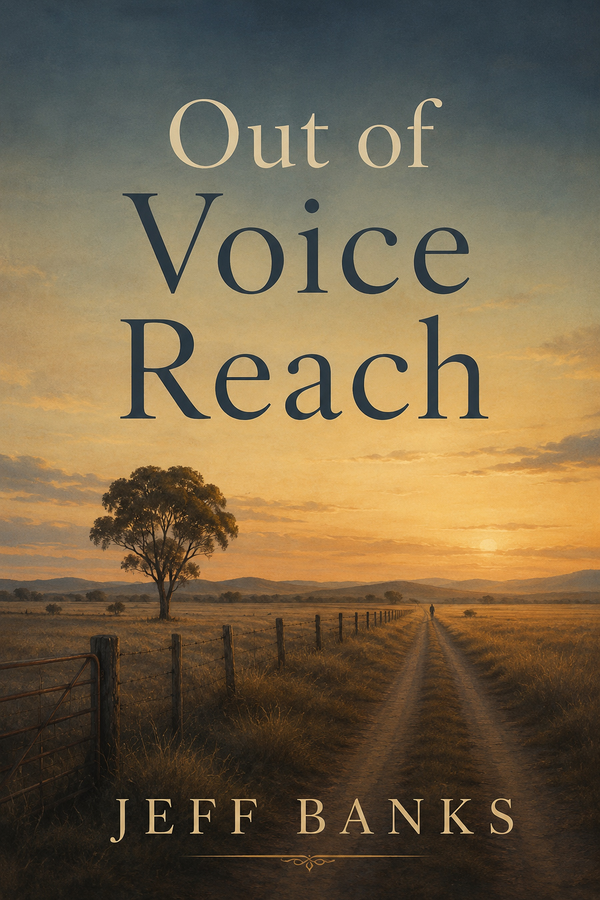
OUT OF VOICE REACH - Chapter 13 - The Caravan Park Years

OUT OF VOICE REACH - Chapter 13 - The Caravan Park Years | Travelling Around Australia with Jeff Banks

The river kept moving. It moved on the days I thought I could not, and it moved on the days I did. It carried no message for me, not really, but perhaps that was the message: keep going, not because everything is fixed, not because the wounds have closed neatly, not because belonging has finally arrived, but because life is still moving and you are still in it.
OUT OF VOICE REACH

A life spent trying to belong

Chapter 13 — The Caravan Park Years

The first thing I remember about the caravan park is not the van itself, or the road in, or even the reason I was there. It is the sound of the river moving nearby, doing what rivers have always done, going on with its own business as though human collapse was just another bit of weather passing through.

There is something mildly insulting about that when your life has come apart. You can be standing there with your marriage behind you in pieces, your future looking like a badly folded map, and the river will still move past with complete indifference, carrying leaves, sticks, reflections and whatever else has been tipped into it upstream.

I had not planned to be a man living in a caravan park. Very few people do, I suspect, unless they are on holidays, retired with a carefully polished van, or have convinced themselves that downsizing is a lifestyle choice rather than a financial negotiation with reality. For me it became less of a choice and more of a holding pattern, the place I landed when the shape of my life no longer fitted the old rooms.

Divorce is one of those words that looks clean on paper and feels anything but clean in the body. It sounds like a legal process, a filing, a division, a line drawn by someone with a steady hand, but for the people inside it, the line is usually jagged and keeps cutting long after the papers have done their job.

I do not want to pretend I was noble through it all. I was wounded, defensive, proud, frightened, angry, ashamed, relieved in odd moments and then ashamed of feeling relieved. I had spent so much of my life trying to be competent that I did not know what to do with a failure that could not be fixed by working harder, staying later, running faster or finding the right answer.

That was part of the insult too. I had built much of my identity around being useful, around being the person who could sort things out, carry responsibility, understand numbers, solve problems, get things across the line and keep moving while others stood around wondering what came next. Then I found myself in a place where none of that worked, because the problem was not a spreadsheet or a business arrangement or a game that could be won by effort.

The caravan park had its own strange democracy. There were people passing through, people staying longer than they admitted, people who had fallen on hard times, people who preferred not to explain themselves, and people who had simply discovered that a small place with wheels underneath it could be less disappointing than a bigger place with history in the walls.

You learn a lot about people when everyone is living close enough to hear each other cough. Privacy becomes less a right and more a skill, managed through lowered voices, turned backs, walks along the river and the quiet agreement not to ask too many questions unless someone clearly wants to answer them.

In some ways it should have felt familiar. I had grown up out of voice reach, seven miles from the nearest settlement and beyond calling distance of the nearest neighbour, so distance had always been part of me. Yet the caravan park taught me that you can be surrounded by people and still be out of voice reach, because isolation is not only measured by paddocks, dirt roads or the gap between farmhouses.

At the park, I was physically close to others in a way I had rarely been as a child. Vans sat near vans, ropes held awnings against the wind, folding chairs appeared in the afternoon, and the amenities block became a shared piece of civilisation that no one praised unless something went wrong. Even so, I carried my old separateness with me like a second shadow, and I kept it between myself and the world because I did not know what else to do with it.

There was a kind of quarantine in those years. Some of it may have been practical, some of it emotional, and some of it was simply the way life corrals you after a break, placing you somewhere apart until the fever passes or at least until you stop looking contagious to yourself.

Quarantine is supposed to protect others from what you carry. In my case, I think it protected me from being asked to explain too much before I had language for any of it, because when you are newly broken, even sympathy can feel like another demand being placed on an already exhausted body.

I had wounds I could not show because they were not the sort that attracted bandages. A broken arm has the courtesy to announce itself, to give people something visible to sign, support or avoid knocking into, but emotional wounds ask you to keep turning up as though nothing is leaking from you.

That was always my habit anyway. If in doubt, keep going, because the moving man is harder to question than the still one, and productivity has always been a respectable disguise for pain. I had learned that trick early, although I did not understand it as a trick at the time.

At school, being better had given me a way to stand somewhere. It did not make me belong, not properly, but it gave me a role, and roles can be mistaken for belonging if you are young enough or desperate enough. Academic success, sport, representative honours, work, competence, the whole long chain of proving myself became a way of saying, “See, I am allowed to be here,” even when some part of me remained unconvinced.

In the caravan park, that old arrangement began to break down. There was no team to be picked for, no classroom mark to earn, no client to satisfy in the middle of the night, no applause worth chasing and no obvious medal for surviving the afternoon. There was just the van, the river, the weather, and the stubborn fact that I had to wake up inside my own life every morning.

The Black Dog was there too, although I was not always willing to name it. It padded around the edge of things, sometimes quietly, sometimes with weight, sometimes close enough that I could feel its breath before I had even opened my eyes.

People who have not lived with that sort of heaviness sometimes imagine it as sadness. Sadness would have been simple by comparison, because sadness has a story attached to it and can often point to a cause, but this was duller, heavier and less cooperative. It sat on the chest, slowed the legs, dimmed the light and made ordinary tasks feel as if someone had quietly added bags of wet sand to them.

The maddening thing was that from the outside I could still appear functional. I could talk, work, joke, help, organise, calculate and make myself useful, because I had spent years training myself in the art of not looking as lost as I felt. The world rewards that skill, unfortunately, which means it can take a long time before anyone notices the cost.

I was not lying to people exactly. I was presenting the part of me that still worked, because there is a difference between pretending and rationing the truth, and I had become very good at rationing mine.

The river helped in a way I did not understand at first. It did not offer answers, which was a mercy, because by then I had heard enough advice, enough explanations, enough moral summaries and enough well-meant rubbish to last several lifetimes. The river simply existed beside me, and its refusal to tidy my life into meaning became a kind of companionship.

I would look at it and think about all the water that had already passed before I arrived. I would think about floods, droughts, fish, old camps, children swimming, men drinking too much, women packing food, dogs barking, boats scraping against banks and all the private grief that must have sat beside that same moving water over the years.

That is the thing about rivers. They can make you feel very small, but not always in a cruel way, because they remind you that your pain is both completely real and not the only pain that has ever been carried. There is comfort in that, if you are not in too much of a hurry to turn it into philosophy.

The caravan park itself had a rhythm. Mornings came with zippers, car doors, kettles, birds, distant traffic and the sort of coughs that told you some people had been smoking too long or sleeping badly or both. Afternoons stretched out in heat or wind, and evenings gathered people into little pools of light where everyone pretended they were exactly where they meant to be.

I did a bit of that pretending myself. There is pride in a man that can survive almost anything except being pitied, and I carried enough pride then to make a small load for a ute. I did not want to be looked at as a casualty, even when casualty might have been one of the more accurate descriptions available.

Survival is not always heroic. Sometimes it is doing the washing, paying the bill, making something to eat, answering a phone call, getting through the next hour without making things worse, and then doing the same thing again tomorrow. It does not look much like the version of courage we were sold as boys, but it may be closer to the truth.

The boy from the farm would have understood some of it. He knew about distance, about keeping things in, about earning approval through usefulness, about the strange humiliation of wanting to belong to people who had not quite opened the gate. He would not have understood divorce, but he would have recognised the feeling of standing outside a circle and wondering what rule he had missed.

That is where the old pattern returned with uncomfortable clarity. I had spent years changing the scenery but carrying the same ache, moving from farm to school, from school to sport, from sport to work, from work to family, from family to community, always trying to prove I was worth making room for. The caravan park stripped that back until I had to ask whether I had ever really believed I was worth room without first earning it.

That is not an easy question for a man who prefers practical problems. Practical problems have handles, and you can pick them up, move them around, blame the right person, invoice the right client or buy a better tool. Questions of worth do not behave so well, and they tend to sit quietly in the corner until the house is silent.

There were days when I did not feel much like answering them. There were days when the best I could do was move through the motions and trust that motion itself might keep the machinery from seizing. That may not sound like much of a strategy, but there are seasons in life when strategy is too grand a word and you are grateful for habit.

Habit kept me fed, dressed, washed and moving. Pride kept me from collapsing in public, which was not always healthy but was occasionally useful. Stubbornness, that old family fuel, did the rest.

I sometimes wonder whether stubbornness has saved more men than wisdom ever has. Wisdom requires perspective, and perspective can be hard to come by when your life is sitting around you in cardboard boxes and half-formed explanations. Stubbornness only asks that you do not stop yet, and there were times when that was a much more achievable standard.

I do not want to romanticise those years. There is a danger, looking back, of turning hardship into a sepia photograph, as though the pain was somehow noble because it produced a lesson later on. I am wary of that, because some things hurt simply because they hurt, and not every wound has to justify itself by becoming wisdom.

Still, I would be lying if I said nothing came from it. The caravan park years forced me to live without some of the usual disguises, and while I did not enjoy the process, I can see now that something in me was being exposed to the air. Wounds do not heal in hiding forever, no matter how sensible hiding may feel at the time.

The river became part of that exposure. It gave me a place to look when looking inward became too much, and it gave my thoughts somewhere to travel without demanding that they arrive anywhere useful. I could stand there as a divorced man, a wounded man, a frightened man, and still be just another figure beside the water, which was oddly relieving.

There is a mercy in being ordinary when you have spent too long trying to be exceptional. I had chased better for so long that I had forgotten the possible peace in merely continuing, in being one person among many, in not needing every day to prove something to someone who may not even have been watching.

The Black Dog did not vanish because I walked beside a river or lived through a few hard seasons. That would be too tidy, and life has rarely shown that much interest in my preferred narratives. It stayed around, sometimes at a distance, sometimes nearer, but I began to understand that its presence did not have to be the whole story.

There were small survivals, and small survivals matter. A conversation that did not hurt, a morning where I got moving sooner than expected, a meal that tasted like something, a laugh that arrived before I had time to stop it, a day where the heaviness lifted just enough for me to remember that I was still in the world.

I think men of my generation often have trouble admitting the importance of such small things. We were trained to value the big markers, the job, the house, the marriage, the scoreboard, the business, the title, the numbers, the evidence that we had become what we were supposed to become. When those things falter, or when they no longer explain us, we can be left with a frightening shortage of language.

The caravan park gave me a different vocabulary, although it took me a while to read it. It spoke in river sounds, worn steps, damp towels, cheap chairs, neighbours who nodded without prying, and the nightly business of lights going out one by one across a community of temporary souls. It was not grand, but it was honest.

Honesty was not always comfortable. I had to face the fact that I had been hurt, but also that I had hurt, that I had been excluded, but also that I had sometimes kept myself beyond reach, that I longed for belonging, but also mistrusted it when it came too close. These contradictions did not make me unique; they simply made me human, which is a less impressive but more accurate category.

Looking back, I can see that the caravan park years were not outside the story of my life. They were right in the middle of it, because they showed me what happened when the old machinery of achievement could no longer drown out the quieter questions underneath.

Who was I when I was not succeeding. Who was I when I was not needed in the same way. Who was I when the roles slipped, the marriage ended, the home changed shape, and the man who had spent a lifetime trying to earn his place found himself living in a place designed for people passing through.

That last phrase stays with me. Passing through. It sounds temporary, almost harmless, but there are times when an entire life can feel like passing through, never fully settling, never quite belonging, always preparing to move on before anyone asks you to stay.

Maybe that is why the caravan park hurt more than I admitted. It was not just a place after divorce, or a quarantine from the life I had known, or a refuge beside a river. It was a mirror, and I did not particularly enjoy the reflection.

The man in that mirror looked tired. He looked older than he wanted to be, more frightened than he would have confessed, and less certain of himself than his competence had allowed others to believe. He also looked alive, which should not be overlooked, because there are periods when being alive is not a small achievement.

I survived those years, though survival is too plain a word for all it carried. I survived the paperwork, the silences, the judgement I imagined and the judgement that was real, the mornings when the Black Dog sat heavy, the evenings when memory became too loud, and the long stretch of not knowing what sort of life would come next.

Survival did not make me triumphant. It made me more cautious, more tender in places I still tried to hide, and perhaps a little more understanding of others who were living in their own versions of a caravan park, whether anyone could see it or not.

That may be the quiet gift of being broken in public-adjacent places. You begin to recognise the makeshift shelters other people build inside themselves, the emotional annexes and patched canvas, the small ropes tied against the wind. You become less impressed by polished surfaces, because you know how much can be hidden behind a neat door and a working lock.

I do not look back on the caravan park years with fondness exactly. Fondness is too soft a word for a place that held so much grief, uncertainty and rawness. But I do look back with a kind of respect, because that period did what hard periods often do; it took away the story I preferred and left me with the one I had to live.

The river kept moving. It moved on the days I thought I could not, and it moved on the days I did. It carried no message for me, not really, but perhaps that was the message: keep going, not because everything is fixed, not because the wounds have closed neatly, not because belonging has finally arrived, but because life is still moving and you are still in it.

I had begun life out of voice reach, beyond calling distance, learning early that people could be nearby and still unreachable. In the caravan park years, I found myself close to others and still carrying that same old distance, but I also began to understand that a voice does not return all at once.

Sometimes it comes back quietly. Sometimes it comes back in fragments, in stubborn mornings, in river walks, in dark jokes, in the decision to answer the phone, in the refusal to let the Black Dog have the whole yard. Sometimes it comes back long before you are ready to call it hope.

I would not choose to live those years again. I would not polish them into a tale of renewal with a neat bow tied around the last paragraph. But I can say this much: the caravan park was not the end of me, even when parts of me believed it might be.

It was a hard, temporary country, but I crossed it. I crossed it wounded, stubborn, frightened, proud, sometimes lonely beyond words and sometimes surprised by small mercies I had not earned. On the other side, I was not healed in the storybook sense, but I was still here, and for that period of my life, still here was enough.

Author

Menu