

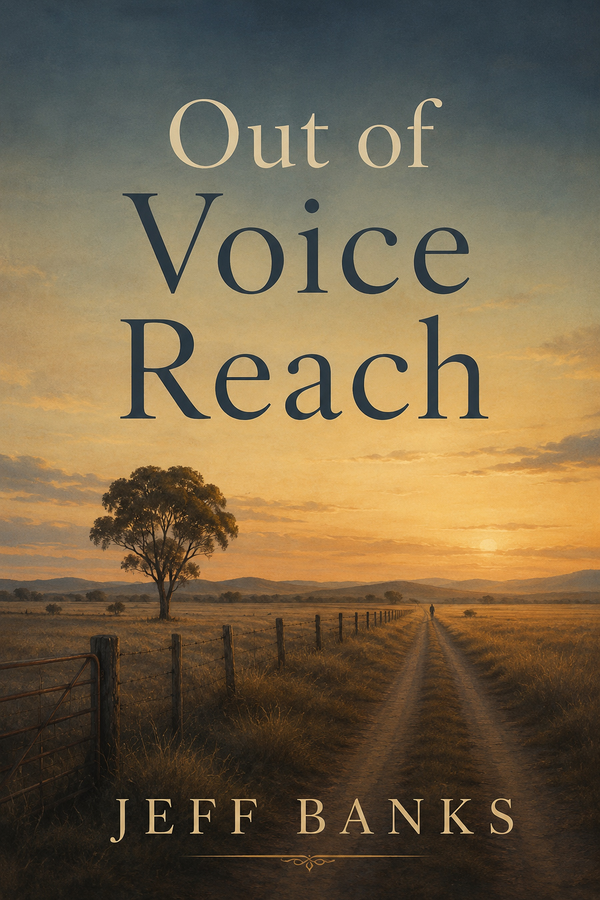
OUT OF VOICE REACH - Chapter 10 - Home as a Visitor

OUT OF VOICE REACH - Chapter 10 - Home as a Visitor | Travelling Around Australia with Jeff Banks

In the end, night school did not bring me fully inside the circle. Nothing has ever done that as cleanly as I once hoped. But it moved me closer to my own voice, even if I could not hear that at the time. It taught me that effort could repair some things, though not all things, and that a life can be rebuilt from disappointment without pretending disappointment never happened.

OUT OF VOICE REACH

A life spent trying to belong

Chapter 10 — Home as a Visitor

There is a particular feeling that comes when you turn back onto a road you once knew without thinking, and suddenly realise you are concentrating. The corners are familiar, the rises are where they always were, the trees lean with the same tired patience, and yet you are watching for landmarks as though you have been given directions by someone else. That is when it first occurs to you that home is not only a place you leave. It is also a place that goes on without you.

The road back to the farm was never just a road. It was measurement, memory, weather, family expectation, and proof that we lived out where the bitumen seemed to have given up on being useful. Seven miles from the nearest settlement did not sound much when spoken aloud, especially to people who thought distance was something you overcame with a car and a bit of patience. But as a child, seven miles was enough to make the world feel divided into those who were already gathered somewhere and those who had to travel just to arrive at the edge of things.

I had grown up with that distance as part of me, almost as natural as the dust on my shoes or the smell of dry grass after a hot day. We were out of voice reach of the nearest farm, which sounded like a practical description until I grew old enough to understand it had worked its way under my skin. You could not simply call out and expect someone to hear. You had to go to them, wait for them, or learn to do without the answer.

For years I thought leaving the farm might solve that. I thought that once I got further away, once I proved myself at school, on the sporting field, in work, in life, the old distance might fall away like dust shaken from a coat. I did not understand then that some places do not leave you simply because you have left them. They come with you, packed quietly in the back of the mind, waiting for a road, a smell, a family gathering or a gate latch to bring them all back.

Returning to the farm, or to the family base that grew out of it, was supposed to feel simple. It was supposed to be the place where I did not have to explain myself, where the old rules might at least be known even if they were not always fair. That is the promise carried by the word home. It suggests there is a place somewhere in the world where you are not being assessed at the gate.

But I often found that going back made me feel more like a visitor than arriving anywhere else did. In other places I expected to be slightly out of step, so the unease at least had the courtesy of being predictable. At home it caught me differently, because I carried a childish belief that there should still be a spot kept for me somewhere. Not a room or a chair exactly, but a recognised shape in the air where I could stand without wondering whether I was in the way.

The first signs were small enough to dismiss. The house felt slightly different, not necessarily because anything much had changed, but because I had changed in ways I had not yet admitted. The rhythm of the place still belonged to those who were living it every day, and I came into it carrying other rhythms from school, town, work, sport, and later the complicated machinery of adult responsibility. I knew the place, but I no longer moved through it with the authority of someone whose days began and ended there.

That is a strange demotion, though nobody announces it. You come home and discover you are not quite part of the working order of things anymore. You can see where something is kept, but perhaps not where it is kept now. You know the old stories, but not always the latest version. You recognise everyone, yet there are conversations that began before you arrived and will continue after you leave.

Nobody has to be cruel for that to hurt. In fact, it can hurt more when nobody means anything by it, because then there is no villain to blame and no argument to win. Life has simply moved on, as life has an irritating habit of doing. The farm, the family, the old rooms and habits had continued to function without waiting for me to come back and resume the part I had left behind.

As a younger man I would not have described it that way. I would have hidden the feeling behind busyness or humour, or told myself I was being foolish. There was always some practical job to do, some conversation to join, some memory to drag into the light and laugh over. Country families are good at that, or at least the ones I knew were. Emotion was often allowed in disguised form, provided it wore boots and did not make too much of itself.

So I would stand there, half at home and half not, pretending the split did not exist. I knew where I had come from, and that should have been enough. Yet the more I returned, the more I understood that origin is not the same as belonging. A birth certificate might point to a place, a childhood might be built there, and still the adult who comes back can find himself standing on familiar ground without quite having permission to settle.

Part of the trouble was that I had spent so much of my life trying to become more than the boy from out the road. At primary school, I learned quickly that being from the outlying place marked you even before you opened your mouth. At secondary school, twenty miles away, that mark travelled with me, dressed up in a different uniform but still visible enough to those who knew how to look. I tried to outrun it with marks, sport, effort, manners, competitiveness and whatever else seemed useful at the time.

The trap was that every effort to move beyond it also made returning more complicated. If I did well, I risked being seen as thinking I was better than where I came from. If I failed, I risked confirming that I had never quite belonged in the wider world either. Achievement became a sort of passport, but it was not citizenship. It got me through gates, onto teams, into rooms and conversations, but it never quite answered the question of where I could rest.

Going home exposed that contradiction in a way nothing else did. Away from home, I could tell myself I was building something, proving something, becoming someone. Back home, I was reminded that much of what I had been trying to become had started as a response to feeling outside the circle in the first place. The boy who wanted to be better had not vanished. He had simply learned to use adult tools.

There is a particular discomfort in being praised for having left. People may mean it kindly, and often they do. They might say you have done well, made something of yourself, got out, found your way, or taken your chances. Those words can carry respect, but they also carry distance. They place you on the far side of an invisible line, as though leaving was the achievement and returning was merely a courtesy visit.

I was never comfortable with that version of success. I did not want to be the one who had escaped, because escape suggests there was something wrong with the place or the people left behind. I also did not want to pretend leaving had cost nothing, because that would have been another kind of lie. The truth sat awkwardly between the two. I had needed to go, and I had also needed somewhere to come back to.

The family base, like the farm itself, held more than buildings and old stories. It held the evidence of who I had been before I learned to explain myself in polished terms. It knew the awkwardness before the competence, the hunger before the achievement, the long rides and long roads before the meetings, tax files, committees and responsibilities. You would think that knowledge would make a place gentle. Sometimes it does, but sometimes it makes it harder because there is nowhere to hide from your earliest self.

When I returned, I was often confronted by versions of me that still seemed to be standing around the place. There was the boy waiting for the bus, the one who knew the town children were connected by blood, habit and proximity in ways he was not. There was the boy discovering that being good at school could win marks while losing warmth. There was the one who found temporary shelter in sport because a team will accept a useful player for at least as long as he keeps being useful.

Those old versions did not ask for much, but they were persistent. They wanted to know whether all the striving had finally worked. They wanted to know whether the accolades, the work, the competence, the long years of being reliable and capable had bought the thing I had been trying to buy. They wanted to know whether I had found a place where I could be more than useful. I did not always have the courage to answer them.

Home should have been the easiest place to put down the burden of proving myself. Instead, it sometimes reminded me how early I had picked it up. The same habits came back before I noticed them. I would look for a job to do, a problem to solve, a way to be necessary. If belonging could not be granted, perhaps usefulness could at least be negotiated.

That is a pattern I have carried further than I care to admit. In work, I could be useful. In business, I could be useful. In community roles, committees, family obligations and the endless odd jobs of adult life, I could be useful. Usefulness became a language I trusted more than affection, because usefulness had rules I understood. Do the thing properly, meet the obligation, be available, fix what can be fixed, and perhaps nobody will ask whether you feel like you belong.

The problem with usefulness is that it has to be renewed. It is never quite paid up. The moment you stop being useful, or fear you might stop, the old question returns with interest. That is one reason retirement carries such unease for me. It is not just the end of employment or the slowing of routines. It is the threat of losing the most reliable disguise I ever found.

The farm taught me work before it taught me rest. That is not a complaint, because there is value in learning early that things do not fix themselves and animals do not wait until you feel like getting around to them. Country life can be a stern teacher, and sometimes a fair one. But when work becomes the main proof of worth, rest starts to feel like trespass. You can sit down, but some part of you keeps listening for the accusation that you should be doing something.

Returning home brought that back strongly. Even if I was there as a son, a relative, a guest, or simply a man revisiting the ground that made him, I often felt the need to justify my presence. I would offer help before I was asked, because asking to belong felt too naked. Better to carry something, fix something, drive somewhere, make a call, sort out a document, or play the dependable part. Dependability has always been a safe costume for me.

There were moments, of course, when the old warmth came through. A familiar joke, a shared memory, the sound of someone using the tone they had always used with me, and suddenly I could feel the years fold in on themselves. Those moments mattered. They were not false simply because they did not last. In fact, their passing may be why they stay so sharp in memory.

But even warmth can remind you of distance. You can laugh at an old story and still realise you are hearing it as someone who now comes and goes. You can stand in a yard you once crossed without thinking and feel the odd formality of your own presence. You can look at the land and feel affection, gratitude, irritation, pride and grief all at once. Country life has room for all of those, though it rarely labels them for your convenience.

The grief is not only for what was lost. Sometimes it is for what never quite happened. I grieve the easy belonging I imagined other people had, whether or not they actually did. I grieve the childhood version of home that should have gathered me in without qualification. I grieve the fact that distance became such a familiar setting in my life that I sometimes mistook it for personality.

That may be the hardest part to admit. When you grow up outside the circle, you can begin to arrange yourself around the outside and then call it independence. You learn to watch before joining, to prepare before speaking, to earn before receiving, to leave a little emotional gap around yourself so rejection has less distance to travel. Later, when people do offer a place, you may not know how to step fully into it. You may stand at the doorway of your own life, hat in hand, pretending you are only passing through.

I have often wondered whether home felt different to others, or whether everyone carries some private version of this. Perhaps those who appeared settled were also performing a kind of belonging, only with better timing and more confidence. Perhaps the children who seemed already included had their own silent distances I never saw. That is one of the tricks of loneliness. It convinces you that everyone else has received instructions you missed.

Still, there was something particular about returning to the farm and feeling the old distance reassert itself. It was not the distance measured in miles this time, because roads had become easier and vehicles better and my life had stretched far beyond those seven miles. It was the distance between memory and present reality. It was the distance between being from a place and being of it in the way I once imagined possible.

The land itself did not seem concerned with my identity crisis. Paddocks have a way of making human drama look slightly overdone, which is probably healthy. The same winds moved through, the same dust lifted, the same light settled over things with that late-day softness that can make even a hard country look forgiving. The farm did not ask whether I belonged. It simply existed, which may be one reason I kept returning to it in my mind long after I had stopped living there.

People are more complicated than paddocks. Families are more complicated again. They carry love, duty, resentment, memory, expectation, silence and loyalty in bundles so tightly tied that nobody wants to pull the string in case the whole thing spills across the floor. To belong in a family is not always to be understood. Sometimes it is simply to be remembered in a particular role long after you have outgrown it.

That is part of what made returning difficult. I was not only visiting the old place. I was visiting old versions of how others saw me, and perhaps how I still saw myself. In some eyes I was still the boy from the outlying school, still the one trying too hard, still the one whose achievements were both admired and slightly held against him. In my own mind, I was still negotiating with those judgments, trying to decide which ones were real and which ones I had carried forward without being asked.

Depression complicates this because it does not always arrive dramatically. Sometimes it sits quietly in the passenger seat on the drive home, saying nothing but making everything heavier. It tells you that the old distance proves something permanent. It suggests that if you do not belong where you began, and do not fully belong where you have gone, then perhaps you are the common problem in every room. It is a persuasive liar, which is why it is dangerous.

I have learned not to give that voice complete authority, though I cannot pretend I have always beaten it. There have been days when returning home filled me with tenderness, and days when it left me hollow in a way I could not easily explain. There have been days when a familiar road steadied me, and others when it seemed to confirm that I had spent my life moving between places without ever arriving. Both can be true. That is the inconvenient thing about honest memory.

The older I get, the more I mistrust simple stories. I do not think I was banished from home, nor do I think I simply outgrew it in some grand upward journey. I think I left because life required it, and because ambition, injury, hope and restlessness all had their hands on my back. I think I returned because part of me still wanted to be claimed by the place that first taught me distance. I think I kept finding myself a visitor because childhood belongings cannot be collected later like an item left behind in a shed.

That does not make the return meaningless. There is value in walking back into a place even when it cannot give you what you once needed from it. There is value in seeing the truth without turning it into accusation. The farm gave me endurance, awareness, independence and a certain stubborn ability to keep going when I would rather not. It also gave me loneliness, watchfulness and the suspicion that belonging had to be earned. A place can give both gifts and wounds, and pretending otherwise does not honour either.

Perhaps home is not the place where nothing has changed. Perhaps that is only a child’s demand, understandable but impossible. Perhaps home, in later life, is the place where you can finally see the full arrangement of things: the beauty and the lack, the love and the silence, the distance and the pull. I am not sure that makes it easier, but it may make it more truthful.

When I think of being out of voice reach now, I no longer think only of the nearest neighbour who could not hear a call across the paddocks. I think of all the times I stood near enough to people to be seen, but not near enough to feel heard. I think of family rooms, schoolyards, dressing sheds, offices, meetings and celebrations where I knew my role better than I knew my place. I think of how often I mistook being noticed for being known.

Going home as a visitor sharpened that understanding. It showed me that belonging is not guaranteed by geography, blood, history or effort. It cannot be forced by achievement, though I spent years giving that theory a fair trial. It cannot be secured by being useful, though usefulness will always have its attractions for a man who would rather carry a load than admit he is lonely. Belonging, if it comes at all, comes more quietly than that.

I do not know whether I have made peace with home. Peace may be too neat a word, and neat words have a habit of lying about untidy things. But I have stopped expecting the old place to repair every distance it created. That may not sound like much, but for someone who spent a life trying to earn a permanent place, it is a beginning.

I can return now and let the road be a road, at least on better days. I can feel the ache without turning it into a verdict. I can remember the boy waiting to be included and offer him something kinder than another demand to prove himself. I can tell him that he was not wrong to want a place, and he was not weak because the wanting hurt.

The farm remains part of me, whether I belong there now or not. It sits beneath the later years, beneath the work and the striving, beneath the humour and the stubbornness, beneath the fear of retirement and the question of who I am when I am no longer needed in the same old ways. It is where I first learned distance, and perhaps where I must keep returning in memory until I learn that distance is not the whole story.

Home, then, may not be the place that finally takes me back without question. It may be the place that helps me understand why I spent so long asking the question in the first place. I was home. I was visiting. And somewhere between those two truths, a great deal of my life can be found.

Author

Menu