

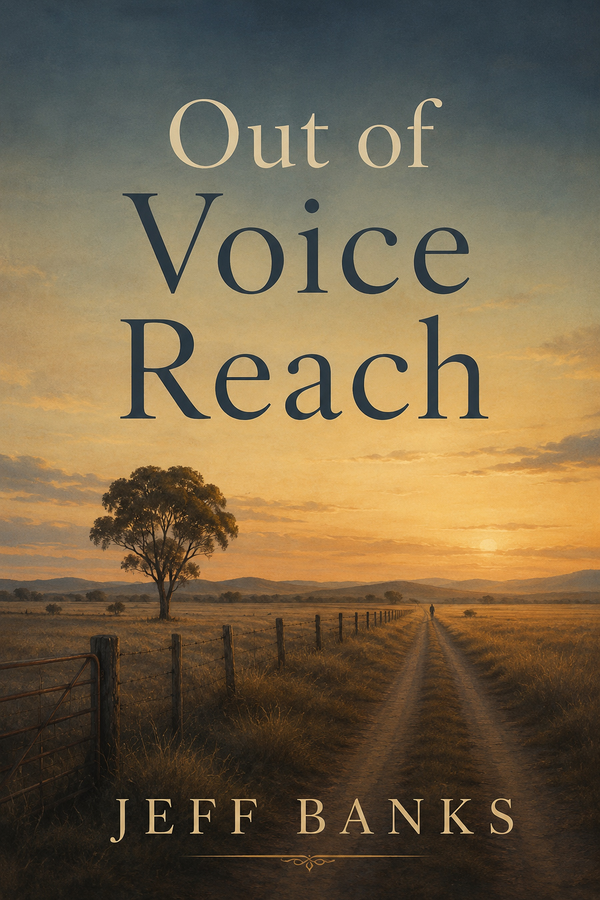
OUT OF VOICE REACH - Chapter 1 - Out of Voice Reach

OUT OF VOICE REACH - Chapter 1 - Out of Voice Reach | Travelling Around Australia with Jeff Banks

There is a danger in writing about isolation that the story becomes too neat. The lonely child becomes the striving man, the striving man becomes the tired retiree, and everyone nods as though life has arranged itself into a tidy sequence for the benefit of readers. I do not trust neatness, because my life has usually arrived in tangles, contradictions, half-finished explanations and moments that meant one thing at the time and another thing thirty years later.

OUT OF VOICE REACH

A life spent trying to belong

Chapter 1 – Out of Voice Reach

The first thing I knew about the world was distance. Not distance as a word in a geography book, or as a line measured neatly on a map, but distance as something you lived inside every day without thinking too much about it because there was no alternative.

We were seven miles from the nearest settlement, which sounds almost quaint now, as though it belonged to some old Australian story of dirt roads, stockyards, dust, sheep, cattle, dogs, and people who made do because making do was the only recognised profession. But seven miles in that country was not simply seven miles. It was the space between help and no help, between company and silence, between being known and being somewhere beyond the comfortable reach of everyone else.

The nearest farm was not within voice reach. That expression has stayed with me because it says more than any road sign ever could. You could stand outside and call as loudly as your lungs would allow, and the sound would vanish into paddocks, timber, sky and wind without landing on another human ear.

That was my first understanding of belonging. It was not something I had and then lost, but something that seemed to exist somewhere else, beyond a ridge, down a road, across a paddock, or inside the houses of people who had neighbours close enough to shout to.

I do not remember feeling lonely in the dramatic way loneliness is often described. Children do not always have the language to know what they are absorbing, and in any case I had no comparison that made me think our life was unusual. The farm was simply where I was, and the quiet was simply the sound the world made when it had finished asking questions.

There was family, of course, and I do not want to pretend the place was empty of love or movement or practical life. A grazing property is never still in the way outsiders might imagine stillness, because there is always an animal needing something, a fence requiring attention, a gate that should have been shut, a trough to check, a job half-done, or a weather change being watched with the suspicion country people reserve for the sky. Yet even within that working life, there was an early awareness that our family unit sat apart from others, and that apartness became part of the furniture of my mind.

The farm taught you self-reliance before it taught you conversation. You learned that problems were not always solved by calling someone, because there may not have been anyone close enough to call, and even if there was, the practical answer was still usually to get on with it. That may have been a useful lesson for life, but it was also a dangerous one because a boy can grow into a man who thinks needing help is a kind of failure.

I suspect that is where some of it began, although I would never have said so at the time. There is something about growing up out of voice reach that gets under the skin and becomes a pattern, because you learn not only that people are physically distant, but that your first instinct is to manage the distance yourself.

When I look back now from the edge of full-time retirement, with all the old roles starting to loosen their grip, I can see how much of my life was built on overcoming distance. I tried to close it by being useful, by being good at things, by working harder, by proving I had a right to be wherever I happened to be. But a strange thing happens when achievement becomes your bridge to other people, because you begin to suspect that without the achievement there may be no bridge at all.

The farm was not cruel. That would be too simple and, in its own way, untrue. It gave me space, resilience, observation, stubbornness, and a kind of country-born practicality that has probably saved me more times than I have recognised.

But the farm also gave me a first lesson in being nearby and not quite included. We were part of a district, part of a rural life, part of the great loose Australian network of properties, roads, schools, sports days, family names and seasonal conversations. Yet we were also apart, because distance has a way of deciding your place before anyone else gets around to it.

I have often thought about the phrase “out of voice reach” because it holds the whole story in four words. It is literal enough to belong to childhood, to a boy standing in open country with no neighbour close enough to hear him. It is also symbolic enough to follow a man all the way through school, sport, work, family, business, community obligations and retirement, always somewhere near the circle but not necessarily inside it.

That is not a complaint so much as an attempt at understanding. I have no wish to turn childhood into evidence for the prosecution, because there was beauty in that country and there was strength in the life it demanded. But there was also a shape being pressed into me, and only later did I realise how hard it is to grow out of a shape formed early.

On the farm, distances were measured in practical terms. Seven miles to the nearest settlement meant time, planning, petrol, road conditions, and the small calculation of whether something was worth the trip. It meant that ordinary things for other people were not always ordinary for us, because even casual contact required movement.

There was no wandering down the street to see who was about. There was no cluster of children appearing outside the back gate as though community were something that simply happened after breakfast. The world beyond our property was available, but it had to be travelled to, and that is a different thing altogether from belonging to it.

A child learns a great deal from what is easy and what is difficult. If seeing other people requires a bus, a car, a road, a reason, or adult permission, then companionship begins to feel like something arranged rather than assumed. That does not mean I sat around lamenting the absence of playmates, because farm children are not usually encouraged to conduct emotional audits before morning tea.

There were always things to do, or at least things to observe. There were animals, machinery, paddocks, weather, adults working, and that endless rural curriculum of knowing where you were by fence lines, water points, gates, trees and tracks. Still, beneath all that ordinary activity, the first geography I learned was not just of land but of separation.

It is difficult to explain the silence of such a place without making it sound either romantic or bleak. It was neither one thing nor the other, because country silence can be comforting in the morning and oppressive by late afternoon, depending on the weather, the work, and the state of your own head. It can feel like freedom when you are roaming in it and like exile when you realise no one is coming unless someone has made arrangements for them to come.

I grew up with that double meaning. Space was both a gift and sentence, and like many things in rural life it did not ask whether you liked the arrangement. You accepted it, worked within it, and later discovered that acceptance is not the same as being untouched by it.

Family life on a property had its own orbit. There were routines, expectations, chores and the unspoken understanding that everyone was part of something bigger than themselves, even if that something was as practical as keeping the place going. Children in that world were not always indulged with explanations, because adults were busy, seasons did not pause for discussion, and emotions had a habit of being folded into work.

That was not necessarily neglect. In many ways it was just the culture of the time and place, where people showed care by doing what needed to be done, keeping food on the table, fixing what was broken, and carrying on. The language of affection was often practical, and the language of distress was often silence.

A boy learns from that too. He learns that competence earns approval, that usefulness matters, and that asking too often for reassurance may place a burden on people already carrying enough. He learns to read faces, weather, moods and machinery before he learns to read himself.

I do not know when I first understood that I was separate. Perhaps there was no single moment, only a slow accumulation of small facts that gathered like dust on a windowsill. We were away from town, away from neighbours, away from the daily traffic of other people’s lives, and even when we went into the settlement the road home always reminded us that we did not quite belong there either.

That is one of the oddities of rural isolation. You can be known by name and still not feel known in the deeper sense. People might know where you come from, who your family is, what property you are on, and how far out you live, yet none of that necessarily means they understand what it is like to carry that distance inside you.

Being out of voice reach also made the imagination work differently. When there are fewer people immediately around, you spend more time watching, thinking, inventing company, listening to adult conversations from the edges, and learning the strange skill of being present without being central. That skill can later be mistaken for independence, and sometimes it is, but sometimes it is simply the habit of a child who learned not to expect the circle to make room.

The road to town mattered because it was the road to other people. It was also the road back from them, which is just as important. Every trip outward contained the knowledge of return, and every return confirmed the distance again.

I can still feel the idea of those miles, even if memory has made some parts sharper than others. The actual road may have changed in my mind, as roads do when they are revisited through years rather than driven under the wheels, but the emotional map remains clear. There was home, there was town, there were other farms, and between all of them there was space that said more than anyone intended.

In later years, I would learn that people can be isolated in crowded rooms, offices, clubs, meetings, families and marriages of convenience between duty and exhaustion. But the first isolation was honest enough not to hide itself. It had fences, paddocks, creek lines, distances, and the simple fact that if you yelled, nobody beyond the farm would answer.

That honesty may be why I still respect the country even when I recognise what it did to me. The farm never pretended closeness was available. It did not dress distance up as community engagement, networking, opportunity or any of the modern phrases that make loneliness sound like a scheduling problem.

It simply placed me where I was and allowed the lesson to form. If I wanted the world, I would have to travel towards it. If I wanted to be heard, I would have to find places where my voice carried.

The trouble was that when I eventually found those places, I often felt my voice still did not quite land. Primary school, secondary school, sport, work and community all offered chances to step into the circle, yet each came with conditions I did not fully understand at first. Be clever, but not too clever. Be good, but not so good that others feel measured by you. Be useful, but do not expect usefulness to become belonging.

Those lessons came later, and they came with their own bruises. The farm was only the beginning, the first page in a much longer education about proximity and exclusion. It gave me the first language of distance before school, sport and life gave me the rest of the vocabulary.

I sometimes wonder whether I became ambitious because ambition was rewarded, or because it gave me something to do with the ache of being outside. It is a difficult distinction to make after a lifetime of confusing effort with identity. There were times when striving felt like character, and there were other times when it was probably just fear wearing work boots.

From the farm, achievement made sense. You did the job in front of you, and the job told you whether you had done well enough. Gates were either shut or they were not, stock were either fed or they were not, fences either held or they did not, and in that world there was comfort in outcomes that did not require interpretation.

People were never so straightforward. With people, you could do well and still not be wanted, win and still be resented, help and still be misunderstood, turn up and still feel peripheral. That may be why practical competence became such a seductive shelter for me, because work could be completed even when belonging remained uncertain.

The family farm also taught hierarchy without needing to name it. Adults knew what mattered, children watched and absorbed, and everyone understood that the place itself sat above individual moods. You might have felt tired, hurt, bored or restless, but there was still something to be done, and doing it was often the closest thing available to being all right.

That has followed me into retirement more than I care to admit. When the old tasks fall away, and the phone rings less for work than it once did, and the identity built around being needed starts to wobble, the child from the farm is still there looking for the next job. He is still trying to prove he belongs by being useful enough that someone keeps him within calling distance.

I do not say this to make the farm responsible for everything. Life is never that clean, and people who pretend it is usually have a book to sell or a theory to defend. I am more interested in the way an early fact can become a lifelong metaphor without asking permission.

Seven miles from town. Out of voice reach of the nearest farm. A child inside a family, inside a property, inside a district, yet already learning that belonging was something other people seemed to inherit while he would have to earn it.

That is where this story begins, not because nothing happened before school or sport or work, but because the emotional weather was set there. The farm was the first country I inhabited, and isolation was the first climate I learned to breathe. It was not all sorrow, because there was strength, humour, family, landscape and the plain ridiculousness that rural life often provides when machinery, animals and humans decide not to cooperate on the same day.

But even the humour had distance in it. Country people can laugh at trouble because the alternative is usually swearing at it, and I learned early that a dry remark could cover a bruise better than any elaborate explanation. Later, that humour would become one of my better masks, because it allowed me to stand near sadness without inviting too many questions.

Looking back, I think the farm gave me both the wound and the tools to hide it. It taught me to endure, to observe, to work, to compete against conditions rather than complain about them, and to treat discomfort as something to be managed rather than announced. It also taught me that being distant was normal, and that is the sort of lesson a person can spend decades trying to unlearn.

The first geography of isolation was not only outside the house. It entered the body quietly, becoming a way of standing, listening, deciding when to speak, and deciding when silence would save trouble. It made me sensitive to the edges of groups, to the moment when laughter included me and the moment it moved past me.

That sensitivity can be useful, because people who have stood outside circles often notice others standing there too. But it can also be exhausting, because you are forever taking emotional readings that no one has asked you to take. You can become skilled at belonging just enough to function, while never quite relaxing into the idea that your place is secure.

Retirement has a strange way of bringing old distances back into view. When life is busy, you can mistake motion for settlement, and I certainly did my share of that. There were clients, deadlines, meetings, family obligations, community roles, accounts to prepare, problems to solve, and all the small emergencies that make a person feel indispensable until one day indispensability begins to look suspiciously like a trap.

As that world starts to thin, I find myself returning to the farm in memory, not because I want to live there again, but because the boy in that place still explains more than I expected. He explains the unease in a crowded room, the hunger to be recognised, the suspicion of praise, the reluctance to ask for help, and the habit of measuring worth by the next thing achieved. He also explains the stubborn resilience, the capacity to sit with silence, and the ability to keep going long after common sense might have suggested a rest.

There is a danger in writing about isolation that the story becomes too neat. The lonely child becomes the striving man, the striving man becomes the tired retiree, and everyone nods as though life has arranged itself into a tidy sequence for the benefit of readers. I do not trust neatness, because my life has usually arrived in tangles, contradictions, half-finished explanations and moments that meant one thing at the time and another thing thirty years later.

So I will begin simply. I came from a place seven miles from the nearest settlement and out of voice reach of the nearest farm. It was home, and it was distance, and for a long time I did not know those two things could be the same.

From there, the road led to school, sport, work, family, business and all the other places where I tried to find a circle that would hold. Sometimes I stood inside it for a while, usually because I had performed well enough to be useful, respected or necessary. But even then, some part of me seemed to remain back on that property, listening across the paddocks for a voice that could not quite reach me.

Perhaps that is why the title of this book feels less like a phrase than a diagnosis. Out of Voice Reach is not only where I began, but where I have too often found myself standing. It is the place just beyond easy hearing, where a person can be seen, assessed, relied upon, praised, resented and even loved, yet still wonder whether anyone has truly heard him.

That is the first geography of isolation. It is a farm, a road, a family, a boy, and a silence large enough to become a life. It is also the beginning of whatever comes next, because once you know where the distance began, you might finally have some chance of measuring the road back.

Author

Menu