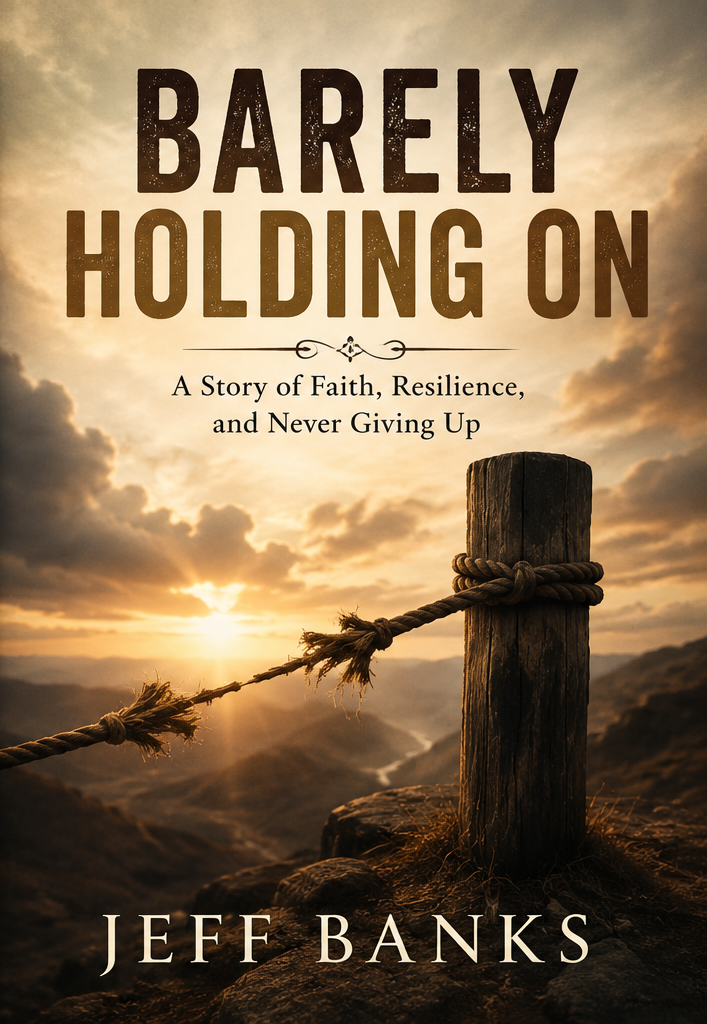
BARELY HOLDING ON - Foreword

BARELY HOLDING ON - Foreword | Travelling Around Australia with Jeff Banks

Barely Holding On is not a book that you simply read and move on from. It is a book that lingers. That asks you, gently but persistently, to reflect. Not just on the life within its pages, but on the lives around you, and perhaps, most importantly, your own.

BARELY HOLDING ON

Foreword

There are books that tell stories, and there are books that reveal truths.

Barely Holding On sits firmly in the latter category.

From the very first pages, this work does not ask for your attention in the conventional sense. It does not rely on drama, spectacle, or neatly packaged resolutions. Instead, it does something far more confronting and, ultimately, far more generous. It invites you to sit quietly inside a life. To listen. To feel. To recognise.

What unfolds within these pages is not a linear tale of hardship overcome, nor a tidy narrative of triumph. It is something more authentic than that. It is the lived experience of endurance. The kind that does not announce itself. The kind that is built, almost invisibly, in the small, repeated acts of getting through a day when the weight of that day feels disproportionate to the task.

The world the author brings us into is textured and deeply sensory. Rooms are not just described; they breathe. Light is not merely present; it carries meaning. Objects, a night light, a carved wooden sheep, a woodheap, become anchors in a shifting emotional landscape. These are not literary devices for effect. They are survival tools, rendered with such clarity that the reader begins to understand their necessity.

What makes this work particularly powerful is its restraint.

There is no indulgence in exaggeration. No attempt to manipulate emotion. The pain, when it appears, is presented with a quiet honesty that is far more affecting than any dramatic retelling could be. Moments of fear, confusion, and even violence are not sensationalised; they are contextualised. They sit within a broader framework of family history, generational influence, and the unspoken rules that govern households where love and hardship coexist in uneasy balance.

And within that balance lies one of the book’s most important contributions.

This is not a story about blame. It would be too easy, perhaps even expected, for a narrative such as this to draw clear lines between right and wrong, victim and perpetrator, cause and effect. But Barely Holding On resists that simplicity. Instead, it offers something more challenging and, ultimately, more meaningful: an exploration of “why” without excusing “what.”

The reader is invited to consider the forces that shape behaviour, history, environment, and inherited trauma, while never losing sight of the impact those behaviours have on a child trying to make sense of the world. It is in this space, between understanding and accountability, that the book finds its moral centre.

Equally compelling is the thread that runs quietly but persistently throughout the narrative: you are not alone.

This is not presented as a slogan or a conclusion. It emerges gradually, almost imperceptibly, through the author’s reflections. In the act of reaching out, whether through memory, observation, or simple acknowledgement, there is a subtle but profound connection formed between writer and reader. It is an invitation to recognise something of your own experience within these pages, even if the circumstances differ.

That is the quiet brilliance of this work. It does not demand empathy; it earns it. It does not seek to inspire in the traditional sense; instead, it affirms. It affirms that endurance, in all its imperfect and often invisible forms, has value. That survival is not always loud or heroic. That sometimes it is found in the decision to stay, to breathe, to continue.

For those who have walked similar paths, this book will feel familiar in ways that may be difficult to articulate. For those who have not, it offers a rare and important window into a reality that is often misunderstood or overlooked. And for all readers, it provides something increasingly rare in modern writing: honesty without performance.

Barely Holding On is not a book that you simply read and move on from. It is a book that lingers. That asks you, gently but persistently, to reflect. Not just on the life within its pages, but on the lives around you, and perhaps, most importantly, your own.

It reminds us that behind every quiet exterior may sit a story still being carried. That the absence of noise is not the absence of struggle. And that sometimes, the most important thing we can offer, whether to ourselves or to others, is the simple recognition that the effort to keep going matters.

In the end, this is a book about holding on.

Not perfectly. Not gracefully. But persistently. And that, as these pages so clearly show, is often enough.

About the Author

Jeff Banks is, by trade, an accountant. For more than four decades, he has worked with individuals, families, and small businesses across Australia, guiding them through the often complex and unforgiving landscape of taxation, compliance, and financial decision-making. As the founder of Banks Consultancy, his approach has always extended beyond numbers, built on a belief that good advice is not simply about accuracy, but about understanding the person behind the problem.

But numbers, for all their certainty, have never told the full story.

Behind the professional life sits a much longer, quieter narrative. One shaped by a childhood on rural land in New South Wales, where responsibility arrived early and without negotiation. A world where the rhythms of chores, schooling, and family life were intertwined with deeper, less visible forces, depression, expectation, and the unspoken dynamics that exist within many households but are rarely given voice. It is from this landscape that Barely Holding On emerges.

This is Jeff’s first deeply personal work, and it marks a deliberate shift away from the structured clarity of his professional career into something far more uncertain and, ultimately, more revealing. The book does not seek to present a version of events that is neat or resolved. Instead, it offers a series of lived moments, observed, remembered, and reflected upon, with a focus on how those moments shaped not just decisions, but identity itself.

Throughout his life, Jeff has been drawn to understanding the “why” behind behaviour. In business, this has meant helping clients avoid costly mistakes by thinking ahead. In writing, it has meant turning that same lens inward, examining the experiences that formed his own responses to pressure, responsibility, and, at times, the quiet persistence of the Black Dog.

His writing style reflects the same principles that have guided his advisory work: clarity where possible, honesty where necessary, and a refusal to simplify complex situations into convenient answers. He writes as he speaks, directly, thoughtfully, and with an awareness that the reader is not simply observing, but participating in the act of understanding.

Beyond his professional and writing life, Jeff has remained deeply connected to community. Whether through business mentoring, local involvement, or simply the day-to-day interactions that come with a life spent working alongside others, his perspective has always been shaped by people, their stories, their struggles, and their capacity to endure.

Barely Holding On is not a departure from that life. It is an extension of it.

It is the story that sits behind the advisor. The context behind the voice. The lived experience behind the measured response.

And, perhaps most importantly, it is a reminder that even those who spend a lifetime helping others navigate their way forward are, at times, still learning how to do the same for themselves.

Author

Menu