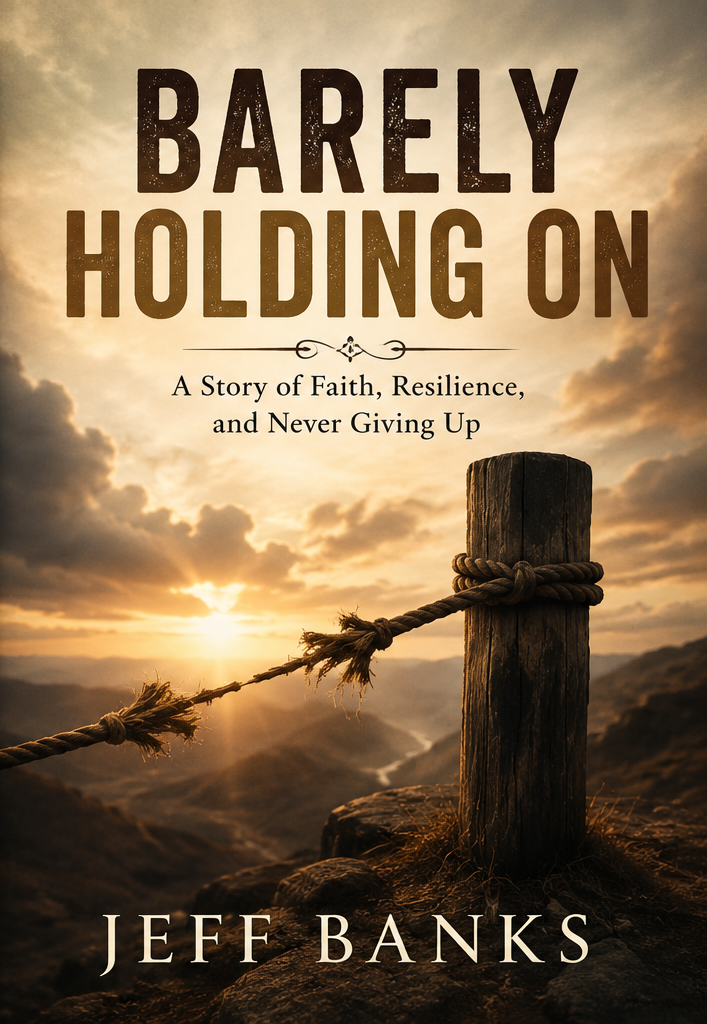
BARELY HOLDING ON - Chapter 9 - The Dog Never Leaves

BARELY HOLDING ON - Chapter 9 - The Dog Never Leaves | Travelling Around Australia with Jeff Banks

I wonder how I keep faith in the idea of possibility. It is not a dramatic faith. It is a patient one, built of small acts: a text that asks how a son slept through the night, a walk with the dog in the morning light, a shared meal that tastes of nothing extraordinary yet feels like structure. It is the alignment of my own breath with the rhythm of a world that continues to push against fear without breaking it, the way a boat pushes against the current but does not surrender to it. The dog’s presence remains a constant, but its hold loosens in direct proportion to our willingness to be responsible for each other’s well-being—the boys, Robyn, the ex-wife, the daughter, and me.

BARELY HOLDING ON

Chapter 9 – The Dog Never Leaves

The road is not empty; it asks to be walked with another.

The caravan ground to a soft, stubborn halt just outside Meadowbank, a tract of suburbia swallowing the night. The engines sighed, a chorus of tired metal and the damp breath of diesel. It was the kind of stillness that settled into your bones, the air thick with dust kicked up by the wheels, the memory of road and rain, and the weight of a dozen small lives curled in sleeping bags and car seats. I stood at the edge of the lot, listening to the wind pick up a thread of conversation from inside the vehicle and tug it away, like a child pulling a kite string until the string goes slack and the kite hovers in the air, uncertain but momentarily free.

I had not slept well for months. Sleep had become a negotiation with a dog that never fully left the room, black, broad-shouldered, patient, and quietly insistent. The dog did not roar; it drifted. It found a corner where the light pooled, then stood sentinel. It watched me walk in circles around a future that didn’t want to appear, a future where the boys would be older and the air would smell of rain and announcements and the careful sound of a kettle heating on a spare table.

The friends who had dragged me through the caravan’s last months, through the hiss of the engine, through the memory of a broken radiator and a night spent listening to the world turn, stood nearby. They did not pretend to fix me. They offered company, practical help, a laugh that didn’t pretend the ache wasn’t there. In the end, companionship is a kind of mercy; it does not erase the dog, but it makes room for the light to needle through.

“New address, same old weather,” one of them remarked, a dry joke couched in a cough of wind. The joke landed not as a joke but as a small ceremony of acceptance. We were not pretending to be saved, only that we could be found.

Meadowbank’s rental front was a pale brick thing with a door that sighed when you opened it and a carpet with a faint scent of lemon disinfectant. The corridor lights hummed in a way that felt almost ceremonial, as if each fluorescent tube wished to remind us that ordinary life, even with all its ordinary irritations, is a kind of salvation. The rooms were modest, three bedrooms, a kitchen that was large enough for a small family table, a lounge that seemed to wait for someone to sit in it and declare, “We are back.” The light spilled in a certain way in the late afternoon, a pale gold that did not pretend to be sunshine, merely a memory of it.

It started with nights after Scouts when the drive home seemed a bridge too far in the eyes of the other leaders. Eventually, a night is offered on a couch and then something far more formal and “permanent.”

The first morning, once the decision was made, was not a sudden reversal of history. It was the slow, honest work of unpacking, of deciding which box goes where, of dust in corners you never knew existed until you moved, of the kettle warming water for Milo that tasted like a careful attempt to claim normalcy. I learned to listen to the house, to listen to the way the air shifts when a window is opened, to the soft creak of the floorboards under a child’s weight in the early hours. The boys could almost walk here from their mother’s home, they could wake with a question in their eyes I could answer without saying a word: we were here. We were safe and even better we were close, or at least we were trying to be safe, which is a different thing altogether but not a small thing.

“The dog,” someone reminded me, not unkindly, when I paused by the door to the second bedroom that would soon become a sanctuary for a child who did not yet understand the stakes but understood fear. The dog was not in the room, nor was it in the hall, but the dog’s shadow stretched across the floor, a long, unwelcome thing that travelled with you as you walked.

I could now take the boys to the local park for the first Saturday ritual, sand and water, a cricket bat pinned into a blacktop, the smell of dry grass and the metallic tang of a nearby barbecue, not needing to keep tabs on time enough to return them the many miles home. The water fountain hissed with cool impatience; the wind threaded through the trees and carried with it the distant clamour of city life, sirens, voices raised in argument, a child’s laughter that rose and fell in a rhythm I could almost trust.

You might think that with a move, the dog loses a little ground. It does not. The dog changes its tactics. It learns to wait in a different spot, inside a chest of drawers that has been painted over, under a bed that doesn’t quite catch the dust the way it used to, behind a curtain that picks up the evening light and glimmers with a kind of dull resilience. I could feel the dog’s breath on the back of my neck when I stood at the kitchen sink and sorted through the groceries, when the fridge door opened and the cold rush of air reminded me that even in the quiet there is a rhythm, even when the rhythm is not the rhythm you wanted.

There is a thread in this: the people who stand with you, who do not fix you but stand near, are a kind of lifeline. They are not a cure; they are a map to a safer place, and maps are not places, but they take you somewhere you can be. They remind you to slow down, feel the temperature of the room, listen for the small sounds, the hum of the fridge, the clock ticking in the living room, the soft breathing of your oldest boy as he sleeps with his mouth open and his hand clenched in a fist, searching for the world he cannot name.

We did not rush toward Balmain the moment Meadowbank stopped offering its quiet, neutral air. Balmain would come with its own set of weights and measures, its own wind to learn to walk with. But there was a sense, a practical sense, that life was trying to move from the caravan’s heart of darkness toward something that could be described as “home.” The weight of the door’s swing, the texture of the carpet under bare feet, the way sunlight pooled in the kitchen at 4:00 p.m these were not trivial things. They were a method for teaching the Dog where to stand when the world asked it to sit.

A month passed like a careful exhale. We packed a few boxes, emptied a few cabinets, and learned to trust the routine again: sport runs, late errands, and the after-hours quiet when a room becomes a refuge.

Then came the Scout Leaders Conference, a gathering of people who spoke a language that sounded like the rattle of a jamboree: tents, badges, the careful press of a handshake, the unspoken rule that you must pretend you know what you’re doing even when you are certain you do not. I was there because the boys needed a place to belong that didn’t revolve around my mistakes or my fears. And in a corner, where laughter erupted with the sort of ease that only comes from a room full of adults trying not to remember the day’s burdens, I met Robyn.

Robyn moved with a calm you can hear in someone’s voice when the world becomes loud and you still choose to listen. She wore a smile that didn’t pretend to fix things but offered a different kind of gravity, a gravity that invited trust rather than demanded it. We talked in a circle of plastic chairs and the scent of cooling coffee, a mix of glue, rain on fabric, and something like courage. The moment didn’t feel seismic; it felt practical, like the moment you decide to repair a crack in a wall with the careful press of a finger and a line of plaster.

We met in a race. My fellow Cub Leader and I were clambering into a makeshift camel suit, me the front, him the rear. Robyn was appointed the jockey. Silliness in all its glory, but creating a formality that would endure from that point on. Something that would certainly entertain the minds of the Cub Scouts we were to lead.

“You should know I am not very impressive at telling people what I want,” I said, because honesty sometimes arrives as a confession dressed as humour.

Robyn’s eyes, steady, almost amused, settled on mine. “Then we’ll learn together,” she replied. The line wasn’t a declaration of destiny; it was a simple admission of possibility. You could sense the air shift in that room, as if the ceiling itself exhaled and decided to give us a little more time.

In the days that followed, Robyn and I found ourselves in a shared rhythm. We moved through the space that had become the new normal: two bedrooms, a couch that invited a watchful eye on someone who needed a seat for a while, and the quiet sound of a kettle warming, a reminder that nourishment and routine are not enemies of healing. Our conversations did not rush toward a future they could not yet claim. They moved in the small, patient direction of truth-telling: what we could bear today, what we could do for the boys today, what we could not do without causing harm or fear.

The room that would become Robyn’s new life entered a different light one late afternoon as I walked along the street toward Balmain, the river just beyond, a line that did not pretend to be anything but a line. You know the feeling, the city’s pulse in your ears and the edge of sleep still clinging to your eyelids as you cross a bridge that looks both ancient and new, a road that has witnessed so many versions of you.

The boys watched with a mixture of suspicion and relief as Robyn folded into our daily lives. They were old enough to notice the difference between a house that feels like a project and a home that feels like a decision you did not regret. They clung to the rituals that still worked: the sound of a cricket bat tapping the pavement after dinner, the quiet of the kitchen as one of them counted the hours until a visitation, the ritual of letting the dog outside and then letting the dog back inside, a daily performance of boundaries and safety.

And then, almost without ceremony, a daughter entered the picture. The news came with a kind of gravity that felt both heavy and bright, like a weight that suddenly becomes a spark. The first time I held her, my daughter, my breath, much like each time with each of her now brothers, caught as though I had stepped into a doorway I hadn’t anticipated. Her small fingers, warm as a thumbprint on the back of my hand, made a map of me in a way nothing else had. It was not a romance born of fireworks and a dramatic confession; it was a gentle, stubborn establishment of presence. The eye of the dog, the Black Dog, shifted to a corner that wasn’t quite as drafty, a corner where even fear could be kept at a respectful distance because love happened to be louder in that room.

Two women now measured the days in somehow competing clocks. The ex-wife, with a history of bitterness that could crystallise into a dozen small fights in a single afternoon, had a voice that rose with the weather, often in the form of a text, sometimes as a call, always with a reminder of who was in charge of the calendar and the sports events and the supposed “best interests.” Robyn, by contrast, moved with the unassuming confidence of a partner who understands that a future is not owned by one person but negotiated by two. The boys remained the centre, as they must, and the rest of us learned to orbit the orbits that were already set in motion before we arrived.

Holiday plans became the battlefield and the treaty room all at once. The ex-wife wanted certain canonical weekends, holiday camps and the same visits at the same time as before. Robyn wanted to weave in the idea of a family that included a daughter, a girl who would someday ask about her place in those plans. The logistics of holidays, who would drive whom where, who would pay for a camp suit, who would sit in the bleachers with a blanket and a thermos while the wind cut across the field, became a kind of constant negotiation. And in the midst of it all, the dog’s presence persisted as a quiet, unspoken reminder: the past may demand a share of the future, but the future can still belong to more than one.

The months wore on with the patient cadence of a road trip you cannot abandon but cannot rush. The car’s engine, once an anxious metronome, began to steady. The upholstery wore into a pattern that welcomed the weight of a child’s leg and a wife’s hand on your shoulder. The sun angled across Balmain’s riverfront with the tenderness of someone who understands that light can heal only when it travels the long way around a memory. And I learned to listen to the sound of my own breath, the way it slowed when I reminded myself to align with the present rather than conduct an ongoing vigil for a past that refused to stay buried.

I wonder how to measure a life when two women claim the same man, and a dog still sits in the room, not as an adversary but as a stubborn, quiet witness. It is not the glamour of a new romance or a neatly resolved custody schedule. It is the slow, stubborn work of disentangling fear from decision, of choosing to stay when the old patterns threaten to pull you back into the caravan’s dark, of learning to trust a partner who will not erase the dog’s presence but will not be deterred by it either. It is a life that still carries the ache, the ache that comes when you have to tell a child without melodrama that holidays will be different now, and you will still try your best to make them good. You are not alone as you hear these things spoken aloud. The reminder sits at the edge of the room: you are not alone.

The dog never truly leaves. It is a shape you can’t quite dismiss, a memory with the texture of a damp wool coat that clings to the skin. It sits in corners, in the weight of a moment when you pause to answer a call, in the way a curtain catches the light and makes the room feel smaller or larger depending on how much truth you are willing to tell yourself about fear. But there is a difference between fear that paralyses and fear that teaches you to move with a little more care. The dog’s shadow doesn’t vanish; it moderates. It becomes a second line of weather you learn to read: when the wind twists and the temperature drops, you know you must tighten your grip on the steering wheel, on your own spine, on the knowledge that you are capable of guiding more than yourself.

Sometimes I catch myself talking aloud on this memory. I talk of what I have learned, not to claim authority but to offer a map: that the path away from the darkest parts of the night is not a single bright corridor; it is a corridor with doors that open and close, a hallway in which the lights burn at different levels, and a floor that creaks in sympathy with your steps. If I listen carefully, I hear the sound of a lamp switching on in a room that used to feel uninhabitable and now feels merely lived-in, a lamp that makes a circle of light on the floor where a child’s shoes are left by the door.

The two women, ex-wife and Robyn, are not villains in this story, though they are often cast as obstacles in a melodrama. They are who I needed them to be, the people who made the road more navigable. The ex-wife’s remonstrations were sharp, yes, but they were not without a reason rooted in love, fear, and the stubborn insistence on routine. Robyn’s presence is the counterweight to that: a person who knows when to take a breath, when to step away, when to hold. Between them, the children have to learn a language of compromise that does not erase their feelings or mine but preserves a space in which they can grow. If resilience is a practice of alignment, then these relationships have become a strange kind of compass, pointing toward a horizon where the dog’s shadow does not eclipse the light.

I do not pretend the road is easy. Crawling out from under the Dog does not guarantee a clear sky. There will be days when the memory floods the room, little moments of fear or loneliness that arrive with the same quiet insistence as a knock at the door. There will be days when a holiday plan dissolves into a new, deliberate negotiation and you must stand on a balcony at dusk with the river running in a straight line behind you and ask the questions you never learned to ask aloud: What does it mean to be fair to the children? How can we build a family that includes both a past and a future that are not at war? Who am I when I am not merely the man who survived a long night in a caravan?

I wonder how I keep faith in the idea of possibility. It is not a dramatic faith. It is a patient one, built of small acts: a text that asks how a son slept through the night, a walk with the dog in the morning light, a shared meal that tastes of nothing extraordinary yet feels like structure. It is the alignment of my own breath with the rhythm of a world that continues to push against fear without breaking it, the way a boat pushes against the current but does not surrender to it. The dog’s presence remains a constant, but its hold loosens in direct proportion to our willingness to be responsible for each other’s well-being—the boys, Robyn, the ex-wife, the daughter, and me.

I want to say, that what seems like “real life” after a long season of darkness is not a return to the old normal. It is a new normal, with its own set of rules, its own allowances for misstep, its own pauses for breath. It is the road we walk together, the engine of a life you can hear in the distance, the sound that grows louder when you keep moving. You learn to tolerate the weight of fear without letting it pull you under, to listen to the wind and to the river and to the city’s hum as if you are hearing them for the first time. You learn that hope does not arrive as a triumphant shout but as a quiet decision to stay, to keep showing up for the people you love, to let your sons see that a father can be imperfect and still be part of something sturdy.

Author

Menu