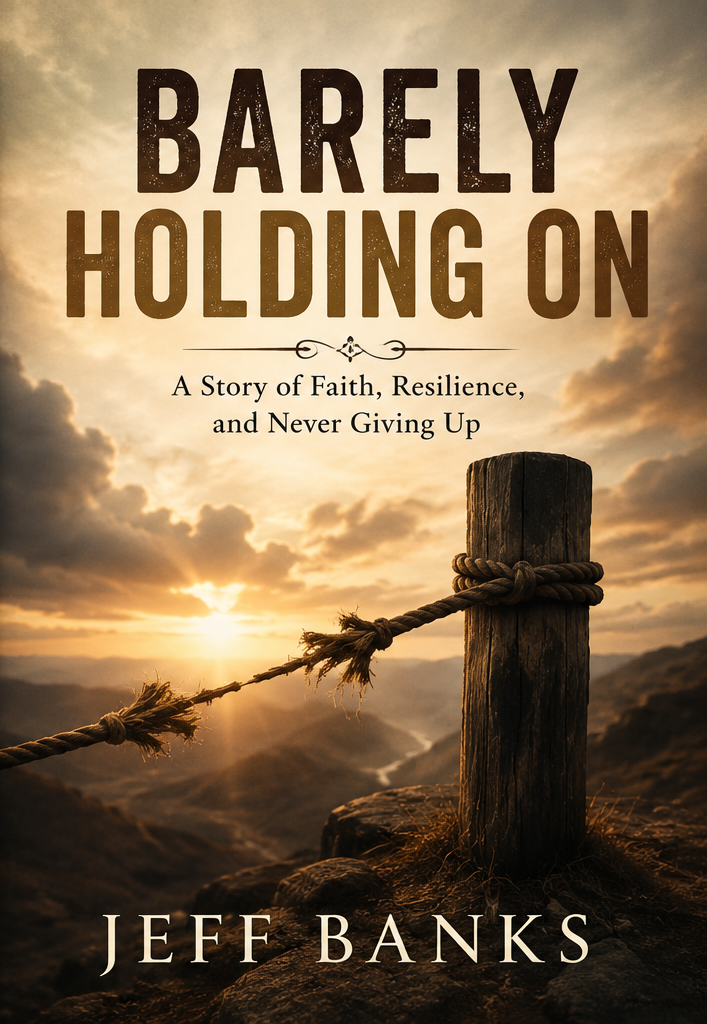
BARELY HOLDING ON - Chapter 5 - Letting Life Drive

BARELY HOLDING ON - Chapter 5 - Letting Life Drive | Travelling Around Australia with Jeff Banks

The road is not a straight line from a bright start to a glittering end. It’s a circuitous path that harnesses pain, learning, and wood-pale light of early mornings. It’s a path that often asks you to choose between what you want to be and what you have to do to keep going. Depression is not a badge or a story to be told loudly; it’s a weather system you learn to predict and endure, and then perhaps, more slowly, to outlive.

BARELY HOLDING ON

Chapter 5 – Letting Life Drive

Life could have meandered on. I could have stayed in the shearing shed, wasting a posted IQ in the 130’s. In fact I did for a while, but then a call came with an offer, come to Sydney for a party. Cousin Phil, about to head to teachers’ college was interested in breaking loose one last time at home

The morning after a party you didn’t intend to attend arrives with the gravity of a new language learned too late. I woke in a room that wasn’t mine and a city that felt like a shipyard, all steel and wind, and a bed that carried the memory of a night you can’t quite tell if you survived or merely endured. The window was a fogged pane, pale light leaking in like a shy apology. The air, cooler than any country morning I’d known, carried the distant sound of traffic, an unrelenting tide that never asks your permission to move.

I remember the room first, the way a small space can hold a larger fear. The bed sheet’s texture told me how long I’d slept: rough cotton, frayed at the edge, the fabric that always seems to hold a memory more accurately than the mind can. The carpet underfoot was dry dust, the way a light dusting settles on the floor after a storm has passed, nothing dramatic, just enough to remind you that something happened here. The clock on the wall ticked with a stubborn regularity, each tick a small reminder that time continues to pull you along whether you’re ready or not.

You might ask what the party did to me, what it did to the boy who had learned to measure life in kilograms of effort, not hours. It did nothing visible, at least not at first. It let me walk into a world I hadn’t learned to navigate, a city that demanded a different kind of pace. The party wasn’t the end; it was the catalyst for the next, quieter chapter a man writes when he’s had enough of pretending to be ready for everything and not quite ready for anything.

I drifted toward the door of that house, next to the police station at Dee Why and found the corridor’s light more honest than the conversations I’d had that night. Sydney, for a boy who’d grown up with the wind on the hills and the soft, patient dust of home under his boots, presented itself as something both exciting and dangerous: a road with no guard rails, a map that showed you destinations you might never reach, a city that rewarded speed even as it punished patience. The party’s echo followed me as I stepped into the lift and watched the floor numbers move with a clinical coldness, 1, 2, 3, then down to street level, where the air felt less like a breath and more like a story you’re trying to convince yourself of.

I was given a glimpse of a life that was possible in its own terms, a life that didn’t revolve around the farm’s predictable weather, a life where you could walk into a room and be treated as if you belonged there, not because you did, but because you showed up and learned fast enough to pretend you did. The problem wasn’t that the city had failed me; it was that I hadn’t learned to tell the city what I needed, to tell it what I would accept. The memory of the party is a seed, yes, but in this memory the soil is city dust and the rain is city noise.

You, might picture a boy who has tasted the edge of risk and wants more. But I wasn’t there to chase risk as a thrill; I was there to find a doorway that could support the weight of a life I hadn’t yet learned to carry. I found the doorway not in a grand entrance but in a half-lit reception area, the kind that makes you pause and ask, Not here. Not this. Then realise that maybe this is the place you’re meant to learn how to become someone who can stay.

The job came to me the way a gull pulls a fish from a wave, the work not offered, but discovered as you move forward. I walked into an accounting firm with a briefcase that still smelled faintly of train carriage and hay, a city clerk’s dignity tucked inside, and a nervousness that claimed far more space in me than any confidence I could muster. I didn’t know what accountants did, not really. I’d heard stories in Rye Park and read of ledgers in Boorowa, but the city’s version of the profession felt like a foreign dialect spoken in a language I hadn’t learned. The cartoon above the tea area, “Six Munce ago I couldn’t even spell Akkountant. Now I are one.” That quiet joke wrapped around me like a blanket I hadn’t earned yet. It wasn’t a boast. It was a shield.

The partners, two men with the kind of calm certainty you grow to respect in professions that insist they know the path forward even when you don’t know the path at all, invited me to sit and talk about debtors and ledgers as if they were just ordinary objects, like a chair and a lamp. They asked questions I didn’t understand and, in that moment of not knowing, I found something that felt burdensome and true in equal measure: structure. Not rules that smother, but a lattice of expectations that could hold a life together when the walls shook.

I walked out with a job, not a title. The sense of belonging felt more like a hinge than a door, something that could swing and hold, a little bit of air on each side, and a growing realisation that the work may be simple, but the consequences were not. It is a strange thing to discover your own usefulness in a room full of strangers, to understand how quiet competence can be a weapon against chaos you’ve grown up with since birth.

That first week, I learned not the arithmetic or the poetry of accounting, but the rhythm of it, the way the numbers move when you don’t move with them, the way the desk breathes when you arrive early, the way a coffee cup sits and keeps a secret: we’re watching you, we’re trusting you, we’re hoping you’ll stay. The city’s brightness, so loud, started to feel less like an invitation and more like a responsibility. You may find it odd that I learned responsibility not in the country’s stillness but in a room where the air always smells faintly of toner and coffee and something you can only call potential.

The second day in Sydney came with its own weather. I wandered the streets with a briefcase that felt heavy with both opportunity and fear. It carried share certificates, paper shivers of a future that hadn’t yet hardened, the kind of things you stash inside a bag and tell yourself you’ll understand later, but you don’t yet. The concrete felt like a paddock that had learned to scratch at your ankles with its own roughness. The wind moved along the city’s corridors with a purposeful persistence, the way a river knows where it’s headed even when the banks don’t quite agree with the direction. The light on the water at the harbour looked like a thin, fragile gold thread, as if someone had laid a delicate line across the surface and whispered, Do not tear it.

In that walk, I realised something essential: the path after the HSC wasn’t about being the clever one in the room. It was about showing up when there was no map, about choosing the option that offered safety to a mind that had learned to live with danger as a constant companion. I looked at the seized, stamped certificates in my bag and thought of the alternative, going home to the life I’d known, the volatility that had carved itself into every wall, the threat of a flame that could ignite at any misstep. The memory of that choice, that the only real option was to keep moving in some direction rather than to ride the last wind that had forced me into the party’s orbit, became a quiet ember: small, steady, and stubborn.

Later that evening I stood on a balcony overlooking the city’s edge and listened to the distant hum of the traffic. The room’s air, cooler now after the day’s heat, pressed lightly against my skin, a reminder that the body remembers what the mind pretends not to: survival is a daily practice and often a private one. The day’s weight lay in the rectangle of the briefcase, the smooth edges of its corners pressing into my palm, the tactile memory of the moment when I understood that I had to hold two lives at once: the life that came from the hills, quiet, patient, and predictable, and the life being built in the city, fast, uncertain, and driven by the need to prove something, to prove that I could belong there, even if I didn’t yet know what that “there” looked like.

The memory of that moment sits behind the eyes like a dull glaze you can’t wipe off, even when you try to pretend it wasn’t there. The HSC results didn’t just close a door; they sealed a corridor you hadn’t noticed before, the kind that keeps you from turning left toward university and instead points you toward a quieter, more practical corridor. It wasn’t anger so much as a long, deliberate exhale. The kind of breath you take when you realise the storm you’ve been waiting for isn’t outside but inside, a shift in direction that doesn’t demand drama, only a quiet decision to keep moving.

And yet the decision wasn’t mine alone. The partners at Ruwald & Evans, men who believed in honest work, in the discipline of debits and credits, in the way a ledger can anchor a life, saw something in a kid who could stand in front of a room and talk about numbers as if they were weather patterns. They didn’t pretend the world would bend to fit a dream of “uni.” They believed in a different pairing: you could learn to speak the language of business by learning the language of numbers, and you could do that inside a classroom that felt almost invisible to the world outside, the kind of place where the hum of a fan, the scent of new chalk, and the faint smell of toner on printer paper could become the compass by which you’d navigate your own future.

So I enrolled at a TAFE college soon after. Not because I believed it would unlock some grand career, but because it offered a language I could learn with my hands as well as my head. There were no bright lights in this choice, no fireworks or dramatic turning points. It was a door that opened slowly, a pace that matched the room’s rhythm rather than forcing a new rhythm onto me. Debits and credits, the double-entry, the trial balance, these words filled the air with the sense of possibility I’d always searched for in the bush but found in the city’s arithmetic: a set of rules, a structure, a way to sanity.

Night classes meant I had to give up, for the time being, the chance to chase the things I’d loved in the yard and at representative levels, both district and school, the cricket, the rugby league trainings, the late afternoons where the air would carry the scent of wool and sun and the sound of a cattle bell. Those things required a different pattern of living, a pace that didn’t fit into the schedule of an office and a desk that glowed under a fluorescent lamp. The decision wasn’t dramatic, but it was a quiet, frank shift: I would stack my days with theory and practice and let the other possibilities wait their turn.

I won’t pretend the choice felt heroic. It didn’t. There was no choice; this was all that was offered. It felt precise, clean, almost clinical in the way a good ream of paper looks when you pull it from the printer: orderly, predictable, capable of becoming something you can trust. The room at night, its pale light, its hum of computer fans, the scratch of a pencil across a ledger page, could have been a paddock in another world: a place where the steps you take matter and the ground you stand on holds steady if you place your weight correctly. The balance sheet, once a distant rectangle of numbers, began to look like a map: debits on one side, credits on the other, a route through the fog that hinted at meaning when nothing else did.

Meanwhile, the personal weather kept its own schedule. Night after night, I would stumble from the day’s work to a room that smelled faintly of coffee and damp wool, and I would tell myself that this was only temporary, that the room would loosen its gravity if I kept showing up, kept learning, kept aligning. The HSC’s failure to tether me to a university seat felt like a barbed wire fence I could walk around if I chose the right gate. The gate was narrow and quiet: a college bell’s soft chime, the chalk dust clinging to skin, the light-blue cover of a grammar book, the slow rhythm of a class that valued process over noise.

You may ask what the city gave me in those early weeks. It gave me a language I could hold in my hands, a vocabulary for how money moves and how people live with those movements. It gave me a corridor that didn’t demand a stage entrance, a space that rewarded careful listening more than loud talking. It gave me the sensory memory of upright chairs, the solid feel of a wooden desk that would not budge when I pressed my palms into it, and the sound of pages turning in a quiet room that never seemed to mind if you read aloud or read to yourself.

The decision to enrol wasn’t a tale of grand sacrifice in the moment; it was a story of shape. It reshaped my days so they could fit a future in which I could still be me, even when that “me” was learning to shift from the boy who chased wind to the man who learned to listen to the numbers’ weather. The path was clear enough to walk, and I walked it with the same quiet determination that had carried me through the paddocks when a storm crept across the horizon and the sheep moved as one weathered body.

And still, there was the price, night after night a ledger’s neat rows demanded attention, the cricket pitches and rugby drills sat in the corner of my memory like faded banners, and the scent of wool clung to my skin as if to remind me of where I’d come from and what I’d chosen to leave behind for a while. Some days the choice felt dull, no fireworks, no triumphant music, just the ordinary arithmetic of time used well. Other days the sense of weight, the weight of a life wanting to be something more than a set of jobs, a string of balances, a line on a report, pressed in on my chest with the quiet insistence of gravity.

But this is how I learned to live with life driving: slowly, deliberately, with a cadence that respects the road ahead. The TAFE doorway didn’t erase the memory of the farm’s weather, nor did it erase the ache of leaving behind practice games and evenings spent under a huge red sun. What it did was give me a room to grow in, a space where the engine could hum without shouting, where I could accumulate a language that would eventually hold the entire work of a life together.

There is somewhere locked inside, the impulse to chase speed, to chase certainty, to chase something you can point to and say, “That’s the thing.” But there’s another direction here: the slow, sturdy persistence of learning to listen to the numbers, to the rhythm of rooms, to the weight of a night class that becomes the anchor for a future. This is not a glamour shot of progress. It’s the quiet, necessary work of coming to terms with a chapter that didn’t begin with a triumph, but with a door that opened at a pace my feet could keep.

And so I stepped through. The HSC blast still echoed in the distance, but the corridor it opened, TAFE, not university, became the place where I learned to be useful, to be present, to be measured. A door that opened slowly, yes, but opened. And in that opening, I found the first steady engine of momentum that would carry me toward the rest of the chapters I would write with care, restraint, and, eventually, a guarded hope.

You might wonder how it feels to let go of a dream you’ve carried since childhood, to surrender even temporarily to a different rhythm. It feels like standing at the edge of a road you’ve never walked before and taking a step anyway, feeling the pressure of the past’s gravity tug at your ankle and choosing to walk forward because forward is where the light seems to land. It’s a careful, cautious motion, the kind that doesn’t look dramatic but is, in its own way, the bravest thing a person can do in a moment when the ground beneath you is shifting.

As I learned to read the numbers, I learned to read the room. The firm’s offices, like a city’s mix of streets, held a different kind of weather: the hum of the machines, the click of keyboards, the soft cadence of colleagues who speak with a language that’s precise and inclusive at once. My colleagues didn’t ask me to pretend to be older or more certain than I was. They asked me to learn, to apply, to show up with a calm that felt unusual for a kid who’d grown up learning that lightning could strike anywhere and at any moment.

The second day’s walk through Sydney’s concrete paddocks had a companion thought: if not this, then what? The HSC’s failure to chart a clear course hadn’t been a failure of intellect so much as a failure of fit. Here, finally, I found a path that fit, one that didn’t promise glory, just the chance to build something that could endure. I could feel the possibility not as a roar but as a steady engine’s purr: a sense that the road isn’t a trap but a vehicle, and I could steer it if I learned the rules of the road.

If you’ve stood on a platform with your backpack heavy with unspoken worries, if you’ve learned to trust a process more than a moment’s burst of energy, know this: you are not alone. Depression, the Black Dog and the thoughts of insufficiency come in different guises: quiet, persistent, almost polite; it doesn’t always announce itself with drama. It arrives as a weight, as a pressure on the chest that makes every breath feel edged, as a wind that sweeps dust into your eyes when you try to see clearly. It’s not a thing to be glamorised or exaggerated; it’s a room you walk through, a hallway you must navigate with your feet as well as your heart.

Let life drive, I tell you now, not as a surrender but as a discipline. Let the engine teach you what it can, and you’ll discover that even when the road isn’t straight, the car still moves. The memory anchors, the road, the engine, the weight of the briefcase, the dust, the wind, are not obstacles. They are your compass. They show you what you carry, what holds you, and what can carry you forward when you’re tempted to stay where you are because it feels safer to do so.

And so I walked into the next room, the next desk, the next set of numbers, with a quiet, patient resolve. I didn’t have all the answers, not that I knew the questions being asked, but I had a method: show up, learn, do the work, and let the path unfold in front of me. The road was imperfect, the weather unpredictable, and the future uncertain. But there was a growing sense that if I could endure, I could also be useful in a way that mattered beyond the sum of the days’ bills and the month’s balance sheets.

Letting life drive isn’t about giving up agency. It’s about choosing which direction to lean toward when the wind shifts. It’s about the small, steady acts of staying present, the handshake with a client who needs clarity, the moment you resist the urge to fill a silence with pretty promises, the patient, almost ritual act of double-checking a figure you could almost trust to be right because you know you’ve done your due diligence.

The road is not a straight line from a bright start to a glittering end. It’s a circuitous path that harnesses pain, learning, and wood-pale light of early mornings. It’s a path that often asks you to choose between what you want to be and what you have to do to keep going. Depression is not a badge or a story to be told loudly; it’s a weather system you learn to predict and endure, and then perhaps, more slowly, to outlive.

The party’s memory is not a trap but a turning point. It taught me that survival isn’t only in the act of enduring; it’s in the act of choosing a direction and walking toward it, even if you don’t know what you’ll find on the other side. The following years, the learning, the friendships, the work, the family, and the slow reconstruction of a life, these would become the scaffolding upon which I’d build a different relationship with the Black Dog: not as a companion I could banish with one grand gesture, but as a shadow I could learn to walk beside, to respect, to invite into conversation, and to invite out again when its company became too heavy.

So I offer you this memory not as melodrama but as a map. If you’re in a room with the Black Dog, listening to the hum of a city you didn’t choose, if you’re the one who wakes with a weight that won’t lift, if you’re the one who fears the next step as much as the next breath, you are not alone. We carry these stories in our pockets, in the weight of a briefcase, in the texture of a worn bench, in the quiet spaces between two numbers that finally make sense when read together. The road may be long, and the engine may feel small, but there is a pace that respects the fear, and a pace that allows hope to grow even in the most restrained, careful way.

Author

Menu