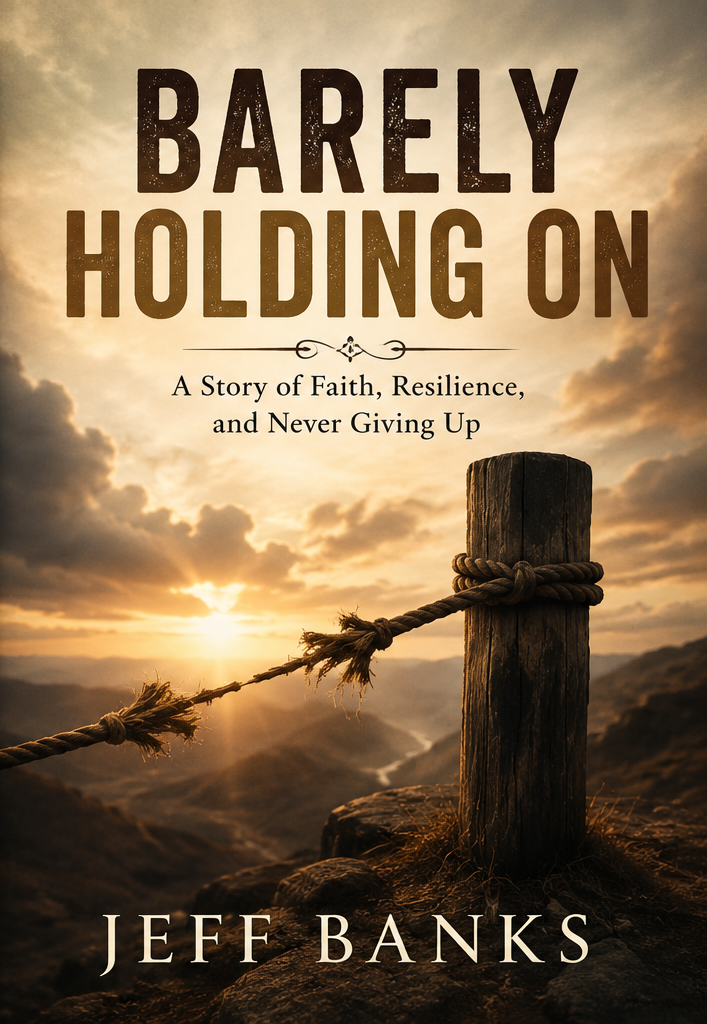
BARELY HOLDING ON - Chapter 4 - Home is No Escape

BARELY HOLDING ON - Chapter 4 - Home is No Escape | Travelling Around Australia with Jeff Banks

There is no heroic turning point, only a sequence of careful decisions. I commit to routines that respect the body’s limits while gently extending them: a daily walk at a pace that leaves room to notice, a warm shower that soothes like a hand on the shoulder, a balcony chair facing the street where dust and leaves drift with the wind, an ordinary theatre of weather and time. The room’s light shifts through the day, and I learn to read it as if it were a weather report for the mind. A pale dawn invites action; a late afternoon shadow invites reflection. The engine inside, the stubborn current of consciousness, keeps running, but I learn to tune it, to direct it toward a road that might lead somewhere healthier than today, even if the destination remains uncertain.

BARELY HOLDING ON

Chapter 4 – Home is No Escape

The Black Dog does not announce itself with a growl or a crash. It slides in through the door when the kettle is singing to itself on the stove, and the light in the kitchen is pale and patient. It makes itself comfortable in the quiet warmth of a room that knows you too well. In my memory, the house is always a place of small, careful rituals: shoes stacked by the door, a mug that fogs with the heat of tea, a chair that creaks just enough to remind you that it’s there. The Dog arrives not with drama but with a methodical, almost domestic persistence. It sits on the edge of the bed, or in the chair by the desk, or in the empty space where the old couch used to rest a child’s weight and a mother’s patience. It weighs nothing and everything at once, the sensation of something that has learned your habits, then uses them against you.

You might imagine safety as a bright, polished thing: a map, a plan, a checklist. In this memory, safety is a careful, deliberate alignment of breath and posture, a small routine that can hold a storm at bay even when the storm is not weather but mood. Depression does not crash the room with a shout. It settles. It makes the ordinary feel heavy, the ordinary sound, traffic on the street, a neighbour’s lawnmower, the wind around the eaves, sound different, muffled, as if the world itself had found a slower tempo and invited you to perform at that tempo, whether you wanted to or not.

The home I’m returning to, during my formative schooling years, is the only home I’ve known: a place of careful surfaces and the quiet machinery of daily life, contrasted against the manic forces of parents. It is a house full of memory, and yet memory itself can become a weather system, wind pushing through blinds, dust drifting in a sunbeam, the woodstove sighing as if it is listening for something it cannot name. Depression does not need drama to assert itself. It likes the rhythm of routine, the soft insistence of “later” when today would be better spent just keeping still.

So I learn to walk through a day with the same meticulous care I once reserved for a task on the farm, only this time the task is to stay present. I start with the simplest things: coffee that is barely hot enough to steam, a kettle’s quiet whistle, the way a mug’s handle warms my fingers through a thin cotton glove. The room smells faintly of aged paper, of a coat left hanging too long in a wardrobe, a hint of dust that settles where the sun won’t reach. The soundscape is a stitched memory: the fridge’s hum, the tick of a wall clock, the distant murmur of a radio turned down to a whisper because the house wants to hear nothing except the sound of a breathing body and a mind that will not wander too far.

The first sign of Depression’s presence is not loudness but absence, an absence of energy, of appetite, of interest in things that used to matter. It is subtle, almost polite, a weight that sits in the chest and slightly behind the eyes, a reminder that gravity is real even in a world that still smells of soap and food and rain. When I walk to the window, the glass feels cool, almost ceremonial, as if it’s a boundary between what I want to do and what I must do. The air outside is a thin, pale wind that carries the scent of damp earth and damp leaves. It touches my skin and I notice how temperature changes as if the room itself has turned into a kind of weather forecaster. The world is still, but the body is not sure where to anchor itself. In the back of my mind, I catch a not-yet-named thread: I don’t yet see Depression as a presence; I only feel the days thickening, as if the air itself has turned heavier, as if routine has gained a second, quieter weight, in the eternal fight against the whip.

The not-knowing is almost a kind of mercy I grant myself, until I don’t. I tell myself this is just the weather, or fatigue from a long week, or a winter that insists on slow mornings. The Dog in me, the part that wants to surge forward, to fix, to finish, coexists with a version of me that lingers at the edge of the bed, counting breaths, counting tasks, waiting for the pulse to reset. I’m thinking this is how it is, that this is what the day will hold, and I move through the rooms as if I’m rehearsing a routine I have known since childhood: Milo, kettle, cup, chair, the soft rasp of the chair’s fabric as I sit, the slight tremor in my hands as I steady the mug. The memory of the paddocks, the weight of a rifle, the rhythm of a measured breath, returns like a silent echo, but here it is not a tool to wield; it is a memory of how I learned to endure without collapsing, how I learned to align with what the body asks, rather than what the mood demands.

The window frame becomes a fence between two days, the day I hoped for and the day that is arriving with quiet insistence. The weather outside is pale and patient, the wind a thread that tugs at the blinds and at the corners of my mind, asking me to notice without surrender. But the weather inside can turn gale force in the blink of an eye. I notice how the glass catches light, how a sunbeam leans along the sill and leaves a narrow stripe of warmth on the opposite wall, how the coil of dust particles drifts in that beam as if they are tiny asterisms marking a map I am not sure I want to read.

The world outside hums with ordinary life, the kettle’s hiss returns, the fridge rotates its quiet, the distant traffic on the street seems almost a memory from another life, but inside, the body hesitates, unsettled, not sure which motion will keep the day intact. I realise I am not naming Depression disguised in the fear or retribution; I am living with the possibility that it has already taken up residence in the corner of the room, in the charge of the air, in the way light pools on the kitchen floor.

And yet, there is a strand I can hold onto: the half-seen promise that I am not alone, that the room’s quiet has a companion somewhere nearby, that another person could hear the same quiet and respond with steadiness. But there is more now, a small, messy, honest addition to that tether: a fantasy world I became willing to revert to, simply to escape. In that private theatre, the room falls away, and I am driving a long, straight road where the boundaries blur into edge and horizon. The motorcycle engine rumbles beneath my hands, or a horse snorts in expectation of a morning ride, a persistent, intimate weight that never asks for permission to exist. The wind pulls at the window and the blinds, a reminder that movement is possible even when the body resists. I am not past the pain, but I slide into a version of me who can outface it for a few miles, who can pretend the room is a quiet trailer and not a prison. In this world, the Black Dog is a distant shape behind the glass, a sound less a growl than a distant coastline that slowly recedes as the road carries me forward.

The fantasy is not a lie, but a doorway. It offers a temporary alignment: the sensation of a road well-timed with the breath, a scene where the weight in the chest translates into a calm push of momentum rather than a sinking. In the fantasy, I can open the accelerator, nudge the horse into a gallop, feel the metal heat, or the animal beneath me, against the palms, hear the tyres kiss the strip of rain-washed asphalt, or hooves scream across a paddock, and watch the world blur into a map I know how to read. It is a careful narcotic of control, safe, distant, neatly contained, where the mind rehearses competence without the sting of real consequence. Yet even as I slip into that imagined lane, I carry the memory of the paddocks, the wind in the grass, the rhythm of a measured breath, the way the land asks for patience. The fantasy becomes a parallel discipline: a road map drawn in my head that resembles the engine’s tremor more than it resembles a cure.

This is where the not-knowing is reframed: it is not ignorance but a deliberate practice of choosing where to anchor. The strand remains: you are not alone. You, reader, who might have stood in a quiet doorway or listened to a room that refuses to rise. I invite you to hear the hush with me, to measure a breath, to set a small, exact task, one lift of the mug, one settle of the spine, one window opened just enough to admit a fraction of wind. The fantasy world doesn’t erase the weight; it reframes it as fuel for staying. It is not an escape, it is a route, a phase, a way to keep walking when staying still would be easier. And every time the door closes on the fantasy and the real world returns, I hold to the truth I’ve learned: the room’s quiet can be answered, not by erasing it, but by meeting it with a steady, practised presence.

We can name what we can, and we can choose one small action that suggests the day is not beyond repair. The door remains a hinge, the floor a tape of memory, the window a boundary and a bridge. And maybe, just maybe, the light that slides along the sill can become a path toward steadiness, toward a day that’s survivable, toward a future that allows room for both the weight and the possibility of relief.

In this home, safety also looks like a routine of restraint. The Dog in me, dark and loud in private, quiet and careful in public, insists I pause before I speak, weigh before I act, decide before I move. It’s not about denial of feeling; it’s about telling the feeling where to go. The door to the mind, often left ajar when mood dips, has a latch I learn to slide shut with a deliberate, almost ceremonial click. Not a denial of the pain, but a pause: a moment to observe, not to react. This is a skill I learned in the paddocks with the rifle or the dog, but now the game is different. There is no target quiet enough to confine, only a mind that sometimes refuses to yield to the noise.

The knot of a day that feels slept-in and weighty, the way the morning light lands on a floorboard in a way that makes you notice the grain again. Depression, that word yet not defined within me at this point in the journey, does not always announce itself with a scream; sometimes it speaks in a syllable you almost miss, a sound that returns again and again in the same place: the throat tight, the tongue thick, the impulse to pause, to recoil, to withdraw from contact. It is a current threading through the body, a slow river under ice, a current that pulls at the ankles when you stand still too long. The memory trembles here, not because it is novel, but because it is true: the fatigue that makes the bed feel like a harbour, the room’s quiet that becomes a shield, the weight of a thought that has learned to rest on the chest like a stone in water.

I do not pretend this is unique to me, and I do not pretend it is simple, in fact depression is always felt like someone else’s problem. The story I tell myself, about a life that used to be about movement and purpose, becomes something closer to a map with missing roads. Yet I also learn something crucial: memory can be a compass if you hold it with care. The anchors I keep returning to are the tactile ones, the feel of a chair’s upholstery, the cold edge of a mug at the hinge of winter, the way a window frame holds the morning’s breath as if it can stabilise the day. The world remains the same outside, rain or shine, but I need to re-learn how to move within it when my own weather refuses to align with the calendar.

There are moments when the screen door slams and the world seems to hold its breath. The bell is a little like a bellows on a fire; it forces a moment of action, a choice to respond or to run in retreat. I choose to respond. I answer with a careful “Hello,” a voice that does not promise a cure but offers a place to stand. The conversation is a thread I pull gently, not to reveal every ache but to offer a map of light through a corridor that has grown darker than it should be. The other person’s voice is a soft buoy, a reminder that you are not alone, that someone else has walked into a room where the air feels heavy and found a place to stand and breathe with you.

The body remembers its old language, the language of movement, of turning toward the light, of continuing to walk even when the feet feel leaden. I place my feet on the floor with the same careful precision I once used to measure a shot’s angle. I let the breath do its work: in through the nose, a slow count to four; out through the mouth, to the count of six. It is not a magical solution, but a procedure, a way to translate a storm into a series of small, tractable actions. The world still holds its edges; I simply learn to live within them again. The memory of the paddocks, grass at ankle height, wind on the exposed skin, the quiet justice of a job well done, offers a template. Not to recreate the old life, but to echo its discipline in a new form.

You are not alone, I tell you, but I also tell myself. The sentence repeats, not as a cliché but as a necessity: one’s own companionship is a form of shelter. We speak of small things at first, how sleep has shifted its hours, how the body’s appetite for routine remains, how the mind’s hunger for novelty wanes and then returns with a slower, more hopeful rhythm.

The home’s rooms become studios for practice. I practice naming the feeling without worshipping it. I practice asking for help without muttering apologies for needing it, even though the requests fall on deaf ears. I practice the stubborn, stubborn truth that I am not broken, just learning to enter a world that still carries risks but now also carries possibilities. The window remains the same, but the way I listen through it shifts. I learn to notice when the wind shifts and to let that shift guide a new form of movement: a longer walk, a slower pace, a routine that reintroduces small pockets of quiet that don’t require justification.

The memory anchors push toward a reconstruction of self that is more elastic than brittle. The body’s responses to light and sound become a way to test reality again: does a day truly begin with sunlight on the kitchen floor, or is that just the echo of sleep’s remnants? If I place my hand on the radiator, I feel its warmth spread through the wrist, up the forearm, into the shoulder, as if heat itself could realign a posture that has grown slouched with worry. The texture of the chair’s fabric offers a tactile reminder: some days are meant to hold you; other days you must hold them. The weight of a day is not a punishment but a physical fact to be accounted for, measured, and then slowly reduced with care.

In the quiet afternoons of later life, I begin to write. Writing is not distraction but discipline, a way to translate the feeling into something legible, a form that you can set down and walk away from with less fear. The page does not scream; it clarifies. I write to separate the emotion from its threat, to demystify its hold. The words become a physical thing on the page, a weight that you can lift and move. The act of writing becomes a small rescue operation: the memory’s sharpness is tempered by the act of shaping it into something that can be seen, named, and held without dissolving the self.

Even now, there are days when the dog returns. Not the old, private dog of a wandering mind, but a companion: a friend, a neighbour, a partner who sits with me in the same room, not to fix the mood but to exist alongside me, as the road sits beside a storm you cannot outrun. Their presence is not a cure; it is a signal that I am not on my own map. The dialogue is quiet, the cadence careful, the tone steady. We talk about small things and big things in the same breath, work pressures, family obligations, or simply the fear of waking with the same heaviness again. The rhythm remains slow, but it is moving in a deliberate direction. Resilience feels less like a flash of grit and more like a practiced breath: a loop of initiation that returns you to the room, to the chair, to the mug, to the window where light refuses to pretend it is everywhere and nowhere at once.

There is no heroic turning point, only a sequence of careful decisions. I commit to routines that respect the body’s limits while gently extending them: a daily walk at a pace that leaves room to notice, a warm shower that soothes like a hand on the shoulder, a balcony chair facing the street where dust and leaves drift with the wind, an ordinary theatre of weather and time. The room’s light shifts through the day, and I learn to read it as if it were a weather report for the mind. A pale dawn invites action; a late afternoon shadow invites reflection. The engine inside, the stubborn current of consciousness, keeps running, but I learn to tune it, to direct it toward a road that might lead somewhere healthier than today, even if the destination remains uncertain.

In the end, resilience at this point is not a finale but a pattern: the same thread that threads through a morning’s routine and through a night’s quiet, the same approach that allowed me to move through the paddocks with a patient hand, now extended toward a broader landscape, the city’s echo, a cousin’s visit, a new kind of work, a life that might require different measures. I do not pretend that Depression, or whatever this is I am feeling, has vanished, or that the fear it sometimes stirs is merely a memory with a pretty bow on it. I do pretend that the mind’s weather can be read and, more importantly, navigated with care. The company that keeps me now is not the absence of pain but the presence of people who stay, who listen, who respond with steadiness to the sudden tremor of a feeling no one asked for and everyone deserves to name.

There is more to come. The chapters ahead won’t pretend to erase the night, but they will test how we carry its weight into dawn. If you walk with me, we will learn the next turns together: the wrong turns that remind us to slow, the small shifts that keep us from breaking, the conversations that taught us to ask for help without apology. The room will remain a stage for memory and weather, and yet it will also become a doorway. The Black Dog will still visit, but it will be a visitor we recognise, greet with quiet, and invite to stay only as long as it’s needed for the next step to begin. And we will choose that next step, not as a solitary act, but as a shared choice: a future that is uncertain, yes, but not abandoned; a day that begins with a breath and ends with a decision to stay present, to be seen, and to keep moving.

Author

Menu