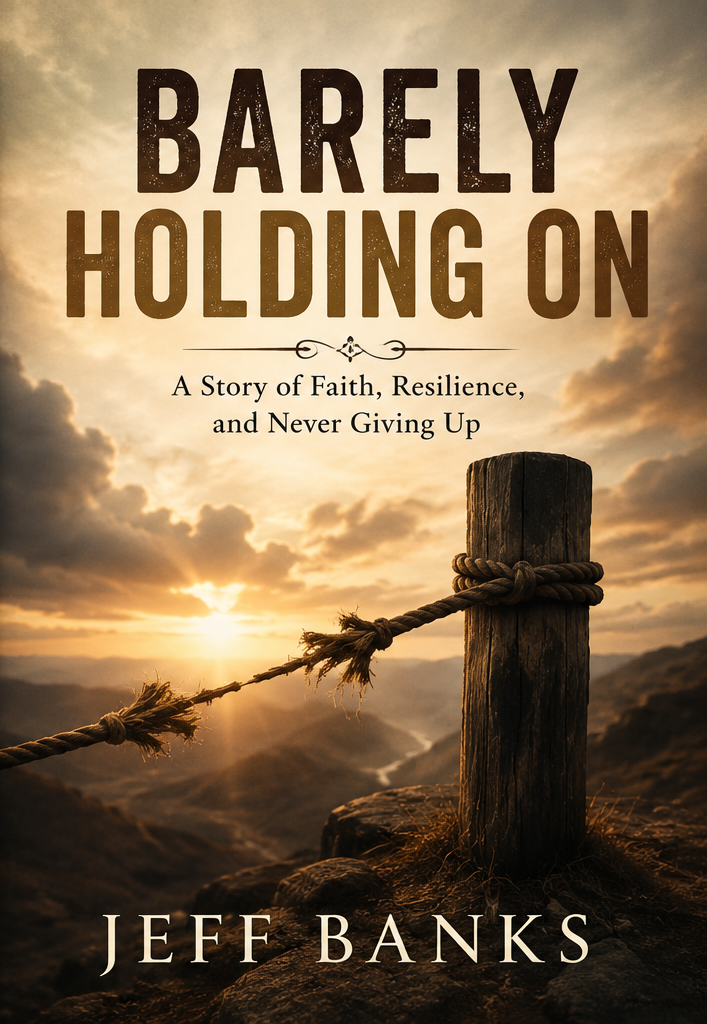
BARELY HOLDING ON - Chapter 12 - Retirement: Not Bloody Likely

BARELY HOLDING ON - Chapter 12 - Retirement: Not Bloody Likely | Travelling Around Australia with Jeff Banks

In the end, the outcome matters less than the path toward it. The numbers, the houses, the profits and losses, these are the punctuation marks of a sentence that has been long and complex. The real story is a memory of touch and atmosphere: the way the air feels cool on the morning skin when the sun has yet to commit to warmth, the texture of a mug handle warmed by a steady hand, the sound of the caravan’s door sealing with a soft thud that sounds like a promise to begin again, the weight of a decision to step away from the edge even when the edge looks inviting. It is in the careful act of staying, of choosing not to vanish but to endure for a while longer, that I begin to see a pattern of resilience that does not pretend to erase pain but gives it a place to live.

BARELY HOLDING ON

Chapter 12 – Retirement: Not Bloody Likely

The end of something is always the start of something else, even when the something else is a version of you you scarcely recognise. Retirement tried to land on me like a quiet snowfall, no blizzard, just a steady, unaccustomed hush. The work that filled the calendar, the conversations that filled the room, the feeling that I was moving toward something definite, something set in rose coloured glasses, pressed to the edge of the floorboards and disappeared into the carpet.

The money moved with it, too: the earned-out sums that had kept our life fluttering along the edge of prudence and risk, the numbers that used to feel tangible and now only weigh in the pocket like a coin you know is valuable but cannot spend. And in the silence that followed, Depression, my Black Dog, made a more careful entrance than any auditor at the door with a clipboard.

You may hear the door’s creak in the quiet between sentences. There may be a recognition of the glint of a daylight hour that has learned to hold its breath. This is not melodrama; it is calibration. The light changes most things when it matches the right weight, when it travels with the right rhythm through a room. And I am here, tracing the lines of that rhythm, trying to understand what it asks of me now, in a new house with an uninterrupted view across a lake to the ocean, trying to hear what the Dog might be telling me when the water’s voice is low and even.

The house, my home now, sits on the land like a patient witness. The lake is a long, slow mirror; the ocean beyond it is a periphery, a memory of storms and salt. In early mornings, the light spills along the window sills and lays a pale gold path across the floorboards. Dust moves in the corners as if it remembers every day it spent in a different orbit around a lamp. The first thing I notice is the weight of quiet. It presses gently, not menacingly, but with a seriousness that makes a person pause before making noise. The silence is not empty; it is full of the things you don’t say aloud when you fear the sound might echo back as failure.

The Dog sits at the threshold between rooms, as if his body is a weather vane pointing to the place where I choose to go next. He watches me with that patient, unhelpful devotion that is both a comfort and a reminder that some truths do not require clever phrasing. I am not sure the Dog ever existed or if he simply remains, a constant, stubborn companion whose appetite for food and certainty has not diminished even as my appetite for energy has. He is not a metaphor I can escape; he is an anchor I carry with me, especially on days when the wind off the lake feels like a hand pressed against the chest.

The retirement plan, if one could call it that, was meant to reduce the friction of living, a place where we are all supposed to go once our purpose in life, at least at an economic level, has been fulfilled. We thought a slower pace, a country house, a view across a waterway to the sea, would reduce the demands upon the nerve endings that kept score of every minor failure and every bright moment with equal gravity. The view works for a while. Light on water is a kind of permission: you can see what you have done, where you have gone, and you can tell yourself that some of it was good. The warmth of the sun on the back of a shoulder makes promises about the day and then withdraws with the afternoon; you learn to accept the daily shift in weather as a way to practice patience. But the Dog is not moved by the weather.

The first winter is quieter than I expected and louder than I want. The house has all the signs of care: a good kitchen, a well-kept garden, a Man Cave where the air carries a faint scent of old paper and resin. And yet the sense of a future that would be carved out with a purposeful stroke, some long-term plan that would justify the risk and the cost, begins to fray. The accounts lay themselves bare in the quiet as if they are listening for a verdict. The earned-out sums that created a sense of forward motion begin to feel like an old traffic report read aloud by a speaker who no longer remembers the path they took to arrive at the conclusion. I am not immune to the simple thrill of owning the space. A home outside the mortgage maintenance orbit feels liberating for a breath or two, the mind allowed to imagine a life where the future is a sequence of small, doable tasks rather than a ledger of looming obligations. But the Dog’s heavy presence makes the air feel thicker, more prone to the kind of weather that makes a risk look wrong even when the math says otherwise.

There are interludes of entrepreneurship. Stupidity in the realms of what retirement should bring, but the inability to say no continues to be a failure of ego. Times that bring me back to a life of stress without the realisation.

The friend I become in memory, the voice that thinks simply because it has always existed, therefore it must continue, knocks at the door with a certainty that doesn’t always deserve a seat at the table. They say it with the ease of years: “We know you’ll help us.” It isn’t malice so much as habit, the old certainty that I, because I listened once, will listen again, and again, until the room fills with the sound of permission given and debts owed. Their posture is a compact of entitlement, a little velvet rope dropped at the threshold: we arrive; you fix; we depart with a story about how generous you were to us in a moment of need. The memory of such certainty is not loud, but it is thick enough to press against the doorframe and make the hinges sigh.

I watch the memory of myself in their eyes as if I am a bystander in a quiet play. They read the map of my life as if every street I have walked belongs to them now, as if the years I spent learning to breathe under pressure were a field guide to be consulted on demand. The room offers its ordinary textures: the mug on the coffee table with a faint ring of dried tea, the carpet’s fiber catching a little more dust where the sun finds the edge of the blind, the Dog’s weight on the rug, a slow thump of tail against a leg rest. The Dog’s ears tilt toward the doorway, not with suspicion so much as a sense that the room’s temperature has shifted and something, some boundary, some risk, needs a reply from us.

The friend’s cadence, “We know you’ll help us”, carries a certain gravity, more an order than a request, creating a weight that sits in the chest as if it were a counterweight to years of restraint. I hear the language not as a threat, but as a reminder of a habit I have not yet untangled: the impulse to fix, to rescue, to translate a plea into a plan before the other person has spoken their own truth. And with that memory comes a familiar companion, the Dog. He thrums, a quiet drumbeat that travels up from his chest into mine, a reminder that a boundary, when proposed but not yet established, sends a ripple through the body. The weight in my throat thickens; the breath I draw for speech lands heavy, like a stone settled in a pocket. The Dog’s presence is a tactile warning: this is not a moment for grace alone; it is a moment for boundaries that keep the room safe for both of us.

In that doorway moment, the memory of retirement’s promise, slower pace, fewer demands, a life measured by light on water rather than numbers in a ledger, collides with the stubborn arithmetic of obligation. The people who come bearing the aura of friendship, old clients who now pose as friends, and new prospects who appear with a familiar cadence, are not wrong to want help. What becomes crooked is the assumption that help must be offered without question, that the “no” will always be a whisper easily swallowed by the next request. Saying no is an act of careful physics: a different air in the lungs, a different weight in the throat, a new alignment of the backbone. I try to practice the gesture: a spoken boundary that is not a sharpened blade but a measured beam of light aimed at the next hour. The Dog responds with a steady hum, his breath a weather pattern, heavy and patient, telling me that a boundary is not a betrayal of affection but a shelter for it to endure.

The temptation to fix surfaces as a car horn in the distance: loud, quick, persuasive. I do not want to crash into the impulse and lose the thread of what we are building here, this house, this life, this fragile balance between care for others and care for myself. I rehearse a tone that is firm yet unshaken: “I can’t take this on right now,” not as a refusal born of cruelty but as a decision grown from restraint, from the long practice of listening to the body when the mind wants to sprint. Saying no becomes a skill that is learned through small, repeated trials: the breath that steadies before speaking; the pause that holds before the verdict; the posture that remains open to conversation without surrender to obligation. The memory of the Dog’s deep, listening eyes becomes the touchstone: if I am to protect him, I must protect this boundary too, not as a weapon but as a protocol for living with what is possible in this hour.

And so the door closes again, softly, with a light click that feels almost ceremonial in its intention: a signal that the room will hold, that the year’s slow weather will pass, that a new rhythm can begin. The friend’s footprint lingers in the air, no malice, just the stubborn belief that someone else’s crisis is a good reason to push forward, and I am reminded of a truth that keeps returning in the quiet: learning to say no is not a rejection of care; it is a way of keeping care steady enough to be real, enough to be shared, enough to last. The Dog’s breath settles; the lamp’s shade angles a little more toward the chair; the room returns to its ordinary temperature, as if the house itself exhales with relief. And I, in the space between the old impulse and the new practice, learn to inhabit a boundary as if it were a shoreline, something to walk along, not leap across.

Retirement does not quiet the engine of a life lived with the pace of a busy schedule. It supposedly slows the engine, yes, but the road remains, and the road is a memory that keeps circling back. The caravan becomes a symbol of an attempt to circumnavigate the self, to test if distance from the urban centre can erase the sense of failure that seems to ride along behind every decision I have made since the onset of Depression. We buy a caravan and take to the road, not as an escape from responsibility but as an experiment in witness: what happens to a mind when it is compelled to move, to watch, to listen to the small, ordinary noises of countryside life, the creak of the chassis, the slam of a cabinet when the wind shifts, the distant howl of a dog, the sigh of a door that hasn’t learned to stay still in the morning light?

The first circle around the map is, as maps always are, a mixture of triumph and disaster. The engine bays hum with a contentment that feels earned, the clicking of switches, the precise cadence of gear changes, the tactile comfort of a solid wheel under gloved hands. The road has a weathered smile and a memory of old habits: speed during a season, steadiness in another, the weight of planning that can either save you or press you to the ground. We begin to see new towns, new diners, new views that resemble other views but never quite replicate them. The Dog learns the rhythm of the caravan as a kind of convoy that travels where the air moves, where the wind shifts between valleys and hills, where the lake’s edge reflects a sky that seems to have learned patience from a lifetime of watching water.

And still, the Dog remains the truth teller here. The Dog does not ask for permission to feel heavy, to be tired, to demand a quiet moment on the doorstep while the sun slides low across the lawn. The Dog’s needs are plain: warmth, food, a corner to lie in, a person to lean into when the night grows long. He is not a symbol I can reframe to suit the mood of a chapter; he is a companion that makes the loneliness possible to bear. The loneliness does not vanish when the caravan wheels spin again or when the sale of a property closes with a satisfying number in a ledger. It sits at the table where we talk about futures for the children, where a grandmother’s voice on the phone says, “You sound tired,” and I answer with a nod that the other person cannot see. I am tired, I say; not exhausted, not defeated, merely tired from carrying a weight that is not mine to measure but which I must bear for now.

The costs of the life we built, the one that looked to be a perfect balance of risk and reward, reveal themselves in the quiet of a morning when a mug of tea becomes a small confession. The years of growth, a practice that grew to be attractive to buyers, a home bought outside the ordinary mortgage straits, a dream that looked like a reward for perseverance, these become a ledger with entries that are both gold and shadow. We sold the practice for a significant profit, and the money, in the abstract, feels like a badge. Yet the badge sits on a chest where the heart still beats with the old rhythm: the fear of failing, the itch for more, the need to keep the children safe and inspired, the sense that the world outside is perhaps more dangerous for those you love than for yourself. The balance sheet becomes the map of a life lived with a breath that holds for too long.

The children, who started with questions that sounded like small sparks, began to seek larger skies. They wanted knowledge with a fierce, almost insistent hunger; they sought the kind of education that would not merely fill a bench in a classroom but expand the space in their minds to accommodate complexity. They asked for books, sporting equipment, science and art in ways that required me to learn anew how to listen, not just to answer with the things I already know but to hear the questions beneath the questions. I learned to watch their faces for the moment when a detail would light a path and the moment when a silence would allow their own thoughts to take shape. They achieved, as children do when they have space, when adults stop telling them the only path to safety is sameness. They achieved because the world around them shifted into something that favoured curiosity over caution. And I felt both pride and a weight: pride in watching them thrive, weight in knowing how close I had walked to the edge of my own fog to get them there.

If there is a single moment of turning in this chapter, it comes in a retreat, not a cure, where a member of the therapeutic circle sits with me and listens, really listens, in a way that makes me believe listening might be enough. The therapist had spoken of “holding space,” a phrase I once found clinical and a touch pretentious. But the simple act of letting someone in without trying to fix them, without offering a plan before the person has asked for one, that is a real gesture of courage. The person across from me on the walk to the beach, and an activity nothing to do with the Dog, did not pull me toward the light with a direct prescription; they opened a doorway with their listening, a doorway through which I could begin to tell the truth of the day’s small, ordinary pains, the ache in my chest when I realised retirement did not end the need to perform, the disappointment in myself when a plan collapsed into a pile of receipts and unresolved questions, the fear of losing another thing I thought I could control.

You might ask how I learned to stay when the Dog’s breath grows heavy in the doorway and the sea-air memory pulls at me like a loose thread. The answer lies not in a single bold act, but in a sequence of small decisions that accumulate the courage to face the next hour. I begin to understand that resilience is not loud. It is a careful, patient alignment of intention with action, like a road that stays true in wind and rain, like the engine that maintains constant comfort while the wheels turn and the miles accumulate. Restraint becomes a tool rather than a prison; it is the difference between a reaction and a deliberate response, between an impulse that would leap to rescue and a measured decision that allows the Dog to rest in the sun without dragging us toward an expense we cannot bear.

The lake’s surface gives me a daily lesson in reflection without collapse. In mornings when the wind pushes across the water and the light comes at a low angle, I notice how the surface looks effortless: a smooth skin that cannot hold a ripple for long, the wind’s touch quickening then releasing the moment before the glass cracks. Depression is a current that moves beneath the surface and tries to pull me toward the bank. The trick, I tell you, is not to fight every wave but to learn its rhythm. Sometimes the best response is to wait for the surface to settle and then to wade in, slowly, with the weight of the body distributed evenly, the feet finding rock and mud alike, the breath moving in a cadence that allows the chest to hold more air without tipping the balance toward fear.

This is not a sermon, and I am no guide who pretends to know the final answer. It is a map drawn with careful lines: the road of a life, the weight of a debt that still lingers in the rooms we left behind, the engine’s steady purr that keeps the caravan keyed to a future that might be only a little bit brighter than the present, the dust motes that rise in a sunbeam and remind me that even small particles matter. If there is any truth worth holding onto, it is this: you are not alone. When the Dog sits with his head over his paws, when the old ledger glances at me from the desk as if to say, “We are not done,” when a neighbor’s voice on the telephone says, “I am here,” I feel the earliest stirrings of a light that does not pretend to erase the dark but promises to travel with it.

In the end, the outcome matters less than the path toward it. The numbers, the houses, the profits and losses, these are the punctuation marks of a sentence that has been long and complex. The real story is a memory of touch and atmosphere: the way the air feels cool on the morning skin when the sun has yet to commit to warmth, the texture of a mug handle warmed by a steady hand, the sound of the caravan’s door sealing with a soft thud that sounds like a promise to begin again, the weight of a decision to step away from the edge even when the edge looks inviting. It is in the careful act of staying, of choosing not to vanish but to endure for a while longer, that I begin to see a pattern of resilience that does not pretend to erase pain but gives it a place to live.

To readers, I say this: if you have ever stood at the edge of a road that splits, if you have ever felt a weight you cannot name pressing in the chest, if you have listened to the sea and heard in its depth a memory of things you’ve tried to forget, you are not alone. We do not share the same pain, perhaps, but we share a bed in the same house, the same skin, the same breath, the same longing for light that does not blind us but guides us. The Dog remains a constant that makes the night feel survivable. The lake remains a patient mirror offering a reflection not of who we wish we were but of who we are when we choose to stay. And the light, though never loud, returns in little ways: the quiet conversation with a friend, the moment a child’s question opens a door of curiosity you did not expect, the simple act of listening that costs little yet means everything.

So here is the gesture I offer in farewell to this part of the journey: loneliness will not vanish, but it can be mapped. It can be named and gently carried, not ignored, not hidden. It can become the compass that points toward a coastline you have not yet reached, a shoreline where the water is not a threat but a guide. And if you listen, you will hear the same answer I hear: you are not alone. We are two travellers crossing a complex landscape, each with our own ballast, each with a dog whose slow, deep breath steadies us both. And perhaps, in the quiet between sentences, we will find a small, steady light, enough to walk toward as the day leans into evening.

Author

Menu