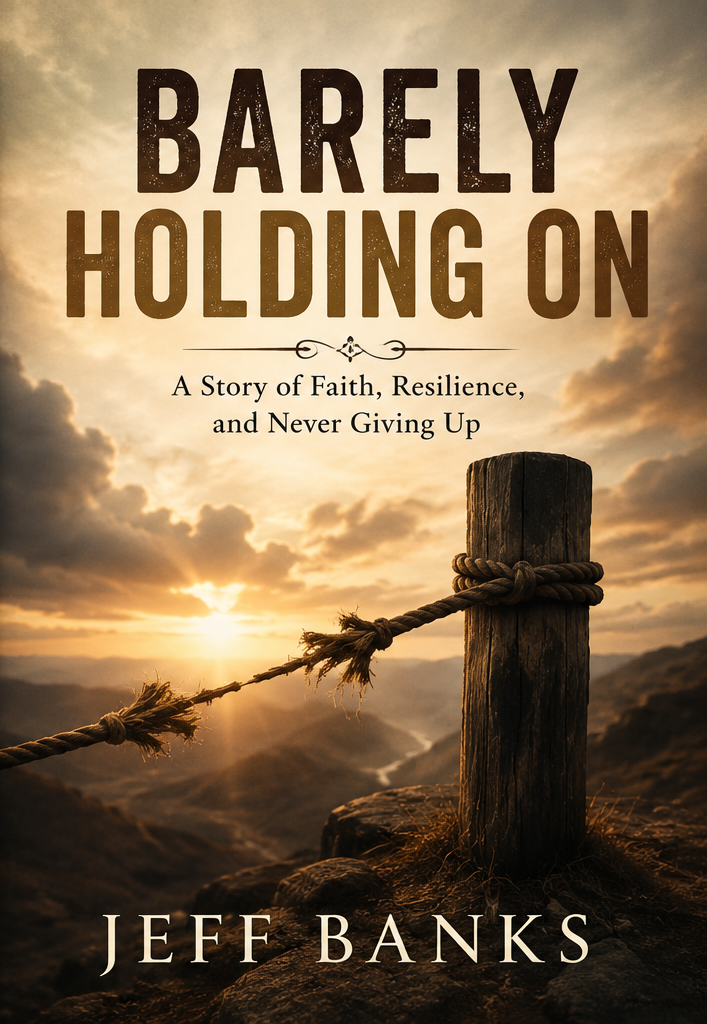
BARELY HOLDING ON - Chapter 11 - Selling Up

BARELY HOLDING ON - Chapter 11 - Selling Up | Travelling Around Australia with Jeff Banks

One truth persists through all the shifts and changes: the agreement I must keep is not with a client list or a balance sheet or a property deed but with the best version of myself who can show up for the children, the mentors, and the person who built the life we now renegotiate. The sale did not erase the mission; it reframed it. The Pillars did not vanish; they transformed into a way of holding the line more lightly, more carefully. The pain did not disappear; it learned how to stand closer to the edges of the day without dictating how the day must end.

BARELY HOLDING ON

Chapter 11 – Selling Up

The decision lands like a door closing with a soft click, not a slam. It’s not a moment so much as a tremor that travels from spine to spine, the way a late autumn wind travels through the gaps in a house built to last. The Pillars, the core of the practice, the house we built with our own hands, the scaffolding that kept us upright against storms of client demands and the calls of the market, have become too heavy to carry. We’ve reached a balance of sorts, a precarious equilibrium between what we owe and what we deserve, between the care we gave and the care we could not pretend to guarantee any longer. My mentors, men who have learned the art of stepping back before the heart gives out, tell me we must sell up. The practice, the house, the life we engineered, let them go, they say. A clean break, a reset, a chance to listen to what the body and the city are telling us in the language of dust and light.

The room feels like a harbour, every surface calm, every instrument checked, every clock set to the same slow tempo. The air is cool and clean, a quiet restraint that resides in places where decisions are made, not in the loud rooms where fear appears as a louder version of itself. The dust motes drift in a sunbeam that cuts across the conference table, tiny planets orbiting a pale, patient sun. I run a finger along the edge of a binder, the edge catching and giving, as if to remind me that edges exist to hold things together, even when what they hold is fragile.

The suitor arrives with the quiet confidence of someone who has learned to phrase ambition as opportunity and opportunity as inevitability. He speaks in soft consonants and even softer vowels, as if each sentence has its own pillow. He is not cruel; he is efficient. He walks through the office with the same care a runner uses to pace a mile, as if tempo can be measured in footfalls rather than feet. He admires what we built, nodding toward the pillars in the front hall, the stone colours of the walls, the way the desk lamp catches on the brass nameplate, the satisfaction of a well-tuned set of numbers. He asks about the margins, about the clients who have stayed with us for decades, about the children who never asked for anything beyond a simple comment on their future.

The negotiation is a dance, and I am a dancer who has learned to count beats in a hall of echoes. We negotiate not just on price but supposedly on continuity: who will preserve the not-your-ordinary ethos of the firm? Who will keep the care we offered without turning it into a ledger entry? My mentors caution me to keep the line, to hold the line, to remember that a sale is not a surrender but a reset. It is, they say, a chance to listen to the other voice in the room, the voice that says perhaps we were holding on to something we did not have the strength to carry anymore.

The deal closes, and the relief is a quiet thing. The relief that what I have built will continue and those who are on the receiving end of it will keep getting what they had become accustomed, or so I thought.

The suitor’s people bring papers with labels that gleam with the allure of efficiency and the gloss of a well-ordered balance sheet. The Not Your Ordinary Accountant tagline, once a badge of a certain stubborn pride, appears now as a signpost, a reminder of the paradoxes we live with: the world wants the comfort of standardisation, and we offered a different kind of solace, a slower form of diligence. The house, too, has a buyer. The sale’s momentum feels almost ceremonial, the kind of process that honours the past while making room for something new to begin.

Yet the earn-out operation, the time-bound piece that ties the new owners to our outcomes, begins to feel like a noose disguised as a lifeline. The line between stewardship and control thins until it is nearly transparent. The pillars we built to stand tall, financial architecture, client trust, staff loyalty, now tighten, tighten, tighten. The words “not enough” show up, not as an external artillery but as a quiet intruder that occupies the room where pride once stood. I watch the numbers as if they were a weather system, a forecast I can’t ignore: a probability curve that promises blue-sky days only if I am willing to tolerate rancid winds in the interim.

The weight of the sale sits on my chest during late-night video calls with the team, faces on screens that look back at me with the same mix of hope and fear that exists in the pause between a breath. Client falls become more “will we continue to get the service?” rather than questions of direction or taxation returns. There are losses, initially created by conflict of interest. Later they come simply because as “smaller clients” feel lost in a big business firm.

The air is different in the house after hours, each corridor a tunnel that leads to rooms no longer mine, each door closing with a finality that makes the room feel more like a chapel than a workspace. The pillar symbolism remains, but it shifts from architectural metaphor to a more intimate, personal reminder: a structure meant to bear, a load meant to protect, now becoming the line we draw around ourselves to keep the world from slipping away.

Then the money comes through, although even there, there is a hiccup and significant interest accumulates in the lateness of the remittances, whilst enhancing the final cash position, certainly creates worry, precise, and almost too easy. The suitor’s people deliver the signatures with the kind of ceremonial flourish that belongs to a wedding or a coronation, not to a business transaction.

The house is transferred, after creating a sales record for the suburb, with a similar economy of motion, keys exchanged in a briefcase, a final walk through the rooms that once felt like a breathing organism, now a dry map of rooms that will house another life. The relief is real, but so is the aftertaste of something lost: the sense that what we built was more than a ledger, more than a brand, more than a promise to clients, something that spoke to us, to the way we moved through the world, to the way we listened to people when they spoke about their own days.

Between the two assets, we are to be walking away with in excess of $3,500,000. A measure of success in anyone’s language.

The hour of the official close comes and goes, the moment when the last courier leaves and the last signature is appended. It is done, and the room feels different now, less heavy, more empty, as though we have unhooked a heavy chain and watched it fall away with a slow, almost affectionate thud. The Not Your Ordinary tagline lingers in a corner of the hallway, a memory of a time when the phrase did not feel like a marketing tactic but an invitation to a way of being, except for snippets remaining on the internet. There is nothing to grieve about, surely, nothing that requires a ceremony of farewell; the sale has occurred without drama, with the quiet competence we had learned to expect from the people who stood in our shadow and learned to stand there with us.

That night, a quiet sadness settles in the house like dust on a shelf. The rooms hold their breath for a moment, then exhale with a sigh that travels through the walls and reaches my ears in a distant echo. I lie in bed with the bedcovers pulled tight around me, the weight of the day pressing on my chest as if it were a physical rampart. The body remembers what the mind tries to forget: the road we travelled, the engine that kept us moving when hope ran thin, the way the early morning light found its way through the blinds and stretched across the floor with stubborn patience. The house is no longer mine, but the memory of it is. It sits in the bones like a fingerprint: the way the door hinges sigh when it opens, the way the stair nosing wears down with each ascent, the way the air smells after a rain.

The next morning, the air outside feels different, crisp, the way a fresh page feels when you have no idea what to write on it yet. The children’s footsteps in the hall are gone now, as though they sense a change in the texture of the day. I think about what to tell them, about how to name the road we have chosen to walk now we are empty nesters, that the house and the practice are no longer ours in the same way. I choose a language that does not pretend to promise miracles: we did what we could, we did it with care, we learned to pace ourselves with the rhythm of the road and the engine. If anything, the act of selling has taught me a stubborn truth: resilience is not the absence of pain but the endurance of it with a watchful, careful, and honest mind.

And yet the body keeps its own, slower calendar. A few weeks into the earn-out, I find myself sitting in a hospital bed, waiting for a glucose check or a heart-monitor readout or a set of blood labs that will tell me whether the body still believes I can stand straight and keep a line of credit and a mortgage and a life that makes sense to the next person who buys what I built. The doctor’s words arrive in a language that is almost clinically kind, the way an accountant speaks to a client, with numbers as a shield and empathy as a secondary colour. The tests come back negative for anything acutely dangerous, but the possibility of trouble haunts me with the persistence of a low-grade fever. It is a false alarm, yes, but a reminder that the body makes an argument I cannot simply ignore: you are not invulnerable; you are vulnerable, and vulnerability is a form of honesty you cannot outwit with discipline alone.

The hospital stay becomes a strange kind of mercy. The room is too bright, the ceiling a trap where the fluorescent glow makes every breath feel like it has a measurable duration. The machines hum and tick, a metronome that reminds me I am still here, still listening. I am not the same person who left the office with a signed bag of papers and a future that looked as clean as a new floor. I am someone who understands that even the best pursuit can tip into strain, that the drive to win, especially when framed as a father’s obligation to his children, can turn a life into a circuit that never quite cools down.

In those days, memory starts to rearrange itself into a more useful structure. The Black Dog, my constant quiet companion, visits with less thunder and more patient accrual: it sits at the edge of the room, not barking, just waiting for me to notice how I breathe, how I carry weight, how I speak to myself in a way that either calms the room or makes the room louder. It is not a dragon to slay but a weather pattern to observe. The aim is not to exorcise it but to learn its gusts and to adjust my sails accordingly. The body, the mind, the business, all of them must align in a way that resembles a road that will not vanish when the weather turns.

I begin to understand that the strategies that once seemed clever in the glow of success, speed, escalation, the insistence on turning every obstacle into a challenge to be conquered have a life of their own. They are engines with an appetite for revving; they demand fuel, and the fuel can run out when the road is long and the miles are many. The blowback of attempting to outpace every constraint is the quiet erasure of the capacity to listen, to clients, to staff, to the body that signals that enough is enough. The children watch from afar with the unfiltered clarity of youth: they ask for time with their father, a presence that is not a machine but a person. I answer with small, ordinary acts, keeping any gravity that might be perceived at a minimum.

The turning point comes not as a grand revelation but as a collection of small decisions to protect what remains and to risk what must be endured for the future. I stop counting every failure as a personal fault and begin counting the moments of alignment: a morning walk where the air feels like it forgives the past; a phone call from a former client who still wants to trust us even though we are not the same; a letter from a mentor that says the word “enough” can be a doorway to something truer than the old blueprint ever allowed. The road, once a courier for ambition, becomes a companion for endurance. The engine, once a symbol of unstoppable momentum, learns to idle at a pace that it can sustain without burning the lungs of the body or the patience of those who must ride with me.

The chorus of hands that reach out is not always loud; sometimes it is a quiet arrangement of ordinary favours, an offered seat, a shared coffee, a short text that says “thinking of you.” The memory of the battle is not a hero’s saga but a ledger of small, stubborn acts of care. The care is the nourishment I give to the Black Dog, not an attempt to starve it of attention, but to feed it with something else: rhythm, restraint, meaningful work, and the honest conversation that it craves but rarely receives.

There are days when I forget this, of course. There are days when the sound of the road outside my window, the engine’s gentle purr, the tyres singing softly on the pavement, feels like a taunt. There are days when a meeting with a client or the memory of a failed promise tugs me toward the old habit of finishing everything, of making the numbers come out clean even when they come at the price of my breath. In those moments, I centre myself around a few quiet anchors: the weight of a breath, the texture of the air against my skin, the way the light travels across a desk and tells me where to place my hands. The road remains, and I learn to share the ride with the Dog rather than pretend it is not there.

One truth persists through all the shifts and changes: the agreement I must keep is not with a client list or a balance sheet or a property deed but with the best version of myself who can show up for the children, the mentors, and the person who built the life we now renegotiate. The sale did not erase the mission; it reframed it. The Pillars did not vanish; they transformed into a way of holding the line more lightly, more carefully. The pain did not disappear; it learned how to stand closer to the edges of the day without dictating how the day must end.

The memory anchors, the road, the engine, the dust, the wind, the weight, the touch of light, these are not decorations. They are the scaffolding of a life that has learned to bend without breaking. And if you have found yourself in a moment when the world seems to demand a merciless pace, hear this: the pace you choose, the breath you take, the words you offer to those you love, all of that matters more than any quarterly forecast. You are not alone.

So I keep walking. Not fast, not slow, but in a steady, measured rhythm that respects the weariness in my bones and the stubborn hope in my chest. The Black Dog remains, and so does a version of me that has learned to speak softly to the pain and to the people who stand with me. I do not promise triumph in the old sense. I promise a real, sometimes quiet kind of survival: a life where the work of staying present for the people I love, my children, my mentors, the reader who has joined me with the simple act of listening, matters more than the applause of a market that loves drama more than truth. And if you hear that note in your own breath, I say again, you are not alone. The road will endure if we walk it together, in the slow, patient way a road deserves.

Author

Menu