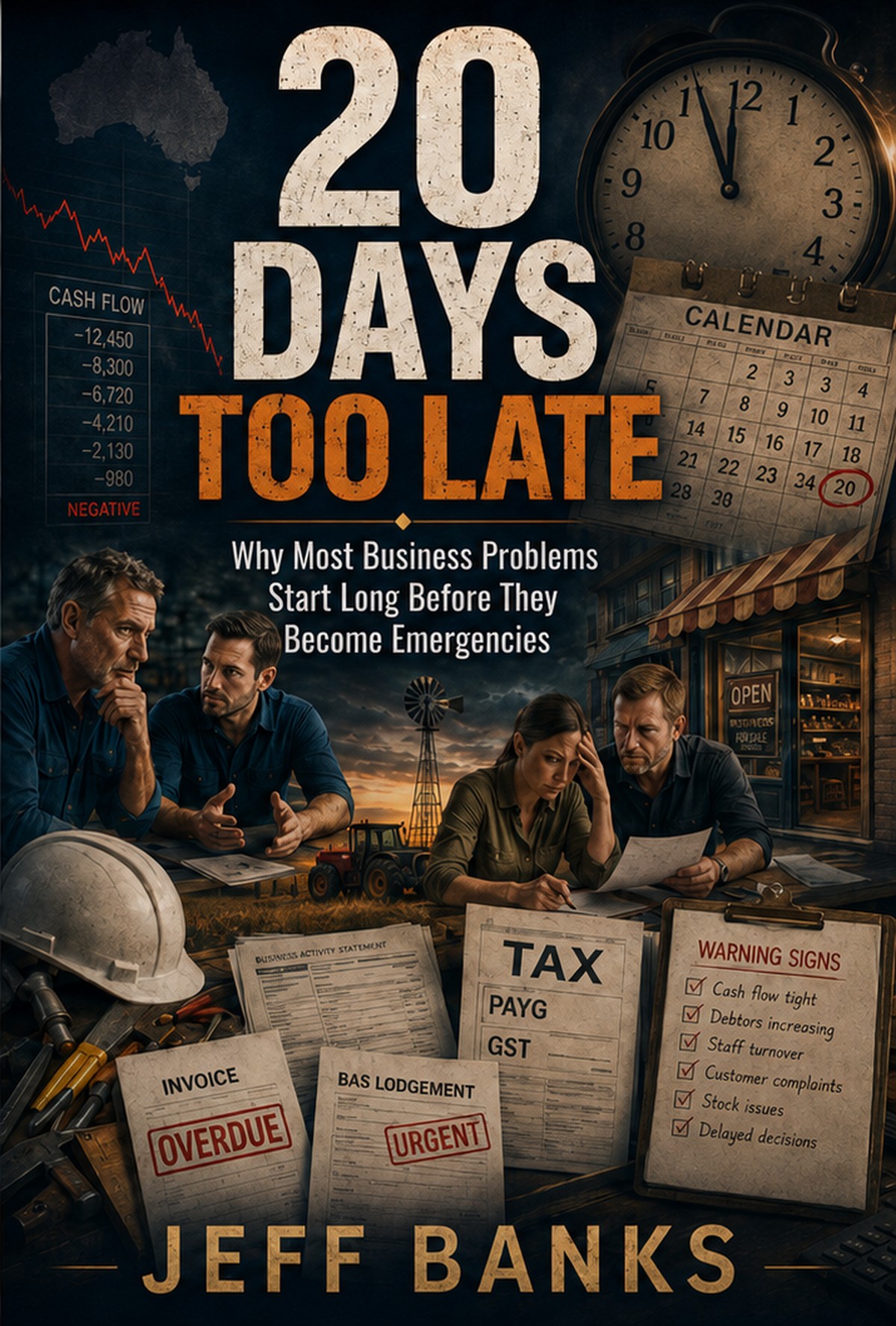
20 DAYS TOO LATE - Introduction

20 DAYS TOO LATE - Introduction | Travelling Around Australia with Jeff Banks

Twenty days before the end of the financial year, many business owners finally start thinking about what the year has produced. They ask about tax, superannuation, deductions, write-offs, stock, debtors, wages, cash flow and the possibility of doing something useful before the deadline arrives. Those conversations matter, but they matter most when they become a reminder of a larger discipline rather than a last-minute scramble.

20 DAYS TOO LATE

Introduction

The Myth of the Clever Business Owner

There is a particular look a business owner gets when they arrive twenty days before the end of the financial year and ask whether anything can be done about their tax. It is not panic, exactly, although panic is usually somewhere in the room. It is more like the look of someone who has suddenly realised that a football match has been going on for eighty minutes and they have only just noticed the scoreboard.

I saw that look many times across more than forty years as a tax accountant and business adviser. It usually arrived with a folder, a shoebox, a spreadsheet, an apology, or occasionally a confident declaration that everything was under control. The words varied, but the request was nearly always the same: “What can we do before 30 June?”

That question is not a bad question. In fact, it is a very sensible question when asked early enough to leave room for sensible answers. The problem was never that business owners wanted to reduce tax, manage cash flow, make superannuation contributions, buy equipment, review stock, or tidy up their affairs before the end of the year. The problem was that too many of them asked the question after the year had already made most of the decisions for them.

By twenty days out, there are still things that can be done. There are always small levers to pull, small adjustments to consider, and small decisions that may improve the final result. But the larger truths have usually already been written by then, not in tax law, but in habits, choices, delays, blind spots and assumptions that have been building quietly since the previous July.

That is where this book begins, even though the title points towards the end of the financial year. 20 Days Too Late is not really a book about tax planning, although tax planning has a role to play in its final pages. It is a book about the way business problems form slowly, gather weight quietly, and eventually appear as emergencies only because they were not dealt with while they were still manageable.

The myth of the clever business owner is that business success belongs to the person who knows the most, moves the fastest, talks the best, negotiates the hardest, or somehow sees around corners more clearly than everyone else. I met plenty of clever business owners, and some of them did very well. I also met plenty of clever business owners who managed to outsmart themselves into trouble that a much less clever person may have avoided simply by paying attention.

Business does not always reward brilliance in the way people imagine. It often rewards consistency, curiosity, discipline, humility and the willingness to look at uncomfortable information before that information turns into an expensive fact. The best business owners I saw were not necessarily the loudest in the room or the ones with the most impressive growth stories. They were often the ones least surprised by what happened next.

That idea took me a long time to understand properly. As a younger accountant, I thought the numbers revealed the truth because numbers seemed clean, objective and orderly. As the years passed, I came to realise the numbers were rarely the beginning of the story. More often, they were the final record of decisions people had already made, avoided, delayed, justified, forgotten or refused to revisit.

A profit and loss statement can look like a technical document, but it is often closer to a diary. It tells you what a business owner believed mattered. It shows where attention went and where it did not. It records whether sales were pursued at any cost, whether wages were understood, whether margins were protected, whether debt was watched, and whether the business had learned the difference between being busy and being profitable.

The balance sheet can be even more revealing, provided someone is willing to read it as a story rather than a schedule. It can show whether the business has been living on borrowed time, whether stock is turning into dust, whether debtors are becoming fiction, whether loans are multiplying, and whether the owner has been extracting a lifestyle from a business that has not truly earned it. It can also show strength, patience, discipline and quiet resilience, although those qualities rarely shout as loudly as revenue.

For many years, I sat across from people who had convinced themselves that revenue was the answer to almost every problem. They believed that if sales increased, everything else would sort itself out. It was a seductive belief because it allowed activity to masquerade as progress, and it allowed the owner to avoid the harder question of whether the business model actually worked.

The problem with revenue is that it has a wonderful way of making people feel successful while quietly hiding weakness. A business can grow its sales and still become poorer. It can win new customers and lose money on every job. It can employ more people, move into larger premises, buy new equipment, appear busier than ever, and still be walking towards a cash flow cliff with a smile on its face.

I remember one business that always seemed busy. The phones rang, the vans moved, the staff looked occupied, and the owner carried himself with the weary pride of someone who believed exhaustion was proof of achievement. From the outside, it looked like a business with momentum, but the numbers told a different story once anyone bothered to look at them properly.

The margins were too thin, the quoting was too optimistic, the debtors were too old, and the owner had slowly trained himself to mistake turnover for success. None of that happened in a single month. The warning signs had been visible for years, but they had been softened by activity, explained away by optimism and postponed by the hope that the next busy period would fix the last bad one.

By the time the problem became undeniable, the business was not dealing with one crisis. It was dealing with the accumulated effect of hundreds of small permissions granted to itself over time. A little underquoting here, a slow payer tolerated there, a staff issue avoided, a loan extended, a tax debt pushed forward, and suddenly the owner was sitting across the table asking what could be done.

That is the real meaning of twenty days too late. It is not always literal, although sometimes it is. It may be twenty weeks too late to review pricing, twenty months too late to deal with an employee who should never have been left in charge, or twenty years too late to admit that a family business has no succession plan beyond everybody hoping the difficult conversation never needs to happen.

Business owners are not foolish for delaying these things. Most of them are overwhelmed, under-supported and carrying more responsibility than outsiders realise. They are trying to keep customers happy, staff paid, suppliers patient, banks satisfied, families secure and the tax office from becoming too interested. Many of them are doing all of this while pretending, for everyone else’s comfort, that they are coping better than they are.

That is why this book is not written as a lecture. I have no interest in standing on a pedestal and pretending that business would be easy if only everyone followed a neat list of rules. I made mistakes in business, in judgment, in timing and in assuming people would act on advice simply because the advice made sense. Experience does not turn a person into a guru; with any luck, it turns them into a better observer.

What I have seen repeatedly is that business owners often know more than they admit. They know when a customer is becoming a problem. They know when an employee is no longer the right fit. They know when a debt is getting uncomfortable, when a supplier relationship is strained, when the bank account is being nursed, and when the numbers do not quite match the story they have been telling themselves.

The issue is not always ignorance. More often, it is the human ability to delay the unpleasant. Business owners, like everyone else, have an astonishing talent for telling themselves that the uncomfortable thing can wait until after the next BAS, after the next big job, after the school holidays, after the rain, after Christmas, after the bank meeting, after the staff member settles down, or after the customer finally pays.

Delay is rarely dramatic at the time. It usually feels reasonable, even responsible, because there is always something more urgent demanding attention. But business does not forget what has been postponed. It merely stores the consequences until the day they can no longer be ignored.

One of the great traps in business is that problems often remain quiet while they are becoming more dangerous. Cash flow problems do not always arrive as empty bank accounts. Sometimes they arrive as slightly slower payments, slightly larger overdrafts, slightly more reliance on credit cards, and slightly more creative conversations with suppliers. By the time the bank account is truly empty, the problem is no longer a cash flow issue; it is a history lesson with invoices attached.

The same pattern appears with tax. Tax is often blamed for problems it did not create, because tax tends to arrive at the end of the story holding a bill. A business owner may say the tax office is the problem, but the tax office did not set the prices, hire the staff, extend the credit, draw the money, ignore the margins, buy the equipment, or leave the accounts unreconciled. Tax may be painful, but it is usually the scorecard rather than the game.

This is not to suggest the system is perfect, simple or always fair. Any Australian business owner who has dealt with payroll tax, GST, superannuation obligations, PAYG withholding, company tax, trust distributions, Division 7A, land tax, workers compensation, or the endless parade of forms and deadlines knows that compliance can feel like a business of its own. Small business owners often carry obligations that are far easier to design in legislation than to manage at the kitchen table after dinner.

But even within that frustration, there remains a hard truth. Complaining about the system rarely changes the numbers. Understanding the system early enough to make better decisions often does. That distinction matters because resentment can feel productive while producing nothing, whereas attention can feel tedious while quietly saving the business from avoidable trouble.

The businesses I admired most were not those that never had problems. Every real business has problems, because every real business deals with people, timing, weather, markets, costs, mistakes, regulations and the occasional dose of plain bad luck. What set the better businesses apart was not the absence of difficulty, but the speed with which they noticed reality and responded to it.

Farmers understand this better than most, although they do not always apply it to their books. A farmer can look at a paddock, a sky, a fence line, a water trough or a mob of stock and see signs that would mean very little to a city visitor. The information is there, but it only has value because experience has taught the farmer to pay attention before the situation becomes obvious to everyone.

Business works the same way. The warning signs are usually present long before the crisis becomes public. A gross profit percentage slips. Stock turns more slowly. A good employee becomes quiet. A customer starts disputing invoices. The owner stops opening mail with the same confidence. The bank account becomes something checked with a small knot in the stomach rather than ordinary curiosity.

None of those signs may be fatal by themselves. In fact, most of them are quite ordinary when seen early. But when ordinary signs are ignored, they begin to gather in the corners of the business like dust, and eventually someone wonders how everything became so difficult.

One of the uncomfortable lessons of a lifetime in accounting is that many disasters are not mysterious. They may be sad, stressful, unfair in parts and complicated in their detail, but they are rarely as sudden as they first appear. When you look back through the records, the emails, the bank statements, the decisions and the conversations, you can often see the path forming long before anyone admitted where it led.

That is not hindsight pretending to be wisdom. Hindsight can be smug, and business owners deserve better than smugness. The point is not to say that every problem could have been avoided with perfect vision. The point is to recognise that many problems give us more notice than we care to accept.

A customer who should have been fired rarely becomes unbearable overnight. There are usually early clues: the constant disputes, the urgent demands, the slow payments, the disrespect towards staff, the pressure to discount, and the way the owner explains away bad behaviour because the sales look too important to lose. The eventual loss is often not the moment the customer leaves, but the years spent letting that customer reshape the business around them.

An employee problem follows a similar pattern. The wrong person in the wrong role can quietly change the culture of a small business. The owner may see it but avoid the conversation because they dislike conflict, fear losing capacity, or hope maturity will arrive on its own. By the time action becomes unavoidable, the cost may include morale, customers, good staff, management time and the owner’s own peace of mind.

Business structures are another example. Many owners do not think about structure until something goes wrong, money is made, money is lost, a relationship breaks down, a creditor appears, an asset is sold, or a succession issue moves from theory to argument. The structure that seemed good enough at the beginning may become dangerously inadequate once the business has changed, but reviewing it is easily postponed because nothing appears urgent until everything is.

Even success can create twenty days too late moments. Growth feels like proof that a business is working, but growth also tests systems, people, pricing, cash flow and the owner’s ability to manage complexity. A business can survive its early mistakes because it is small enough for the owner to hold everything together by force of personality. When the business grows, the same habits that once kept it alive can begin to hold it back.

That is why cleverness is overrated. Clever people can invent very persuasive reasons for not doing simple things. They can explain why the accounts are behind, why the margins will recover, why the difficult customer is worth keeping, why the staff issue is not as bad as it seems, why the tax debt is temporary, and why the business only needs one more good month to get back on track.

The ordinary disciplines of business are less glamorous but far more useful. Look at the numbers. Ask what they mean. Watch cash carefully. Price properly. Review customers honestly. Deal with staff issues early. Understand your structure. Plan before the year is nearly over. Have the conversations you are tempted to avoid.

None of that sounds revolutionary. In truth, much of good business is almost embarrassingly plain when reduced to its essentials. The difficulty is not knowing that these things matter; the difficulty is doing them consistently while real life is making noise.

Real life always makes noise. A child is sick, a parent needs help, a vehicle breaks down, a staff member leaves, a customer complains, a supplier changes terms, interest rates move, the weather turns, or a piece of equipment fails at the worst possible time. Business owners do not make decisions in the calm environment imagined by textbooks. They make decisions in the middle of life, and life has no respect for neat planning cycles.

That is why I have always believed business and life are inseparable. A set of accounts may belong to a business, but the decisions behind those accounts belong to human beings with fears, ambitions, habits, loyalties and blind spots. You cannot understand a business owner properly if you only look at the ledger. You also need to understand what they are trying to protect, what they are afraid to lose, and what they cannot bring themselves to face.

Some people fear failure. Some fear success because success creates responsibility they are not sure they can carry. Some fear disappointing family, admitting weakness, upsetting staff, confronting partners, or discovering that the business they have built is not as strong as they hoped. These fears rarely appear in the notes to the financial statements, but they can shape the numbers more powerfully than any tax rule.

Over the years, I learned to listen for the sentence behind the sentence. When a business owner said they were waiting for things to settle down, they sometimes meant they did not know where to start. When they said a customer was important, they sometimes meant they were frightened of replacing the revenue. When they said the accounts were nearly ready, they sometimes meant they had avoided them because they did not want confirmation of what they already suspected.

That is not a criticism. It is a recognition of the human condition. We all avoid things, and business ownership merely gives avoidance a set of financial consequences. The owner’s desk is often where personality, family pressure, commercial reality and legislation all arrive at once, each demanding to be treated as the priority.

This book is written for the person sitting at that desk. It is for the business owner who suspects there are things they should be looking at more closely. It is for the professional, tradie, farmer, retailer, consultant, manufacturer, franchisee, investor or family business operator who has felt the quiet discomfort of knowing that being busy is not the same as being in control.

It is also for the person who has done reasonably well but is not entirely sure why. Success can be just as dangerous as failure if it convinces the owner that good outcomes were caused only by good judgment. Sometimes timing, luck, market conditions, property cycles, loyal staff, patient suppliers, family labour, cheap debt or a forgiving economy have been carrying more weight than anyone wanted to admit.

That is one reason no business owner should be too proud to review the basics. The basics are not beneath successful people. They are often the reason successful people remain successful after conditions change. When the tide turns, the business that understands its numbers, cash flow, customers, people and structure is far less likely to be surprised by the rocks.

The phrase “no surprises” became one of the simplest ways I came to think about good business. It does not mean nothing bad will happen, because bad things happen to even the best-run businesses. It means the owner has developed the habit of noticing small changes before they become large problems, and of asking questions while there is still time to choose among decent options.

Choice is the great prize of early attention. When a problem is dealt with early, there are usually options. Prices can be adjusted, costs can be reviewed, customers can be managed, staff can be trained or moved on, structures can be reconsidered, finance can be arranged, and tax planning can be done with some measure of calm. When the same problem is ignored too long, the options narrow until the owner is left choosing between unpleasant alternatives.

That narrowing of options is one of the saddest things to watch. It is not always the debt, the tax, the employee, the customer or the bank that hurts most. It is the moment the owner realises they no longer have the freedom they thought they had. Delay has quietly spent their choices.

The chapters that follow are built around that idea. They are not intended to provide a complete technical guide to running a business, and they are certainly not designed to replace proper accounting, legal, financial or commercial advice. They are reflections drawn from decades of watching patterns repeat themselves in different industries, different towns, different family situations and different economic climates.

We will begin with the business that never looked at the numbers, because almost every business problem becomes harder when the owner does not know what the numbers are trying to say. From there, we will look at revenue, cash, customers, employees, tax-driven purchases, government obligations, structures, difficult conversations, profit, mid-year reviews and finally the twenty-day countdown to 30 June. Each chapter is separate in topic, but they all return to the same central question: what could have been seen earlier?

The answer is not always comfortable. Sometimes the warning sign was obvious, but the owner was tired. Sometimes the adviser raised it, but the owner was not ready to hear it. Sometimes the family knew, the staff knew, the bank knew, or the bookkeeper knew, but nobody wanted to be the person who forced the issue into the open.

In small business, silence can be expensive. A business may survive a bad month, a bad customer, a bad hire or a bad decision, but it may not survive a culture in which nobody tells the truth early enough. The truth does not need to be brutal, dramatic or humiliating. It simply needs to arrive while it can still be useful.

That is the spirit in which this book is written. It is not about blame. It is about recognition. If a reader sees themselves in one of these chapters, the purpose is not to make them feel foolish, but to encourage them to act while action still has value.

There is dignity in facing the numbers. There is strength in asking for help before the situation becomes desperate. There is wisdom in admitting that a business can look successful from the outside while still needing careful attention on the inside. There is also relief in discovering that many problems, when caught early, are not nearly as frightening as they seemed while being avoided.

The clever business owner is not the person who never makes mistakes. That person does not exist, and anyone who claims otherwise has either never owned a real business or has forgotten the truth of it. The clever business owner is the one who learns to recognise the small signs, ask the awkward questions, and act before circumstances take the decision away.

Twenty days before the end of the financial year, many business owners finally start thinking about what the year has produced. They ask about tax, superannuation, deductions, write-offs, stock, debtors, wages, cash flow and the possibility of doing something useful before the deadline arrives. Those conversations matter, but they matter most when they become a reminder of a larger discipline rather than a last-minute scramble.

The real work begins much earlier. It begins when the owner decides that the numbers are not a punishment, the adviser is not a historian, the tax bill is not the first warning, and the business cannot be managed properly by instinct alone. It begins when the owner understands that avoiding surprises is not a slogan, but a way of running the business with eyes open.

That brings us to the first and most basic failure of all. Before revenue can be understood, before cash can be protected, before customers can be judged, before employees can be managed, and before tax planning can be meaningful, someone has to look honestly at the numbers. Many businesses do not fail because the numbers were complicated; they fail because the numbers were ignored until they had nothing left to say except what had already gone wrong.

So we begin there, with the business that never looked at the numbers. It is a story I saw in many forms, and it remains one of the simplest warnings in business. If the owner will not look at the scoreboard while the game is being played, they should not be surprised when the final siren tells them what they can no longer change.

Author

Menu