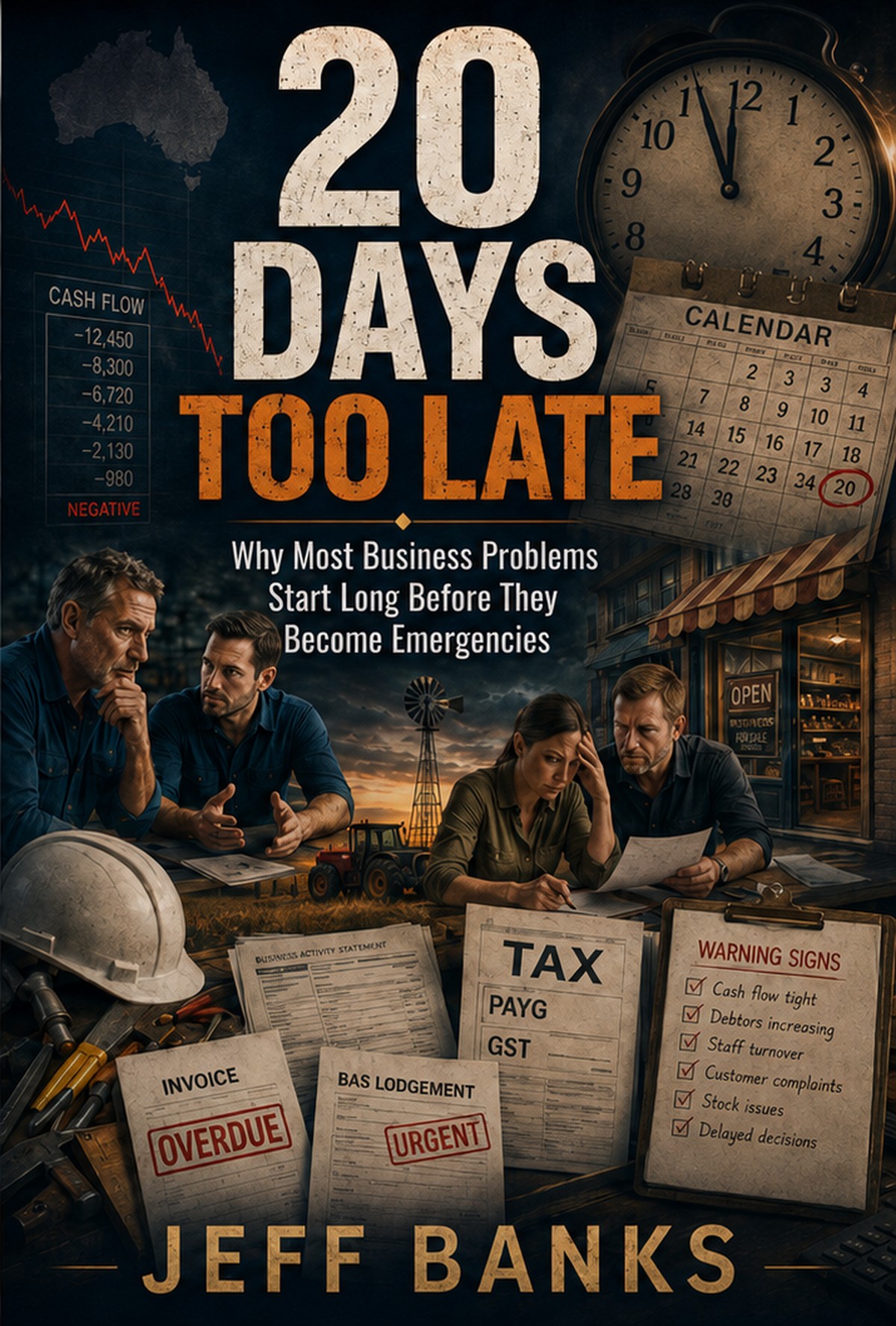
20 DAYS TOO LATE - Foreword

20 DAYS TOO LATE - Foreword | Travelling Around Australia with Jeff Banks

I hope readers recognise themselves in these pages without feeling condemned by them. I hope they see customers they have kept too long, purchases they justified too easily, tax bills they treated as surprises, margins they never quite understood, conversations they postponed and warning signs they renamed as temporary inconveniences. Recognition is not failure; it is the beginning of better judgment.

20 DAYS TOO LATE

Foreword

There is a particular look business owners get when they know something is wrong but have not yet said it aloud. I have seen it across desks, in farm kitchens, beside filing cabinets, in workshops, on building sites, over boardroom tables and in the pauses between sentences when the truth was trying to get into the room before pride, fear or habit shut the door again.

It is not usually panic at first. Panic comes later, when the bank is calling, the tax bill is due, the wages need to be found, the supplier has stopped extending credit or the business partner has finally said what everyone else already knew. At the beginning, the warning signs are much quieter.

A slow-paying customer becomes “just a timing issue.” A shrinking margin becomes “the cost of doing business.” A staff problem becomes “that is just how he is.” A cash flow squeeze becomes “we will catch up next month.” A structure that no longer suits the business becomes “something we should look at one day.”

That one day is the dangerous part. It is the day that never quite arrives while the business is still manageable, yet somehow arrives with great urgency once the choices have narrowed. By then, the conversation is no longer about planning so much as damage control.

This book is called 20 Days Too Late, but it is not really a book about twenty days. It is not even really a book about tax, despite the final chapter looking directly at the decisions business owners should be considering before the end of the financial year. The title is about the habit of waiting until a problem has changed shape before we decide it deserves our attention.

For more than forty years, I worked as a tax accountant and business adviser. That meant I saw businesses through their numbers, but the longer I stayed in the profession the more I understood that numbers were only the footprints. The real story was always the person who made the decisions that left those footprints behind.

Financial statements are often treated as records of profit, loss, assets and liabilities. They are that, of course, but they are also biographies written in figures. They reveal confidence, fear, optimism, denial, discipline, neglect, ambition, loyalty, exhaustion and sometimes stubbornness masquerading as resilience.

A set of accounts can tell you whether a business made money, but it can also tell you whether an owner was paying attention. It can reveal whether growth was creating wealth or simply creating movement. It can show whether the business was being managed or merely endured.

This book has grown from that observation. It is not written as a manual for accountants, nor is it intended to be a technical taxation guide. There are already plenty of books and websites that can explain rules, thresholds, deductions, structures and compliance obligations in language that makes perfectly normal people wonder whether they should have chosen another life.

My purpose here is different. I want to talk about what those rules and numbers mean in the life of a business owner. More importantly, I want to talk about the patterns that appear long before the accountant, the solicitor, the bank manager or the Australian Taxation Office becomes involved.

The businesses I saw succeed were not always run by the most brilliant people in the room. Some were, but intelligence alone was never the dividing line. Often the difference was that the better owners noticed things earlier and acted while action still gave them choices.

They did not need to predict the future. They simply paid attention to the present. They noticed when the cash did not match the profit, when the busy customer was not the profitable customer, when revenue was flattering the ego but not feeding the bank account, and when the business was slowly becoming dependent on the owner in ways that would one day become dangerous.

They asked questions before questions became accusations. They sought advice before advice had to become rescue. They were not perfect, but they were less often surprised by the things their businesses had been trying to tell them.

That is the central lesson of this book. Most business disasters are not caused by one catastrophic event arriving without warning. More often, they are caused by small warnings that were visible, understandable and inconvenient, so they were pushed aside until they became expensive.

That is not a criticism of business owners. Anyone who has run a business knows how easy it is to become consumed by the day in front of you. Customers want attention, staff need answers, suppliers want payment, banks want reports, family wants time and the business itself seems to require more hands than any one person has been given.

In that environment, avoidance can feel almost practical. You tell yourself you will deal with the awkward issue after the next BAS, after the next big job, after the Christmas rush, after the quiet month, after the bank review, after the employee settles down or after the customer finally pays. The problem is that business rarely pauses while you gather the emotional strength to face it.

This is why the phrase “twenty days too late” matters. It is not a precise measurement of time, but a description of a familiar business condition. It is the moment when the owner realises the best time to act has already passed, and the only remaining choices are harder, dearer and less pleasant than the choices that were available earlier.

Sometimes twenty days too late is literally twenty days before year-end, when the owner finally asks what can be done about tax. Sometimes it is twenty weeks too late, when a debtor who should have been chased has quietly become doubtful. Sometimes it is twenty months too late, when a staff problem that began as attitude has become culture.

Sometimes it is twenty years too late, when an owner who built a business around their own energy discovers they never built a business that could survive without them. That is one of the saddest business conversations of all, because by then the issue is not only financial. It is also personal, and often deeply so.

I have always believed business and life are more connected than we pretend. A business owner does not leave their worries at the office door, especially when the office is a ute, a shed, a spare bedroom, a farm desk or a kitchen table covered in invoices. The business follows them home because, in many cases, it was already part of home.

That is why this book is written as a conversation rather than a lecture. I have no interest in standing at a distance and telling business owners what they should have done. I have made my own mistakes, watched others make theirs and learned that advice without humility often lands as judgment.

What I can do is share what I have seen. I have seen revenue disguise weakness, cash expose truth, structures save families, structures fail families, loyal customers become unprofitable customers, good employees become bad fits, and clever tax ideas become poor business decisions. I have seen people buy things to save tax while ignoring the fact that they were spending a dollar to save less than a dollar.

I have seen business owners blame the government, the bank, the staff, the customer, the market, the weather, the accountant and sometimes sheer bad luck. There are times when those complaints contain truth, but even then they rarely contain the whole truth. A business owner cannot control everything, yet they must still pay attention to the things they can control before those things are lost among the things they cannot.

The chapters that follow are built around that idea. They look at numbers, cash, revenue, customers, employees, structures, tax, profit and year-end planning, but underneath each chapter sits the same question. What did the business already know before the owner was willing to listen?

That question can be uncomfortable, but it is also useful. Discomfort is not always a warning to look away. Sometimes it is the first honest signal that a better decision is waiting to be made.

If there is a phrase I hope stays with the reader, it is “no surprises.” That does not mean nothing bad will happen, because business has never offered that promise. Markets shift, customers fail, seasons turn, governments change rules, technology moves, illness arrives and life has an old habit of interrupting even the best plans.

No surprises means something more achievable and more valuable. It means fewer avoidable shocks. It means the business owner knows enough about their own business to be less often ambushed by it.

It means tax is not a mystery at the end of the year. It means cash flow is not discovered only when the bank account is empty. It means an unprofitable customer is recognised before the business has spent years subsidising someone else’s expectations.

It means staff problems are addressed before they become folklore. It means structures are reviewed before a dispute, death, divorce or retirement turns them into weapons. It means the owner has the courage to ask what the numbers are saying before the numbers have to shout.

This book is for business owners who are busy, tired, hopeful, stubborn, ambitious and occasionally overwhelmed. In other words, it is for the people I spent much of my working life trying to help. It is for the person who knows something in their business needs attention but has been waiting for the right time to face it.

The right time is rarely as dramatic as we expect. It is often just a quieter moment, a clearer conversation, a willingness to look at the figures, or the decision to stop calling a recurring problem temporary. It may not feel heroic, but many good business outcomes begin that way.

The aim of this book is not to make business owners fearful. Fear can paralyse people just as easily as complacency can mislead them. The aim is to make business owners more attentive, because attention is one of the cheapest and most powerful tools in business.

A business that is watched honestly has a better chance of being repaired early. A business that is questioned regularly has a better chance of avoiding the emergency meeting. A business owner who asks for advice while there are still options has a better chance of choosing rather than reacting.

That is really what this book is about. It is about preserving choice. When you act early, choices exist; when you wait too long, choices disappear.

There are few sadder sentences in business than “I wish I had known sooner.” In many cases, the truth is that the owner did know sooner, but the knowing was inconvenient, incomplete or too uncomfortable to confront. This book is an invitation to respect those early signals before they harden into consequences.

I hope readers recognise themselves in these pages without feeling condemned by them. I hope they see customers they have kept too long, purchases they justified too easily, tax bills they treated as surprises, margins they never quite understood, conversations they postponed and warning signs they renamed as temporary inconveniences. Recognition is not failure; it is the beginning of better judgment.

Business success is rarely about perfection. It is more often about seeing clearly, acting earlier and refusing to be surprised by things that were already visible. That may sound simple, but simple truths have a way of becoming expensive when ignored.

So read this book not as a lecture from an accountant, but as a conversation with someone who has watched the same patterns repeat across thousands of business stories. Take from it the questions that matter to your circumstances, and ask them before the calendar, the bank, the tax office, the customer, the employee or the crisis asks them for you.

Because in business, the warning signs are usually there. The opportunity to act usually exists. The real question is whether we notice in time, or whether we wait until the only words left are the ones no business owner wants to hear.

Twenty days too late.

About the Author

Jeff Banks is a retired Australian tax accountant, business adviser and author who spent more than forty years sitting across the table from business owners, farmers, tradespeople, investors, professionals and family enterprises. In that time, he saw thousands of financial statements, but more importantly, he saw the human stories that sat behind the numbers.

20 Days Too Late is the business book Jeff always wanted to write. It is the book that grew from years of watching good people become trapped in the microcosm of their own existence, so consumed by the daily pressures of running a business that they could no longer hear what the business was trying to tell them.

Again and again, Jeff saw business owners miss the warning signs not because they lacked intelligence, effort or ambition, but because their rose-coloured glasses were simply too tight. They believed the next month would fix the cash flow, the next customer would solve the revenue problem, the difficult employee would settle down, the bank would remain patient, or the tax result would somehow be kinder than the year’s decisions deserved.

His writing reflects the voice of a country accountant who has seen the same patterns unfold across many desks and many lives. He does not write as a guru offering fashionable theories, but as an observer who understands that business is rarely separated from family, pride, fear, loyalty, exhaustion and hope.

Jeff is also the author of What the Accountant Saw, a title that reflects much of his writing life. His work is grounded in the belief that every number tells a story, every business has a blind spot, and most problems are far cheaper to address before they become emergencies.

In 20 Days Too Late, Jeff brings together decades of observation into a simple but confronting message for business owners. The warning signs are usually there, the opportunity to act usually exists, and the best businesses are not the ones that avoid every problem, but the ones least surprised by the problems they should have seen coming.

Author

Menu