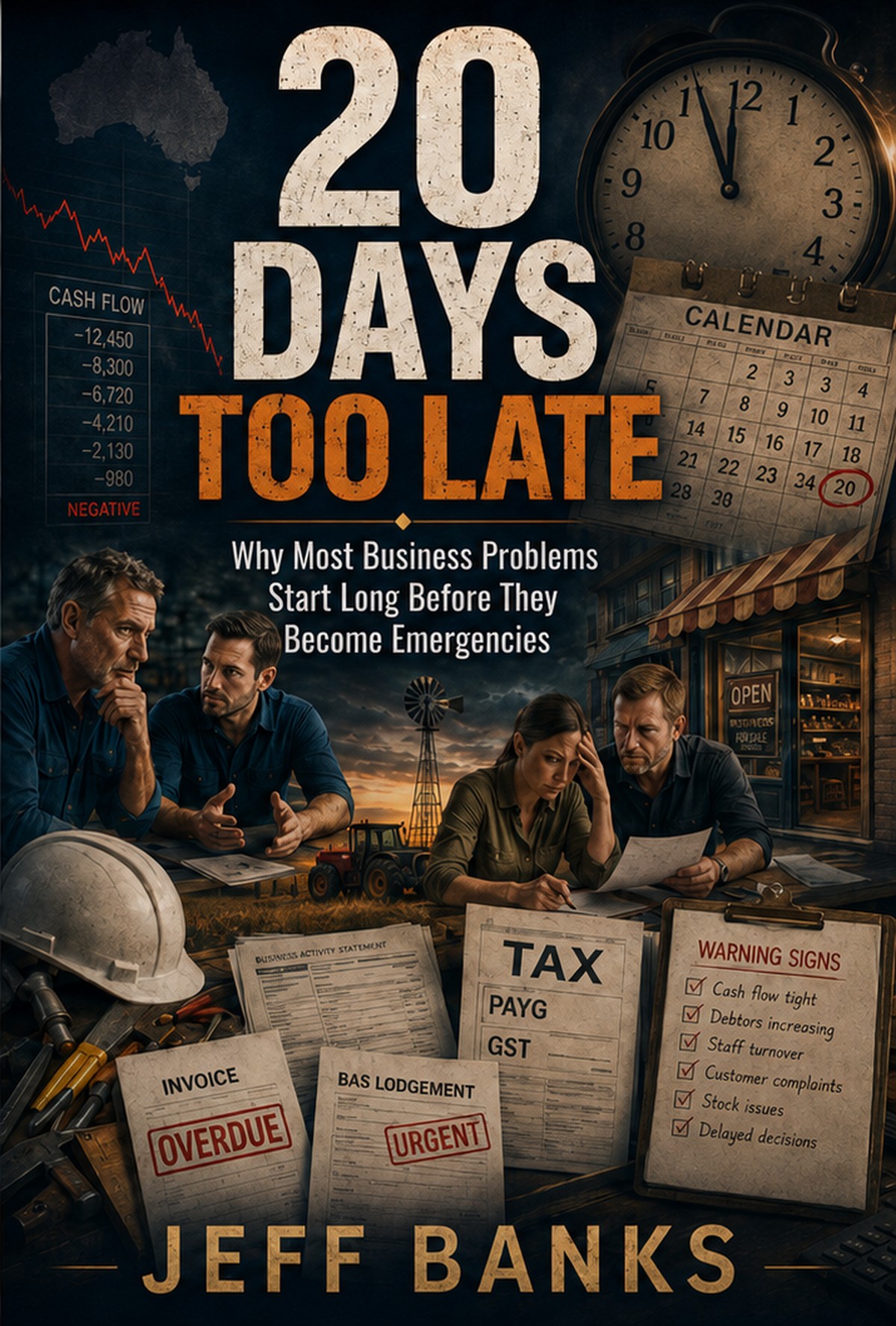
20 DAYS TOO LATE - Chapter 7 - The Government Is Not Your Business Partner

20 DAYS TOO LATE - Chapter 7 - The Government Is Not Your Business Partner | Travelling Around Australia with Jeff Banks

Once a business owner sees that clearly, the conversation naturally moves beyond tax and into structure. If the government is not your business partner, then who is exposed when things go wrong? If obligations attach to the business, the owner, the family home, the trading entity or the wrong person, the issue is no longer just cash flow. That is where many businesses discover the next lesson too late. They begin with whatever structure was convenient at the time, then years later try to make it carry risks, profits, family interests, asset protection and succession plans it was never designed to hold. By then the business may have grown around the structure like a tree growing through an old fence, and removing the fence becomes much harder than placing it properly in the first place.

20 DAYS TOO LATE

Chapter 7

The Government Is Not Your Business Partner

There is a particular kind of silence that falls across a business owner’s face when they finally understand that the money has already gone. It is not panic at first, because panic usually requires a little more energy than they have left. It is closer to disbelief, as though someone has opened the cupboard where the rainy-day money was supposed to be and found only a few old receipts, a broken stapler and a sense of embarrassment that nobody quite wants to name.

I have seen that silence many times across a desk. It usually arrives after a few months of letters, a few ignored reminders, a few promises to catch up next month and a few weeks of pretending that the balance in the bank account meant the business was doing better than it was. By the time the owner comes in, the conversation is rarely about whether the debt exists. The conversation is about how the debt became so large without anybody feeling the moment it happened.

One of the most common causes is not fraud, extravagance or stupidity. It is the simple mistake of treating government money as business money. GST comes in, wages are paid, PAYG withholding accumulates, superannuation waits for its due date and the business account still looks healthier than expected. The owner sees money, the suppliers see money, the staff see wages being paid and the bank sees activity, yet part of that money is already spoken for.

The dangerous part is that nobody from the government stands beside the EFTPOS terminal saying, “That bit is ours.” Nobody places a little red sticker on the portion of each customer payment that will one day need to be remitted. It all lands in the same bank account, wearing the same disguise, pretending to be available until the day the obligation becomes due and the owner realises availability was never the same as ownership.

I remember one tradesman who had built a strong little business on hard work, loyalty and a reputation for turning up when others did not. He was not a fool, and he was certainly not lazy. He had simply grown from a bloke with tools into a business with vehicles, staff, subcontractors, materials, finance payments, insurance, BAS obligations, superannuation obligations and a diary that never seemed to leave him alone.

For a while, growth felt like success. The jobs were bigger, the invoices were larger and the bank deposits had more commas in them than they used to. He would look at the account on a Friday afternoon and feel, for a moment at least, that the years of effort had finally begun to pay him back. The problem was that the balance was telling him a story, but not the whole story.

The business had become a collector for other people without ever admitting it. Some of the money belonged to suppliers, some belonged to employees, some belonged to the tax office and some belonged to future commitments that were already sitting quietly in the shadows. What remained for the owner was not the bank balance, but the amount left after every silent hand had reached into it.

When the first large tax debt appeared, he treated it as bad timing. When the second arrived, he blamed a slow-paying customer. When the third appeared, he blamed the government, the economy, the weather, the builder above him in the chain, the cost of materials and anybody else who happened to be standing nearby. There may have been truth in each of those complaints, but none of them changed the central problem.

The business had spent money it was only holding temporarily. It had borrowed from the government without a loan agreement, without approval and without properly admitting that borrowing had taken place. Like many unofficial loans, it worked beautifully right up until the day the lender wanted to be repaid.

That is the trap. The government is not your business partner, yet many businesses behave as though it is. They use tax money as working capital, superannuation money as breathing room and lodgement delays as a kind of informal overdraft. Then, when the government eventually asks for what was always due, the business owner feels betrayed by someone who was never on their side in the first place.

A business partner shares risk. A business partner may understand the seasonal pattern of your work, the problem with a difficult customer, the impact of one bad job or the pressure of payroll falling due before debtors pay. A business partner may sit down with you, argue with you, challenge you and still remain emotionally invested in the survival of the enterprise. The government does not occupy that role.

The government is not cruel for expecting payment, nor is it generous when it allows time. It is simply operating according to its own rules, priorities and collection powers. The mistake is not that the government behaves like the government. The mistake is that business owners sometimes convince themselves it will behave like a patient investor, a flexible banker or an understanding relative.

This misunderstanding usually begins in small amounts. A BAS is lodged a little late, but nothing terrible happens. A payment arrangement is entered into and somehow the business keeps trading. Superannuation is delayed because wages had to be covered first, and the owner tells himself he will square it up as soon as the next big invoice comes in.

Then life does what life does. A debtor pays late, a vehicle breaks down, a staff member leaves, a job goes over budget and the next big invoice arrives with a dispute attached to it. The old debt is still there, the new obligation arrives on schedule and the business discovers that using government money once is rarely a one-off event.

I have always thought tax debts behave like weeds in a neglected paddock. At first, there are only a few, and you can still convince yourself the paddock is mostly clean. Then one wet season arrives, a few weeks pass without attention and suddenly the weeds are no longer an inconvenience but the defining feature of the landscape.

The “20 Days Too Late” moment usually arrives when the owner finally seeks help after the choices have narrowed. Twenty days earlier, there may have been a debtor to chase, a payment plan to negotiate, a job to delay, a vehicle purchase to postpone or a conversation to have with the bank. Twenty weeks earlier, there may have been a pricing problem to fix, a cash flow system to install or a staff cost to review.

By the time the owner walks in with a folder of notices and a look of wounded confusion, the problem is no longer a single overdue payment. It is the accumulated cost of treating obligations as interruptions rather than as part of the business model. The debt did not arrive from nowhere, and the government did not suddenly become a problem overnight.

The funny thing about tax is that many business owners want it to be separate from the business. They talk about tax as though it is an external nuisance, like roadworks outside the shopfront or rain on a market day. In reality, tax is woven through the business from the first invoice, the first wage, the first asset purchase and the first decision to take money out for personal use.

This is why I have always been wary of business owners who say, “We will worry about tax later.” They usually mean they want to focus on sales, customers, jobs and production first. That sounds reasonable until later arrives and brings with it a number that was created by all those earlier decisions.

Tax is rarely the disease. More often, tax is the thermometer. It tells you something is happening inside the business, and it often tells you after the symptoms were already visible elsewhere. A high tax bill may reflect profit, but it may also expose poor cash discipline. A tax debt may reflect poor timing, but it may also reveal that the business has been underpriced, overdrawn or surviving on money that never belonged to it.

The owner who complains about the government often has a legitimate emotional point. Tax does feel heavy when margins are thin, customers are slow and the owner is last in line to be paid. It can feel particularly unfair when a business owner works longer hours than almost anyone on payroll and yet watches money leave the account before he or she feels properly rewarded.

The practical point remains the same. Fairness does not pay the BAS, emotion does not fund superannuation and resentment does not change a lodgement date. The best businesses do not survive because the owners love paying tax. They survive because they understand that tax obligations are not surprises unless the business has chosen not to look.

One of the simplest questions I used to ask was also one of the most revealing. “How much of the money in your bank account is actually yours?” Most owners could tell me the balance, but far fewer could tell me the answer to that question. The difference between those two numbers often explained the entire business.

A bank balance is a photograph taken at one moment in time. It does not show the bills sitting in the tray, the BAS coming due, the superannuation not yet paid, the wages next week, the supplier who has been patient for too long or the owner’s drawings that will quietly continue whether the business can afford them or not. Looking at the bank balance and calling it available cash is like looking at the fuel gauge at the top of a hill and ignoring the road ahead.

The discipline of separating government money is not sophisticated, but it is powerful. Some businesses operate separate bank accounts for GST, PAYG withholding and superannuation provisions. Others transfer a percentage of receipts each week, not because the calculation is perfect but because the habit prevents self-deception. The method matters less than the discipline behind it.

The point is not to make the business look poorer than it is. The point is to stop it pretending to be richer than it is. A business that cannot operate unless it spends the government’s money has already learned something important about its pricing, timing or cost structure. That lesson is uncomfortable, but it is better learned while options still exist.

There is a strange comfort in confusion. If the owner does not know exactly how much is owed, he can tell himself it may not be too bad. If the BAS is not prepared, the number remains imaginary. If superannuation is not calculated, the obligation feels less immediate. If the accountant has not produced the accounts, the owner can continue living inside the version of the business that still might be true.

That comfort is expensive. Numbers do not become kinder because they are discovered later. In my experience, they usually become more brutal, because delay adds penalties, interest, stress and fewer options. The debt itself may be manageable, but the months spent avoiding it often create the real damage.

I have seen business owners who could have fixed a problem with one hard conversation but waited until it required three banks, two lawyers, one accountant and a spouse who had run out of patience. I have seen tax debts that began as temporary timing issues become permanent burdens because nobody wanted to open the envelope. I have seen businesses with good reputations and loyal customers lose the ability to choose simply because they mistook delay for strategy.

The government is an unforgiving teacher because it does not care how tired you are. It does not know that your mother has been unwell, that your leading hand left without notice, that your main customer changed payment terms or that you have not had a proper holiday in eight years. Those things may be real, human and important, but the system is not built to absorb the emotional life of the business owner.

That is why business owners must build their own systems before the government’s system becomes the only one that matters. A business should know what it owes before the notice arrives. It should know whether its prices cover its obligations before the accountant delivers the annual accounts. It should know whether growth is producing cash or consuming it before the next tax debt proves the point.

There is also a moral dimension that business owners sometimes avoid because it is easier to talk about cash flow. GST collected from customers was collected under a system that assumed it would be remitted. PAYG withholding taken from wages was withheld from employees on the understanding that it would go where it was meant to go. Superannuation is not a favour to staff, but part of their remuneration.

That does not mean every business owner who falls behind is dishonest. Many are overwhelmed, under-supported and genuinely trying to keep everyone paid. It does mean, however, that the money carries obligations that are different from ordinary trade creditors, and pretending otherwise can damage more than the balance sheet.

Employees may not see the unpaid superannuation straight away, but the obligation is still attached to their work. Customers may not think about the GST component when they pay the invoice, but the business has collected money within a framework larger than itself. The government may be an impersonal collector, but some of the money moving through the business connects to very personal consequences.

This is where the language of partnership becomes dangerous. If the government were a partner, perhaps the owner could say, “We had a tough quarter, so your share is delayed while we keep the doors open.” But the government is not sharing the upside in the way an owner imagines when he works weekends, risks the house and lies awake at 3 a.m. wondering whether the next month will hold together.

The government does not become more understanding because the owner worked hard. It does not waive the obligation because the business created jobs, supported families or served the community. Those things may matter in life, and they certainly matter to the people involved, but they do not alter the arithmetic.

That may sound harsh, yet there is freedom in accepting it. Once the owner stops expecting the government to behave like a partner, the business can be managed more honestly. Obligations become costs to plan for rather than enemies to resent. Tax becomes part of the operating rhythm rather than a seasonal ambush.

Some of the strongest businesses I saw were not those with the cleverest tax planning. They were the ones with boring habits. They lodged on time, paid regularly, reconciled often and knew roughly where they stood without needing a dramatic meeting to discover it. They were not necessarily more profitable than everyone else, but they were less surprised, and lack of surprise is one of the most underrated business strengths.

The weaker businesses often had more exciting stories. They had bigger opportunities, grander plans, impressive turnover and owners who could talk brilliantly about the next stage of growth. The problem was that the basics were always running behind the speech. The dream was in front of them, but the obligations were behind them with a firm grip on the collar.

I once dealt with a business owner who kept telling me that one large contract would fix everything. The contract was always close, always promising and always just one meeting away from changing the future. In the meantime, tax debts grew, suppliers became less patient and the owner became more emotionally invested in a rescue that had not yet occurred.

The contract eventually arrived, but it did not save the business. The margins were too thin, the payment terms were too slow and the old debts consumed the early cash. What looked like the solution became another pressure point because the business had entered the new opportunity carrying the weight of every delayed decision that preceded it.

That is one of the great traps in business. Owners often believe tomorrow’s revenue will fix yesterday’s discipline. Sometimes it does, but more often it simply gives the old problem a larger stage. A business that cannot manage obligations at one level of turnover rarely becomes magically disciplined at a higher level.

Growth magnifies habits. If the habit is disciplined cash management, growth can be powerful. If the habit is using tomorrow’s money to pay yesterday’s obligations, growth can become a very efficient way to create a larger collapse.

The government is often blamed at the end because it is visible, formal and powerful. The letter has a logo, the debt has a number and the due date has passed. Yet the deeper cause usually sits somewhere quieter. It sits in the owner’s refusal to price properly, to keep records current, to reduce drawings, to confront a bad customer, to stop buying equipment for the wrong reasons or to accept that turnover without cash is not success.

This is why Chapter 6 matters so much in the journey of this book. Buying things to save tax often comes from the same misunderstanding as spending money owed to the government. In both cases, the owner focuses on the appearance of saving rather than the reality of cash. In both cases, the business makes a decision today because it wants to avoid a discomfort tomorrow.

The equipment purchase feels proactive because something tangible has been acquired. The unpaid BAS feels temporary because nothing visible has been lost yet. Both can create the illusion that the owner is managing the situation when, in truth, the business may simply be moving pressure from one corner of the room to another.

There is a world of difference between tax planning and tax avoidance by neglect. Good planning asks what the business can afford, what it needs, what obligations are coming and how decisions fit the broader picture. Neglect waits until the numbers are uncomfortable and then searches for a clever move to make the discomfort disappear.

Business owners often ask whether there is a way to reduce tax. It is a fair question, and every adviser has heard it more times than they could count. The better question is usually whether the business has enough cash to pay the tax that remains after sensible planning has been done.

There is no victory in reducing tax by spending cash the business needed to survive. There is no wisdom in delaying obligations while pretending the business is in control. There is no cleverness in using the government as a bank and then complaining that the bank has no sense of humour.

I understand why it happens. Business ownership can feel like a daily act of improvisation. Money comes in unevenly, problems arrive without appointments and everyone seems to want payment before the owner feels properly paid. In that environment, the temptation to use whatever money is available can feel less like mismanagement and more like survival.

Survival mode, however, is dangerous when it becomes normal. A week of survival may be unavoidable. A month of survival may be understandable. A year of survival dressed up as business strategy is a warning sign flashing brightly enough for everyone except the owner to see.

One of the most useful disciplines is to remove false choices before they appear. If GST is moved out of the operating account, the owner cannot spend it accidentally. If superannuation is provided for weekly or fortnightly, it does not become a quarterly shock. If PAYG withholding is treated as untouchable from the beginning, payroll does not create an invisible debt every time wages are processed.

These habits do not require genius. They require humility. The owner has to admit that money sitting in the account can be tempting, that optimism can distort judgement and that a business under pressure will often make short-term decisions that create long-term harm. Systems exist because humans are not as disciplined as they believe they will be when the pressure arrives.

Good systems also protect the owner from the emotional rollercoaster of business. When obligations are separated and monitored, the owner does not have to carry every number in his head. He does not have to wake up at night wondering whether the next BAS will be fatal. He may still have challenges, but he is dealing with known problems rather than ghosts.

The phrase “no surprises” sounds simple, almost too simple for a business book. Yet it may be the most important phrase in the whole conversation. Surprise is what turns manageable problems into emergencies, and emergencies are where business owners lose the ability to make calm decisions.

The government’s demands feel most frightening when they are surprising. A tax bill expected months earlier may be annoying, but it can be planned for. A tax bill discovered after the money has been spent becomes a crisis. The difference is not the bill itself, but whether the business allowed the obligation to remain invisible until it was too late.

That is why regular accounts matter, even when the owner finds them boring. That is why reconciliations matter, even when the bank balance seems to tell enough of the story. That is why conversations with advisers matter before the envelope becomes red, the payment arrangement defaults or the bank manager begins asking sharper questions.

The government is not your business partner, but it can become your most demanding creditor. It has systems, memory and patience of a kind that should not be confused with forgiveness. A quiet period does not mean the obligation has disappeared, and a lack of immediate action does not mean the debt has become harmless.

Many business owners misread silence. They lodge late and nothing dramatic happens, so they assume the system is flexible. They miss a payment and no one arrives at the door, so they assume there is room to move. They fall behind again and again until the silence ends, and when it ends, it often ends with less room for negotiation than they imagined.

The tragedy is that many of these situations are preventable. Not always easy, not always painless, but preventable. A business owner who knows the numbers early may still have difficult decisions to make, but difficult decisions made early are usually cheaper than desperate decisions made late.

Early action may mean lifting prices, even when the owner fears losing customers. It may mean reducing drawings, even when the family budget is already tight. It may mean stopping a growth plan, selling an asset, changing payment terms or admitting that a staff structure is no longer affordable. None of those choices are pleasant, but they are choices.

Late action often looks different. It becomes begging for time, refinancing under pressure, selling assets in a weak position or explaining to staff why superannuation was not paid when it should have been. It becomes conversations where pride has already been removed and options have been replaced by consequences.

The old saying that cash is king is true enough, but it does not go far enough. Cash is only king when you know whose cash it is. Otherwise, the king may be wearing a borrowed crown, and the day of reckoning will feel less like accounting and more like betrayal.

A healthy business owner develops a healthy suspicion of the bank balance. Not fear, not paranoia, but suspicion. He looks at the number and asks what sits behind it, what has not yet been paid, what will fall due next week and how much of the apparent comfort is merely timing.

This suspicion is not negativity. It is maturity. The optimistic owner believes the bank balance tells the truth because optimism is easier. The mature owner knows the bank balance is only one witness, and every witness should be questioned before the verdict is delivered.

The same principle applies to profit and loss statements. A business may show a profit and still struggle to pay tax because cash has been trapped in debtors, stock, work in progress, loan repayments or owner drawings. The profit may be real, but the cash may be somewhere else, and the government does not accept explanations about where the money might have gone as payment.

This is where owners can become angry with accountants. “How can I have made a profit when there is no money in the bank?” It is a fair question, but it usually reveals the very lesson the business needs to learn. Profit and cash are related, but they are not twins.

The government taxes outcomes according to rules, not feelings. The owner may feel poor, exhausted and underpaid, yet the accounts may still show taxable profit. That apparent contradiction is not proof that the system is personal. It is proof that the business needs to understand the journey from profit to cash before the tax bill arrives.

There is a deeper business lesson hiding here. Every business owner must decide whether they want to be surprised or informed. Being informed can be uncomfortable because it removes excuses early. Being surprised can feel comfortable for longer because it allows hope to fill the space where knowledge should be.

Hope has a place in business. Nobody starts, grows or rescues a business without some belief that tomorrow can be better than today. But hope cannot be allowed to do the work of records, planning and cash management. Hope is a companion, not a system.

The government will never care how hopeful the owner felt when the money was spent. It will never understand that the next job was supposed to fix everything or that the late debtor promised payment by Thursday. The government’s indifference is precisely why the business must create its own discipline before that indifference becomes expensive.

I do not say any of this from a position of judgement. Anyone who has run a business knows how easy it is to make a short-term decision and then defend it long after the evidence has turned against it. Anyone who has carried payroll, family pressure, customers and debt knows that theory often looks cleaner from the outside than it feels on the inside.

That is why the answer cannot simply be, “Pay everything on time.” Of course that is the objective, but it is not always the reality. The more useful answer is to know early when you cannot, understand why you cannot and act before the inability becomes a pattern.

A business that cannot meet its obligations should not begin with shame. It should begin with diagnosis. Is the problem pricing, debtors, stock, wages, drawings, debt, timing, growth or a combination of all of them? Until the cause is known, every payment arrangement is only a pause, and every pause eventually ends.

The most dangerous payment arrangement is the one that allows the owner to avoid changing anything else. It feels like relief because the immediate pressure reduces. It becomes a trap when the business continues operating in the same way that created the debt while also carrying the burden of repaying it.

This is why I used to be cautious when owners celebrated getting time to pay. Time is valuable only if it is used to change the conditions that made time necessary. Otherwise, the owner has not solved the problem but merely purchased a later version of the same meeting.

The government is not your partner, but its demands can reveal whether your business is honest with itself. If each reporting period produces the same fear, the same scramble and the same excuses, the issue is not the reporting period. The issue is the business model, the habits or the unwillingness to face what the numbers have been saying.

At some point, the owner must stop asking why the tax office wants money and start asking why the business did not keep it. That question is uncomfortable because it removes the villain from the story. It shifts attention away from the logo on the letter and back to the decisions inside the business.

Good advice can help, but advice works best before the emergency. An accountant can explain obligations, estimate liabilities, identify trends, suggest systems and help the owner understand the real position. What no adviser can do is make last year’s spent cash reappear simply because the owner now wishes it had been protected.

That is the heart of the “20 Days Too Late” problem. The final crisis often looks sudden, but the useful moment was earlier. It was when the first BAS was delayed, when the first superannuation payment was postponed, when the first payment arrangement was treated as success rather than as a warning.

The lesson is not that every business must be perfect. Perfection is not available to human beings, and business owners are usually human beings with more balls in the air than hands to hold them. The lesson is that imperfection must be seen early enough to be managed.

If there is a practical rule worth taking from this chapter, it is this. Never let government obligations become a mystery. Estimate them, separate them, review them and speak about them before they become embarrassing. What is known can often be managed, while what is hidden tends to grow teeth.

The second rule is just as important. Never confuse money passing through your business with money belonging to your business. A business bank account is often a railway station, not a destination. Money arrives, waits briefly and then continues its journey to suppliers, employees, lenders, the government and only finally, if the model works, the owner.

The owner who understands that journey is less likely to be seduced by temporary balances. He can still be ambitious, still take risks and still grow, but he does so with cleaner vision. He knows which money is fuel, which money is cargo and which money must never be touched.

Once a business owner sees that clearly, the conversation naturally moves beyond tax and into structure. If the government is not your business partner, then who is exposed when things go wrong? If obligations attach to the business, the owner, the family home, the trading entity or the wrong person, the issue is no longer just cash flow.

That is where many businesses discover the next lesson too late. They begin with whatever structure was convenient at the time, then years later try to make it carry risks, profits, family interests, asset protection and succession plans it was never designed to hold. By then the business may have grown around the structure like a tree growing through an old fence, and removing the fence becomes much harder than placing it properly in the first place.

The government is not your business partner, but neither is your company, trust or partnership merely paperwork. Structure is not decoration, and it is not something to worry about only after the business becomes successful. Like tax, like cash and like every warning sign in business, structure matters most before the problem arrives.

Author

Menu