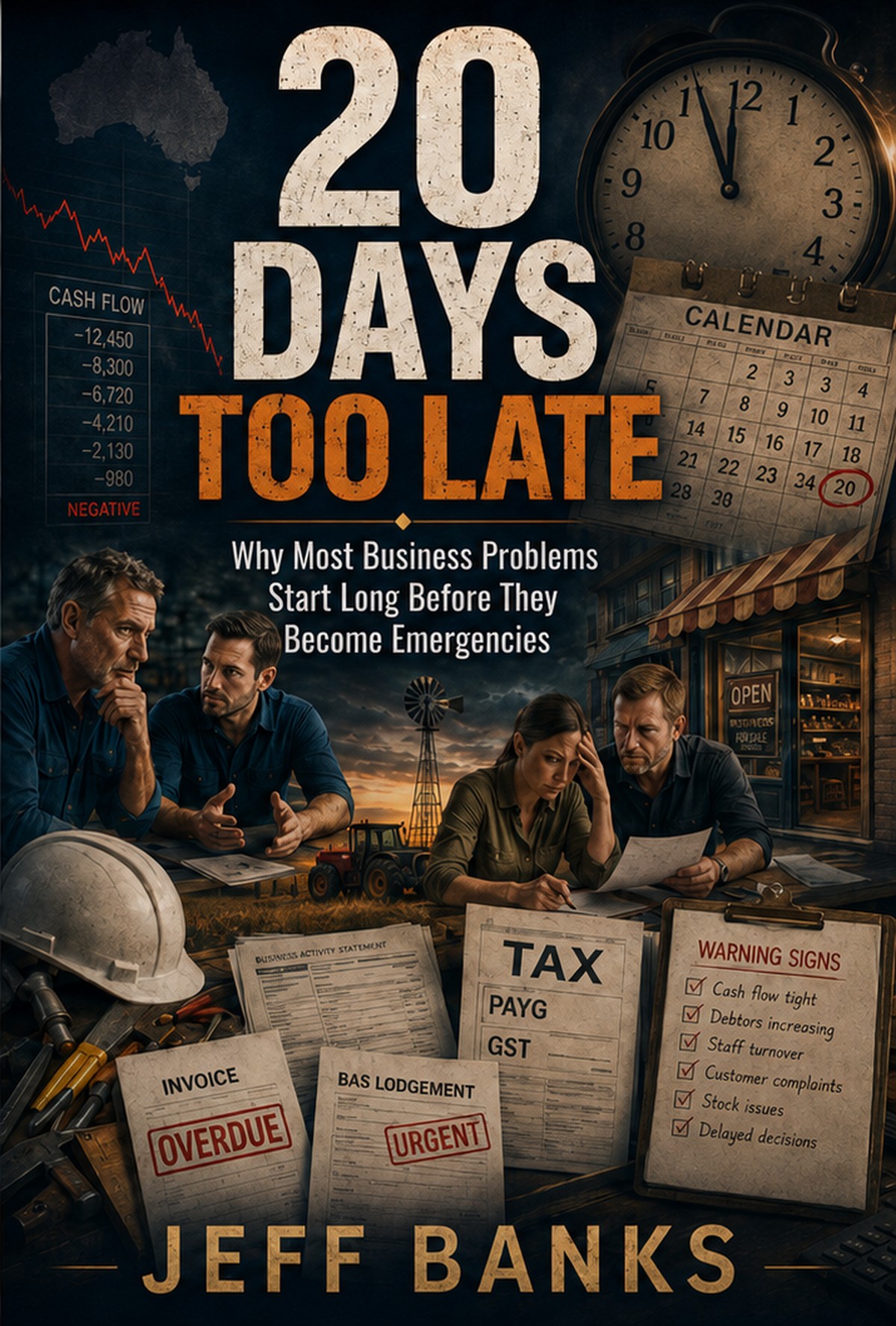
20 DAYS TOO LATE - Chapter 6 - Buying Things to Save Tax

20 DAYS TOO LATE - Chapter 6 - Buying Things to Save Tax | Travelling Around Australia with Jeff Banks

As this book keeps returning to the same theme, the issue is rarely knowledge alone. Most business owners know, at some level, that spending a dollar to save part of a dollar is not automatically clever. The reason they still do it is because business pressure makes simple truths harder to obey.

20 DAYS TOO LATE

Chapter 6

Buying Things to Save Tax

There is a particular look that comes across a business owner’s face in June when they have just been told they have made a profit. It is not always happiness, even though, in theory, it ought to be. More often it is a mixture of suspicion, mild panic and the faint hope that the accountant is about to reveal a secret passageway through the taxation system that everyone else has somehow missed.

I saw that look many times across more than forty years. It usually appeared after the words, “You are going to have a tax bill,” had been spoken. The business owner would lean back, fold their arms, stare at the ceiling for a moment, and then ask the question that has probably kept more motor dealers, equipment suppliers and office furniture stores busy in June than any other sentence in Australian business.

“What can I buy to save tax?”

It is a fair question, at least on the surface. Nobody enjoys paying tax, and small business owners in particular can feel as though they spend their lives collecting money for everyone else. They collect GST, pay PAYG withholding, pay superannuation, pay insurance, pay wages, pay suppliers, pay fuel excise indirectly every time they fill a vehicle, and then finally discover that if anything is left over, the Tax Office would also like a share of that.

The problem is not that the question is foolish. The problem is that it often begins from the wrong end. It assumes tax is the disease rather than the symptom, and it assumes spending money is a cure rather than a choice. That distinction matters, because many businesses have weakened their cash position in June while congratulating themselves for being clever.

I remember one client, a tradesman with a decent little business and a very ordinary approach to paperwork. He was good at what he did, and that had carried him a long way. The phones rang, customers waited, and there was always enough activity around him to create the impression that business was strong.

When we finally pulled the numbers together, the result surprised him. He had made a profit, and not a terrible one. It was not enough to buy an island or retire to the coast, but it was enough to create a tax bill that made him shift in the chair and rub the back of his neck the way people do when they suspect an unpleasant conversation has only just begun.

His answer was immediate. He would buy a ute. Not because the old one had stopped. Not because he had budgeted for it. Not because it was central to a plan. He would buy it because somebody at the pub had told him he could claim it, and because the dealership had a sign in the window that made tax deductions sound almost like a government-funded reward for decisive men in work boots.

The old ute was not pretty, but it worked. It started in the morning, carried tools, pulled the trailer and looked exactly like the vehicle of a man who used it for work rather than polish. There was nothing wrong with wanting to replace it, and in another year it may have been a sensible decision. The question was not whether the new ute was deductible in some form, because business vehicles often carry some tax consequences one way or another. The question was whether spending money he did not have, to reduce a tax bill he did not like, would actually improve the business.

This is the part that often gets missed. A deduction does not mean the government bought the asset for you. It does not mean the money comes back. It means the taxable income may be reduced, subject to the rules, and the tax saved is only a portion of what has been spent.

If a business owner spends a dollar simply to save tax, the business is still down the difference between the dollar spent and the tax saved. That may be perfectly sensible where the asset was needed, productive, planned and affordable. It is much harder to defend where the purchase exists only because the owner would rather see money leave the bank account for a shiny object than leave the bank account for the Tax Office.

The tradesman was not alone. I saw the same thinking in retailers buying stock they did not need, farmers buying equipment earlier than necessary, professionals upgrading office furniture that nobody noticed, and contractors buying tools that sat in boxes for months. The purchases were often different, but the psychology was the same. A tax deduction felt like a bargain, even when the cash flow said otherwise.

That is how tax planning becomes dangerous when it is done too late. In June, the business owner is no longer planning the year. They are reacting to the year. The business has already made its decisions, earned its income, paid its wages, carried its debt, delayed its invoices, ignored its margins and tolerated its waste.

By then, buying something to save tax can become a way of avoiding the more uncomfortable question. It is easier to ask, “What can I buy?” than “Why did I not know this profit was coming?” It is easier to look for a deduction than to ask why the bank account does not reflect the profit shown in the accounts.

That is the first real lesson in this chapter. Tax does not usually create the business problem. Tax reveals the business problem.

If profit has appeared on paper but cash has disappeared from the bank, the answer is rarely hidden in a catalogue. It may be sitting in debtors, stock, loan repayments, private drawings, poor pricing, slow work-in-progress, overstaffing, underquoting, or the simple habit of treating business money as though it becomes personal money the moment it arrives. The tax bill only exposes what the business has already been doing.

I used to say to clients that buying something to save tax was like eating a second dinner to avoid wasting leftovers. There may be circumstances where it makes sense, but it is not a health plan. It may solve one small emotional problem in the moment while creating a much larger practical problem afterwards.

The business owner who buys an asset in June often enjoys a brief glow of satisfaction. They have done something. They have acted. They have taken control, or at least created the feeling of control. Then July arrives, the BAS arrives, wages still need to be paid, superannuation remains due, suppliers do not disappear, the bank wants its loan payment, and the asset that looked so clever in June becomes another drain on cash.

There is nothing wrong with buying assets. Good businesses must invest. A builder cannot run on broken tools, a farmer cannot maintain productivity with failing equipment, a medical practice cannot fall behind in technology, and a manufacturer cannot compete using machinery that belongs in a museum. Investment is not the enemy. Panic investment is the enemy.

The distinction is purpose. Buying because the business needs capacity is different from buying because the owner dislikes tax. Buying because an asset will produce income, reduce labour, improve efficiency or solve a genuine operational problem is different from buying because the calendar says June and the accountant has mentioned profit.

That is why the best tax planning rarely starts with tax. It starts with the business plan, the cash flow, the equipment schedule, the staffing plan, the debt position and the owner’s personal requirements. Tax then becomes one factor in the timing of decisions, rather than the reason decisions exist.

A business that knows it will need a new vehicle within twelve months can sensibly consider timing, finance, usage, trade-in value and tax treatment. A business that discovers on 20 June that it has made a profit and rushes into a purchase before 30 June is not planning. It is flinching.

I once had a farming client who understood this better than many. He did not hate tax any less than anyone else, but he had a calmer relationship with it. He would sit in the office with a notebook, not because he was old-fashioned, although he was, but because he trusted paper more than memory.

He would have a list of machinery that might need replacing, fencing that might need work, water infrastructure that was becoming unreliable, and repairs that could not be left forever. Some years he would accelerate a purchase. Some years he would not. The difference was that the decision already existed before the tax conversation began.

His question was never, “What can I buy to save tax?” His question was, “Of the things I already need to do, is there any sense in doing one of them now?” That is a much better question, because it starts with need rather than deduction.

There is a world of difference between those two questions. One treats the taxation system as a shopping voucher. The other treats tax as part of the cost-benefit analysis of a decision that has already survived scrutiny.

Many business owners learn this lesson only after the cash has gone. They buy the vehicle, the machine, the computer system, the trailer, the shelving, the tools or the equipment, and then discover the tax saving was smaller than the hangover. Worse still, some discover the asset does not qualify in the way they assumed, or the private-use component reduces the benefit, or the finance arrangement creates a different cash flow burden than expected.

That is why general pub advice is so expensive. It arrives with confidence but without responsibility. The person at the bar never has to prepare the tax return, reconcile the loan, answer the ATO query, explain the GST treatment, adjust for private use, or help the business owner when the next quarter’s cash flow goes tight.

I have no objection to conversations at pubs. Some of the best business lessons in Australia have probably been discussed beside a bar, at a barbecue, around a truck tray, near a shearing shed, on a building site or at a local footy ground. The danger is not the setting. The danger is that tax comments are often stripped of all the boring details that make them true or false.

Someone says, “You can write it off,” as though that sentence answers everything. It does not answer whether the business is eligible. It does not answer whether the asset is new or second-hand, whether it is installed and ready for use, whether the cost is below the threshold, whether there is private use, whether the business is using the simplified depreciation rules, whether GST has been handled properly, or whether the business could afford the purchase in the first place.

Even when the tax treatment is favourable, the commercial question remains. Will this asset make the business better, or will it merely make the owner feel better for a week?

That question should be written on the wall of every small business in June. It is simple, practical and mildly annoying, which is often the mark of a useful question. It cuts through the noise and forces the owner to confront the reason for the purchase.

A new piece of equipment that allows a tradesman to complete jobs faster may be a good investment. A software system that reduces administration, improves debt collection or gives management better information may be a good investment. A machine that removes a production bottleneck may be a good investment.

A luxury vehicle that spends more time at the owner’s house than at job sites may be something else entirely. It may still be partially deductible in some circumstances, depending on the facts and the law, but that does not make it a good business decision. The taxation system does not transform vanity into strategy.

This is where business owners often confuse two different ideas. The first is minimising tax legally and sensibly. The second is avoiding tax emotionally and impulsively. The first is good management. The second is often expensive theatre.

The best business owners do not volunteer to pay more tax than required. They use legitimate deductions, plan superannuation, manage timing, review structures, watch debtors, think about stock, understand depreciation and seek advice early enough for that advice to matter. They do not regard tax planning as immoral, nor should they.

But they also understand that tax is not the only scorecard. A lower tax bill achieved by destroying cash, increasing debt or buying useless assets is not a victory. It is like losing weight by cutting off a leg.

There is a particular madness that can take hold when the phrase “before 30 June” enters the room. People who would normally negotiate hard, compare prices and sleep on major decisions suddenly become urgent. They ring suppliers, ask what is in stock, accept finance terms they barely understand, and take delivery of assets they had not considered a fortnight earlier.

The calendar becomes the salesman’s best friend. The fear of missing out is no longer about investment markets or property auctions. It is about tax deductions, and fear can make otherwise sensible people behave as though common sense has an expiry date.

I saw businesses buy things they could not use immediately because they thought owning the thing was enough. I saw others buy assets that created new expenses through insurance, registration, maintenance, storage and finance. I saw some buy technology nobody in the business knew how to operate properly, which meant the asset created frustration long before it created efficiency.

One retailer bought a large amount of display equipment late in June because the profit for the year was higher than expected. The fit-out looked terrific when it was installed, and customers probably did notice it. The difficulty was that the business had already been carrying slow-moving stock, and the money spent on display units would have been better used reducing supplier pressure and clearing old inventory.

That business did not fail because of the display equipment. Businesses rarely fail because of one decision alone. It struggled because many small decisions had been made in isolation, each one justified at the time, each one taking a little more oxygen from the room.

The display equipment was simply the “twenty days too late” moment. By the time the tax planning conversation occurred, the business had already ignored stock problems for months. It had already trained itself to measure success by sales rather than gross profit. It had already allowed supplier accounts to stretch beyond comfort.

When the owner asked what could be bought to save tax, the better question was what needed to be sold, cleared, collected, renegotiated or stopped. The answer was not more stuff. The answer was more attention.

That is why Chapter 6 follows the employee question. Staff decisions and asset decisions often share the same weakness. Business owners commit to ongoing costs in moments of optimism, then wonder later why the business feels heavy.

An employee hired without a clear role can become an expensive form of hope. An asset bought without a clear purpose can become an expensive form of denial. Both decisions can be defended at the time with sentences that sound reasonable, but both can quietly damage cash flow if they are not connected to a real plan.

The other similarity is pride. Business owners like visible progress. A new ute, a new machine, a renovated office, a warehouse full of stock or a second location can feel like evidence that the business is going somewhere. Sometimes it is. Sometimes it is only evidence that money has been spent.

Profit often feels invisible, especially in small business. It is not always sitting in the bank where the owner can admire it. It may be hidden in debtors, absorbed by stock, used to reduce debt, or taken home by the owner without being recognised as drawings. Assets, by contrast, are visible. You can point to them, photograph them, drive them and tell yourself they represent success.

That is why buying things can become emotionally satisfying even when financially questionable. The owner gets proof of progress. The accountant gets a transaction to record. The supplier gets a sale. The Tax Office may get a smaller taxable profit, but the business may get a weaker balance sheet if the purchase was not commercially sound.

There is an old saying that turnover is vanity, profit is sanity and cash is reality. Like most sayings, it survives because it contains enough truth to be useful. In this chapter, we could add another line: deductions are only useful when the business needed the expense anyway.

There are plenty of expenses that should be incurred before year end if they make commercial sense. Repairs that are genuinely needed may be worth attending to. Consumables that will be used soon may be worth ordering. Subscriptions, insurance, training, software and other costs may deserve review. Superannuation contributions may need to be paid and received on time if the business expects a deduction.

The key phrase is “commercial sense.” Tax timing can be useful, but only when it supports the business rather than distracting from it. The owner should be able to explain the decision without mentioning tax in the first sentence.

If the only argument for a purchase is that it reduces tax, the business should pause. Not reject it automatically, because rules and circumstances vary, and timing can genuinely matter. It should simply pause long enough to ask what problem the purchase solves and whether that problem existed before the tax bill appeared.

That pause is where many bad decisions die. It is also where many good decisions improve. A business may still proceed with the purchase, but with better finance, a clearer purpose, proper advice, accurate records and a realistic view of the cash flow impact.

Good advice often sounds disappointingly boring. It does not always deliver magic. It might simply say, “Yes, you can claim that, but you still need to pay for it,” or, “No, not in the way you think,” or, “Yes, but only for the business-use portion,” or, “The timing matters, and delivery after 30 June may change the outcome.”

Those sentences do not make exciting headlines. They do not fit neatly on a dealership poster. They do, however, prevent business owners from making decisions based on half-truths.

The tragedy is that many business owners do not seek that advice until after the decision has been made. They buy first and ask later. They sign finance documents first and ask later. They trade in a vehicle first and ask later. They commit to a fit-out first and ask later.

By then, the adviser is no longer helping plan the transaction. The adviser is merely reporting the consequences.

That is the difference between advice and archaeology. Advice helps shape the future. Archaeology digs through what has already happened and tries to identify the remains.

Too much accounting work, especially around tax time, becomes archaeology. The year is finished. The money has moved. The invoices have been issued. The stock has been counted or not counted. The loans have been drawn. The assets have been bought. The private expenses have been mixed with business expenses. The owner arrives hoping the accountant can create a different result from the one the year has already produced.

Sometimes there are still options. Often there are not many. That is not because the accountant lacks imagination. It is because timing matters, and business decisions harden once they have been acted upon.

The best tax planning meeting is not the one held when the year is over. It is the one held early enough for the business owner to still choose between paths. It happens when there is time to review profit, cash flow, debtors, stock, wages, superannuation, equipment needs and the owner’s personal position.

That meeting can be surprisingly calm. There may still be tax to pay, but there are fewer surprises. The owner understands why the profit exists, where the cash went, what liabilities are coming, and what decisions should be made before year end. The conversation becomes less emotional because the numbers have stopped behaving like strangers.

I always preferred those meetings. They were more useful and less theatrical. Nobody needed to perform panic, and nobody expected miracles. We could talk like adults about what the business was doing, what it needed, and what could wait.

The clients who got the most value from tax planning were not always the most profitable. They were the ones who gave themselves time. They understood that twenty days before year end is better than twenty days after, but twenty weeks before year end is better again.

That is the lesson hidden inside the title of this book. “Twenty days too late” is not really a complaint about June. It is a complaint about the months before June, when the warning signs were present but not yet urgent enough to demand attention.

The business that buys an unnecessary asset on 28 June did not suddenly become impulsive on 28 June. The impulse was created by months of not looking closely enough at the numbers. The purchase is merely the visible ending of an invisible pattern.

I think that is why so many business owners repeat the same cycle. During the year they are too busy to review the business properly. At year end they are too late to change much. After tax time they are too relieved to think about it again. Then the next year begins, and the same pattern quietly rebuilds itself.

The cure is not complicated, but it requires discipline. Review the numbers before they become history. Understand the difference between profit and cash. Keep a list of assets the business genuinely needs. Know which purchases are essential, which are desirable and which are merely tempting. Talk to the accountant before signing, not after.

That last point sounds self-serving coming from an accountant, but it is not really about accountants. It is about the simple reality that better decisions are usually made before commitments become irreversible. Advice is cheaper when it is early.

A five-minute phone call before buying an asset can prevent a five-year irritation. A short discussion about finance can reveal whether the tax saving is being swallowed by interest and fees. A review of business-use percentages can prevent unrealistic expectations. A cash flow forecast can show whether the business can afford the decision even if the tax treatment is favourable.

None of this means the business owner has to become timid. Caution and cowardice are not the same thing. Good businesses take risks, invest, expand, modernise and occasionally move before every detail is perfect.

The point is not to avoid decisions. The point is to make decisions for the right reasons. Tax can influence timing, but it should not become the business plan.

There is also a deeper issue here, and it has nothing to do with depreciation schedules. Some business owners buy things to save tax because paying tax feels like losing. It feels like punishment for effort. It feels like the government standing at the finish line with a bucket.

I understand that feeling. Small business is hard, and many owners carry risks employees never see. They sign leases, guarantee loans, chase invoices, work weekends, employ people, deal with regulations, absorb mistakes and then get told that profit creates another obligation.

But tax is also evidence that the business has produced something. It may not feel that way when the bill arrives, and it certainly does not help if the cash has disappeared. Still, a tax bill is often the final scorecard of decisions already made, not an enemy that appeared from nowhere.

The owner who can calmly provide for tax is usually running a more mature business than the owner who spends in anger to avoid it. That maturity does not happen overnight. It develops when the business treats tax as a known cost rather than a recurring ambush.

One of the simplest disciplines is to put money aside for tax as profits are earned. Many owners resist this because cash is always needed somewhere else. There is always a supplier to pay, a wage run approaching, a vehicle to repair, a loan to service or a household expense waiting at home.

That resistance is understandable, but it is also dangerous. When tax money is left in the everyday trading account, it begins to look available. The owner uses it, often without malice or even awareness, and months later is offended when the Tax Office asks for money that has already been spent.

Separate accounts do not solve poor profitability, but they can reduce self-deception. A business that regularly moves GST, PAYG withholding, superannuation and income tax provisions into separate accounts is less likely to mistake obligations for surplus cash. It may still have problems, but at least the problems are visible earlier.

Visibility is the heart of this book. The best business owners are not the ones who never face problems. They are the ones who see problems while there is still room to move.

Buying things to save tax often happens when visibility arrives too late. The owner suddenly sees profit but not cash. They see tax but not the decisions that created it. They see a deduction but not the longer cash flow impact.

That is why the question must change. Instead of asking, “What can I buy to save tax?” the business owner should ask a series of better questions. What does the business genuinely need? Will this purchase improve profit, cash flow, capacity, safety, quality or efficiency? Can the business afford it without weakening itself? Would I still buy it if there were no tax deduction?

The last question is brutal, which is why it is useful. If the honest answer is no, the purchase deserves suspicion. Not automatic rejection, but suspicion.

There will be cases where the answer is yes. The business needed the asset anyway, the timing is sensible, the cash flow is understood, the finance is manageable, and the tax treatment improves the decision. In those cases, tax planning has done its job. It has helped the business make a necessary decision at a sensible time.

There will be other cases where the answer is no. The asset is not needed, the old one still works, the finance is stretched, the private-use element is high, and the only attraction is the thought of reducing tax. In those cases, the deduction may be the most expensive part of the bargain.

I sometimes told clients that if they were determined to spend a dollar badly to save part of that dollar in tax, they could send the dollar to me and I would promise to give them back less. That usually earned a laugh, or at least the sort of look accountants receive when they are being deliberately unhelpful. The joke worked because it exposed the absurdity beneath the impulse.

No business owner would normally spend money just to receive a smaller portion back. Yet when the word “deduction” appears, the same decision can suddenly feel intelligent. Language has power, especially when it allows us to disguise emotion as strategy.

That is why the role of the adviser is not merely to know the rules. It is also to slow the room down. A good adviser should help the business owner separate the tax effect from the business effect, because those two things are related but not identical.

An expense may be deductible and still be wasteful. An asset may be eligible for favourable treatment and still be unnecessary. A purchase may reduce taxable income and still make the business weaker.

The reverse is also true. A purchase may create little immediate tax joy and still be a brilliant business decision. Training staff, improving systems, building customer relationships, reducing rework, strengthening stock control, documenting procedures and fixing pricing may not always produce the same emotional thrill as driving away in a new vehicle, but they may create far more value.

This is one of the quiet tragedies of small business. The most useful investments are often the least glamorous. Nobody gathers the family in the driveway to admire a better debtors system. Nobody posts a photo of a repaired pricing model. Nobody takes a new procedures manual for a Sunday drive.

Yet those dull improvements can transform a business. They reduce mistakes, improve collection, protect margins and make the owner less dependent on memory and heroics. They rarely arrive with a big red bow, but they often do more for profitability than the asset bought in June because the salesman said it was a great time to act.

I have always believed that financial statements are records of behaviour. The profit and loss statement does not merely show income and expenses. It shows habits. It shows what the business values, what it tolerates, what it measures and what it ignores.

A business that repeatedly buys assets in June while struggling with cash flow is telling a story. The story may be about poor planning, emotional tax avoidance, lack of discipline or the owner’s need to feel successful. The numbers will not diagnose the psychology, but they will reveal the pattern.

The balance sheet tells another part of the same story. It shows whether the business is building strength or merely accumulating things. It shows debt, stock, unpaid taxes, unpaid superannuation, loans to owners, equipment finance and the quiet consequences of decisions that once felt isolated.

That is why asset purchases should never be reviewed only through the profit and loss statement. The deduction may appear there, but the cost may live on the balance sheet for years. The business owner who looks only at taxable income can miss the debt that remains after the tax benefit has passed.

This is especially important when finance is involved. The fact that an asset is financed can make the purchase feel painless in the moment. The business may not pay the full amount immediately, and the tax outcome may create a short-term benefit. But the loan does not care about the tax deduction once the next year begins.

Repayments continue. Interest continues. Insurance continues. Maintenance continues. Registration continues. The asset must earn its place every month, not merely justify itself on the day it was purchased.

That is the test many assets fail. They are exciting on purchase day and ordinary thereafter. They sit in the business like a promise that was never quite kept.

A good asset should either produce revenue, protect revenue, reduce costs, reduce risk or improve the owner’s ability to run the business. If it does none of those things, it may still be pleasant, impressive or personally satisfying, but it should not be dressed up as tax planning.

There is no shame in wanting nice things. Business owners are human. They work hard, and many have gone years without rewarding themselves properly. The trouble begins when personal reward is disguised as commercial necessity.

That disguise can create tax issues, but it can also create family and business issues. A spouse may see the new vehicle and wonder why household bills are still tight. Staff may see the owner’s new purchase and wonder why wage increases are apparently impossible. Suppliers may see the business spending while their invoices remain overdue.

Perception is not everything, but it is not nothing. Business decisions speak, even when the owner says nothing. Assets bought for the wrong reasons can send messages the owner did not intend.

This does not mean owners must live like monks or drive rusted vehicles to prove virtue. It simply means they should be honest about the nature of the decision. If something is a reward, call it a reward. If it is a business investment, prove it through the numbers.

Honesty simplifies many things. It may not reduce the tax bill, but it reduces confusion. The owner can then make a personal decision with open eyes rather than pretend the business demanded something it merely allowed.

The best conversations I had with clients were often the ones where we stripped away the pretence. The owner would begin by talking about tax, but eventually admit they were tired, proud, frustrated, ambitious, fearful or simply sick of feeling as though everyone else got paid first. Once the real emotion was on the table, the decision could be examined properly.

Business is full of emotion pretending to be arithmetic. Tax planning is one of the places where that disguise appears most often. The numbers matter, but the impulse behind the numbers matters too.

If a business owner is buying because they are angry at the Tax Office, that is emotion. If they are buying because they feel behind their competitors, that is emotion. If they are buying because they want proof that the struggle has been worthwhile, that is emotion.

Emotion is not automatically wrong. It simply should not be allowed to hold the pen while the business signs finance documents.

There is a calm way to approach this. Keep an asset register that is not merely a list for the accountant but a management tool. Note what the business owns, what condition it is in, when it may need replacement, what repairs are becoming uneconomic and what new assets could improve productivity.

Review that register before June. Better still, review it during the year. Then, when profit appears, the business can make decisions from a prepared list rather than a frightened imagination.

Do the same with tax obligations. Estimate profit during the year, not after it. Estimate tax before it becomes payable. Consider whether cash flow allows voluntary payments, increased instalments, superannuation contributions, debt reduction or necessary investment. None of those options is magic, but all are better considered early.

The point is not to remove tax from business life. That cannot be done, and any person promising otherwise should be approached with the same caution as a man selling miracle fuel tablets from the boot of a car. The point is to remove surprise.

No surprises. That phrase belongs at the centre of good business. It does not mean nothing bad ever happens. It means the owner has fewer avoidable shocks because the obvious things are being watched.

A tax bill should not arrive like a stranger at the door. A vehicle replacement should not be discovered only after a salesman mentions deductions. A profit result should not feel like an accusation. These things can be planned, estimated, reviewed and understood.

When business owners resist that work, they are not avoiding administration. They are avoiding reality. Reality is patient, but it is not forgiving.

Reality waits until the BAS is due. It waits until wages are due. It waits until the bank account is low, the supplier is impatient, the equipment breaks, the debtor delays payment, and the owner finally realises that the clever June purchase did not create cash. It only changed the shape of the problem.

That is the “twenty days too late” lesson in its purest form. The business owner wants tax planning at the end of the year, but the useful decisions belonged earlier. The business wants a deduction now, but the real need was information months ago.

A late deduction can reduce a tax bill. It cannot repair a year of poor pricing. It cannot collect old debtors. It cannot make excess stock move. It cannot turn an unnecessary employee into a productive one. It cannot transform private drawings into business strength.

That does not make tax planning useless. It simply puts it in its proper place. Tax planning is a tool, not a rescue helicopter.

Used well, it helps a sound business keep more cash, time decisions properly and avoid unnecessary leakage. Used badly, it becomes a justification for spending money the business needed more than it needed the deduction.

The owner who understands this begins to think differently. They stop asking how to avoid tax and start asking how to build a business strong enough to pay tax without fear. That is a very different ambition.

A business that can pay its tax is not automatically successful, but it is usually healthier than one that cannot. It has at least produced taxable income, and if cash has been managed properly, it has not mistaken obligations for opportunity. That is not glamorous, but it is powerful.

We do small business owners no favour by pretending tax can be made painless. It cannot. What can be removed is the panic, the guesswork, the resentment and the last-minute scramble.

There will always be tax rules, thresholds, deadlines and concessions. They will change over time, and advisers will continue to interpret them, explain them and occasionally complain about them. But the commercial principle underneath this chapter will not change.

Do not spend money badly to save tax. Do not confuse a deduction with a refund. Do not let 30 June make decisions the business should have made for itself.

If the business needs the thing, can afford the thing, will use the thing and has taken advice about the thing, then the tax outcome may be the final nudge. If the business does not need it, cannot afford it, will barely use it and has only discovered its desire after hearing the word deduction, then the wisest tax strategy may be to do nothing.

Doing nothing is underrated in business. It is not always laziness. Sometimes it is discipline. Sometimes it is the refusal to let fear spend money.

The harder lesson is that paying tax may sometimes be the best available outcome. That sentence will never be popular, and I do not expect it to appear on motivational posters in small business workshops. Still, it is true often enough to deserve a place in the conversation.

If the choice is between paying tax on genuine profit or wasting money on something unnecessary, the first option may be the more sensible one. The business owner may not enjoy writing the cheque, but at least the remaining cash stays available for wages, suppliers, debt reduction, working capital and the next opportunity.

That is the adult version of tax planning. It is less exciting than the dealership poster, but it leaves the business stronger.

As this book keeps returning to the same theme, the issue is rarely knowledge alone. Most business owners know, at some level, that spending a dollar to save part of a dollar is not automatically clever. The reason they still do it is because business pressure makes simple truths harder to obey.

Pressure narrows the field of vision. It makes the urgent feel more important than the important. It makes a tax bill feel like an emergency, even when the conditions that created it were visible long before. It turns normal decisions into rushed decisions, and rushed decisions into expensive habits.

That is why the government should never be treated as your business partner, even though many owners unconsciously behave as though it is. They make decisions because of tax rates, concessions, grants, deductions, deadlines and compliance fears. They allow government rules to shape commercial behaviour more than customers, margins, cash flow and strategy do.

The government is always present in business life, and pretending otherwise is childish. It sets rules, collects tax, imposes obligations and occasionally offers incentives. But it does not carry the same risk as the owner, and it does not suffer in the same way if the owner makes a poor commercial decision chasing a tax result.

That is where we go next. Buying things to save tax is only one version of a larger problem. Many business owners spend too much time trying to make the government part of their business model, when the real work is building a business that can stand on its own feet.

The next chapter is therefore not an attack on government, because complaint is rarely a strategy. It is a reminder that the government is not your business partner, and if you begin to run your business as though it is, you may find yourself making decisions for the wrong audience.

Author

Menu