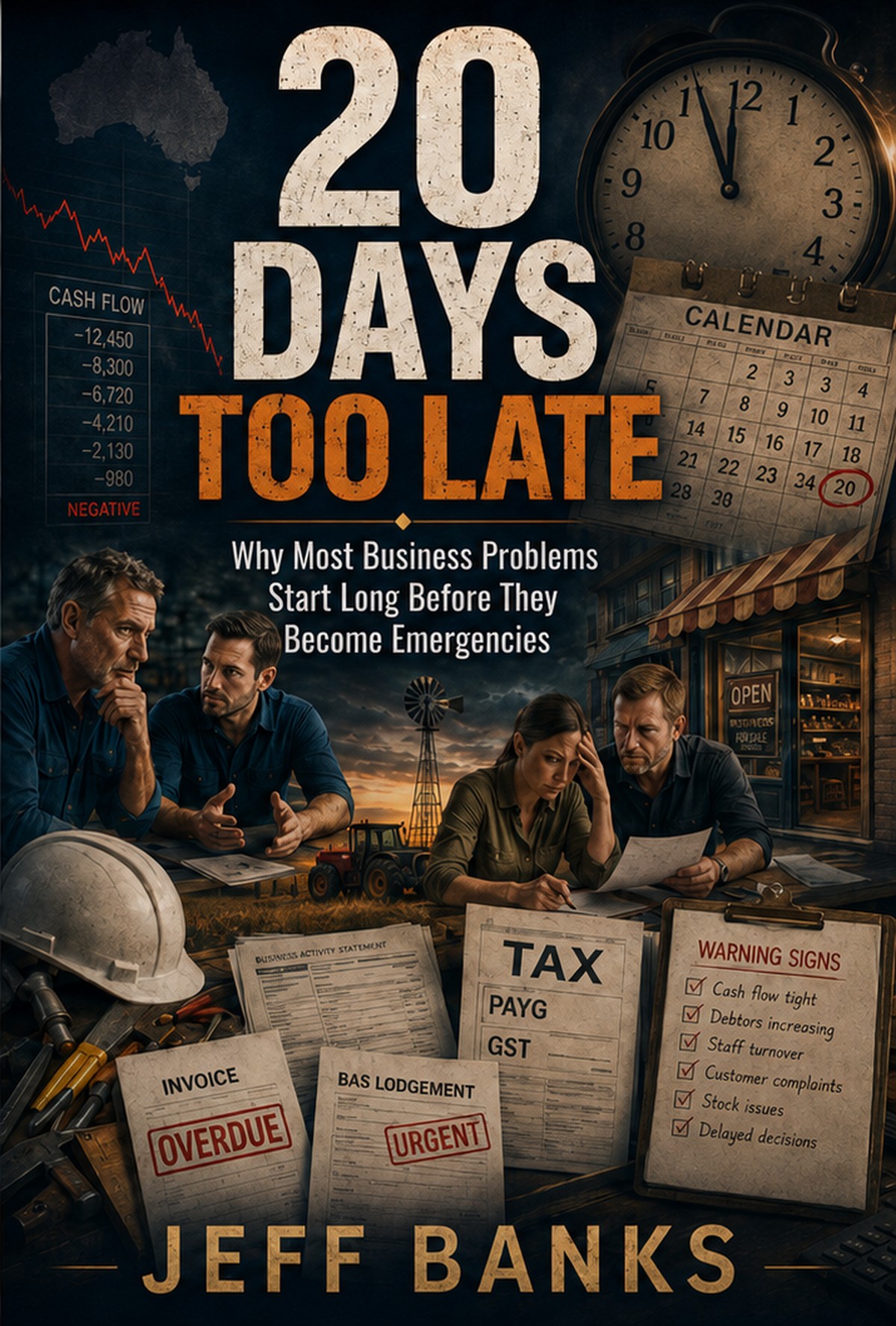
20 DAYS TOO LATE - Chapter 3 - Cash Is Oxygen

20 DAYS TOO LATE - Chapter 3 - Cash Is Oxygen | Travelling Around Australia with Jeff Banks

That is why cash deserves its own chapter. It is not just another number in the accounts. It is the living breath of the business, and when it runs short, every other weakness becomes harder to ignore. The next question is where the oxygen goes. Sometimes it disappears into overheads, stock, debt, drawings or poor systems. Very often, though, it disappears into customers who should never have been allowed to consume so much of the business in the first place.

20 DAYS TOO LATE

Chapter 3

Cash Is Oxygen

The first time I heard a business owner tell me that cash flow was only a timing problem, I was young enough to almost believe him. He said it with such confidence that, for a moment, it sounded less like a warning and more like a sophisticated explanation.

He had a good business by most casual measures. There were staff on the tools, vehicles on the road, work booked ahead and invoices going out regularly. From the outside, it looked like the sort of small Australian business people admire because it appears busy, useful and productive.

The problem was that none of that activity was sitting in the bank account. The invoices existed, the work had been done and the customers had received what they ordered, but the cash had not arrived. Meanwhile, wages still had to be paid, fuel still had to be bought, suppliers still expected their money and the Australian Taxation Office remained stubbornly uninterested in how good the sales looked on paper.

He was not dishonest. He was not lazy. He was not even particularly bad at business in the way people sometimes imagine when they hear that a business is in trouble.

His mistake was simpler and much more common. He thought profit meant safety, and he thought revenue meant strength. He had not yet learned that a business can be profitable on paper and still be quietly suffocating.

That is the part of business people often misunderstand until it becomes painful. Profit may describe the score, but cash describes whether the players can stay on the field. A business without cash is not merely uncomfortable; it is running out of air.

When I looked through his records, the pattern was not complicated. His turnover had grown, but so had the gap between doing the work and being paid for it. His suppliers wanted payment within thirty days, his staff wanted payment every week, his customers were taking sixty or ninety days to pay, and he was carrying the difference out of his own overdraft.

For a while, that worked. Banks exist partly to smooth those timing gaps, and a sensible overdraft can be a useful business tool. The problem begins when the overdraft stops being a bridge and becomes the road itself.

By the time he came to see me, the bank account told a story his profit and loss statement had politely avoided. He was not short of work, but he was short of oxygen. He had been breathing shallowly for months and calling it growth.

That is one of the cruellest traps in business. The very thing that looks like success can sometimes be the thing that kills you. More work brings more wages, more materials, more administration, more GST collected and owed, more pressure and more chances for delay.

It seems strange to say, but growth is dangerous when cash does not grow with it. Many business owners discover this only after they have taken on the bigger job, hired the extra staff member, bought the additional vehicle or accepted the customer who promised volume but demanded generous terms. They win the work and lose their balance.

I have seen businesses fail because they did not have enough sales, but I have seen just as many fall over because they had too many sales of the wrong kind. The first failure is obvious because the phone is not ringing. The second failure is more deceptive because everyone is busy right up to the moment the bank account gives up.

Cash is oxygen because it is required before almost everything else. It pays wages before customers pay invoices. It buys materials before the final claim is approved. It covers rent, fuel, insurance, repairs, subscriptions, superannuation and tax long before the owner has the luxury of calling anything profit.

There are many things a business can survive for a while. It can survive a bad month, a difficult customer, a delayed job, a staff resignation, an equipment breakdown or even a wrong decision. It cannot survive indefinitely without cash, because every other problem eventually becomes a cash problem.

That is not a technical statement. It is not something found buried in an accounting standard or explained in a tax ruling. It is the practical reality of running a business where people expect to be paid in money rather than in optimism.

I used to tell clients that the bank account is the only report that never lies. A profit and loss statement can be misunderstood, delayed, massaged by timing or distorted by things that have not yet been paid. A bank account is brutally direct, because it tells you what is available today.

That does not mean the bank account tells the whole story. It can be temporarily high because GST has been collected but not yet paid, because suppliers have not yet been paid, because a tax bill is coming or because the owner has delayed necessary spending. Still, the bank account remains the place where theory meets reality.

The dangerous moment arrives when the business owner starts treating all cash in the bank as their own. The BAS money gets used to pay wages, the superannuation money gets used to pay suppliers, the supplier money gets used to pay the bank, and the owner tells themselves they will catch it up when the next big payment arrives.

Sometimes that next payment does arrive. Sometimes it is delayed by a customer who has their own cash problem, a builder waiting on a progress claim, a farmer waiting on a season, a government department waiting on paperwork or a large company using small suppliers as unwilling financiers.

That is when the quiet panic starts. The owner begins to check the bank account not once a day but ten times a day. They know which invoices are overdue, which customers are avoiding calls and which creditors must be paid first to keep the doors open.

The funny thing is that many of these owners are not careless with money in their personal lives. They will drive across town to save a few cents on fuel, keep old tools going long after they deserve retirement and argue over a small private expense with admirable discipline. Yet inside the business, they sometimes allow thousands of dollars to drift through the system without anyone truly watching the timing.

Part of the reason is emotional. Revenue feels good because it is visible and affirming. Cash management feels dull because it is defensive, repetitive and sometimes unpleasant.

It is much nicer to talk about a new contract than to ring a customer about an overdue invoice. It is much more exciting to quote a large job than to calculate whether the business can fund the materials and wages until payment arrives. It is easier to say the business is growing than to admit the growth is consuming every spare dollar it creates.

I once had a client who ran a trade business with a wonderful reputation. He was reliable, skilled and genuinely liked by his customers. The problem was that his niceness extended into his invoicing, which meant he was doing work promptly and being paid whenever other people got around to it.

His customers loved him for it. They praised his workmanship, recommended him to others and told everyone he was one of the good ones. What they did not do was pay him on time.

He told me he did not like chasing people. He felt embarrassed asking for money, even when the money was owed for work already completed. He had somehow convinced himself that collecting payment was less honourable than performing the work.

That idea has damaged more small businesses than most people realise. There is nothing noble about allowing customers to use your cash while you borrow money to survive. There is nothing unkind about expecting payment under terms that were agreed before the work began.

The first time we looked seriously at his debtors, we found money that should have been in his bank account months earlier. Some customers were only late because nobody had asked firmly. Others had worked out that he was the sort of person who would keep turning up without ever making payment uncomfortable.

The “twenty days too late” moment had actually started with one invoice. It was not large enough to frighten anyone, and it was not late enough to cause alarm. He let it slide because he knew the customer, liked the customer and wanted to avoid awkwardness.

Twenty days later, another invoice was overdue. Twenty weeks later, late payment had become part of the culture of the business. Twenty months later, the bank overdraft was funding customers who were better at protecting their cash than he was at protecting his.

That is how cash problems often begin. They do not arrive wearing a sign that says crisis. They begin as tolerance, courtesy, avoidance and the belief that good people eventually do the right thing.

Many good people do eventually do the right thing. The problem is that your business may not have enough oxygen to wait for them. A small business cannot pay wages with goodwill, and the ATO does not credit your account because your customers seem nice.

This is where accountants sometimes fail business owners as well. We can talk too much about profit and taxable income without talking enough about timing. We can prepare reports that explain what happened last year while the owner is gasping for cash this week.

Tax is important, but cash is immediate. A business owner may be able to negotiate tax debt, arrange a payment plan or restructure future obligations, but the staff still expect wages on Thursday. The supplier who has stopped the account may not care that the profit and loss statement looks respectable.

One of the most useful conversations in business is also one of the simplest. When does money leave, and when does money arrive? If a business owner cannot answer that question clearly, the business is flying in fog.

The answer is rarely found in one number. It sits in the rhythm of the business, in the time between purchase and sale, between sale and invoice, between invoice and payment, between payroll and receipts, between GST collected and GST remitted. Each gap matters because each gap must be funded by somebody.

In many small businesses, that somebody is the owner. They fund the gap with savings, credit cards, overdrafts, unpaid wages to themselves, delayed superannuation, delayed tax or money borrowed from family. They may call it temporary, but temporary has a way of becoming permanent when nobody measures it.

The most dangerous funding source is often unpaid tax. It is easy to fall into because the money is already in the bank. GST collected from customers looks like business cash until the quarterly BAS arrives and reminds the owner that it was never theirs.

PAYG withholding can create the same illusion. Money deducted from employees’ wages is held for the government, not for the business. Superannuation is even more dangerous, because failing to pay it on time can create penalties, director exposure and a breach of trust with the very people helping keep the business alive.

Yet I understand why it happens. When the choice appears to be paying wages today or preserving tax money for a future due date, most owners choose the immediate human pressure. They tell themselves they are buying time, and sometimes they are.

The problem is that time purchased with unpaid obligations is expensive. It may buy relief this week, but it often sells next month’s options. By the time the tax debt is acknowledged, the business may already be carrying the weight of many small postponements.

Cash management is not about being miserly. It is not about refusing to invest, avoiding growth or keeping every dollar locked away in fear. It is about knowing which dollars are truly available and which dollars already belong to someone else.

A business owner needs to understand the difference between cash in the bank and cash that can be spent. That distinction sounds obvious, but it is one of the first things to disappear under pressure. When the bank balance is low, every incoming payment looks like rescue.

I have seen owners celebrate a large deposit as if it solved everything. By the time we allocated GST, materials, wages, subcontractors, finance repayments and existing overdue creditors, there was almost nothing left. The deposit had not solved the problem; it had simply revealed how many claims were already waiting for the same dollar.

That is why a cash flow forecast does not need to be fancy to be useful. Some of the best cash flow tools I have seen were spreadsheets that would make a software consultant faint. They worked because the owner understood them and used them regularly.

The forecast should show what money is expected in, what money must go out and when the pinch points are likely to occur. It should be honest enough to include tax, superannuation, loan repayments, owner drawings, seasonal quiet periods and customers who habitually pay late. A forecast built on hope is not a forecast; it is a bedtime story.

The purpose is not to predict the future perfectly. Nobody does that, especially in small business where a single debtor, breakdown or weather event can change the month. The purpose is to see the danger early enough to still have choices.

Choices are the great benefit of acting early. When a cash issue is recognised early, the owner can speak to the bank, renegotiate terms, slow spending, chase debtors, adjust pricing, reduce drawings, change payment arrangements or decline work that would make the position worse. When it is recognised late, the choices narrow until every option feels unpleasant.

That is the true cost of waiting. The problem itself may not be fatal, but the delay removes the ability to solve it cleanly. By the time the owner seeks help, they are not choosing between good and bad options; they are choosing between bad and worse.

Many business owners avoid cash flow discussions because they fear what they will find. They already know something is wrong, but they have not converted the discomfort into numbers. As long as the problem remains vague, they can keep moving.

Vagueness is strangely comforting. It lets the owner say things like “it will be right when the next job pays” or “we are just waiting on a couple of invoices.” Those statements may be true, but they may also be disguises worn by a much deeper problem.

Numbers remove the disguise. Once the cash flow is written down, the business cannot pretend that a $30,000 hole will be solved by a $12,000 receipt. It cannot pretend that next month will be easier if next month contains the BAS, superannuation, insurance renewal and two loan payments.

This is where the owner sometimes becomes angry, not with the numbers but with the person showing them. I have learned not to take that personally. The first reaction to a hard truth is often resentment toward the messenger.

After the resentment passes, relief often follows. It is better to see the cliff while there is still road left than to discover it after the wheels have left the edge. Hard numbers are not the enemy; they are the torch in a dark room.

Cash also has a psychological effect that business books sometimes underestimate. When cash is tight, owners do not think clearly. They become reactive, short-tempered, overly optimistic in some areas and paralysed in others.

A business owner under cash pressure may take on bad work because they need the deposit. They may discount too heavily because any sale feels better than no sale. They may tolerate poor customers, delay necessary conversations and make decisions designed to survive Friday rather than build a stronger business.

This is how cash pressure spreads into every part of the operation. It affects pricing, staffing, quality, customer selection, supplier relationships, family life and health. The bank account may be a financial report, but the stress it creates is deeply human.

I have sat with owners who looked exhausted before they even opened the folder. They were not simply tired from work. They were tired from carrying invisible calculations in their head every hour of the day.

They knew the payroll figure. They knew the overdue supplier amount. They knew the customer who had promised payment last week, the cheque that had not cleared in the old days, the transfer that had not arrived in more recent ones and the credit card sitting close to its limit.

That is not management. That is a form of captivity. The owner becomes trapped inside the timing of other people’s payments.

The saddest part is that many of these businesses had the chance to change earlier. They could have tightened terms, taken deposits, invoiced faster, stopped work on overdue accounts, priced properly, built reserves or simply looked at cash weekly rather than when panic demanded attention. None of those actions would have been dramatic at the time, which is precisely why they were postponed.

Business owners often look for the heroic solution after rejecting the boring one. They want a restructure, a new investor, a major contract, a bank extension or a sudden burst of sales. Sometimes those things help, but often the boring discipline would have solved the problem earlier and more cheaply.

Invoice the day the work is done. Make payment terms clear before the job starts. Follow up overdue accounts quickly and politely. Put tax money aside before it becomes tempting. Know what wages and superannuation require before taking drawings.

None of that sounds glamorous. It will not make a stirring speech at a business conference. It will, however, keep oxygen flowing.

I remember another client who had no obvious reason to be in trouble. The business had been around for years, the customers were steady and the industry was not collapsing. Yet every quarter, the BAS created a crisis.

He spoke about the BAS as if it were an ambush. Every three months, he seemed genuinely surprised that the same obligation arrived again. It was like watching someone stand on a railway line and complain about the timetable.

The issue was not the tax itself. The issue was that the business had no rhythm for setting money aside. Every dollar that came in was absorbed by the urgent, and the predictable was treated as if it were unexpected.

We changed very little at first. A separate account was created, and a percentage of receipts was moved into it regularly. It was not perfect, but it changed the conversation.

For the first time, the BAS became less frightening because some of the money was already there. The business had not become more profitable overnight. It had simply stopped pretending that tax money was available cash.

That distinction matters enormously. Many business owners do not need a miracle; they need compartments. They need to separate what belongs to the business, what belongs to the government, what belongs to suppliers, what belongs to employees and what may eventually belong to them.

Without compartments, everything becomes one pool of money. In good times, that pool creates overconfidence. In bad times, it creates confusion.

The owner sees money in the bank and believes the position is better than it is. Then the BAS arrives, superannuation falls due, insurance renews and the supplier account tightens. Suddenly the same bank balance that felt safe becomes inadequate.

Cash reserves are sometimes dismissed as conservative. People say money sitting in the bank is not working hard enough. That can be true in some circumstances, but a reserve is not lazy money if it prevents panic decisions.

A cash reserve buys patience. It allows the owner to wait for the right customer instead of accepting the wrong one. It allows the business to handle a slow month, a late payer, a vehicle repair or a delayed shipment without immediately reaching for debt.

There is no perfect reserve for every business. A professional practice, a builder, a farmer, a retailer and a manufacturer all carry different risks and timing pressures. The right reserve depends on the business model, the volatility of income, the payment terms, the debt load and the owner’s appetite for sleepless nights.

What matters is not the exact formula. What matters is that the owner recognises cash as a resource to be protected rather than a residue left over after everything else happens. In too many small businesses, cash management is what occurs after the real work is done, when it should be part of the real work from the beginning.

That begins with pricing. A business that prices too low may create revenue, work and reputation while starving itself of oxygen. Every job then requires effort but does not leave enough cash behind to strengthen the business.

It continues with terms. A business that allows customers to pay slowly while it pays suppliers quickly has effectively become a lender. That may be acceptable if it is deliberate and priced into the work, but it is dangerous when it happens by accident.

It also includes stock and work in progress. Money tied up in shelves, materials, half-finished jobs or unrecovered time is still money unavailable for wages, tax and survival. Many businesses do not run out of value; they run out of liquid value.

That phrase may sound like accountant language, but the idea is plain enough. You cannot pay a supplier with stock that has not sold. You cannot pay wages with a job that is ninety per cent complete but not yet claimable.

This is why different businesses need different cash habits. A retailer may need to watch stock turn. A builder may need to watch progress claims and variations. A farmer may need to plan around seasons, machinery repairs and commodity prices.

A professional firm may need to watch work in progress and debtors. A trade business may need to watch materials, labour recovery and customer payment habits. A hospitality business may need to watch wages, rent, food costs and daily takings with almost ruthless consistency.

The principle does not change. Cash enters, cash leaves and the timing gap must be understood. If the owner does not understand it, the business will eventually teach the lesson in a harsher language.

One of the great myths of business is that cash flow problems are always caused by insufficient income. Sometimes they are, but sometimes they are caused by success, delay, poor terms, weak systems, excessive drawings, tax neglect, bad customers or a refusal to say no. Cash flow is rarely one issue; it is usually a collection of behaviours.

That is why the bank account is a report card for decisions made earlier. It records the customer who was allowed to pay late, the job priced too cheaply, the equipment bought too soon, the tax money spent, the drawings taken because the owner was exhausted and felt they deserved something. The bank balance may look like a number, but it is really a history.

This is not said to judge the owner. Most people in business make these decisions under pressure, and many make them while trying to look after staff, family, customers and suppliers at the same time. The tragedy is not that they make imperfect decisions; the tragedy is that they often make them without seeing the pattern soon enough.

The pattern becomes visible when cash is reviewed regularly. Not yearly, not when the accountant prepares the financial statements, and not only when the bank starts asking questions. Cash must be watched while there is still time to respond.

A weekly cash meeting can change a business. It does not need to involve a boardroom, a consultant or a thick report. It can be the owner, the bookkeeper and the key numbers that determine whether the next month is survivable.

What is owed to us? What do we owe others? What must be paid no matter what? What receipts are likely, doubtful or already late? What spending can wait, and what spending will cost more if it waits?

Those questions sound simple because they are simple. The difficulty is not intellectual; it is behavioural. The owner must be willing to look before the crisis forces them to look.

I have learned that businesses do not only need better numbers. They need better habits around numbers. A report that is produced but ignored is not management; it is decoration.

The best owners I dealt with were not necessarily the cleverest or the most technically trained. They were the ones least willing to be surprised by their own business. They wanted to know early, even when knowing early was uncomfortable.

They understood that cash problems rarely improve through neglect. Silence does not make debtors pay faster. Avoiding the bank account does not make the balance rise.

There is a point in almost every cash problem where a reasonable conversation could still have changed the outcome. The supplier may have agreed to terms, the bank may have considered support, the customer may have paid when pressed, the ATO may have accepted a plan and the owner may have adjusted spending. That point usually arrives well before the desperate phone call.

The desperate phone call often comes too late because the owner has spent weeks trying not to admit the size of the problem. They are not foolish. They are human, and human beings are very good at postponing discomfort until discomfort becomes unavoidable.

By then, the conversation changes. Instead of asking how to preserve options, we ask which damage can be contained. Instead of planning, we triage.

That is the essence of “twenty days too late.” It is not always a literal twenty days, although sometimes it is frighteningly close. It is the space between the first warning and the first honest action.

Cash warnings usually whisper before they shout. A supplier account moves from current to slightly overdue. A customer takes longer than usual to pay. The owner uses the credit card for expenses that should have been covered by operating cash. The BAS is lodged but not paid, and the explanation is that next month will be better.

Each event can be explained. Each delay can be justified. Each small compromise feels temporary.

Then the pattern hardens. The business learns to survive by pushing obligations forward. It becomes normal to pay late, chase harder, borrow quietly, delay tax and hope for a large receipt.

Normal is a dangerous word in business. Many businesses do not collapse because something abnormal happens. They collapse because a bad habit becomes normal long enough to remove the margin for error.

That is why cash discipline must be built before it is needed. You do not start thinking about oxygen after you are already underwater. You think about it before you dive.

A business owner should know the minimum cash required to operate safely. They should know the fixed costs that arrive regardless of sales, the variable costs that follow each job and the obligations that cannot be ignored without creating personal or legal risk. They should know which customers pay reliably and which customers consume more cash than they contribute.

That last point leads us towards one of the harder lessons in business. Not all customers are good customers. Some customers bring revenue but take cash, energy, margin and confidence.

The customer who pays late is not just late. They are using your business as their bank. The customer who argues every invoice is not just difficult. They are increasing administration and delaying cash that should already be available.

The customer who demands urgency but pays slowly creates a special kind of unfairness. They expect your business to treat their problem as immediate while treating your payment as optional. Many owners accept that imbalance because they fear losing the revenue.

That fear is understandable. When cash is tight, every customer can look necessary. The owner begins to believe that saying yes to everything is the only way through.

Yet the opposite is often true. A business short of cash cannot afford bad customers. It needs customers who respect the exchange, pay on time and allow the business to make a sensible margin.

This is where cash management becomes more than accounting. It becomes judgement. It asks the owner to decide not only how much work they can win, but what kind of work they should accept.

I have seen businesses transformed not by finding more customers, but by firing the wrong ones. That sounds harsh until you understand what the wrong customers were doing. They were consuming the oxygen needed by the rest of the business.

A business cannot serve good customers well while bad customers are draining its time and cash. It cannot invest in staff, equipment or quality if every spare dollar is tied up in overdue accounts and underpriced work. It cannot build confidence if the owner is constantly negotiating with people who should have paid without being chased.

Cash reveals these truths earlier than profit often does. A profit report may show that a customer contributes sales. The bank account may reveal that the same customer leaves the business gasping between payments.

That is why Chapter 3 belongs after the discussion about revenue. Revenue may prove that people are willing to buy what you sell, but cash proves whether the business model breathes. The first can flatter an owner, while the second forces honesty.

The lesson is not to become fearful, mean or obsessed with every dollar. Business requires generosity, trust and relationships, especially in regional communities where reputation travels faster than invoices. The lesson is that generosity without boundaries can become self-harm.

A good business owner learns to be both helpful and firm. They can care about customers without financing them indefinitely. They can support staff without pretending unpaid superannuation is a strategy.

They can invest in growth without confusing expansion with survival. They can make decisions from strength rather than from the panic created by an empty bank account. They can act before the options disappear.

Cash is oxygen, and oxygen is not the whole purpose of life. Nobody starts a business merely to admire the bank balance. People start businesses to build something useful, provide for family, create independence, serve customers, employ people and perhaps leave something better than they found it.

Still, none of those purposes survive long without oxygen. The noblest business intention in the world must eventually pass through a bank account. If the cash is not there, the intention becomes irrelevant.

The owners who understand that do not wait for the crisis. They watch the signs, build the habits and ask the uncomfortable questions early. They know that the cost of attention is far cheaper than the cost of rescue.

By the time the business is gasping, the owner is no longer managing from choice. They are reacting from necessity, and necessity is rarely generous. It demands quick decisions, ugly compromises and conversations that would have been easier weeks or months earlier.

That is why cash deserves its own chapter. It is not just another number in the accounts. It is the living breath of the business, and when it runs short, every other weakness becomes harder to ignore.

The next question is where the oxygen goes. Sometimes it disappears into overheads, stock, debt, drawings or poor systems. Very often, though, it disappears into customers who should never have been allowed to consume so much of the business in the first place.

That is the uncomfortable doorway into the next lesson. If cash is oxygen, then some customers are fresh air and others are smoke. The hard part for many business owners is learning which is which before loyalty, fear or habit leaves them twenty days too late again.

Author

Menu