

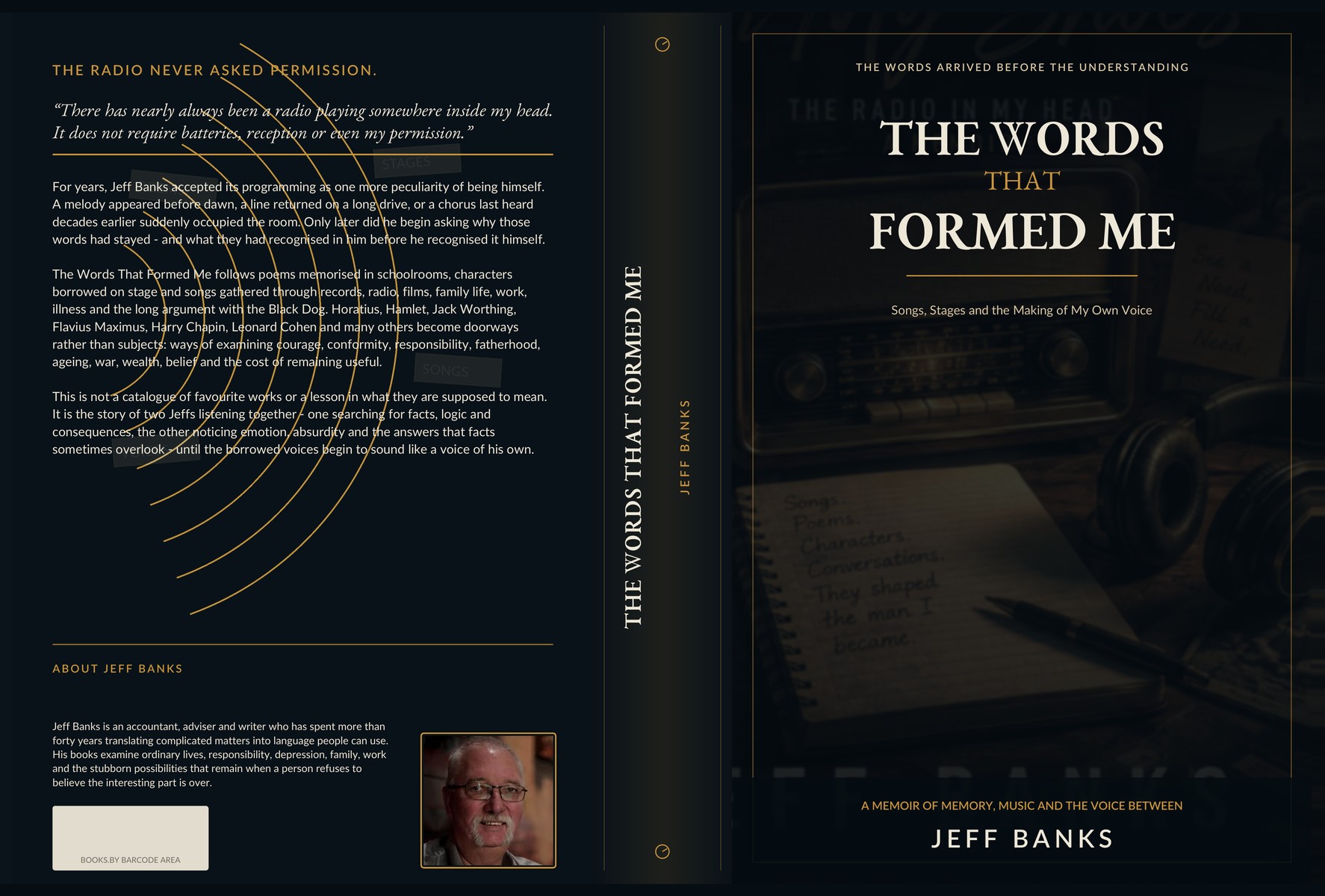
THE WORDS THAT FORMED ME - Foreword

THE WORDS THAT FORMED ME - Foreword | Travelling Around Australia with Jeff Banks

I have reached an age when many people might expect the important influences to have completed their work and taken their final positions. That assumes considerably more order than I have observed in memory, writing or life. Words have a habit of returning when the listener has changed enough to hear something previously unavailable.

THE WORDS THAT FORMED ME

Poems, Songs and the Life Between the Lines

Foreword

There has nearly always been a radio playing somewhere inside my head. It does not require batteries, reception or even my permission, and its programming decisions remain beyond explanation. On some mornings it offers a song perfectly suited to the day ahead, as though some thoughtful producer has studied the circumstances and selected the appropriate soundtrack. On others it broadcasts Mahna Mahna, which suggests either that the producer has a sense of humour or that nobody has been in charge for years.

For much of my life, I treated that internal radio as little more than one of the peculiarities that came with being me. A tune would be playing when I woke, a line would return while I was driving, or a chorus last heard decades earlier would suddenly make itself at home while I was trying to think about something entirely different. I seldom asked why that particular song had arrived or what it might be attempting to tell me. Songs were simply there, part of the background noise behind work, family, ambition, disappointment, laughter and the continuing effort to appear as though I understood what I was doing.

Only later did I begin to wonder whether the words had found me long before I was capable of understanding why I needed them. Some came through poems recited at school, when success meant remembering the lines and delivering them without embarrassing myself. Others arrived through plays, theatre restaurants and characters who allowed me to say things that Jeff Banks might have been too cautious, too uncertain or too sensible to say directly. Most came through songs, entering unnoticed through the radio, records, films, television and the accidental soundtrack of an ordinary life.

This book is not an attempt to prove that every poem, performance or song carried a secret message intended specifically for me. That would give the universe far too much credit for organisation, and it would give me an importance I have never been entirely comfortable claiming. It is instead an exploration of recognition: the strange moment when words written by somebody else seem to describe something within us that we have not yet managed to name. The words may have existed for years, but their meaning sometimes waits until life provides the necessary translation.

The boy who encountered Horatius could admire courage against fearful odds without understanding how often adulthood would place him beside gates he had not chosen to defend. He could hear the grandeur in Death or Glory before learning that glory is usually announced by people standing a safe distance from the consequences. He could perform Oscar Wilde, Gilbert and Sullivan or a ridiculous Roman detective without recognising that each role offered temporary permission to try on another version of himself. Those voices were entertainment at the time, yet they remained somewhere in the archive, ready to be reopened when age and experience finally supplied the password.

The songs behaved in much the same way. Some offered comfort, some offered questions and a few offered promises that life would later reveal to be unreliable. Certain songs grew wiser as I grew older, while others became less convincing once their optimism was tested against reality. A lyric that once seemed romantic could become unsettling, a protest song could become a personal challenge, and a cheerful chorus could conceal something much darker beneath its melody. The music remained the same, but the listener kept changing.

That changing listener is at the heart of this book. He is the child trying to understand why he does not quite fit, the young man seeking applause without admitting how much it matters, and the accountant determined to explain complicated things without sounding like an instruction manual written by a committee. He is the husband, father, adviser, performer, writer and logical bystander who keeps noticing that technically correct answers may still leave human beings frightened, diminished or alone. He is also the man who has spent much of his life negotiating with the Black Dog while attempting to make the negotiation invisible to everybody else.

The Black Dog appears in these pages because he has attended more of the performances than I would have wished. He can silence the radio, drain colour from familiar things and turn the distance between a chair and a desk into something resembling an expedition across hostile territory. He has never won, although that is not the same as saying he has gone away. There has always been another morning, another absurdity, another child or grandchild doing something extraordinary, and another reason to remain long enough to see what happens next.

Words and music have been part of that remaining. They have not cured depression, solved grief or transformed every difficult day into a lesson worth framing on the wall. Sometimes they have done nothing more heroic than provide company, and there are days when company is enough. A line remembered at the right moment can create a little distance between the person and the darkness, allowing him to observe the darkness rather than become entirely absorbed by it.

This is not a book of conventional song criticism, although at times I will examine what a song appears to be doing and why it affected me. I have no musical training beyond knowing what I like, what I dislike and what causes me to change stations with unexpected urgency. I am less interested in chord progressions, studio techniques or whether the definitive recording was made in 1968 or 1972 than I am in what happened when the song entered my life. The concern here is not merely what the writer intended, but what the listener carried away.

Nor is this a chronological autobiography disguised as a record collection. Memory has never respected chronology, and music respects it even less. A song heard yesterday may return me to a room occupied fifty years ago, while something learned at school may suddenly explain an argument I had last week. These chapters follow connections rather than calendars, because that is how the radio in my head has always operated.

Some of the connections are serious, but I have tried not to become solemn. Solemnity is often seriousness wearing ceremonial clothing so that nobody feels entitled to ask a question. I have spent much of my professional life resisting that approach, particularly in a world where complicated language can be used to make ordinary people feel inadequate. Serious matters deserve clarity, but they can usually survive a little humour as well.

That belief owes something to the characters I played and something to the songs that refused to behave respectfully. Flavius Maximus, the private Roman eye, may not appear an obvious ancestor of an accountant who called himself Not Your Ordinary Accountant, but the family resemblance is difficult to deny. Both distrusted unnecessary authority, both preferred plain language and both recognised that absurdity can expose a truth more effectively than a lecture. One wore a toga, while the other wore a suit, although each costume occasionally concealed somebody wondering whether he truly belonged in the room.

There are two Jeffs speaking throughout these pages. One wants evidence, sequence, logic and consequences, and he becomes impatient when emotion is used as a substitute for thought. The other notices the tremor beneath a voice, the sadness hiding inside a joke and the fact that a perfectly logical solution can still wound the person expected to live with it. They do not always agree, but their argument has become part of the voice with which I now write.

That voice was not created from nothing. It contains traces of Peacock and Macaulay, Shakespeare and Wilde, Gilbert and Sullivan, Leonard Cohen, Paul Simon, Harry Chapin, Redgum, Cold Chisel and many others who appear in the chapters ahead. It contains school stages, theatre restaurants, transistor radios, vinyl albums, television speakers and songs encountered by accident on the way to somewhere else. Borrowing their words did not erase my voice; it helped me recognise what my voice might eventually become.

The timing of that recognition matters. I began looking more closely at these words while standing near the edge of full-time retirement, a place where the future can appear both wonderfully open and disturbingly undefined. Work had provided roles, deadlines, clients, arguments and the reassuring illusion that being needed was the same as knowing who I was. When some of that noise reduced, the internal radio became easier to hear.

Retirement has not produced a calm and fully enlightened narrator looking back from a mountaintop. It has produced the same man with slightly more time to question his previous explanations. Age has not resolved the argument between confidence and inadequacy, nor has it convinced the Black Dog to seek accommodation elsewhere. It has, however, made pretending less interesting and honesty more urgent.

The chapters that follow are therefore acts of listening. They revisit poems, parts and songs not to place them in glass cases, but to ask what they left behind. Some taught courage, some encouraged conformity, some offered compassion and some lied with such confidence that crowds still sing their promises together. Even the lies matter, because discovering that a song cannot keep its promise may force us to decide what we will do when nobody arrives to keep it for us.

There is anger here, because there are things in life worth being angry about. There is anger at injustice, war, empty authority, avoidable confusion and systems that reward those who already understand how to work them. Yet anger is not the destination, and rage without responsibility soon becomes another form of performance. The more difficult question is what we do with the hammer once we realise it is in our hand.

There is gratitude as well, although not the polished gratitude that pretends pain was necessary because it eventually produced a marketable lesson. I remain grateful for the family that gave me reasons to continue, the clients who trusted me, the friends who stayed, the stages that tolerated me and the songs that kept returning. I am grateful that words can change meaning without changing their order, because that gives all of us permission to meet them again as different people.

Perhaps readers will recognise some of these poems and songs immediately. Perhaps they will disagree completely with what I hear in them, which may be the most honest response possible. A song does not belong only to its writer once it has entered the lives of listeners, and each listener brings different memories, losses, hopes and unfinished conversations. The version playing inside my head may not be the version playing inside yours.

That is partly why this book exists. It is not intended to tell readers what the words must mean, but to encourage them to notice the words that formed them. There may be a childhood poem still shaping their idea of courage, a film line that became family shorthand, or a song that returns whenever life reaches a particular kind of crossroads. The influence may be profound or gloriously ridiculous, because not every defining piece of music needs to be treated as sacred.

A Year in My Shoes began with me waking and listening to the station inside my head. This book begins from the suspicion that I have been listening to it all my life without appreciating how much of the programming became part of me. The poems, characters and songs did not provide a set of instructions, and they did not lead through a neat sequence towards wisdom. They offered fragments, questions, disguises, warnings and occasional moments of recognition.

Somewhere along the way, I stopped being merely the listener. I began responding, arguing with the lyrics, questioning the promises and adding my own words to the broadcast. The borrowed voices remained, but they no longer drowned out the one voice I was responsible for using. This book is the record of that transition, although transition may be too tidy a word for something still happening.

The internal radio is still playing. Its reception varies, its playlist remains unpredictable and its announcer has yet to reveal himself. There are undoubtedly songs whose meanings have not arrived, just as there are pieces of the man writing this that have not yet found their language. That seems less like a failure now and more like evidence that the broadcast is not finished.

Neither, I hope, am I.

About the Author

Jeff Banks has spent much of his life translating difficult things into language ordinary people can use. For more than forty years, he worked as an accountant, tax adviser, business mentor and reluctant interpreter of systems that often seem designed to make sensible people feel inadequate. His professional philosophy was built around the belief that technical knowledge is worthless when it leaves the person seeking help more confused, frightened or diminished than before. It eventually found expression in the name Not Your Ordinary Accountant, although the instinct behind it began long before he knew what an accountant was.

Jeff grew up in country New South Wales, seven miles from the nearest settlement and beyond ordinary speaking distance of the next farm. It was a childhood of isolation, imagination, school buses, horses, sport and the early suspicion that belonging might be something other people understood more naturally. He succeeded academically and athletically, yet often remained the boy looking at the room from just outside it, noticing the rules without fully accepting their logic. That position would later become what he calls the logical bystander: close enough to care, but distant enough to ask why everybody else appears willing to accept the absurdity in front of them.

Words reached him early, although their meanings often arrived much later. Poems learned at school introduced courage, sacrifice, class, fear and the uncomfortable possibility that the people giving orders were not always those required to face the consequences. Shakespeare offered questions large enough to survive a lifetime, while Oscar Wilde demonstrated that comedy could expose pomposity more efficiently than confrontation. Gilbert and Sullivan provided music, theatre and permission for a country boy to step into the light, sing loudly and briefly become somebody who might even have been a king.

The characters Jeff played remained with him after the costumes were returned. Jack Worthing raised questions about identity and the importance of being whichever version of Jeff the room appeared to require. Giuseppe Palmieri allowed him to sing and perform at an age when boys were not necessarily encouraged to do either. Flavius Maximus, private Roman eye, taught him that authority becomes much less intimidating once somebody is prepared to point out that its toga is crooked.

Those lessons followed him into professional life. Jeff became an accountant who refused to sound like a tax manual and an adviser who believed a technically correct answer could still be humanly wrong. He built Banks Consultancy around four practical promises: to speak in the client’s language, reduce tax legally, drag the reluctant towards compliance and behave like a silent partner in the business. Beneath the humour was a serious conviction that people deserved an adviser willing to explain the rules, question the accepted wisdom and remain beside them when the numbers revealed something they did not want to hear.

His business career was neither smooth nor easily packaged into a success story. It included ambition, partnership, bankruptcy, rebuilding, growth, sale, disappointment and the discovery that protecting a business philosophy becomes much harder after the business carrying it no longer belongs entirely to you. He has worked from established offices, temporary rooms, a garage and a converted spare bedroom known as the Cave. Across those different settings, the purpose remained broadly the same: understand what is really happening, tell the truth in language people can absorb and help them decide what to do next.

Jeff’s writing grew from the same instinct. His books explore business, family, depression, retirement, intelligence, conformity, community and the complicated stories people tell themselves in order to keep moving. In Dumbing It Down, he examines the lifelong pressure to reduce the volume of an active mind so that it does not unsettle the room. In How Did We Get Here?, the logical bystander watches modern systems drift away from their stated purposes and asks why obvious contradictions are so readily accepted. In A Year in My Shoes, the movement towards retirement becomes a daily conversation with health, usefulness, family, unfinished work and the Black Dog.

The Black Dog is not a literary decoration in Jeff’s work. Depression has accompanied achievement, competence, humour and professional confidence, often remaining invisible to those who saw only the suit, the advice or the man apparently in control. It has turned short distances into obstacles, silenced the internal radio and made continuing seem less like an act of courage than a task to be renegotiated each morning. Jeff does not write about defeating it, because he does not believe such a victory can honestly be claimed, but he remains equally unwilling to concede the contest.

Family has provided some of the strongest reasons for that refusal. Jeff and his wife, Robyn, built a life around work, persistence, children, worry, argument, loyalty and the gradual realisation that having enough cannot always be measured on a balance sheet. Their children became proof that extraordinary things might happen next and therefore reasons to remain present for the possibility. Jeff writes about their achievements with pride, but also with the private uncertainty of a father who can celebrate what his children became while still wondering whether he was ever quite enough along the way.

Music has accompanied every version of that life. There has nearly always been a radio operating inside Jeff’s head, beginning before he is fully awake and selecting songs without consulting him about mood, relevance or good taste. At times it has supplied Leonard Cohen, Paul Simon, Harry Chapin, Redgum, Cold Chisel or a song capable of reopening an argument decades after Jeff thought it settled. At other times it has offered Mahna Mahna, confirming that whatever controls the programming is not committed entirely to profundity.

This book emerged from listening more carefully to that station. The songs, poems and performances discussed here were not selected because they form a definitive catalogue of great writing or because Jeff claims any special authority over their meaning. They were chosen because they entered his life, remained there and eventually revealed something about courage, responsibility, injustice, war, wealth, belonging, faith, despair, conformity or the unreliable promises people sing together. Some became companions, some became provocations and some became lies that needed to be challenged.

Jeff is not a conventional music critic, literary scholar or theatre historian. He approaches these works as the person they helped form, bringing the same mixture of logic, emotion, humour and argument that shaped his professional and personal life. The analytical Jeff wants to know what the words say, whether their claims survive examination and what consequences follow when people believe them. The human Jeff notices what the song does to the listener, what memory it reopens and why something demonstrably illogical may still be emotionally true.

The two Jeffs do not always agree. One is driven, impatient with nonsense and willing to walk towards brick walls in the belief that determination should eventually persuade them to move. The other understands exhaustion, inadequacy, tenderness and the need to sit beside somebody without attempting to repair them. Their continuing argument provides much of the voice in these pages and perhaps explains why Jeff can move from taxation to theatre, from war songs to children, or from depression to a ridiculous Roman without believing he has changed the subject.

Retirement has not ended that argument or produced a quieter mind. It has removed some deadlines, reduced some professional noise and created more space for questions that employment once allowed him to postpone. Jeff remains an adviser, writer, husband, father, grandfather, community participant and observer of a world that frequently confuses activity with progress. He has ceased believing that identity must be surrendered merely because paid work no longer occupies the centre of the day.

His involvement with community organisations, Rotary, Scouting and Sandbar Golf Club reflects another idea that appears repeatedly in his work: see a need, fill a need. Jeff admires the principle, while recognising its danger for somebody who can mistake being useful for being responsible for everything. A hammer may build, repair, sound an alarm or strike blindly because action feels more comfortable than patience. The challenge is not merely to possess the tool, but to understand when it should be used and when somebody else must be allowed to lift it.

Jeff’s writing does not offer certainty, redemption or a polished formula for living well. It asks readers to stand briefly beside the logical bystander and examine the assumptions governing their own lives. It invites them to consider the words they borrowed, the characters they performed, the promises they believed and the songs that understood them before they understood themselves. Most of all, it asks whether they are still listening passively or have begun adding their own voice to the broadcast.

Jeff Banks continues to write from the edge of retirement, where the view behind is long and the road ahead remains stubbornly unfinished. The Black Dog still circles, the two Jeffs still argue and the internal radio continues to make programming choices that cannot be defended by logic. There are more stories to understand, more questions to ask and more ordinary lives deserving to be treated as meaningful.

He is not finished yet.

THE WORDS THAT FOUND ME

Preface

There have always been two Jeffs living inside this particular head, although for many years neither was prepared to acknowledge the tenancy of the other. One wanted facts, evidence, logic and an answer capable of surviving contact with a calculator. The other noticed the things that refused to fit neatly into columns: the pause before someone answered, the memory stirred by a melody, the joke hiding inside an absurd situation and the emotional debris left behind after the technically correct decision had been made.

Calling this schizophrenia would be both medically wrong and unfair to those who live with the real condition, but the word has often been borrowed carelessly to describe the sense that more than one person seems to occupy the same skin. Most of us carry several versions of ourselves, even if we prefer to present the public with a single, well-organised tenant. There is the person who speaks and the one who edits the sentence before it escapes, the person who wants to be generous and the one quietly calculating whether generosity has once again been confused with surrender.

Perhaps everyone has two selves, or three, or an entire committee that meets without circulating an agenda. We simply call it judgment, conscience, instinct, doubt or changing our mind, because those descriptions sound considerably more respectable. The only unusual thing about the two Jeffs may be that we have begun acknowledging each other, although even that conclusion could be another piece of self-flattery designed to suggest we are more self-aware than the people around us.

That is what we would like to believe. We would like to think the analytical Jeff and the human Jeff have been formally introduced, accepted their shared accommodation and agreed upon reasonable access to the controls. The truth is probably less orderly, because each continues to claim he is the original tenant and that the other arrived later carrying too much luggage.

The analytical Jeff is convinced he keeps the household functioning. He sees patterns, assesses risk, anticipates consequences and becomes irritated when people insist that a strongly held opinion is an acceptable substitute for evidence. Without him, he believes, life would become a series of emotional purchases made without first checking the bank balance.

The other Jeff considers that assessment predictably arrogant. He notices that numbers may describe what happened without explaining why anybody allowed it to happen, and that an answer can be correct while remaining almost entirely useless to the person asking the question. Without him, he suspects, the first Jeff could successfully calculate the dimensions of the room while failing to notice that everyone else had quietly left it.

Neither operates alone, despite their insistence to the contrary. Emotion searches for evidence to justify itself, while logic is frequently recruited to defend decisions already made for reasons it would rather not disclose. The mind may present its eventual conclusion as the outcome of sober analysis, even when the argument began elsewhere with fear, pride, affection, anger or the simple desire not to look foolish.

The two Jeffs have therefore spent a lifetime doing more than disagreeing. They have covered for each other, contradicted each other and occasionally collaborated in producing explanations so persuasive that even they forgot which one had wanted the result in the first place. Perhaps that is not a disorder at all, but merely the ordinary human condition with the internal paperwork left exposed.

It would be convenient to say the first Jeff had always intended to become an accountant. It would also be wrong, which is often the difficulty with convenient explanations. Accounting was not some carefully charted destination towards which I had been travelling since childhood, armed with a sharpened pencil and a fascination for double-entry bookkeeping.

I wanted to fly jets, but not because I had spent my childhood studying aerodynamics or imagining the quiet satisfaction of a perfectly arranged instrument panel. The dream came from somewhere less orderly and considerably more dangerous. It grew out of the world of “Death or Glory,” where courage was uncomplicated, service was noble and the men worth admiring moved towards danger while everybody else was still deciding what to do.

The stories surrounding service gave a boy something larger than an occupation to imagine. They offered belonging, purpose and the possibility of being tested in a way that would reveal, finally and beyond argument, what sort of person he was. The uniform mattered, the aircraft mattered and the idea of being part of an elite group mattered, but underneath all of them was the belief that a worthwhile life should involve serving something beyond yourself.

There was probably more glory than death in the version I carried then. Childhood stories had a tendency to clean the blood from the uniform before presenting it for inspection, and courage generally arrived without the fear, damage or long aftermath that real service demanded. None of that diminished the dream at the time, because boys are rarely encouraged to study the footnotes beneath their heroes.

Flying jets became the modern expression of that older call. It promised speed, danger, skill and service, but it also promised escape from an ordinary life that seemed unlikely to ask enough of me. I did not merely want to rise above the ground; I wanted to become the sort of person considered worthy of being placed in the cockpit.

When that runway closed, accounting did not appear as another childhood ambition waiting patiently in the departure lounge. I fell into it because another direction had to be taken, and for some time it probably felt less like a new dream than evidence that the original one had failed. The boy who had imagined serving through courage and flight found himself entering a world of desks, ledgers and numbers, none of which initially resembled glory in any recognisable form.

Only later could I see that numbers flew as well. They rose, fell, changed direction and occasionally entered the sort of uncontrolled descent everyone involved preferred to describe as temporary turbulence. Learning to read them early enough to change the outcome became another form of service, though it arrived without a uniform, a jet or any realistic prospect of somebody calling it heroic.

Perhaps that was the compromise life eventually made on my behalf. I did not fly the machines I had imagined, but I learned to fly with numbers, carrying people through risks they did not always see and towards decisions they did not always wish to make. It was a quieter form of service, considerably less glamorous and still capable of ending badly when warnings were ignored, but somewhere inside it the “Death or Glory” boy remained at the controls.

Perhaps flying with numbers became the compromise the two Jeffs could both accept. One could watch the instruments, calculate the risk and warn that the ground was approaching. The other could look through the window and ask why the passengers had boarded, where they believed they were going and why nobody had listened when the engines first began making that peculiar noise.

That life did not become mine. I did not march towards accounting with the determined stride of someone answering a lifelong calling; I fell into it because life required another direction. If I could not fly jets, the alternative, as I would later come to see it, was flying with numbers.

Numbers could move as well. They could rise, fall, turn unexpectedly and occasionally place a business into the sort of uncontrolled descent that no passenger would willingly have boarded. They offered patterns, instruments and warning signs, although clients did not always respond to those warnings with the urgency generally expected when an aircraft begins losing altitude.

The attraction was not bookkeeping for its own sake. I was interested in what the numbers revealed, what they concealed and where they suggested the whole operation might be heading. Numbers could provide altitude, distance and direction, but only when somebody was prepared to read them before the ground became uncomfortably close.

That was how one of the Jeffs became an accountant. He did not arrive there through destiny, but once inside he discovered a world suited to the way his mind worked. He could identify patterns, test assumptions and see consequences forming while other people were still admiring the scenery.

The other Jeff travelled less predictably. He collected stories, phrases, absurdities, fragments of poems and songs that seemed to understand something before he did. He was not especially interested in whether they could be entered into a ledger, although he occasionally suspected they explained the client better than the ledger did.

The two were not enemies, but they approached life from different altitudes. The accountant wanted a reliable instrument panel, a flight plan and some evidence that the person holding the controls knew what he was doing. The other Jeff was inclined to look out the window, notice the shape of the country below and wonder why everyone had agreed that the announced destination was where they truly wanted to go.

For much of my working life, the accountant appeared to have the better seat. He was useful, employable and able to speak with the authority people attach to qualifications, numbers and the possession of a suitably serious expression. The other Jeff remained somewhere nearby, occasionally slipping a joke into a difficult conversation or noticing that the person across the desk needed translation rather than another display of technical knowledge.

Perhaps that was where my own voice began, although I did not recognise it at the time. Serious matters did not become more serious merely because they were expressed solemnly, and intelligence was not improved by making the listener feel stupid. Sometimes the shortest route to the truth passed through humour, particularly when the official route had become obstructed by jargon, pomposity or people enjoying the sound of their own expertise.

Long before tax legislation, business structures or a professional persona entered the story, other people’s words were already taking up residence. Some came from writers introduced at school, where the accepted process appeared to involve discovering what the author meant and reproducing it with sufficient confidence to satisfy whoever held the red pen. I remembered particular lines, although I frequently misplaced their authors, their surroundings and possibly the interpretation I was expected to have learned.

That may have been the beginning of my less disciplined relationship with literature. I became interested in what words did after they entered me, not only in what somebody said they had been designed to do. A line learned by a boy could sit quietly for decades before the life of the man supplied a meaning unavailable in the classroom.

Shakespeare provided questions large enough to survive centuries of repetition, even if everyday use occasionally reduced them to decisions about mowing lawns or answering emails. Wilde played with identity, respectability and the strange authority attached to the correct name. Gilbert and Sullivan turned status, hierarchy and human pretension into something that could be sung, which may be one of the more useful ways of dealing with them.

I did not only read those words. For brief periods, I wore them and stood beneath stage lights pretending they belonged naturally in my mouth. I played men with divided identities, uncertain authority and a suspiciously flexible relationship with seriousness.

At the time, I thought I was learning lines, remembering entrances and attempting not to leave the rest of the cast stranded while I searched for the next piece of dialogue. Looking back, I may also have been learning that another person’s words could provide temporary permission to be heard. A written role could offer a clearer place in the room than ordinary life sometimes provided.

Flavius Maximus, an absurd Roman detective, may have left a longer shadow than anyone connected with the production could reasonably have anticipated. He approached a famous tragedy as though it were an unsolved investigation and applied wordplay, observation and gloriously absurd logic to evidence familiar to almost everybody in the audience. He treated the matter seriously without treating himself with the same reverence.

Somewhere inside that performance was an early version of the person who later became Not Your Ordinary Accountant. He could deal with an important subject without requiring the audience to suffer for its importance. He understood, perhaps before I did, that authority could survive being laughed at and that truth sometimes became clearer after the ceremonial robes had been removed.

Theatre also taught me that an audience’s attention is not an entitlement. This is particularly true in a theatre restaurant, where a performer competes with meals, drinks, private conversations and the possibility that someone is more concerned about the missing potatoes than the murder being investigated on stage. You have to win the room rather than assume its interest.

That lesson followed me into business. Knowing the answer did not mean I had communicated it, just as possessing a flight plan did not mean everyone aboard understood where we were going. A technically correct explanation that left the client confused, embarrassed or unwilling to ask another question had not completed the journey.

The real skill lay in carrying complexity across the space between two people without dropping either the truth or the person receiving it. Taxation, insolvency and financial failure were serious, but their seriousness did not require me to sound like the legislation causing the problem. People generally preferred an explanation they could use over an impressive recital of why I knew more than they did.

Music entered by another route. It came through radios, records, films, television programs, cars and whatever mysterious process permits a song heard decades earlier to return before dawn without presenting identification. By the time I began the diary that became A Year in My Shoes, I regularly woke with an internal radio station already broadcasting somewhere behind my eyes.

Its programming standards were inconsistent. Some mornings it appeared to understand my emotional weather before I had checked the forecast myself. On others, it behaved as though the overnight announcer had discovered the more ridiculous corners of my memory and decided they deserved another airing.

The station did not recognise the boundaries people place between poetry, popular music, theatre and supposedly serious writing. A playwright could be followed by a folk singer, a poet by a piece of rock music and a profound reflection by something that should probably have remained buried in the seventies. The library appeared to have been organised by association rather than artistic reputation.

That is the library this book explores, although it will not attempt to catalogue every item on its shelves. Some songs deserve no more than a passing mention, while other words have travelled beside me long enough to become part of the way I understand family, work, responsibility, belonging and time. Some provided comfort, some carried accusation and a few waited until I was older before revealing that I may never have understood them at all.

I am not concerned with proving that my interpretation is correct. There will be facts to establish, contexts to respect and writers whose intentions deserve honest consideration, but this is not an examination in which I intend to reproduce the approved answer. It is a memoir of what the words became after they entered my life.

That distinction matters because influence is rarely tidy. A writer may have intended one meaning while I carried away another, and memory may have reshaped the original until what remained said almost as much about me as it did about the work. The purpose is not to correct the boy from the safe distance of age, but to understand why he held on to those particular words while so much else disappeared.

There will be humour because humour has often been how I approached the things most capable of unsettling me. It can puncture unnecessary grandeur, reveal the ridiculousness of accepted behaviour and create enough room around a painful subject for honesty to enter without announcing itself. It can also become armour, and this book must recognise when the joke is leading me towards the truth and when it is quietly helping me avoid it.

There will also be anger. Some will rise from systems that rewarded conformity, people who confused position with wisdom and institutions more comfortable with an accepted answer than an honest question. Some will turn back towards the occasions when I made myself smaller, quieter or easier to manage because resisting the room had become exhausting.

That anger belongs because this is not intended to be a polite tour through cultural influences. It is about the inner man, including those parts hidden behind competence, productivity and a professional identity that could continue functioning while the person wearing it was considerably less certain. The Black Dog may wander through these pages, but he will not be handed the keys to the entire property.

The accountant did not replace the boy who wanted to fly. He became the form that boy’s mind took when the original runway was no longer available. Instead of reading airspeed, altitude and direction, I learned to read cash flow, risk and the approaching consequences of decisions people preferred not to examine.

There may be more connection between those lives than I first realised. Both required an understanding that what appeared calm inside the cabin might look very different on the instruments. Both depended upon seeing trouble early enough to alter course, although clients sometimes regarded a warning as proof that the adviser lacked sufficient optimism.

Yet numbers alone could not explain why people ignored the warning lights, repeated mistakes or chose the answer that felt better over the one most likely to keep them airborne. That was where the other Jeff remained necessary. He understood stories, pride, fear, hope and the remarkable human ability to treat gravity as a matter of opinion.

The songs, poems and performed words helped those two Jeffs speak to each other. The analytical one heard structure, argument, cause and consequence, while the human one heard longing, humour, pain and whatever remained unsaid. Somewhere between them, the borrowed voices slowly became recognisable as mine.

This book follows that process without pretending it is complete. There are still songs whose meanings are changing, lines whose sources may need rediscovering and performances that probably taught me more than I understood while waiting behind a curtain. The radio continues to operate, although some of its selections still raise legitimate questions about management.

I have reached an age when many people might expect the important influences to have completed their work and taken their final positions. That assumes considerably more order than I have observed in memory, writing or life. Words have a habit of returning when the listener has changed enough to hear something previously unavailable.

I may never have flown the jets I once imagined. I did, however, spend a lifetime flying with numbers while another part of me kept watching the landscape, remembering lines and listening for a voice beneath the static. Perhaps this book is where those two journeys finally share the same cockpit.

It would be tempting to end by suggesting that I now understand where all of this has led. That would provide a reassuring conclusion and would almost certainly be premature. Bachman-Turner Overdrive offers a more accurate forecast, because whatever has happened so far, you ain’t seen nothing yet.

Author

Menu