

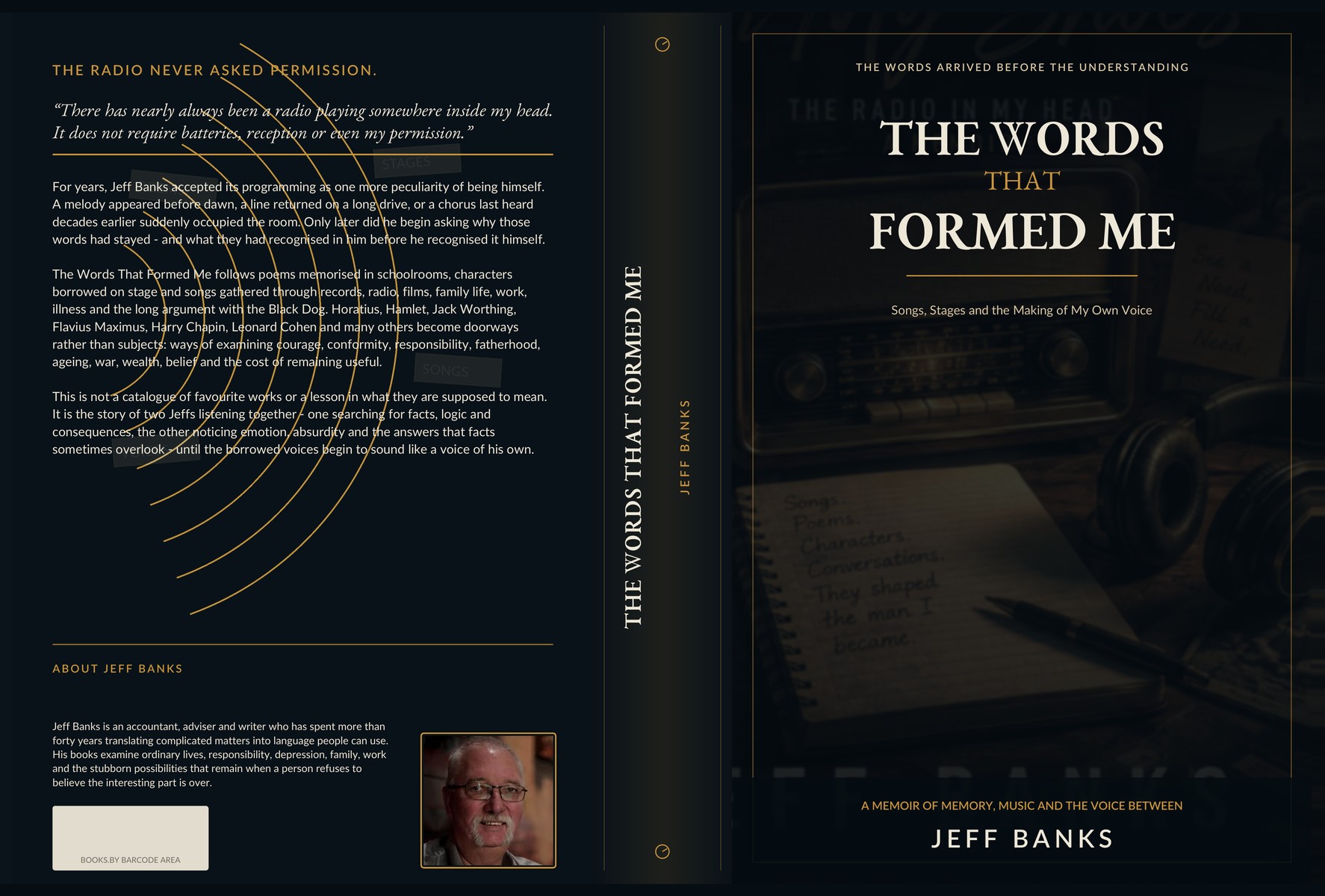
THE WORDS THAT FORMED ME Chapter 22 - The Person Behind the Candle

THE WORDS THAT FORMED ME Chapter 22 - The Person Behind the Candle | Travelling Around Australia with Jeff Banks

That may be more difficult than it sounds because solving things has long been part of my identity. Listening can feel inadequate when no decision has been made, no strategy adopted and no action item allocated to a responsible officer. Yet some people do not need to be fixed by the person in front of them. They need evidence that somebody has noticed there is more than the image being presented. I also have to allow that same possibility for myself. The accountant, mentor, writer, husband, father and volunteer need not be dismantled merely to prove that another Jeff exists. They can remain genuine expressions of the person while surrendering their claim to be the complete explanation. The task is not to extinguish the public image, but to stop using its brightness to hide whatever is standing behind it.

THE WORDS THAT FORMED ME

CHAPTER 22

The Person Behind the Candle

When the opening notes of Candle in the Wind¹ arrive, I do not first see Westminster Abbey, a silent congregation or Elton John seated at the piano for Princess Diana. I see Marilyn Monroe, although even that is not quite true. What I really see is the image the world decided was Marilyn Monroe: the hair, the smile, the dress, the carefully created innocence and the sexuality everybody was permitted to notice without being required to wonder what it cost the woman carrying it.

The later version written for Diana² was moving, particularly in the circumstances in which it was first performed, but it has never possessed the same power for me. That is not a judgement upon Diana, her death or the genuine grief felt by millions of people who believed they had lost somebody they knew. It is simply that the original song asks a more disturbing question, because its subject had already become an image before many of those mourning her had even been born. Marilyn had been turned into a possession of the public, a woman endlessly reproduced in photographs, films, posters and fantasies, while the person inside the image became increasingly difficult to find.

Perhaps that is why the description of a candle troubled me long before I understood why. A candle is light, warmth and something worth protecting, but it is also temporary by design. It is expected to diminish as it performs its purpose, and nobody accuses the room of cruelty when the wax runs down and the flame finally disappears. The candle has done what it was there to do.

That idea is abhorrent to the way I have tried to understand my own life. I have never thought of myself as something delicate, waiting for the first decent gust to finish the job. I have considered myself durable, responsible and capable of continuing long after continuing ceased to be an entirely sensible proposition. When life blew from one direction, I leaned into it, and when it changed direction without providing the courtesy of notice, I leaned the other way and pretended that this had always been the plan.

There is some pride in that, but pride is often the more respectable suit worn by stubbornness. The capacity to remain standing can be admirable, although it can also stop anybody asking whether standing has become painful. A person who keeps getting up teaches the surrounding world that he does not require assistance, and the world, already busy with its own concerns, is generally willing to accept the lesson. Competence can be the finest camouflage ever designed because it does not look like hiding.

The words that reach furthest into me are the ones that insist Marilyn was more than the public construction bearing her name. The brief phrase “more than just our Marilyn Monroe” does something the photographs could not do, because it quietly returns ownership of the woman to herself. She may have belonged to the screen, the studio, the newspapers and the fantasies projected upon her, but there was still a person behind all of that. The tragedy is not merely that she died young, but that so many people were looking directly at her without necessarily seeing who was there.

I cannot know Marilyn Monroe, and I should be careful not to invent a private woman who conveniently supports my own argument. I know the surviving image, pieces of the story and the way the song has interpreted those pieces inside me. That may be another form of projection, although at least it begins by admitting that something remained hidden. I am not claiming to have discovered the real Marilyn from the comfort of a chair decades later, because that would merely replace one public construction with another assembled by an accountant from Australia.

What I recognise is the danger of allowing a role to become so convincing that even the person performing it can no longer easily step outside. Marilyn Monroe was not necessarily false, any more than the professional Jeff is false. A public identity may contain genuine ability, personality, humour and ambition, while still leaving much of the person undisclosed. The problem begins when the part that can be photographed, introduced or explained in a sentence is mistaken for the whole.

I have accumulated enough roles to fill a small theatre company, although the wages have varied considerably. I have been the accountant, adviser, mentor, writer, husband, father, volunteer, committee member and the man expected to understand what everybody else should do next. None of those roles was invented, and I would not dismiss the work or relationships contained within them. They were all me, but they were not all of me.

The toughest role has often been the one occupying the other front seat while the capable man drove. It did not demand applause, costume or a programme acknowledging the cast. It required me to appear in control while another part of me questioned the destination, the vehicle and whether I should have been issued a licence in the first place. The public role handled the road, while the private passenger studied every approaching bend for evidence that the whole arrangement was about to fail.

An accountant is particularly well equipped to disappear behind competence. People do not generally bring an accountant into the room because they want to discuss his emotional weather. They arrive with tax, cash flow, debt, business decisions, structures, deadlines and the occasional financial fire already spreading through the roof. The accountant is expected to bring water rather than mention that he may be burning somewhere as well.

I became good at that role because there was safety in being useful. Numbers had rules, even when the people producing them had displayed a relaxed attitude towards any rules applying to themselves. A balance sheet might reveal bad news, but it did not wake up one morning and decide that today it preferred an entirely different set of facts. Numbers could be questioned, reconciled and explained, and if somebody had made a mess, there was usually a trail showing approximately where the mess began.

People were not nearly as considerate. They could say one thing, mean another and later remember a third, particularly if the second version exposed them to responsibility. They could ask for advice, ignore it and return after the consequences arrived, somehow surprised that consequences had retained the address. My professional role required me to understand this without displaying every thought that passed through my head, which may have been one of the more demanding technical skills never included in an accounting qualification.

The useful man gradually became the dependable man, and the dependable man became the person others expected to continue. That expectation was not always imposed from outside, because I helped build it and sometimes defended it more fiercely than anyone. Being needed supplied purpose, identity and evidence that I occupied a legitimate place in the room. It also provided a convenient reason not to ask what remained when the need was satisfied.

Mentoring enlarged the role rather than removing it. The mentor is supposed to see around corners, recognise patterns and say the thing another person needs to hear without making them feel smaller for not already knowing it. I valued that responsibility because communication mattered to me, and because advice delivered in the wrong language is often little more than expertise admiring itself. Yet the mentor who becomes skilled at reading other people can still remain surprisingly difficult to read.

There is a temptation to believe that insight must work both ways. If I could recognise uncertainty in a client, fear beneath bravado or confusion behind an aggressive question, surely somebody should have been able to perform the same analysis upon me. That assumption ignores the amount of effort I had invested in producing misleading financial statements. The external presentation was strong, the liabilities were carefully classified and several important disclosures had apparently been misplaced by management.

The writer is supposed to be different because writing appears to remove the disguise. I place thoughts on a page that I might not speak in a room, and I allow the reader closer than most people have been permitted to stand. Yet even writing can become another performance if I select only the wounds that have acquired good grammar. A painful memory does not become complete merely because I have arranged it into paragraphs and given it a title.

Writing can reveal me, but it can also let me control the lighting. I decide where the chapter begins, which door is opened and how long the reader is allowed to remain inside. I can show vulnerability while retaining editorial authority over it, which is not quite the same as being unexpectedly seen. The page is honest, but it is an honesty I have rehearsed.

The husband and father are no less real, although those roles carry their own expectations. Providing can become a language of love, especially for a man who finds direct emotional conversation more difficult than solving a practical problem. Work, responsibility and protection can all say, “You matter to me,” but they can also leave the people being protected wishing the message had occasionally arrived without an invoice, a plan or a solution attached. Love expressed through usefulness is still love, although the recipient should not require professional training to translate it.

Robyn has seen more of the person behind the role than most, including parts that would never have survived the professional quality-control process. She has seen the frustrations that remain contained in public, the anger that eventually pushes through and the exhaustion that competence can postpone but not abolish. Even then, I doubt she has seen everything, because hiding becomes habitual rather than strategic after enough years. A person can cease consciously deciding what to conceal and simply present the version that has always been admitted through the door.

My children have known me as their father, but that title can be another image built partly from what I did and partly from what they needed me to be. They saw the working man, the provider, the opinion holder and the person likely to possess a response before the question had been fully completed. I hope they also saw humour, curiosity and the capacity to be surprised by who they became. They continue to surprise me, which remains one of the strongest reasons for staying interested in tomorrow even when the Black Dog offers a less ambitious programme.

The volunteer role also carries flattering assumptions. The person who steps forward, fills the vacancy, keeps the records or solves the administrative problem is described as generous, community-minded and reliable. Those descriptions may be deserved, but usefulness is not always entirely selfless. Sometimes helping another organisation, family or person is easier than sitting quietly with the parts of yourself that cannot be entered into a spreadsheet and cleared before the end of the month.

I do not say that to devalue service. I believe in contributing, doing the work and leaving something stronger than I found it. However, the analytical Jeff becomes suspicious when the human Jeff attempts to claim complete purity of motive. Helping people gave me meaning, but it also gave me somewhere to stand and a reason not to consider whether I belonged there without a job to perform.

That is where Marilyn’s public image begins to move uncomfortably close. The comparison is not in fame, beauty or the scale upon which strangers felt entitled to make judgements. I have never entered a room and caused conversation to stop, unless there had been an audit announcement shortly beforehand. The connection lies in the possibility that a recognisable version of a person can become easier to engage with than the person himself.

Marilyn’s image invited the world to believe it knew her. My roles invite a much smaller world to believe it knows me, although the underlying process may not be entirely different. People see the accountant and assume certainty, see the mentor and assume wisdom, see the writer and assume self-knowledge, or see the joker and assume the joke has removed the pain. The assumptions are understandable because I have supplied the supporting documentation.

The Diana version of the song affects me differently because the woman and the public image were still colliding in living memory when she died. Millions had watched her marriage, motherhood, unhappiness, separation and attempts to create another life under conditions few of us could imagine enduring. The rewritten song became part of an immediate national and international grief, while the original had decades in which Marilyn could become more symbol than person. That distance is what allows the first version to enter me more deeply, because it asks what remains after the image has outlived the human being it once represented.

It also asks who benefits from the image. A public construction is convenient because it reduces complexity into something easily recognised and repeatedly sold. The beautiful woman, the troubled princess, the gifted singer, the brilliant adviser and the strong father all become labels that save everybody the inconvenience of discovering contradiction. Labels are efficient, which is possibly why the accountant in me understands their commercial attraction while the human part despises what they leave out.

Karen Carpenter⁴ enters my thoughts here, not because her life was the same as Marilyn’s, but because the voice and the suffering appear almost impossible to reconcile. The sound was so controlled, warm and apparently effortless that the private battle could remain outside the listener’s experience. Her life ended at thirty-two after anorexia had placed an intolerable burden upon her body, and the knowledge now sits behind every recording whether we invite it there or not. The voice remains full, while the person producing it was disappearing.

It is too simple to say that Marilyn and Karen died because they did not receive the love they craved. Love may have been present and still unable to reach the place where it was required, while illness, exploitation, pressure, family history and the demands of public identity cannot be reduced to a shortage entered in a single column. I recognise the emotional truth of longing, but I cannot turn their lives into evidence supporting a conclusion I prefer. Their stories trouble me precisely because being admired by many does not guarantee being known by anyone, and being loved does not always enable a person to feel lovable.

That produces the question I cannot comfortably dismiss: could I have helped? It is an arrogant question dressed in compassion, although that does not make the compassion false. The adviser in me instinctively looks for the intervention, the conversation or the piece of information that might have altered the result. I have spent much of my working life believing that disaster can sometimes be avoided if somebody is willing to recognise the signs early enough and speak plainly before the damage becomes irreversible.

That belief was not entirely misplaced. Businesses have been saved, decisions changed and people redirected because somebody asked a question before everybody else agreed it was too late. Advice can matter, listening can matter and simply refusing to accept another person’s public performance at face value can matter. There are moments when being noticed is not a sentimental gesture but an interruption of a dangerous process.

Yet “could I have helped?” can quietly become “surely I would have saved them,” and that is where compassion begins admiring itself. I did not know Marilyn Monroe or Karen Carpenter, and I cannot place myself into their lives as the uniquely perceptive man who would have recognised what everyone closer failed to repair. People are not businesses awaiting the correct restructure. Pain does not always respond to logic, love, expertise or the arrival of one determined Australian carrying a whiteboard.

I know this from the other side of the equation. People have loved me, listened to me and tried to help, yet the Black Dog has not accepted that as sufficient authority to leave the premises. Depression can coexist with family, achievement, humour, responsibility and evidence that a life matters. It does not always announce itself through collapse, because sometimes it borrows the capable man’s clothes and goes to work.

That is one reason the candle image remains both resonant and objectionable. It suggests a vulnerable flame at the mercy of forces around it, while my experience tells me the wind can also come from within. The room may appear still, the doors closed and the windows secure, yet something continues drawing oxygen away from the flame. Those nearby may see light and assume there is no danger because they cannot feel the internal weather.

The Black Dog has rarely required me to surrender all visible function. It has been prepared to let me answer questions, advise clients, write words and even make other people laugh while it occupied the darker corner of the room. That arrangement made it difficult for others to see, but it also made it difficult for me to acknowledge the extent of its presence. Functioning became evidence for the defence, even when the case being argued was that nothing serious could be wrong.

There is danger in treating competence as proof of wellness. A person may complete the task because failure feels even more threatening than the effort required to continue. He may make the appointment, chair the meeting or solve the problem while privately measuring the distance back to the chair where he can stop pretending movement is easy. The candle can still produce light while burning through what remains.

This is where Killing Me Softly with His Song³ enters, although the accounting department must record that Bernie Taupin did not write it. Charles Fox and Norman Gimbel hold the formal songwriting credit, but factual correction does not remove the comparison that placed the song in my mind. Taupin’s words in Candle in the Wind seem to know me with the same unnerving accuracy that another song describes when somebody discovers a stranger singing the contents of a life he should not have been able to read.

It is an extraordinary sensation to hear words written for somebody else and feel personally exposed by them. The songwriter cannot know the listener who arrives years later, yet the line finds the concealed room and switches on the light. The experience is not mystical enough to make me religious, but it is mysterious enough to make the analytical Jeff uncomfortable. Words sometimes recognise us before we have supplied the formal introduction.

Perhaps this is why songs have formed so much of my emotional language. They allow another person’s words to approach the part of me that resists direct questioning. A song does not sit opposite with a concerned expression, ask how I am feeling and wait through the silence until I provide an acceptable response. It enters through melody, bypasses security and begins rearranging the furniture before I notice it has arrived.

The public Jeff has often been easier to explain than the private one because the public version comes with headings. Accountant is a heading, as are writer, husband, father, mentor and volunteer. Depression is not a heading I have always wanted placed on the page, particularly when the rest of the document appears to demonstrate capability. Vulnerability is more difficult again because it threatens the impression that the person others rely upon will remain reliably available.

I suspect that my resistance to the candle is partly a resistance to being seen as fragile. Fragility sounds like failure to withstand conditions other people apparently manage without requiring a chapter. It suggests breakage, dependence and the possibility that somebody will begin speaking more slowly in my presence. I have spent too much of my life fighting to be heard to welcome a version of concern that quietly removes authority from the person being protected.

Vulnerability, however, is not the same as fragility. A bridge is vulnerable to load without being badly built, and a person can be affected by pressure without becoming incapable of carrying responsibility. The important distinction is not whether the candle can withstand every wind, but whether anyone notices the conditions in which it is expected to remain alight. Strength should not be measured solely by how long somebody can survive without shelter.

There is another uncomfortable possibility within the song. The person behind the image may not merely be hidden by the public, the studio, the profession or the family role. He may also hide because being accurately seen carries risks of its own. Once somebody knows the capable man is not always capable, he loses control over how that knowledge will be used, remembered or introduced into future conversations.

The role offers protection because it limits the evidence available. Clients need not know what the morning required before I answered the telephone, and acquaintances do not require a guided tour of every room inside me. Privacy is not dishonesty, and memoir does not require the author to surrender all boundaries for the reader’s inspection. The challenge is deciding whether a boundary protects the person or imprisons him.

Retirement sharpens that question because the professional image begins to loosen whether I am ready or not. The accountant who had clients, deadlines and a reason to be required at a particular time can become a retired man with more space than certainty. The role has not vanished completely, but it no longer supplies the same unquestioned answer to who I am and why today matters. When the image recedes, the person behind it must learn to occupy the space without immediately applying for another costume.

Writing may be the role that allows that transition, although I remain alert to its ability to become another hiding place. The difference is that writing gives the two Jeffs somewhere to coexist without one being required to remove the other from the meeting. The analytical Jeff can test the facts, examine the logic and complain about improper song attribution, while the human Jeff can admit that a few words written for Marilyn Monroe have found the man behind an accountant’s desk. Neither has to win for the chapter to be true.

The question of whether I could have helped Marilyn, Karen or anybody else eventually returns as a question about how I look at the people still around me. I cannot retrospectively rescue those whose lives have already become stories, symbols and songs. I can refuse to assume that competence means safety, humour means happiness or a familiar role contains the whole person. I can listen without immediately converting the conversation into a problem requiring my management.

That may be more difficult than it sounds because solving things has long been part of my identity. Listening can feel inadequate when no decision has been made, no strategy adopted and no action item allocated to a responsible officer. Yet some people do not need to be fixed by the person in front of them. They need evidence that somebody has noticed there is more than the image being presented.

I also have to allow that same possibility for myself. The accountant, mentor, writer, husband, father and volunteer need not be dismantled merely to prove that another Jeff exists. They can remain genuine expressions of the person while surrendering their claim to be the complete explanation. The task is not to extinguish the public image, but to stop using its brightness to hide whatever is standing behind it.

Candle in the Wind remains powerful because it mourns more than a death. It mourns the failure to hold a complete human being in view while she was alive, and it recognises how quickly affection can become ownership after the person is no longer able to object. The world continues to display Marilyn, interpret Marilyn and speak for Marilyn. The song, at its best, pauses long enough to suggest that somewhere beneath all that certainty was a woman nobody had the right to reduce to an image.

I do not want my life understood as a candle waiting for an inevitable gust. There is too much stubbornness in me for that, too much curiosity about tomorrow and too many words still insisting upon being written. Nevertheless, I can accept what the image has been trying to tell me: light does not prove invulnerability, usefulness does not eliminate need and being visible is not the same as being seen. The person behind the candle remains more than the roles that made him recognisable, and perhaps writing him onto the page is one way of finally allowing him to stand in his own light.

Notes

  1. Candle in the Wind was written by Elton John and Bernie Taupin and recorded by Elton John for the 1973 double album Goodbye Yellow Brick Road. Taupin has explained that Marilyn Monroe represented a form of beauty and fame frozen in time rather than a lifelong personal fixation upon Monroe herself.
  2. Candle in the Wind 1997 adapted Taupin’s original words in memory of Diana, Princess of Wales. Elton John performed the revised version at her funeral in September 1997, and the subsequent recording became one of the most successful singles of his career.
  3. Killing Me Softly with His Song is formally credited to composer Charles Fox and lyricist Norman Gimbel. Lori Lieberman first recorded the song in 1972, while Roberta Flack’s 1973 recording became the version most widely associated with it and won the Grammy Award for Song of the Year for Fox and Gimbel.
  4. Karen Carpenter was the singer and drummer in the Carpenters with her brother Richard. She died in 1983 at the age of thirty-two from heart failure associated with anorexia nervosa, and her death contributed significantly to wider public awareness of eating disorders.

Author

Menu