

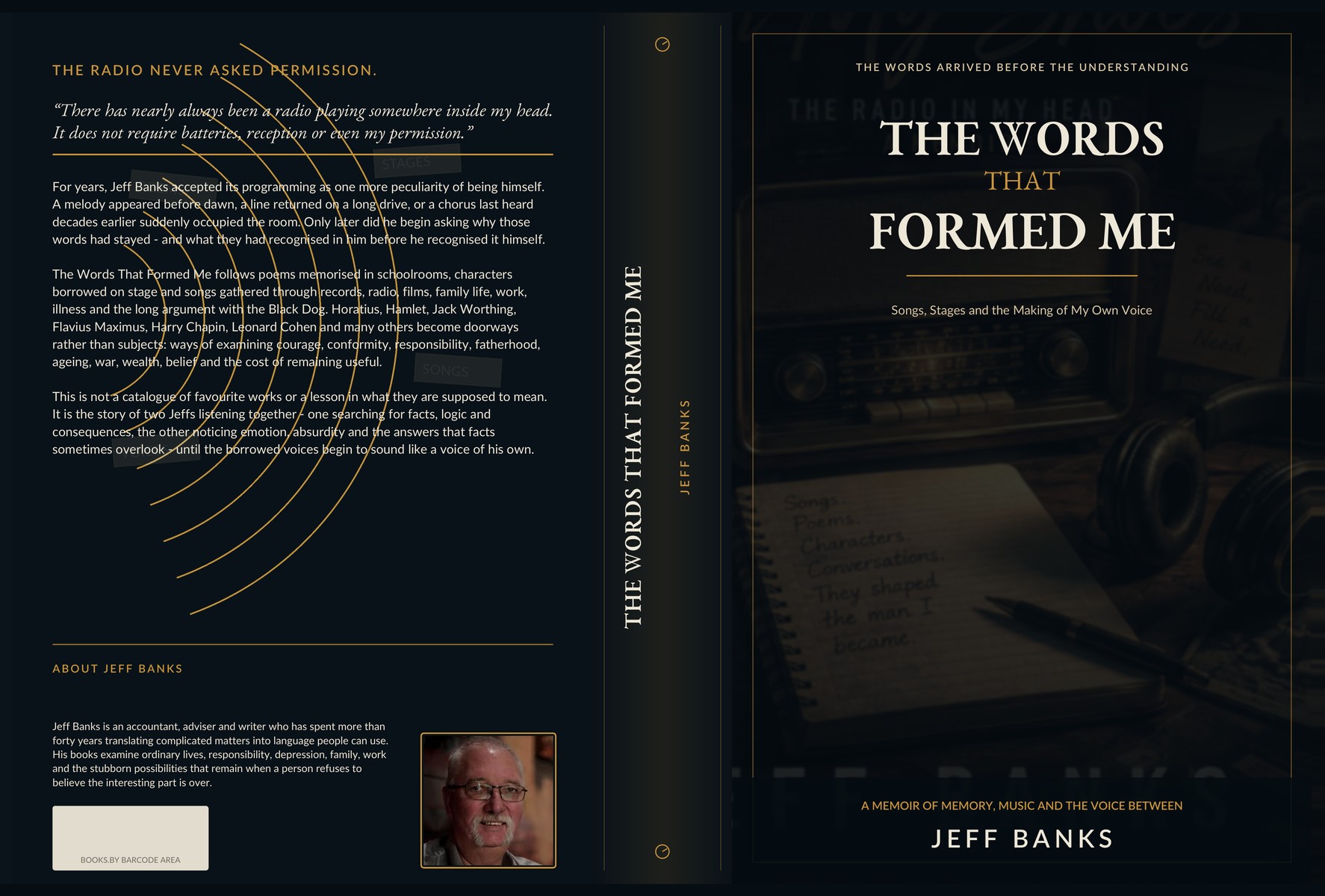
THE WORDS THAT FORMED ME Chapter 17 - Looking for an Echo

THE WORDS THAT FORMED ME Chapter 17 - Looking for an Echo | Travelling Around Australia with Jeff Banks

Writing has become the new broadcast, although it operates on a slower frequency. I send out stories about childhood, work, depression, family, foolishness, intelligence, ordinary courage and the ways people reduce themselves to survive the rooms they enter. Some are read immediately, some may wait years and some may remain silent objects in a world already overflowing with words. I cannot control the return.

THE WORDS THAT FORMED ME

CHAPTER 17

Looking For an Echo

I cannot now remember when I first stood up and performed “Looking for an Echo.” There have been enough microphones, makeshift stages, club gatherings and occasions when somebody believed it was wise to let me near the entertainment for the memories to have run into one another. What remains is the familiar moment before I begin, when the backing starts and I wait for the words to arrive from a part of my memory that has stored them more faithfully than many things I was once examined upon. The song has bounce, nostalgia and enough opportunity for performance to make me believe, temporarily at least, that I know what I am doing. Beneath that, however, is a question I have been asking for most of my life without always recognising that I was asking it.

“Looking for an Echo”¹ arrived for me through Ol’ 55, an Australian band cheerfully reviving the doo-wop sound of an earlier time while looking as though they had raided a wardrobe abandoned by the first wave of rock and roll. I was not drawn to it because I had spent my youth harmonising in American school corridors or singing into tiled subway walls. That was somebody else’s memory, imported into an Australian recording and then imported again into mine. What reached me was the idea of sending a sound out and waiting for something to come back. The song was lively enough to disguise the ache in that idea, which may be why it remained so easy for me to sing.

An echo is a modest request when compared with applause. It does not ask the mountain to admire the voice, only to confirm that the voice reached the mountain and encountered something solid enough to answer. The returning sound is not a new composition, a standing ovation or a written assessment of technical merit. It is evidence of contact. Something left me, crossed the space between, touched the world and did not disappear completely.

That distinction matters because I have wanted recognition, and there is little point pretending otherwise. I have wanted people to notice the work, understand the thought behind it and occasionally concede that what I said before the problem arrived may have been worth hearing. I have wanted a stage, a room, a profession and eventually a body of writing in which I did not have to reduce myself to whatever size made everybody else comfortable. There were times when applause would have done nicely, particularly after long stretches in which even acknowledgment seemed to have been rationed. Yet applause and an echo are not the same thing, and I suspect I have often chased one while telling myself I only needed the other.

When I perform the song, the answer is immediate. A room either comes with me or it does not, and a singer of my particular distinction learns to read those signs fairly quickly. There may be smiles, recognition, a few voices joining in or the unmistakable expression of somebody calculating how long remains before the raffles are drawn. Performance is honest in that way. The sound goes out, the room changes or remains stubbornly unchanged, and I receive my answer before I have time to invent a more flattering interpretation.

The stage had always offered me that kind of clarity. At school I could step inside Jack Worthing or Giuseppe Palmieri, and later I could allow Flavius Maximus to investigate ancient Rome with an Australian accountant’s regard for evidence and a comedian’s disregard for dignity. The words were borrowed, but the response belonged to the moment. A laugh arrived where the timing worked, silence exposed where it did not, and applause closed the transaction with a certainty rarely available elsewhere in life. For somebody who spent much of childhood learning that his own words were not necessarily welcome, being permitted to speak because a playwright had supplied the lines was a useful loophole.

There was safety in the borrowed voice. If the audience rejected Jack, Giuseppe or Flavius, the damage could be shared with Oscar Wilde, Gilbert and Sullivan or the writers responsible for setting a private Roman eye loose upon Caesar’s world. If the audience approved, I could take a little of the credit while maintaining the modest fiction that I was merely delivering what somebody else had created. That arrangement suited both Jeffs. The analytical one could study timing, structure and the mechanics of response, while the human one could enjoy being heard without having to admit how much it mattered.

Songs provided the same shelter. They allowed me to release an emotion under another person’s name, which may explain why I have been more willing to sing some truths than to say them directly. The melody carried the risk, the songwriter supplied the words and I could stand inside the combined structure long enough to feel exposed without appearing completely defenceless. Even a song about looking for an echo could be performed as entertainment rather than confession. The room heard a familiar number; I heard the possibility that somewhere there might be a wall shaped correctly to send me back to myself.

The business seminar was a different stage, although not as different as the serious people attending it may have preferred to believe. There was still an audience, still a performance and still the need to judge whether the room had travelled with me or quietly left while remaining seated. The subject might be tax, business structure, cash flow, compliance or the consequences of pretending that a problem will become less expensive if ignored for another quarter. I had facts, examples and the kind of practical stories that allowed technical material to enter without first demanding that everybody learn the dialect of the profession. The echo came through laughter, questions, a shift in posture or the moment when somebody’s face said that an idea had finally crossed the space between us.

That was the part of accounting I understood best. Knowledge locked inside the adviser was not advice, just private storage, and the cleverest explanation in the room achieved nothing if the person who needed it felt too diminished to listen. I learned to speak in the client’s language, not because the underlying complexity had vanished but because complexity was my burden rather than theirs. A successful seminar was not one in which I demonstrated how much I knew. It was one in which somebody went home able to make a better decision without needing to pretend they had become an accountant during the afternoon tea break.

There were echoes after seminars, but they were not always reliable. Somebody might shake my hand, praise the presentation and then continue doing precisely what I had warned against, proving that agreement and action occupy neighbouring but separate suburbs. Others would say very little and return months later having quietly changed something important. The loudest response was not always the deepest, just as the person nodding most enthusiastically could be mentally composing a list of reasons the advice did not apply to them. I had to learn that a room could applaud the sound without allowing it to alter anything.

Client advice offered an even harsher test. I could explain a risk, calculate the cost, set out the alternatives and send the thought outward with all the care I could manage. Then there would be silence. Sometimes the silence meant the client understood and acted, sometimes it meant they had placed the advice in the special filing system reserved for unwelcome information, and sometimes it meant they were waiting for reality to repeat my explanation using larger numbers and less tact.

When the problem eventually returned, it often came carrying my original words in a distorted form. A client might say that nobody had told them, or that they had not understood the urgency, or that circumstances had changed in a way that looked remarkably like the circumstances we had discussed. The analytical Jeff could retrieve the email, locate the file note and establish that the sound had indeed been sent. The human Jeff was less interested in winning the archaeological excavation than in understanding why the message had failed to become usable before the damage occurred. Being technically heard was not the same as being meaningfully received.

That difference has followed me beyond accounting. I have often been listened to because I was useful, which is not quite the same as being heard because I was valued. People notice the person who can fix the structure, negotiate the problem, explain the form, find the number or stand between them and the approaching consequence. Usefulness produces a dependable kind of recognition, but it may recognise the function more clearly than the person performing it. The echo comes back as another request.

There is satisfaction in being needed, and I cannot pretend I was an unwilling participant in building that identity. Competence became one of the ways I made myself visible, while also allowing the more complicated parts of me to remain hidden behind the service being provided. If I solved the problem, the room had to acknowledge my presence, even if only for as long as the problem remained. It was an effective arrangement until I began to wonder whether anybody would still hear me if I arrived without an answer.

Not Your Ordinary Accountant was, among other things, an attempt to create a sound that belonged to me. It was a business description, a challenge to the profession and a mild warning that the conversation might not proceed according to the usual script. It said that technical knowledge mattered but translation mattered as well, that seriousness did not require solemnity, and that a client could be told an uncomfortable truth without first being buried beneath jargon. It also created a niche, which is what marketers recommend when they wish to turn a human being into a sentence short enough to fit beneath a logo.

I understood the commercial logic of the niche. A distinct voice is easier to recognise, easier to remember and easier to recommend to somebody who asks what makes this accountant different from the row of accountants apparently produced from the same grey mould. Yet I wanted more from it than market recognition. I wanted the relief of finding a place in which the parts of me that had usually been treated as contradictions could remain together. The accountant, performer, adviser, storyteller, irritant, rescuer, sceptic and occasional clown might all be allowed into the same room without one of them being asked to wait in the car.

The search reminded me of The Glenn Miller Story² and the way James Stewart’s Miller remains in my memory as a man hunting for a sound he can recognise as his own. The film builds towards the moment when the reeds combine in the arrangement associated with “Moonlight Serenade”³ and something previously elusive becomes unmistakable. Whether history unfolded with the tidiness Hollywood provided is less important to the place the scene occupied in my imagination. Miller was not merely looking for a successful tune. He was searching for the sound that would tell him he had arrived at himself.

The famous blend placed a clarinet above closely arranged saxophones and created something audiences could identify almost immediately. The ingredients were not unknown, and none of the instruments had been invented for the occasion. The distinctiveness came from arrangement, balance and the decision to hear familiar elements differently. That appealed to me because my own voice was never going to be created from materials unavailable to anybody else. It would come from the way logic, humour, memory, anger, explanation and doubt were arranged when I stopped trying to make them sound like separate bands.

There is danger in romanticising the search for a signature. Once a sound becomes recognisable, the world may demand that it be repeated long after the person making it wishes to explore another arrangement. A niche can provide the wall that returns the echo, but enough walls placed close enough together create a cell. The very thing that confirms where I belong can become the boundary that tells me I am not permitted to move.

That is the contradiction I have not resolved. I want a place narrow enough to say, this is me, this is where I belong, and broad enough that I do not have to amputate anything important to remain there. I want the comfort of recognition without the imprisonment of expectation. I want readers, clients, family and perhaps even myself to hear a sentence and recognise the mind behind it, while still allowing that mind to change its opinion, follow a rabbit hole or spend an unreasonable amount of time explaining why the obvious answer is not always the correct one.

Belonging has rarely felt that simple. I have been inside rooms where I was welcomed for what I could contribute and still felt that some central part of me remained outside, nose pressed to the glass and probably offering unsolicited advice about the ventilation. I learned early that fitting in could require reduction, and that being accepted was sometimes conditional upon keeping the volume of the real self down to the dull roar others could tolerate. The stage allowed volume because volume was expected. Ordinary life was less generous.

The instruction that children should be seen and not heard did more than regulate noise. It established a hierarchy in which authority possessed the microphone and childhood supplied the audience, regardless of whether authority had anything sensible to say. I found other places for the words: schoolwork, performance, fantasy, private thought and eventually the internal broadcasting service that has never shown much regard for authorised programming. The words did not disappear simply because the room refused them. They waited for another room.

Respect became tangled with this history. It was not enough for somebody to hear the sound waves, because I had known plenty of occasions when words were physically present and personally dismissed. I wanted the thought to be considered rather than tolerated, and the person offering it to be acknowledged rather than managed. That desire could make disagreement feel like erasure, even when the other person was merely exercising the right I claimed so vigorously for myself.

The analytical Jeff objects at this point, because he knows that being respected does not require being accepted as correct. Advice is not invalidated merely because somebody chooses another course, and writing is not a failure because a reader reaches a different conclusion. An echo repeats the sound, but genuine communication changes it. If all I want returned is my own voice, perfectly preserved and stripped of challenge, I am not searching for another human being at all; I am looking for a more flattering wall.

That is uncomfortable because certainty has often been one of my working tools. Clients did not pay me to gaze thoughtfully into the middle distance and announce that all viewpoints were equally delightful. They wanted judgment, consequences and a recommendation capable of surviving contact with the Tax Office, the bank or the cash flow. I learned to speak with authority because hesitant advice is rarely useful in a crisis, but authority can become addictive. The line between wanting to be heard and wanting to be obeyed is finer than I have sometimes admitted.

Writing exposed that line because the reader was not sitting in front of me. I could not adjust the explanation when a forehead tightened, speed up when attention wandered or use a question to discover which part had failed to cross. I placed an article on the website, sent a chapter into the world or released a book, and the immediate room disappeared. The sound travelled somewhere beyond my sight, leaving me with statistics, occasional comments and the peculiar modern experience of being told that something had been viewed without knowing whether it had been encountered.

Website numbers are attractive to the analytical mind because they resemble evidence. A page was opened, a link was clicked, a post reached a quantity of people and the little graph moved in a direction that could be described as encouraging if one selected the appropriate period. None of that confirmed that the words entered another life. A person could remain on the page because the telephone rang, share it without reading it or leave after discovering I was not the British fashion designer they had been seeking.

The Oz Jeff Banks identity began partly as a practical answer to that confusion. There was already a better-known Jeff Banks occupying search engines, television memories and the world of fashion, while I was occupying tax files, cricket scorebooks and an office that did not require anybody to understand seasonal colours. Adding Oz gave the internet a fighting chance of telling us apart. Over time, however, the label became more than a digital name tag, because it offered another room in which the accountant, writer and performer might be introduced together.

That created a new difficulty. A persona can help an audience recognise the sound, but it can also become another character I perform in order to earn the right to speak. The Oz Jeff Banks website may present books, articles, ideas and the life behind them, yet the person cannot be reduced to a homepage promise without losing the very complexity the writing is trying to preserve. I do want a reader to arrive and understand what sort of voice lives there. I do not want the web designer, the marketer or my own desire for certainty to build the walls so tightly that only the approved version of Jeff can get through the door.

The human Jeff wanted something less measurable and more demanding. He wanted one reader to say that a sentence named an experience they had been unable to explain, or that a story caused them to look again at somebody they had judged too quickly. He wanted evidence that the writing had not merely occupied screen space but had made contact. One honest echo could matter more than a thousand impressions, although the analytical Jeff would still prefer both and sees no intellectual reason to surrender useful data unnecessarily.

Books intensify the uncertainty because they ask for a larger act of faith. They take years of memory, thought, rearrangement and doubt, then compress the result into an object that may sit unopened on a shelf looking far more confident than the person who wrote it. The author cannot accompany every copy home to explain the difficult parts, point out the carefully placed joke or ask whether the reader noticed what was really happening beneath the anecdote. The book leaves, and the writer listens.

I have sometimes imagined that publication would settle the question of voice. A completed book would stand as proof that the words belonged somewhere and that the years spent gathering them had produced more than an elaborate method of talking to myself. Yet completion does not create the echo. It only sends the sound farther from the place in which it was made.

Recognition matters in that silence. I would like the books to be read, the ideas to be discussed and the name attached to them to become known for something more enduring than completing forms and preventing financial accidents. I would like the work to find its niche, not as a marketing category invented to keep a website tidy but as a genuine meeting place between the ordinary lives I write about and the people who recognise their own lives within them. Denying that ambition would not be humility. It would merely be ambition wearing a cardigan and hoping nobody noticed.

The ordinary lives matter because they are where I have spent most of my time. I have not written from mountaintops reached through immaculate discipline, nor from a position in which confusion, contradiction and depression were defeated before the first chapter began. I have written from offices, family rooms, country roads, sporting fields, committee tables and mornings when crossing a few steps into the Cave required negotiations with parts of myself that were not interested in the published schedule. Perhaps the echo I most want is not admiration for having escaped ordinary life, but recognition that ordinary life contained more courage, absurdity and meaning than we were trained to notice.

The difficulty is deciding how much recognition is enough. Applause offers a temporary answer, sales offer another and praise can quieten the doubt for an afternoon if administered in a sufficiently convincing dose. None remains reliable for long. The next room may be silent, the next article ignored and the next book may discover that the world had urgent appointments elsewhere.

I have known the other side as well. Awards, titles and public acknowledgment can arrive after the work and still fail to reach the part of the person that needed them. Sometimes the echo returns too late, distorted by distance or delivered by somebody who was not present when the original sound was made. Recognition may confirm achievement without repairing exclusion. A trophy can say that the runs were scored, the clients were helped or the contribution was real, while leaving untouched the older question of why the person had to shout for so long before anybody looked up.

There is resentment in that question, and it should not be polished away. I have watched weaker ideas receive louder support because they arrived from an approved voice, and I have seen competence treated as a resource to be used rather than a person to be respected. I have also mistaken my frustration for proof that I was always right and others were always too limited to understand, which is a very efficient way of turning injury into arrogance. The echo I wanted sometimes had to confirm not only that I existed but that I had been unjustly overlooked.

Perhaps that is why the song remains kinder than some of my own interpretations. Its singers are searching for harmony, not supremacy. They want a place where the voices meet and return enriched by being together. The echo is part of the pleasure, but so is the arrangement between the people making the sound.

Harmony requires adjustment. One voice cannot occupy every space simply because it has the widest range or the strongest opinion about the correct key. The individual remains recognisable while listening closely enough to alter volume, timing and emphasis. That is not the same as dumbing down, although I have sometimes confused the two when compromise touched an old bruise.

The lesson, if I am permitted that dangerous word without becoming the substitute English teacher this book has promised to avoid, may be that a niche is not a hiding place. It is not a perfectly shaped cavity into which I can fall and remain safe from misinterpretation, rejection or change. It is closer to an acoustic space in which my voice can be heard clearly enough to join other voices. The walls matter, but so does the opening through which the sound enters and leaves.

Home may be part of that space. I have spent years wondering whether home was the childhood landscape, a later town, the family house, the road between them or some place I had not yet reached. Perhaps home is also the room in which a voice does not have to prove its right to be present before speaking. It is where disagreement does not threaten exile and silence does not automatically mean abandonment.

The complication is that I do not always bring my best voice home. The public version can be patient, explanatory and alert to the exact moment another person has stopped understanding, while the private version may assume that the people closest to me should somehow receive the unedited transmission. They have heard the frustration, the withdrawal and the explosions that rarely escaped into the professional rooms where self-control remained part of the service. Wanting home to provide the safest echo also requires me to ask what sound I have sent into it.

I am not sure I have found that room, and I do not want to invent a comforting conclusion merely because the chapter is approaching its final pages. There are places and people with whom I belong, but the feeling does not always remain available when I need it. The walls can still seem either too distant to return anything or so close that the sound becomes trapped and confused. My search for a niche has therefore continued through professions, communities, websites, books and the identities I have tried to arrange beneath my own name.

Retirement sharpened the search because one of the strongest echoes in my life began to fade. For decades the telephone, inbox and approaching deadline confirmed that I was required somewhere, even when the requirement exhausted me. Clients returned the sound through questions, crises, gratitude, resistance and bills that occasionally achieved the rare distinction of being paid. When the professional noise reduces, the resulting quiet can resemble freedom until the Black Dog leans closer and suggests it may be evidence that the world has managed perfectly well without me.

The analytical Jeff knows that this is poor reasoning. Relevance is not measured by incoming calls, and a reduction in emergencies may even indicate that some advice worked before the emergency developed. Retirement was supposed to create room for writing, family, thought and the parts of life that had waited while urgent work reproduced itself. Yet the human Jeff had spent too long using usefulness as proof of existence to surrender the measurement without withdrawal symptoms.

Writing has become the new broadcast, although it operates on a slower frequency. I send out stories about childhood, work, depression, family, foolishness, intelligence, ordinary courage and the ways people reduce themselves to survive the rooms they enter. Some are read immediately, some may wait years and some may remain silent objects in a world already overflowing with words. I cannot control the return.

What I can control is whether the sound is mine. That does not mean every sentence must be unprecedented or every idea uniquely Jeff Banks, any more than Glenn Miller had to invent the clarinet before he could place it above the saxophones. It means arranging the materials honestly enough that the result is recognisable: practical detail beside emotional uncertainty, humour beside anger, logic beside the things logic cannot settle. The niche may not be a subject at all. It may be the sound produced when I finally stop evicting parts of myself from the arrangement.

That possibility changes what an echo would mean. I no longer need every reader to agree, every client to obey or every audience to applaud in the approved places. I need enough return to know that the words made contact, and enough independence to continue when they do not. A voice that can exist only while being praised is still owned by the room.

There will always be a performance in me. Give me the song, a microphone and a gathering insufficiently protected by formal risk-management procedures, and I am still likely to have a go. I will enjoy the recognition when it comes, notice the laughter, forgive the person waiting for the raffles and probably exaggerate the quality of the response in later retelling. None of that cancels the deeper search concealed inside the entertainment.

I am still looking for an echo, but perhaps I am listening differently now. I am listening for the reader who recognised themselves, the client who acted before rescue became necessary, the family member who understood what I had failed to say directly, and the part of me that hears my own voice without immediately asking whether the room approves. I am also learning that an echo may return changed, delayed or from a direction I was not watching. The sound goes out because remaining silent would be another kind of prison, and because somewhere beyond the walls there may be a place in harmony that I have almost found.

Notes

  1. “Looking for an Echo” was written by Richard Reicheg and first recorded by Kenny Vance in 1975. The version remembered in this chapter was recorded by the Australian band Ol’ 55 and released in 1976 on their debut album, Take It Greasy.
  2. The Glenn Miller Story, directed by Anthony Mann and released in 1954, starred James Stewart as Glenn Miller and June Allyson as his wife, Helen. The film dramatised Miller’s career and search for a distinctive orchestral sound, while taking the liberties customary in a Hollywood musical biography.
  3. “Moonlight Serenade” was composed by Glenn Miller, with lyrics later written by Mitchell Parish. The Glenn Miller Orchestra recorded the instrumental version in 1939, and it became the orchestra’s signature theme.

Author

Menu