

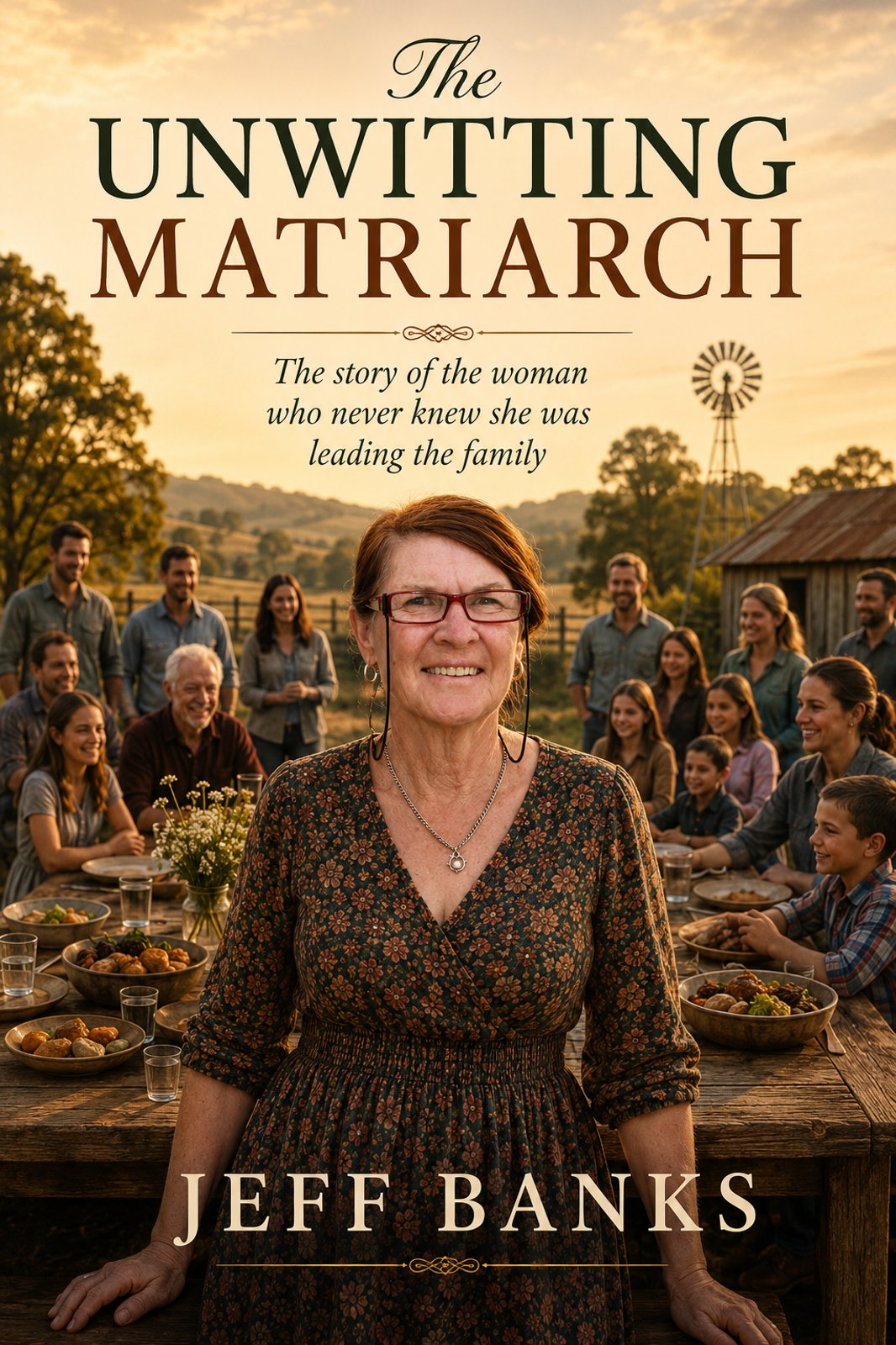
The Unwitting Matriarch - Foreword

The Unwitting Matriarch - Foreword | Travelling Around Australia with Jeff Banks

Perhaps that is why this story matters. Every family has somebody like Kerre. Somebody who quietly becomes indispensable while insisting they are doing nothing special. Somebody who carries more than their share without keeping score. Somebody whose contribution only becomes fully visible when you stop and look back across the years.

THE UNWITTING MATRIARCH

She never asked to lead. She simply never stopped showing up. 

Foreword

There is a danger in writing books about family.

The danger is not that people will disagree with your version of events. That is inevitable. Put three siblings around a table and ask them to describe the same Christmas lunch from forty years ago and you will likely receive five different versions of the story. Memory has a habit of polishing some corners while sanding others away altogether.

The real danger is that you begin looking for heroes. When we set out to record family history, we often expect to find extraordinary people who did extraordinary things. We search for achievements, milestones and defining moments because those are the stories that seem worthy of being remembered. We look for the events that might appear in newspapers, on honour boards or in community histories.

This book taught me something different.

The woman at the centre of these pages never set out to become anybody’s matriarch. In fact, if you asked her directly, she would probably reject the title entirely. She would tell you she was simply doing what needed to be done, looking after family, helping where she could and getting on with life. She would likely be embarrassed by the attention and far more interested in hearing about somebody else than talking about herself.

That answer appeared repeatedly throughout the conversations that created this book. Whether discussing children, siblings, parents, nephews, nieces or grandchildren, the same philosophy emerged again and again. Somebody had to do it. It fell to me. We’re just there for each other. Those responses were never delivered as declarations of sacrifice. They were offered matter-of-factly, as though no other course of action had ever been possible.

What struck me most was that these are not the words of somebody consciously building a legacy. They are the words of somebody carrying responsibility because responsibility happened to arrive at the front door and nobody else was standing there to answer it. There was no grand plan. There was no ambition to become the person everyone depended upon. There was simply a willingness to keep showing up whenever somebody needed help.

As I listened to the stories, a pattern slowly emerged. The little girl who wandered off at country shows became the young woman who worked jobs nobody talks about. The young woman who built a home from almost nothing became the mother who raised children while helping siblings and supporting extended family. The mother gradually became the person who answered the phone whenever a crisis appeared, often before anyone else even knew there was a problem.

Long before she realised it herself, people had begun turning towards her whenever life became difficult. They did not do so because she demanded authority. They did not do so because she possessed special qualifications or sought recognition. They turned to her because she was reliable, and reliability has a way of becoming leadership even when leadership was never the intention.

That quality sounds almost unimpressive in a world obsessed with celebrity, achievement and personal branding. Yet reliability may be one of the rarest virtues of all. Families are not held together by speeches, titles or public recognition. They survive because certain people continue showing up year after year, decade after decade, often without thanks and usually without complaint.

This is not simply the story of one woman. It is also the story of rural Australia, of large families, of hard times and good times, of droughts and celebrations, of work and laughter and grief. It is the story of people who often had very little yet somehow found ways to share what they had. It is the story of a generation who learned to solve problems before they learned to discuss them.

Many of the stories contained in these pages are funny. Some are heartbreaking. Others are so ordinary that they might initially appear insignificant. Yet it is often within those ordinary moments that the true shape of a life becomes visible. The stories that survive are rarely the ones we expect. Instead, they are the stories told around kitchen tables, at family reunions, during long drives and over cups of tea long after the formal occasions have been forgotten.

The older I become, the more convinced I am that families are not shaped by grand events. They are shaped by thousands of small decisions repeated over a lifetime. A phone call answered. A meal cooked. A child encouraged. A sibling supported. A burden shared. A quiet act of kindness performed without expectation of reward. Over time those moments accumulate until they become something far larger than the individuals involved ever intended.

As this book unfolded, I realised I was not recording the story of a matriarch who knew she was leading a family. I was recording the story of a woman who simply kept doing the next right thing until one day everybody realised she had become the centre of gravity around which so many lives revolved. The role was never claimed. The position was never sought. The influence was never planned. Yet somehow it happened anyway.

Perhaps that is why this story matters. Every family has somebody like Kerre. Somebody who quietly becomes indispensable while insisting they are doing nothing special. Somebody who carries more than their share without keeping score. Somebody whose contribution only becomes fully visible when you stop and look back across the years.

This book is my attempt to do exactly that. It is a collection of stories, memories, conversations and observations gathered from a remarkable family and an even more remarkable woman who would almost certainly disagree with that description. If asked, she would probably shrug her shoulders and insist she was simply doing what families do.

After reading these pages, I suspect you may come to a different conclusion. You may discover, as I did, that the people who shape our lives most profoundly are often the very people who never set out to do so. Their influence is not found in titles, achievements or public recognition. It is found in the generations that follow, carrying forward lessons they may not even realise they learned.

Long after the conversations have ended and the stories have been retold for the hundredth time, families continue. They gather around tables, celebrate milestones, weather hardships, argue, laugh and help one another through whatever comes next. In doing so, they continue the legacy of those who taught them, often without ever realising that a legacy was being created at all.

— Jeff Banks

About the Author

Jeff Banks is an accountant, business advisor, property investor, community volunteer and storyteller who has spent much of his life helping people make sense of complicated situations. After nearly five decades working with families, businesses and communities across Australia, he has developed a deep appreciation for the stories that shape ordinary lives.

Born and raised in New South Wales, Jeff built a successful career advising clients on business, taxation and wealth creation. Along the way he discovered that the most important lessons people carry are rarely found in financial statements, legal documents or investment portfolios. They are found around kitchen tables, on long country drives, during family gatherings and in the conversations that occur when nobody realises history is quietly being recorded.

In recent years Jeff has turned increasingly to writing, producing a series of reflective memoirs, travel journals and family histories that explore the intersection of memory, identity, resilience and belonging. His writing style combines personal observation, humour, historical anecdote and thoughtful reflection, preserving stories that might otherwise disappear with the passing of generations.

The Unwitting Matriarch grew from a series of conversations with his aunt, Kerre Pearce. What began as an attempt to record family history gradually revealed something much larger: the story of a woman who never sought leadership, never claimed special status, and yet became the person who held an entire family together.

Jeff lives on the Mid North Coast of New South Wales with his wife Robyn. When he is not writing, he can usually be found gardening, travelling regional Australia, volunteering in the community, playing golf, woodworking, or searching for the next story hiding in an ordinary conversation.

Because in Jeff’s experience, the most remarkable lives are often lived by people who never realise they are remarkable at all.

Author

Menu