

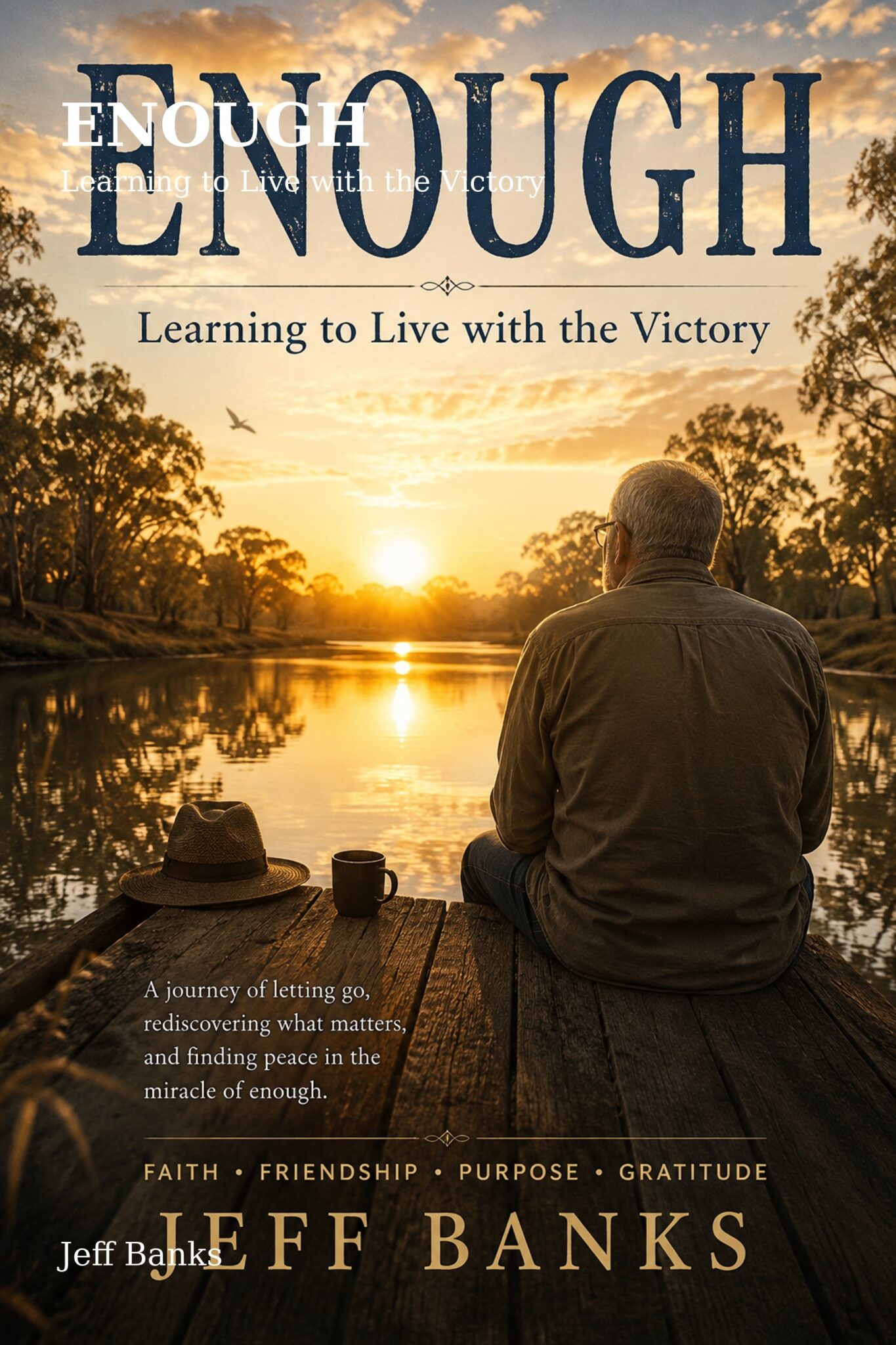
ENOUGH Chapter 9 - Enough

ENOUGH Chapter 9 - Enough | Travelling Around Australia with Jeff Banks

Looking back, I suspect most people who marry or partner into close families eventually discover the same thing. The terrifying examination they imagined was never actually taking place. The judges they feared were mostly spectators. The barriers they believed existed were often little more than shadows cast by uncertainty. The acceptance they sought was available long before they realised it. Their greatest obstacle was rarely the family itself but their perception of it.

Enough

Learning to Live with the Victory

Chapter 9 – Enough

This is to be our last full day on this jaunt to the Central West of NSW and looking back I wonder what has really been achieved. If the truth be known we could have gone home today but I have the need to fully meet a new member of the family with whom we are going fishing today.

My travelling partner has no issue with this. He was “belly aching” yesterday, in the nicest possible fashion that this had been very much a working holiday with the amount of manual labour we had put into the collection and refining of the timber now in the trailer. The daily fishing expeditions throughout the urban landscape that is Condobolin have been an eye opener in the scheme of the plan for the pursuit of the legendary Murray Cod, although as corrected a number of items by the locals, just Cod.

The Buddy as we have come to meet, is a Goologong, probably related to Evonne Cawley but there is no need to ask. He has come into the life of my cousin Tammy after her divorce, and seems to be a good fit for her. She genuinely seems happy when around him, and that’s all that really counts.

He talks a good talk when it comes to fishing the waters of Galari, but today we are going to put him to the test. A test that, if there is failure, will find his nickname turning from his true name of Buddy to Gunna. Not that we are looking to disparage him in any way, but he speaks with such confidence when it comes to prowess that without delivery, even allowing for the best or worst of unforeseen and uncontrollable circumstances, the inevitable outcome will be the same.

“Gunna” is one of those great Australian nicknames. We have all met one. He was gunna build the business. Gunna lose weight. Gunna write the book. Gunna buy the investment property. Gunna start next Monday. Gunna get around to it eventually. The intention is genuine enough. The enthusiasm is often real. The outcome, however, never quite manages to catch up with the promise. Somewhere between the dream and the delivery, life intervenes, excuses appear, priorities shift, and the thing that was always going to happen quietly slips into the category of things that never did.

Buddy is someone who is fresh with ideas, you know the type. I think therefore it is going to be, and one wonders whether he has the back-up to make things happen. This would be a perfectly imperfect chance for him to demonstrate the conversion of passion into actual action. The thing is, I rather like people like Buddy because they represent something many of us lose as we age. They still believe possibilities are worth talking about. They still become excited by opportunities. They still see the destination long before the pathway is properly mapped out. There is an optimism attached to that mindset which can be infectious, even if it occasionally outruns reality.

The danger, of course, is that possibility and reality occupy very different pieces of real estate. One exists comfortably inside the mind. The other demands effort, persistence, sacrifice, disappointment, adaptation, and occasionally a willingness to fail publicly. That gap between idea and execution is where most dreams quietly die. It is also where most people discover whether they truly wanted something or merely enjoyed imagining themselves having achieved it.

There is another danger lurking in that space as well, one perhaps less obvious but equally destructive. Sometimes people become so enamoured with possibility that they unconsciously begin living off the energy, effort, and enthusiasm of those around them. The ideas keep flowing. The visions keep expanding. The plans become grander and more elaborate. Yet the heavy lifting somehow always seems to fall to somebody else. Not through malice. Not through intent. Simply because imagining a thing is often far easier than building it. The dream itself becomes so attractive that it distracts from the labour required to make it real.

I have met people throughout my life who seemed permanently attached to the next great idea. Every conversation contained a new opportunity. Every problem had an elegant solution. Every challenge was merely a stepping stone to something bigger and better. They could inspire a room. They could generate excitement. They could paint pictures of futures so vivid you almost wanted to hand them your wallet and volunteer your weekends. Yet somehow, when the real work began, they became strangely difficult to find. They remained enthusiastic participants in the vision while somehow avoiding becoming participants in the effort.

The uncomfortable truth is that many of us possess a little of that tendency. I know I do. Entrepreneurialism itself can encourage it because the ability to see what might be rather than what is can be a tremendous gift. Businesses are built that way. Communities are improved that way. Innovations emerge because somebody imagined a future that did not yet exist. Yet there is a fine line between vision and dependency. At some point the dream must stop borrowing momentum from others and generate some of its own. Otherwise the visionary risks becoming increasingly reliant upon the goodwill of people who continue doing the work while receiving little more than encouragement in return.

That is where things can become uncomfortable because a person who continually consumes the goodwill, labour, encouragement, and patience of those around them without contributing proportionately eventually becomes a drain on the very relationships they value most. The danger is that such people often remain unaware of the process because they genuinely believe they are contributing. After all, they supplied the idea. They supplied the excitement. They supplied the vision. Surely that counts for something. And it does count for something. It simply does not count for everything.

The world is full of dreamers, and thankfully so because without dreamers very little progress would ever occur. The difficulty arises when dreaming becomes a substitute for doing. Ideas are important. Vision is important. Inspiration is important. Yet none of those things remove the requirement for effort. Somebody still has to swing the hammer. Somebody still has to turn up early. Somebody still has to stay late. Somebody still has to do the work when the excitement has worn off and the reality becomes difficult.

Perhaps that is why execution is so highly valued by those who have spent years building things. They understand that reality has very little interest in intentions. The marketplace does not reward ideas. Customers do not pay for possibilities. Fish do not jump into the boat because somebody confidently predicted they would. Somewhere along the way effort must appear. Persistence must appear. Results must appear. Until then, all that exists is potential, and potential on its own has never paid a bill or solved a problem.

Sitting beside the river, I find myself wondering whether that lesson applies to far more than business or fishing. It may even apply to the questions that brought me on this walkabout. For months I have spoken about purpose. I have spoken about retirement. I have spoken about the Black Dog. I have spoken about finding answers. Yet there comes a point where talking about finding answers becomes another form of avoiding them. Reflection is valuable, but eventually reflection must lead somewhere. Otherwise it risks becoming just another comfortable conversation with ourselves.

Perhaps that is why I am here. Perhaps driving hundreds of kilometres, sitting beside a river, having difficult conversations, and confronting uncomfortable thoughts is the equivalent of picking up the shovel. It may not provide the answer. It may not even provide clarity. Yet it represents action rather than intention. It represents movement rather than speculation. It represents a willingness to test ideas against reality rather than merely discussing them from the safety of the sidelines.

There is also a more personal lesson hidden within all of this because many of us spend our lives drawing strength from the people around us. Family. Friends. Business partners. Mentors. Communities. There is nothing wrong with that because life has never been intended as a solitary pursuit. The danger only emerges when support becomes dependence and encouragement becomes expectation. At that point we risk becoming emotional leeches, feeding on the energy of others while convincing ourselves we are travelling under our own steam.

The distinction can be subtle. One person uses support as a launching pad. Another uses it as a permanent residence. One appreciates the help and then takes responsibility for the next step. The other waits for somebody else to carry them further. From the outside both may appear similar for a time. Eventually, however, reality reveals the difference because only one of them continues moving when the encouragement stops.

Perhaps that is the real divide between the person known as “Gunna” and the person who eventually becomes something more. It is not talent. It is not intelligence. It is not even vision. It is the willingness to stop borrowing momentum from the people around you and begin creating some of your own. The dream still matters. The vision still matters. The possibility still matters. Yet eventually all of those things must be joined by effort, otherwise they remain nothing more than pleasant stories we tell ourselves about a future that never arrives.

As I sit by the river waiting to see whether Buddy can transform confidence into fish, I find myself thinking how often we all fall into the same trap. We mistake enthusiasm for achievement. We mistake intent for action. We mistake talking about doing something for actually doing it. The mind creates a future outcome and, for a brief moment, experiences the satisfaction as though the result has already been achieved. That emotional reward arrives early, before any real work has been undertaken, and can sometimes be enough to fool us into believing progress has been made when in reality we are still standing exactly where we started.

It is a peculiar quirk of human nature. A person can spend an hour describing the business they are going to build and receive almost the same emotional reward as someone who has spent a year actually building it. The conversation itself creates a temporary illusion of progress. The problem arises when the illusion becomes more satisfying than the work required to make it real. In those circumstances, talking becomes a substitute for doing rather than a precursor to it.

Perhaps that is why so many people become trapped in the world of “I think it, therefore it is.” The phrase sounds empowering on the surface. Visualise success. Manifest outcomes. Believe strongly enough and reality will somehow bend itself into shape. Yet rivers, fish, businesses, marriages, retirement plans and life in general rarely cooperate with such thinking. Reality remains stubbornly committed to reality. Fish do not care how confident the fisherman is. Timber does not cut itself because someone imagines a finished product. Purpose does not magically appear because we have decided we deserve it.

Life, irritatingly, demands participation. It demands more than vision. It demands more than confidence. It demands more than intention. It requires action. It requires persistence. It requires a willingness to keep going after the novelty has disappeared and the hard work begins. That is one of the reasons I am interested in seeing how Buddy performs today. Not because the fish matter all that much, but because fishing has a wonderful way of exposing reality. The river does not care about reputations. It does not care about stories. It does not care about previous victories or elaborate plans. The fish either arrive or they do not. The scoreboard remains brutally honest.

In many ways that is what has made this walkabout so valuable. For months, perhaps years, I have been wrestling with ideas about retirement, purpose, happiness and the Black Dog. I have constructed theories. I have analysed symptoms. I have searched for explanations. Yet sitting beside the river has repeatedly dragged me back to the same uncomfortable truth. Thinking about something is not the same as experiencing it. Analysing a problem is not the same as living through it. Describing a destination is not the same as travelling there. There comes a point where reflection must eventually meet reality.

The river demands evidence and so does life. It is not enough to talk about being happier. It is not enough to talk about finding purpose. It is not enough to talk about escaping the walls that seem to be closing in. At some point you have to leave the house. You have to drive across the state. You have to sit beside the river. You have to engage with the world beyond the confines of your own thoughts. Whether answers arrive or not is almost secondary. The important thing is showing up where answers might potentially be found.

Perhaps that is why I find Buddy simultaneously amusing and admirable. At least he is willing to step onto the field. Plenty of people spend their lives talking about what they might do if circumstances were different. They wait for better conditions, more time, more money, greater certainty, or some mythical future where risk no longer exists. Buddy has arrived at the river. He has picked up the rod. He has entered the contest. Whether he succeeds or fails is almost secondary to the fact he has shown up prepared to have his confidence tested by reality.

There is courage in that because reality can be an unforgiving judge. It exposes weaknesses. It highlights gaps between perception and performance. It has little patience for excuses. Yet it is also the only place where genuine achievement can occur. Dreams remain dreams until they collide with reality. Plans remain plans until they are tested. Confidence remains merely confidence until it is supported by action.

After all, the greatest danger is not becoming “Gunna.” The greatest danger is spending an entire lifetime talking about what might have been while never finding the courage to test it. At least Buddy has given himself the opportunity to discover the truth. Whether the river rewards him or humbles him, he will finish the day knowing more than when he started. As I sit here reflecting on my own walkabout, I suspect that lesson applies equally to me because the search for purpose, understanding and perspective ultimately requires the same thing. There comes a time when you stop talking about the journey and simply take the first step.

So keen is he to impress, they are here early to guide us on our way. Perhaps they thought they could catch us unawares, but he didn’t. He didn’t realise we have been on and off the river every day for the past seven and the gear is at the ready at any time and for us, we are on the move early with the crisp morning central western air, keeping us as keen as any knife’s edge ready for action.

Soon enough we are on our way, out the Kicatoo Road and searching for “the spot”. Ease is shortly curtailed when he pulls to the side of the road and turns around, having missed the turn off. Almost a “not happy Jan” moment, but for now we will give him the benefit of the doubt, for a little while at least as youthful exuberance could be the explanation, especially as the speeds we were maintaining to this point was somewhat excessive.

He drives to the edge of the river, a spot not unlike some of those we have enjoyed around the urban area. It’s almost cleared out, there is a platform, albeit the muddy inner side of a river bend. We can easily set up here and seek our intended prey, Golden perch of Yellow Belly as they are colloquially known.

The Gunna tag is lost almost immediately as Trevor hooks a fish. But it’s a Cod not the promised Yellow Belly and what’s more, it’s under legal size. Well you can’t have everything. For a few hours at least we toy with the juveniles until the biting stops. In the interim melee, Buddy’s partner, my cousin Tammy, manages a black bream, something we have not seen on this trip. It is perfect pan size and is quickly dispatched to the keeper net for later consideration as dinner. The fish itself is not particularly remarkable in the broader scheme of things, yet its appearance breaks the monotony of undersized catches and provides tangible evidence that something worthwhile inhabits these waters.

The size issue and a lull in proceedings makes Buddy suggest another spot might be in order. He has won us over already, but we are more than happy to abide by his suggestion. He is probably unable to blot his copybook at this point, but if he wants to try, let him go. After all, confidence is a currency he appears happy to spend and, so far at least, the river has been honouring his cheques. There is a certain comfort in following somebody who has demonstrated they know what they are talking about, even if there remains a lingering temptation to test whether confidence and competence are truly travelling together.

Watching him, I find myself thinking about the curious lengths people will go to in order to impress others. It is one of those strange human characteristics that seems almost hardwired into us. Some do it with money. Some do it with possessions. Some do it with stories. Some do it with expertise, real or imagined. We all want, at some level, to be seen as competent, capable, knowledgeable, or successful. The desire itself is perfectly natural because human beings are social creatures. We seek acceptance. We seek respect. We seek acknowledgement. The problem arises when the desire to impress becomes more important than simply being.

Perhaps that is why genuinely impressive people often appear so effortless. They are not trying. The fellow who truly knows how to fish rarely feels compelled to tell everybody how good he is. The experienced tradesman does not need to constantly remind people of his qualifications. The successful business owner rarely begins every conversation with a list of achievements. Their competence reveals itself naturally through outcomes. The fish appear in the net. The timber gets cut. The business survives. The evidence speaks long before they feel any need to. Their confidence comes not from perception but from repeated proof.

The opposite can also be true. Sometimes the louder the claim, the greater the uncertainty sitting behind it. I have certainly seen enough of that throughout my business life. The self-proclaimed expert who has never actually done the thing they are teaching. The motivational speaker who cannot motivate themselves. The property guru who owns remarkably little property. The business coach whose own business appears permanently on life support. There seems to be an inverse relationship at times between the volume of the promise and the quality of the delivery. The greater the need to convince others, the more one wonders whether the speaker is really trying to convince themselves.

That is not always the case, of course. Some people simply possess enthusiasm in abundance. Some people enjoy sharing their passions. Some people are genuinely excited by what they know. The difficulty lies in distinguishing confidence from performance. One is earned. The other is projected. One survives scrutiny. The other often evaporates the moment reality becomes involved. Until tested, they can look remarkably similar.

Fishing is wonderfully democratic in that regard because fish are completely immune to marketing. They do not care about social media followers. They do not care about stories told at the pub. They do not care about previous victories. They respond only to what is happening right now. In that sense, the river is perhaps one of the fairest judges a person could encounter. It strips away image and leaves only reality. The scoreboard remains brutally honest because fish either arrive or they do not.

The irony is that many of us spend enormous portions of our lives attempting to impress people who are largely indifferent to being impressed in the first place. We buy things. Achieve things. Accumulate things. We build identities around how we wish to be perceived, often forgetting that most people are far too busy worrying about their own lives to spend much time analysing ours. We become performers on a stage where the audience is barely paying attention. The effort expended can be extraordinary when viewed against the actual return.

The older I become, the more I suspect the truly impressive people are those comfortable enough not to perform. They know who they are. They know what they can do. They know what they cannot do. They do not need applause because their self-worth is not dependent upon the audience. There is a quiet confidence in such people which often goes unnoticed at first. Yet over time it proves far more substantial than the louder alternatives because it is grounded in reality rather than perception.

Perhaps that is one of the lessons hidden within this walkabout as well. For much of my life I have felt compelled to achieve. To build. To contribute. To prove. There has always been another mountain to climb, another goal to reach, another horizon to chase. Looking back, I wonder how much of that was genuine ambition and how much of it was simply another form of seeking validation. Not necessarily from others, but perhaps from myself. If I achieved enough, perhaps I would finally feel enough. If I built enough, perhaps the questions would stop. If I succeeded enough, perhaps the Black Dog would lose interest.

The river has been quietly challenging that assumption. The fish do not care what I have achieved. The water does not care what qualifications I possess. The trees have no interest in my reputation. The current continues flowing regardless of whether I feel successful or insignificant. And somehow that indifference feels liberating rather than insulting. It removes the need to perform and replaces it with the simple requirement to be present.

As Buddy suggests another location and we begin gathering rods, bait, and assorted paraphernalia, I realise he has already succeeded regardless of what happens next. He brought us fish. He brought us stories. He brought us a day beside the river. Whether the next spot proves spectacular or disastrous almost ceases to matter. The effort has already been made. The confidence has already been tested. The delivery has already occurred. Whatever happens from here is simply a bonus rather than a requirement.

Perhaps that is the difference between trying to impress and actually impressing. One relies upon words while the other relies upon results. One seeks recognition before achievement while the other allows achievement to speak for itself. More often than not, the people who genuinely impress us are the ones too busy living their lives to spend much time trying. They are occupied with doing rather than appearing, and in the end that distinction becomes impossible to miss.

This new spot is far different than the first. Nothing to do with the potential to catch fish, as we get bites almost immediately. It is that the fishing locales are all up to two metres above the water level. As fish are hooked, contortionists’ efforts are put into place to net the prey. Many a time, being the holder of the net, I am belly on the ground trying to ensure a fish is not lost. At one point I almost roll into the river, unable to stop the force due to gravity, much to the comical enjoyment of the gathered crowd.

The amusing thing is that while the fishing itself remains exactly the same, everything else is completely different. The fish do not know whether the bank is steep or shallow. They do not care whether the fisherman is comfortable or hanging precariously over the edge of a drop-off. To them it is merely another worm drifting through their world. To us, however, every successful hookup suddenly becomes an engineering exercise requiring teamwork, balance, coordination, and occasionally a willingness to sacrifice dignity in pursuit of success.

What had been a relatively civilised pursuit at the previous location quickly degenerates into something resembling a slapstick comedy routine. One person hooks a fish. Another, more often than not me, grabs the net. A third provides instructions of questionable value. Everybody starts talking at once. The fish, naturally, chooses precisely that moment to discover a renewed enthusiasm for freedom. Rods bend. Boots slip. Gravel shifts. Bodies twist into positions that would make a yoga instructor wince in sympathy. It becomes immediately obvious that landing the fish is often less complicated than organising the humans involved in the process.

Age adds its own unique layer of humour to proceedings. The mind still believes it is twenty-five. The body, meanwhile, has quietly joined another committee altogether. Every lunge towards the water is accompanied by a small internal negotiation regarding knees, hips, backs, and muscles not previously consulted. The fish might weigh half a kilogram, yet the effort involved in retrieving it suggests we are attempting to land a marlin from the side of a cliff. Logic departs entirely. Success becomes measured not simply by catching the fish but by doing so without requiring medical intervention afterwards.

My near immersion in the river provides one of the highlights of the afternoon. Stretching beyond what could reasonably be described as my centre of gravity, I find myself slowly sliding forward while desperately attempting to maintain contact with the earth. There is that brief moment where the brain recognises disaster is imminent but remains unable to communicate effectively with the rest of the body. Arms reach. Legs scramble. The net extends further than it probably should. Fortunately, the fish is landed. Unfortunately, so is my reputation as a graceful outdoorsman.

The laughter is immediate and entirely justified. Fishing companions possess a remarkable inability to show sympathy during such moments. Concern for personal welfare takes a distant second place to the entertainment value of somebody else’s predicament. Had I actually entered the river, assistance would undoubtedly have followed eventually. It simply would not have arrived before several photographs had been taken, a suitable nickname allocated, and the story carefully embellished for future retelling.

That is one of the enduring joys of these sorts of expeditions. Misfortune, provided it remains minor, becomes community property. The fish are shared. The stories are shared. The laughter is shared. Most importantly, embarrassment is shared repeatedly and often. Every near disaster becomes a future anecdote. Every mistake becomes part of the mythology of the trip. The actual event becomes less important than the way it is remembered and retold.

By the end of the afternoon, the catches themselves begin blending into a collection of moments. Somebody slips. Somebody misses a net shot. Somebody offers advice immediately proven incorrect. Somebody, usually Trevor, celebrates too early. The fish themselves almost become secondary to the theatre surrounding their capture. It is a reminder that fishing trips are rarely remembered because of the exact number of fish caught. They are remembered because of the stories generated along the way and the people who helped create them.

The strange thing is that this spot mirrors much of what I have been discovering during the walkabout itself. On the surface it appears remarkably similar to the previous location. There is water. There are fish. There are rods. There are hopeful fishermen. Yet a small change in perspective alters the entire experience. The extra two metres of elevation changes everything. What looked simple becomes complicated. What looked straightforward becomes challenging. What appeared familiar becomes something entirely different. The environment remains largely unchanged, yet the way we must interact with it changes dramatically.

Life seems to operate much the same way. A small shift in circumstances can completely alter the nature of a problem. A slight change in perspective can reveal opportunities previously unseen. The river remains the river, just as the questions that brought me here remain the same. Yet the angle from which they are viewed changes everything. Suddenly what looked impossible becomes manageable. What appeared overwhelming becomes amusing. What seemed worthy of worry becomes worthy of laughter. The issue itself may not change, but our relationship with it certainly can.

As the afternoon progresses and fish continue finding our hooks, I begin to realise that nobody is really focused on the tally any longer. The score has become secondary. The enjoyment lies in the process. The river, the banter, the near disasters, and the absurdity of grown adults crawling around on their stomachs trying to land fish have become the real attraction. The fish provide the catalyst, but the experience is built upon everything else happening around them.

Perhaps that is another lesson hiding in plain sight. Too often we focus on outcomes while missing the experience itself. We chase the fish and overlook the laughter. We pursue the answer and overlook the journey. We become so fixated on reaching the destination that we fail to appreciate the ridiculous, wonderful, and entirely unexpected moments occurring along the way. Looking back, those moments often become the memories that endure long after the original purpose has faded.

Had I actually rolled into the river, I suspect the story would have improved considerably. The laughter would certainly have been louder. The retelling would undoubtedly have become more elaborate with each passing year. Thankfully for my dignity, and perhaps regrettably for everyone else’s entertainment, gravity was denied its ultimate victory on this particular occasion. Even so, it came close enough to remind me that sometimes the best stories emerge not from success itself but from how narrowly disaster was avoided.

Young Buddy has passed his test of family. He was always one of us no matter how today went, but his acceptance became more complete, even if the smitten cousin was worried otherwise. That is how this family works. There is much you have to do to do us wrong, but in the early stages, all it takes is the wants of one. Do not cross us, that is a different set of circumstances entirely, but for Buddy he had already passed the Cousin Daryl test and now the Cousin Jeff one as well, for what it was worth.

The amusing thing is that none of those tests actually exist. There is no application form. There is no interview panel. There is no formal vote. There is certainly no secret ceremony conducted beneath the full moon where prospective family members are judged by some ancient council of cousins. Yet for somebody arriving from the outside, it can often feel exactly like that because families like ours possess a gravity all of their own. They have decades of shared history, private jokes, old stories, inherited loyalties, and a shorthand communication that appears almost impenetrable to newcomers.

Conversations reference events that occurred thirty years ago as though they happened last Tuesday. Nicknames appear without explanation. Stories are interrupted because everybody already knows the ending. Arguments begin in one decade and somehow continue into the next generation. To somebody standing on the outside looking in, it can appear as though entry requires passing a series of invisible tests. The reality, however, is usually far less dramatic than the newcomer imagines because most of the pressure exists entirely within their own mind.

They worry about saying the wrong thing. They worry about fitting in. They worry about whether they are being judged. They worry about whether they belong. Meanwhile, the family itself is usually too busy arguing amongst itself, telling stories, preparing meals, discussing fish, or reliving events from years ago to devote much energy to formal assessments. The supposed examination process is largely a work of fiction created by uncertainty.

The veneer people construct in those situations is fascinating to watch. Everyone arrives wanting to make a good impression. They become a slightly polished version of themselves. They carefully choose words. They avoid controversial opinions. They laugh perhaps a little too readily at jokes. They try to demonstrate they are capable, reliable, hardworking, funny, intelligent, or whatever characteristic they believe will earn acceptance. It is entirely understandable because nobody wants to be rejected by people who matter to somebody they care about.

The trouble is that families, particularly close-knit country families, possess an extraordinary ability to crush veneer. Not maliciously. Not deliberately. Simply through prolonged exposure. Eventually the mask slips. The polished edges wear away. The carefully constructed version of yourself becomes too exhausting to maintain. The real person emerges because maintaining a performance indefinitely requires more energy than most people possess.

That is the point where something interesting occurs. Families do not really embrace perfection. They embrace authenticity. The cousin who worries they are being judged is generally judging themselves far more harshly than anybody else. The prospective partner imagines invisible scorecards are being maintained when in reality most people are simply trying to determine whether this person makes somebody they love happy. Everything else is largely secondary. The qualities people fear are being assessed often matter far less than they think.

That is perhaps the great secret of families like ours. The hurdle appears enormous from the outside because it is largely constructed from imagination. The newcomer sees history, relationships, traditions, and familiarity and assumes there must be standards they cannot possibly meet. They imagine hidden expectations. They imagine tests. They imagine scrutiny. They imagine consequences attached to every interaction. The family itself, meanwhile, is generally operating under a much simpler framework.

Are you decent? Are you genuine? Do you care about the person we care about? If the answer to those questions is yes, most of the battle is already won. Everything else tends to sort itself out over time because familiarity breeds comfort far more effectively than perfection ever could.

That does not mean families never become protective. Quite the opposite. Loyalty runs deep. If somebody deliberately hurts one of our own, the reaction can be swift and memorable. The same closeness that creates warmth can create fierce protection. Yet that belongs to an entirely different category of behaviour. Acceptance and protection are cousins themselves, related but distinct. One welcomes. The other defends. Most newcomers spend far too much time worrying about the second while already enjoying the benefits of the first.

Buddy never really needed to prove himself. The fish did not matter. The stories did not matter. The fishing spots did not matter. Those things simply provided opportunities for interaction. What mattered was that he showed up as himself. What mattered was that he clearly cared about Tammy. What mattered was that he was willing to participate in the madness rather than stand apart from it. The rest largely took care of itself because people reveal themselves naturally given enough time and enough shared experiences.

Looking back, I suspect most people who marry or partner into close families eventually discover the same thing. The terrifying examination they imagined was never actually taking place. The judges they feared were mostly spectators. The barriers they believed existed were often little more than shadows cast by uncertainty. The acceptance they sought was available long before they realised it. Their greatest obstacle was rarely the family itself but their perception of it.

Perhaps that mirrors many of the other lessons this walkabout has been quietly teaching me. The walls that appear solid are often less substantial than they seem. The obstacles that appear intimidating are often products of perspective. The tests we fear most are frequently self-imposed. We create narratives about what awaits us, then spend enormous amounts of energy preparing for battles that never actually arrive.

Sometimes the biggest hurdle is not the family, the river, the future, or the Black Dog. Sometimes the biggest hurdle is simply the story we tell ourselves about what awaits on the other side. Buddy, whether he realises it or not, had already crossed that hurdle long before he ever picked up a fishing rod. The rest of us were merely waiting for him to realise there was never really a fence there in the first place, only the illusion of one created by the understandable desire to belong.

Author

Menu