

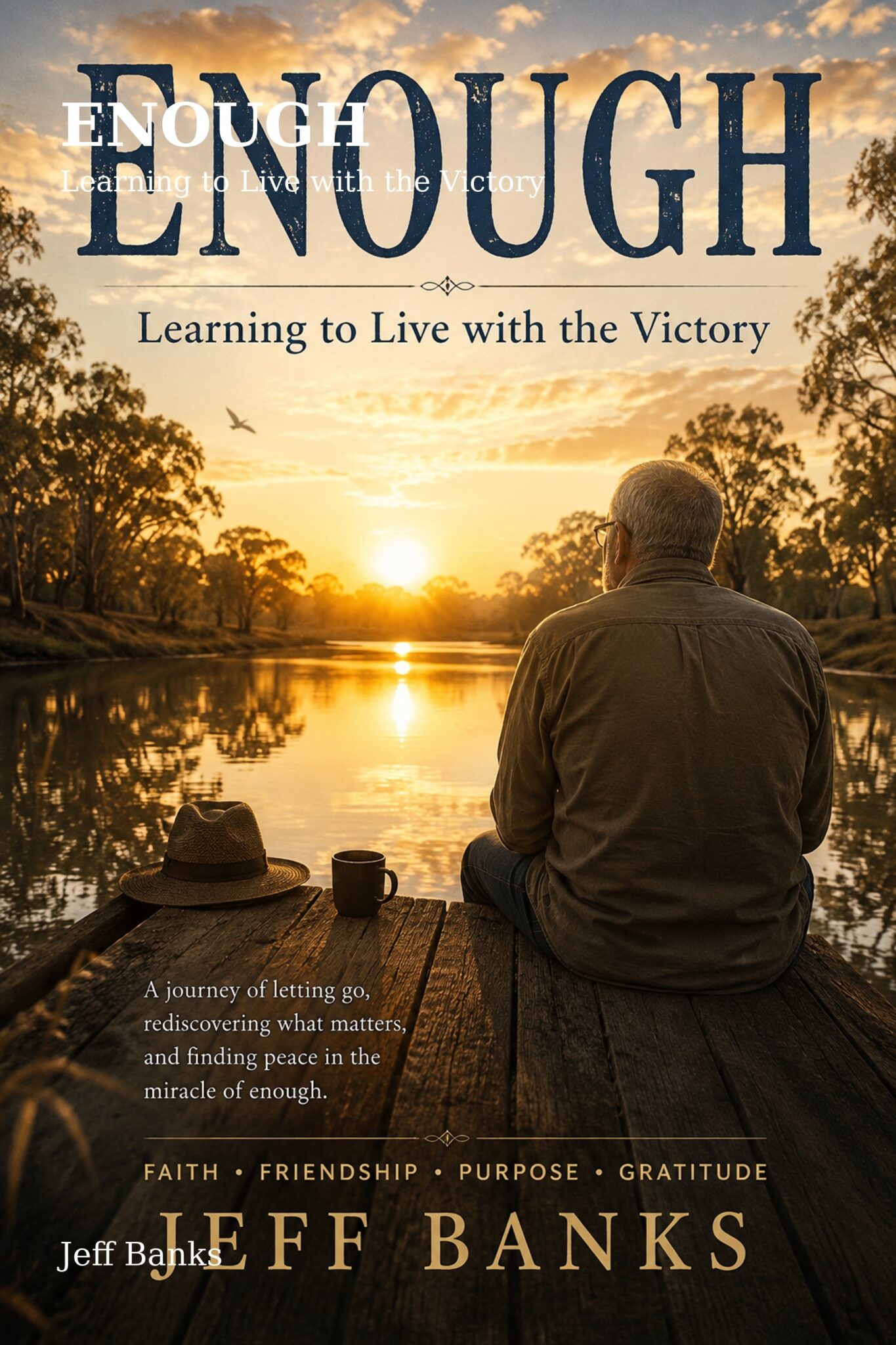
ENOUGH Chapter 10 - Learning to Live With Victory

ENOUGH Chapter 10 - Learning to Live With Victory | Travelling Around Australia with Jeff Banks

So where did this week end? It ended beside a river. It ended amongst family. It ended with laughter. It ended with fish, timber, stories, and memories. Most importantly, it ended with a man who finally understands that winning was never the problem. Learning how to live with the victory was.

Enough

Learning to Live with the Victory

Chapter 10 – Learning to Live With Victory

So where did this week end?

That seems a simple enough question. It sounds like the sort of thing somebody might ask over a beer at the end of a trip. How was the fishing? Did you get the timber? Did you catch up with family? Was it worth the drive? Yet the longer I sit with the question, the more I realise it is not really asking where the week ended at all. It is asking where I ended.

That, after all, was the real purpose of the walkabout. The fishing was an excuse. The timber was an excuse. The road trip was an excuse. Even the river was, in many ways, an excuse. The real purpose was to find something I could not properly define. For months I had been circling around a feeling. The Black Dog was never truly absent, merely quieter on some days than others. Retirement, that mythical destination so many people spend their working lives pursuing, had proven itself to be a far stranger country than expected. The competitions had been won. The businesses had been built. The children had grown. The mortgage battles had largely been fought. The scorecard, if such things exist, suggested life had been remarkably successful.

Yet success and contentment are not the same thing. That is a lesson nobody tells you while you are climbing. The climb itself is easy to understand. There are goals. There are obstacles. There are targets. There are measurements. Every entrepreneur understands the language of mountains. We know how to build. We know how to strive. We know how to push. We know how to sacrifice today for a better tomorrow. The entire process becomes addictive because there is always another horizon waiting in the distance.

The difficulty comes when you arrive. The summit turns out to be a strangely uncomfortable place because there is nowhere obvious left to go. The habits that made you successful become difficult to switch off. The constant search for improvement begins searching for problems where none necessarily exist. The drive that once built businesses starts interrogating life itself, asking whether there should be something more. Perhaps that was the real nature of the questions that brought me here. Not questions about purpose. Not questions about retirement. Not even questions about depression. They were questions about acceptance. Questions about enough. Questions about whether a man who has spent his entire life climbing can learn to stand still long enough to appreciate the view.

I arrived seeking answers. I leave suspecting I never properly understood the question. That realisation brings me back, inevitably, to Douglas Adams and The Hitchhiker’s Guide to the Galaxy. Somewhere in that gloriously absurd universe sits Deep Thought, the most powerful computer ever constructed, spending seven and a half million years calculating the answer to life, the universe and everything. When the answer finally arrives, it is both profound and ridiculous. Forty-two. The genius of the joke is not the answer itself. The genius lies in the discovery that nobody actually knew the question.

Perhaps that has been my mistake all along. For much of this year I have been demanding answers. I have been looking for explanations. I have been searching for some grand revelation capable of explaining why success sometimes feels strangely hollow, why retirement can feel more confronting than employment, and why the Black Dog occasionally appears even when life is objectively good. Yet perhaps I have been operating like the people waiting for Deep Thought’s answer. I have been demanding certainty, clarity, meaning, and a solution to a question I could not properly articulate.

The walkabout has not provided answers. What it has provided is perspective. That distinction matters. The river did not solve anything. The fish did not solve anything. The timber did not solve anything. The conversations did not solve anything. What they did do was allow me to step outside the four walls that had been closing in around me. Those walls felt very real. They were the walls of routine. The walls of expectation. The walls of retirement. The walls of identity. The walls of becoming trapped inside my own thinking.

From within the room, they appeared immovable. Yet sitting beside Galari, watching water flow towards destinations unknown, I began to understand something remarkably simple. The room was never the world. It was merely the room. The walls only appeared dominant because I had been staring directly at them. The moment I climbed the bank and looked beyond them, the landscape returned. That may be the most valuable lesson of the entire trip because the world is always larger than our immediate circumstances.

The Black Dog wants us to believe the room is the world. Anxiety wants us to believe the room is the world. Depression wants us to believe the room is the world. Fear wants us to believe the room is the world. Yet beyond the walls remains family. Beyond the walls remains friendship. Beyond the walls remains purpose. Beyond the walls remains laughter. Beyond the walls remains life. The world never disappeared. I simply stopped looking beyond the room.

Along the way I found myself reflecting upon Buddy and his passage through the peculiar rituals of family acceptance. Looking back, it strikes me that the tests he imagined were largely fictional. The hurdles existed primarily within his own mind. The acceptance he sought had already been granted long before he realised it. That observation feels uncomfortably familiar. How many of the tests I have been attempting to pass over the past year have been equally imaginary? How many expectations have I imposed upon myself? How many battles have I fought against enemies that existed only in perception? How many windmills have I charged believing them giants?

Which brings me neatly to Don Quixote. There is something wonderfully tragic about Cervantes’ hero. He sees the world not as it is but as he believes it should be. He creates quests. He creates enemies. He creates battles. He creates meaning through conflict. Without the conflict, who is he? That question resonates more deeply than I would like because entrepreneurs are not unlike Quixote. We create. We strive. We build. We fight. We overcome. Eventually the fighting itself becomes part of our identity.

The challenge comes when the dragons disappear. The challenge comes when the giants reveal themselves to be windmills. The challenge comes when life no longer requires constant conquest. What then? For much of this trip I suspected there must be another battle. Another challenge. Another mountain. Another purpose. Now I am not so sure. Perhaps the challenge is not finding another dragon. Perhaps the challenge is learning not to create one. Perhaps the challenge is accepting that life does not always require solving. Perhaps it simply requires living.

The river taught me that. Water does not strive. Water does not compete. Water does not obsess over purpose. Water simply flows. It moves around obstacles. It adapts. It continues. It neither resists reality nor seeks to dominate it. It participates. There is wisdom in that. More wisdom than I expected to find sitting beside a creek watching rod tips.

The conversations reinforced it. Daryl reinforced it. Ann reinforced it. Aunty Kerre reinforced it. Trevor reinforced it. Even the dreams reinforced it. Each encounter, in its own way, pointed towards the same conclusion. Not more. Enough. Not another mountain. The view. Not another competition. The satisfaction of having competed. Not another achievement. The appreciation of what has already been achieved.

That sounds simple. It is anything but. For somebody wired to seek improvement, acceptance feels suspiciously like surrender. For somebody accustomed to climbing, stillness feels dangerously close to stagnation. For somebody who has built an identity around solving problems, contentment feels almost irresponsible. Yet perhaps that is the final lesson. Contentment is not surrender. Gratitude is not stagnation. Acceptance is not failure. They are skills. Difficult skills. Skills requiring practice. Skills requiring patience. Skills requiring conscious effort. They may, in fact, be harder skills than building businesses ever demanded.

As this walkabout comes to an end, I cannot honestly claim victory over the Black Dog. That would be dishonest. The Black Dog remains what he has always been, a companion lurking somewhere in the distance. Some days he is visible. Some days he is not. Some days he runs ahead. Some days he falls behind. What has changed is my relationship with him. He is no longer proof something is wrong. He is simply part of the landscape. Just as rivers rise and fall. Just as seasons change. Just as weather shifts. The Black Dog exists, but that does not mean he gets to define the journey.

Perhaps that is enough. In fact, perhaps that word has been hiding at the centre of this entire adventure. Enough. Not more. Not bigger. Not better. Enough. Enough family. Enough friendship. Enough purpose. Enough success. Enough memories. Enough love. Enough life.

I began this walkabout searching for answers. I finish it with a growing suspicion that the answer was never missing. Like the river, it was flowing quietly past the entire time. Like forty-two, it seemed absurd because I was asking the wrong question. Like the room whose walls appeared to be closing in, the problem existed largely in perspective. Like the view from the top of the bank overlooking Galari, the bigger picture was always there waiting patiently for me to look up.

So where did this week end? It ended beside a river. It ended amongst family. It ended with laughter. It ended with fish, timber, stories, and memories. Most importantly, it ended with a man who finally understands that winning was never the problem. Learning how to live with the victory was.

Perhaps that is not the answer. Perhaps it is simply the right question. The distinction matters because answers imply finality while questions invite growth. Answers suggest a destination has been reached while questions acknowledge the journey continues. If this walkabout has taught me anything, it is that life was never really about arriving. It was always about noticing what was already there while I was busy searching for somewhere else to be.

For now, that is enough. More importantly, for perhaps the first time in a very long while, enough genuinely feels like enough.

Author

Menu