

ENOUGH Chapter 8 - The River Never Stopped Flowing

ENOUGH Chapter 8 - The River Never Stopped Flowing | Travelling Around Australia with Jeff Banks

Perhaps that is why places like this possess such power. Not because they solve problems. Not because they remove stress. Not because they magically banish depression. They simply create enough distance for perspective to return. The river does not change my circumstances. The creek does not eliminate responsibility. The fish do not solve existential questions. Yet they slow everything down enough that I can finally see beyond the walls. Sometimes that may be all that is required.
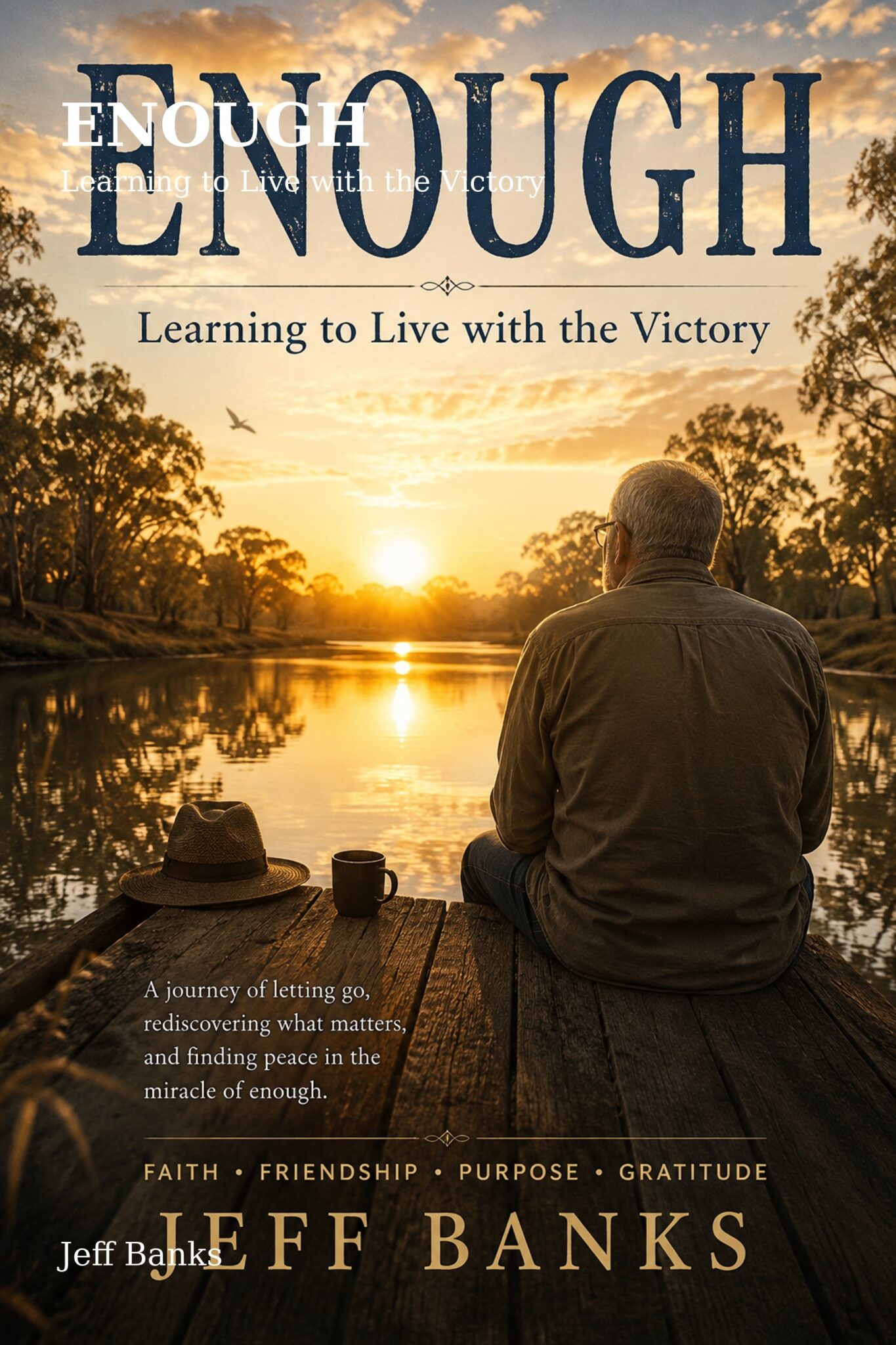
Enough

Learning to Live with the Victory

Chapter 8 – The River Never Stopped Flowing

The discussions from last night have me wondering: have I found what I am looking for and don’t realise it? Or worse, have I found something I didn’t realise was the answer, and perhaps am not happy with the result? Much like the man from the parable. Am I not seeing that right in front of me the answer? If only I want to accept it.

Trevor and I are at a little of a loose end today. The timber is loaded, and other than that we have to tie it down and repair the electrics cable that we destroyed on the way up, that part of the journey is complete. That question has been answered, an itch scratched to a level of comfort that having been an idea can now be filed in the, not only been there done that folder, but also to a chore dimension able to be accessed at some later period.

As for the other questions, the fishing is an ongoing one, which now sits comfortably in the thought that the prime directive has been achieved, Trevor can now call himself a cod fisherman having landed a legal fish. Simply heading back to the river and seeking betterment of results is always the fisherman’s way.

But it’s that elusive third question that still escapes me. I’m not even sure I know the question anymore but being out here, being in the land of my mother’s forefathers seems to be having a desired effect. Perhaps listening to my aunt talk about her lot in life without disparaging, around wanting more or contemplating growth for growth’s sake, is enough to push the walls of the ever-encroaching room back to a point where their place in life is comfortable enough in the understanding that what we have is simply enough.

The simplicity of looking around and thinking that there is joy in the achievement, no matter how large it is or small for that matter, can bring in the delight of a life well lived. Maybe, like the man in the parable, that is what I really need to understand in order to go forward. Keep going forward. Keep the Black Dog at bay, or perhaps even kennel him away from your shot.

The more I sit with that thought, the more I wonder whether the answers I am seeking are not answers at all. Perhaps they are understandings. Perhaps they are shifts in perspective rather than revelations. I have spent much of this trip searching for something I cannot properly define, expecting that somehow I would know it when I found it. Yet maybe the problem is not that the answers are hiding. Maybe it is that I have been asking the wrong questions, or perhaps looking in the wrong places for the right ones.

The man stranded on the roof was looking for a miracle and therefore failed to recognise the miracles that arrived. That story continues to circle through my thoughts because there is an uncomfortable familiarity about it. I came here searching for clarity, purpose, motivation, perhaps even some explanation as to why the Black Dog still prowls around the edges of life despite all the things that should, on paper, keep him away. I have looked for profound moments, life-changing insights, and dramatic revelations. Yet perhaps what has been presented instead are simpler lessons, lessons so ordinary that they risk being overlooked precisely because they lack spectacle.

The timber in the trailer. The chainsaw finally running. The laughter over Trevor’s undersized fish. Watching Mitch repair a machine rather than surrender to a breakdown. Conversations around a dinner table. The quiet satisfaction of seeing a pile of timber transformed from waste into possibility. None of those things are remarkable when viewed individually. None would warrant a chapter in a self-help book or become the centrepiece of some motivational seminar. Yet perhaps that is precisely the point because life itself is not generally lived through grand revelations. It is lived through accumulations. A good conversation here. A small achievement there. A burden shared. A problem solved. A laugh stolen at a mate’s expense. A sunrise observed. A meal enjoyed.

Perhaps the delight of a life well lived comes not from extraordinary moments but from finally learning to recognise the ordinary ones. That thought unsettles me because it suggests the answer may have been available all along. Not hidden. Not buried. Not locked behind some emotional vault requiring years of introspection to access. Simply sitting there in plain sight while I busily searched for something larger, more dramatic, and therefore, in my mind at least, more worthy of being called an answer.

As an accountant, as a business owner, and perhaps most dangerously as a serial entrepreneur, I have spent much of my life focused on outcomes. Targets. Objectives. Goals. Achievements. The next project. The next challenge. The next thing requiring attention. Progress becomes measured by movement and movement becomes confused with purpose. There is always another mountain to climb, another issue to solve, another opportunity demanding consideration. Standing still starts to feel like failure, even when logic suggests otherwise. The problem with living that way for long enough is that eventually the journey becomes invisible because all attention remains fixed on whatever horizon sits ahead.

Yet standing here in the country, watching timber split, birds move through paddocks, and people quietly getting on with life, there is a different lesson unfolding. Nobody here seems especially concerned about greatness. They are concerned with usefulness. They are concerned with contribution. They are concerned with getting through the day, helping where help is needed, and creating something tangible before the sun disappears below the horizon. There is wisdom in that simplicity, a wisdom often drowned out in environments where success is measured primarily by growth, expansion, and accumulation.

I know I am tired. I know I am short-tempered at the moment but being out here, being a different type of tired, allows one to think not clearly but differently. At home tiredness often arrives carrying frustration. Emails still need answering. Clients still need guidance. Problems still need solving. The tiredness becomes wrapped in obligation and responsibility. Out here the tiredness feels earned. Physical. Honest. It comes from lifting timber, walking paddocks, handling machinery, and breathing cold air. The body complains certainly, but the mind seems quieter for the experience.

Perhaps that is because physical fatigue leaves less room for emotional noise. The Black Dog, at least temporarily, appears less interested in chasing someone who has spent the day doing rather than endlessly thinking. He is still there. I know that. He has travelled with me for too many years to suddenly vanish because of a few days in the country. Yet perhaps the goal was never to eliminate him entirely. Perhaps the goal is simply to keep him occupied elsewhere, distracted long enough that he cannot dominate every landscape and every conversation occurring inside my head.

And maybe that is where the answers I am seeking actually reside. Not in finding a cure. Not in discovering some secret. Not in a miraculous transformation that suddenly rewires decades of thinking. Perhaps the answer is learning to keep moving toward useful things. Learning to recognise achievement even when it appears insignificant. Learning that contribution matters. Learning that purpose does not need to be grand to be meaningful. Learning that a life well lived may be measured less by what was accumulated and more by what was created, repaired, improved, or shared with others along the way.

As I sit here watching another country morning slowly unfold, I find myself wondering whether the walkabout was never really about escaping life at all. Perhaps it was about rediscovering it. Not the exciting version. Not the entrepreneurial version. Not the ambitious version forever chasing the next horizon. Simply life as it is when stripped back to its essentials. A conversation with people who matter. A task completed. A meal shared. A friendship strengthened. A problem solved. A laugh enjoyed. A sunrise appreciated. The quiet satisfaction of being useful. The gratitude of still being here to experience it.

And perhaps, just perhaps, recognising those things for what they are may be the miracle I have been overlooking all along. If that is true, then the answer to the questions I brought with me may not be a destination waiting somewhere further down the road. The answer may instead be the gradual realisation that meaning was never absent in the first place. It was simply hidden beneath expectation, obscured by ambition, and drowned out by the constant search for something larger than life, already sitting quietly in front of me.

The only things left on the to-do list are, fix the trailer, take our hosts to dinner tonight, then tomorrow engage in a family fishing expedition with a newer member of the family, Tammy’s new beau Buddy. He is still a bit of a conundrum as yet, a young Aboriginal man who talks a lot of heart and heritage but much in the way of someone you might nickname Gunna. He wants to fish and is keen to show us a spot where we might target a different species of fish but there’s an underlying inkling that things may not be as black and white as they may seem.

For me I am keen to know the new member of the family and the peace of fishing, where conversations can, if they really want to, start or simply maintain themselves within the silence of the pescatorial pursuit.

It is particularly cold this morning. The wind chill factor exacerbates the lack of the expected thermal aspects of previous utopian days, stripping away much of the comfort that had quietly accompanied the earlier part of the trip. Trevor notes he is not in any particular hurry to engage in anything requiring outside effort, save we have to fix the trailer and we of course have to fish more. His observation is delivered with the sort of understated practicality common amongst country men. There is no complaint attached to it. Simply an acknowledgement that it is cold, the wind is unpleasant, and the warmth has disappeared. Yet certain things still need doing regardless of personal preference.

The contrast with the opening days of the walkabout is difficult to ignore. When we first arrived there was almost a sense of possibility hanging in the air. The weather seemed to cooperate. The river beckoned. The timber piles offered opportunity. Every day appeared to contain more hours than could reasonably be filled. There was an optimism attached to the beginning of the trip, not unlike the opening chapters of any new adventure where expectation is allowed to roam freely because reality has not yet imposed its limitations. Everything seemed possible because very little had yet been tested.

Perhaps that is always the way with these things because the beginning of a journey is often fuelled by imagination while the middle is governed by reality. The first days of the walkabout carried a faint sense of utopia about them. Not perfection, because perfection is largely a myth, but the feeling that perhaps this place might provide something I had been missing. The river. The people. The conversations. The isolation. The slower pace. Everything seemed pregnant with possibility. Every bend in the road appeared capable of delivering some insight. Every conversation felt as though it might contain a hidden answer. Every day arrived carrying the expectation that understanding was waiting just around the next corner.

Yet weather has a habit of exposing reality because cold strips romance from situations remarkably quickly. Wind has little respect for expectation. Rain cares nothing for personal growth. Nature remains stubbornly indifferent to whatever emotional journey a visitor happens to be undertaking. The same river that appeared inviting beneath sunshine becomes far less appealing when accompanied by biting wind and grey skies. The same paddock that encouraged wandering becomes a place from which one seeks shelter. The same landscape remains beautiful, yet beauty suddenly becomes secondary to warmth.

There is probably a lesson hidden in that observation because much of life begins with expectation. Businesses begin with expectation. Relationships begin with expectation. Retirement certainly arrives wrapped in expectation. We imagine what things will feel like once we arrive. We construct mental pictures of satisfaction, achievement, peace, contentment, or fulfilment. The difficulty is that reality inevitably arrives carrying weather of its own. Circumstances intervene. Conditions change. The idealised version collides with the practical version. It is at that point the true nature of things begins to reveal itself because fantasy is no longer carrying the weight.

Perhaps that is why this morning feels oddly significant. The weather has removed some of the illusion. The excitement has settled. The novelty has faded. What remains is something closer to truth. The river is still there. The timber is still there. The trailer still needs fixing. The fish still need catching. The questions still remain unanswered. Yet all of those things now exist without the assistance of sunshine and perfect conditions to make them seem more attractive than they really are.

When the weather was perfect it was easy to imagine the walkabout itself was responsible for whatever peace I happened to be experiencing. Sunshine can be remarkably persuasive in that regard. Warmth creates generosity of spirit. Comfort encourages optimism. Yet now, with the wind cutting through clothing and the cold finding every exposed inch of skin, the deeper purpose of the journey becomes easier to examine. If the answers I seek are genuine, they must survive less-than-perfect conditions. They must exist beyond the novelty of being somewhere different. They must remain standing when comfort departs and reality reasserts itself.

That thought connects strongly to the Black Dog because anyone can feel better for a few days when circumstances align favourably. A holiday can do that. Sunshine can do that. Distraction can do that. The real test comes when conditions deteriorate. The real test comes when the weather turns cold, the body feels tired, the novelty fades, and ordinary frustrations return. Does the improvement remain? Does the understanding persist? Or was it merely the emotional equivalent of standing briefly in the sun before the clouds rolled back in?

As I sit watching the wind move through the trees, I realise that perhaps this stage of the walkabout is more valuable than the earlier one. The first days carried expectation. These days, carry examination. The first days were filled with possibility. These days are filled with reality. It is easy to feel optimistic when everything aligns. It is far harder when the weather becomes unpleasant, the body becomes tired, and the answers remain elusive. Perhaps that difficulty is exactly what makes this part of the journey worth paying attention to.

Yet there is comfort hidden within that observation as well because the river remains despite the weather. The landscape remains despite the weather. The friendships remain despite the weather. The purpose remains despite the weather. The conditions may have changed, but the foundations remain intact. That is not a bad metaphor for life either. The things that truly matter are rarely the things dependent upon perfect circumstances.

And perhaps that is what I am slowly learning about myself. The search was never really about finding a perfect environment where the Black Dog could not follow. It was about discovering whether there remained enough curiosity, enough purpose, and enough willingness to continue even when the conditions became less than ideal. It was about finding out whether meaning depended upon comfort or whether it could survive discomfort. It was about determining whether the questions were important enough to continue asking when the weather no longer encouraged the search.

So today begins cold, windy, and distinctly less inviting than those earlier almost utopian mornings. Yet the trailer still needs fixing. The fish still need catching. Life, as it so often does, continues demanding participation regardless of comfort. Perhaps there is wisdom in that. Perhaps the answers I seek are not waiting for the perfect days at all. Perhaps they are hiding amongst the imperfect ones, quietly waiting to see whether I am still prepared to venture outside when the wind starts blowing.

To add insult to injury to the dreariness of the morning, one of the male dogs, smelling and sensing the pheromones of an on-heat bitch on the adjacent property, wails at being tethered inside a fenced yard, unable to attend to his intended conquest. His mournful cry drifts across the paddocks with surprising persistence, rising and falling on the cold wind like some lament for opportunities denied. Every few minutes he tries again, convinced perhaps that a little more volume or a little more determination might somehow alter the realities of fences, distance, and circumstance.

The sound seems perfectly suited to the day. There is a sadness to it, not overwhelming or tragic, merely persistent. It hangs in the air much like the weather itself. The dog knows what he wants. He can sense it. He can almost imagine it. Yet between desire and fulfilment stand barriers beyond his control. The more he protests, the less those barriers seem to care. The fence remains. The distance remains. The cold remains. His complaint becomes part of the landscape, merging with the grey skies, the biting wind, and the general reluctance of the day to offer anything resembling comfort.

Listening to him, it is difficult not to hear an echo of the morning itself. The entire day seems to possess that same mournful quality. The sun exists somewhere beyond the cloud cover, yet makes little effort to announce itself. The warmth of previous days can be remembered, but not experienced. The optimism accompanying the earlier stages of the trip feels similarly distant, not gone entirely but obscured behind conditions less conducive to enthusiasm. Like the dog, the day seems aware that something better exists somewhere beyond reach, yet remains trapped by circumstances unwilling to cooperate.

Perhaps that is why the sound resonates more than it should. On another morning it would simply be a dog being a dog, responding to instincts older than civilisation itself. Today, however, the cry feels almost symbolic. It becomes the soundtrack to a landscape caught between what it is and what it wishes to be. The dog wants the bitch. The land wants the sun. Trevor wants warmth. I want answers. None of us seem likely to get exactly what we want this morning, and so the dog’s mournful serenade continues, providing an oddly appropriate accompaniment to a day wrapped in cloud, cold, and quiet frustration.

I have woken to see we have won a prize in Powerball last night, another $14 as we have the past three weeks. It is not anything major, certainly not the sort of win that results in immediate retirement, luxury motor vehicles, or relatives suddenly discovering how much they enjoy your company. Yet it is enough to keep us interested. Enough to maintain the illusion that next week might be different. Enough to justify another ticket and another brief flirtation with the mathematical improbability of becoming unexpectedly wealthy.

That is really the genius of lotteries. They do not sell millions of dollars. They sell possibility. For a few days after buying the ticket, you are allowed to dream. You mentally spend money you do not possess. You solve problems which do not yet exist. You imagine how life might change if the numbers happened to align in your favour. Rationally, the odds are ridiculous. The accountant in me knows precisely how ridiculous. Yet the dreamer in me happily pays the admission fee regardless because sometimes hope is worth more than the expected return on investment.

There is probably a lesson in that somewhere.

Much of life seems to operate on similar principles. We pursue opportunities unlikely to succeed because occasionally one does. We start businesses despite the statistics. We invest despite the risks. We trust people despite previous disappointments. We continue searching for answers despite repeatedly failing to find them. Perhaps optimism itself is simply a more sophisticated version of a Powerball ticket, an investment in the possibility that tomorrow may contain something better than today.

The $14 win, therefore, is not really about the money. Fourteen dollars barely buys lunch these days. It certainly does not alter financial circumstances. What it does buy is another week of possibility. Another week of “what if?” Another week where the fantasy remains alive. Perhaps that is why so many people continue playing despite overwhelming evidence suggesting they should not. They are not purchasing wealth. They are purchasing imagination.

The leftover fritters, meanwhile, do not last long in the fridge, satisfying my breakfast hunger with considerably greater certainty than Powerball satisfies my financial ambitions. I have never been particularly good at conforming to breakfast expectations. The world seems obsessed with the idea that breakfast foods should occupy a narrow and highly regulated category. Cereals belong at breakfast. Bacon and eggs belong at breakfast. Toast belongs at breakfast. Yet somehow leftover pizza, fritters, lasagna, or cold roast meat are viewed with suspicion despite often being considerably more satisfying.

I have never really understood that distinction.

Food is food. Hunger is hunger. The clock seems an entirely arbitrary mechanism upon which to base dietary decisions. If a fritter is acceptable at six o’clock in the evening, I fail to see why it suddenly becomes controversial at six o’clock in the morning. The fritter itself has not changed. Only society’s expectations have changed, and I have spent much of my life demonstrating a somewhat selective relationship with expectations.

Perhaps that explains why the fritters disappear so quickly.

There is something pleasingly practical about leftovers for breakfast. They require no preparation. They waste nothing. They acknowledge yesterday while fuelling today. There is also something slightly rebellious about them, a refusal to participate in rules that make little sense once examined too closely. The same instinct that occasionally leads me to question accepted wisdom in business, taxation, retirement, or life generally seems perfectly comfortable extending itself to breakfast.

As I sit there with my modest Powerball winnings and my entirely inappropriate breakfast, I realise both are examples of the same underlying characteristic. I have always possessed a tendency to ignore conventional pathways when they fail to make sense to me. Sometimes that tendency has served me well. Sometimes it has led me directly into trouble. Most often it has simply made life more interesting.

The Powerball ticket represents optimism in defiance of probability. The fritters represent practicality in defiance of convention. Together they probably tell a reasonably accurate story about how I move through the world. Logic and hope. Pragmatism and imagination. The accountant who understands the odds and the dreamer who buys the ticket anyway. The bloke who knows what breakfast is supposed to look like and happily eats fritters regardless.

In many ways, that combination probably explains much of my life. I have spent decades balancing caution against possibility, reality against ambition, and practical outcomes against imagined futures. Some mornings that balance appears in major decisions involving businesses, investments, and life direction. Other mornings it manifests itself through a $14 lottery win and a plate of leftover fritters.

Either way, it remains life as it is for me, which is perhaps reason enough not to change it.

The funny thing is that both the Powerball ticket and the leftover fritters probably tell a far more accurate story about me than either deserves. One represents the belief that something better may be just around the corner despite overwhelming evidence to the contrary. The other represents a willingness to ignore convention when convention fails to make sense. Together they form a peculiar combination of optimism and stubbornness that has followed me through most of my adult life.

The more I think about it, the more I realise that same combination may have played a significant role in bringing me to this walkabout in the first place. For decades I have built an exterior that appears remarkably resilient. Business setbacks came and went. Financial pressure came and went. Relationship challenges came and went. Staff problems. Client problems. Community obligations. Family responsibilities. Economic cycles. Political changes. Through it all I continued moving forward. Not always gracefully. Not always successfully. But always forward. Somewhere along the line that persistence became part of my identity.

People began expecting it. Perhaps more importantly, I began expecting it. The difficulty with becoming known as the person who keeps going is that eventually nobody asks whether continuing forward is costing you something. They simply assume movement is your natural state. You become the bloke with the answer. The bloke with the plan. The bloke who survives. The bloke who adapts. The bloke who somehow finds a way through. After a while you start believing it yourself.

The exterior becomes increasingly polished. Confidence becomes habit. Capability becomes expectation. Resilience becomes reputation. To the outside world it appears strong, perhaps even impregnable. Looking back, I suspect much of my life has been spent reinforcing those walls, adding another layer every time adversity appeared. Every success strengthened them. Every survival strengthened them. Every crisis overcome strengthened them further. The structure became so familiar that I stopped questioning whether it was serving me or merely defining me.

Yet strength and brittleness are often far closer cousins than people realise. A piece of steel can bend. A piece of glass appears stronger right up until the moment it shatters. That thought has been troubling me throughout this trip because I increasingly wonder whether much of what I considered strength was actually accumulated tension. The entrepreneur in me was forever chasing another horizon. The accountant in me was forever solving somebody else’s problems. The husband, father, adviser, committee member, mentor and community volunteer all demanded their own share of attention. Every role required energy. Every role required certainty. Every role required me to be the version of myself others expected.

What none of those roles particularly encouraged was vulnerability. Not weakness. Not failure. Simply uncertainty. And yet uncertainty is precisely what has been stalking me for some time now. That may be why the questions remain so frustratingly difficult to articulate. If somebody asked me directly what I am seeking, I am not sure I could provide a satisfactory answer. I know it has something to do with purpose. I know it has something to do with retirement. I know it has something to do with the Black Dog. I know it has something to do with fulfilment, achievement, identity, and worth. Yet none of those words seem large enough to contain the feeling.

The sensation is closer to standing in a room filled with locked doors while knowing one of them leads somewhere important. The problem is not knowing which door. The problem is not even knowing what lies beyond them. The problem is not knowing precisely what you are looking for in the first place. That uncertainty creates its own peculiar frustration because I have spent a lifetime dealing with questions that possessed answers. Taxation questions have answers. Business questions have answers. Structuring questions have answers. Financial questions have answers. Even difficult questions generally possess a framework within which solutions can be developed. These questions are different because they feel more emotional than practical, more spiritual than intellectual, and more human than professional.

Perhaps that is why places like this become important. The river does not provide answers. The timber does not provide answers. The fish certainly do not provide answers. What they provide is space. Space between responsibilities. Space between expectations. Space between the version of yourself the world sees and the version sitting quietly underneath. That space can be uncomfortable because once the noise disappears, the questions become louder. There are fewer distractions available and fewer opportunities to pretend the questions do not exist.

Perhaps that explains why Daryl called. Perhaps it explains why Ann resonated. Perhaps it explains why Aunty Kerre’s observations linger. Perhaps it explains why the story of the man on the roof keeps returning. Each encounter seems to circle the same central theme. Not answers. Recognition. Recognition that I am not really searching for solutions. I am searching for understanding. There is an enormous difference between the two, even though I have spent much of my professional life treating them as close relatives.

The brittle exterior I have spent decades constructing served an important purpose. It allowed me to build businesses. It allowed me to survive setbacks. It allowed me to carry responsibility. It allowed me to become the person others relied upon. Yet every structure eventually reaches a point where maintenance becomes less important than examination. Not demolition. Not destruction. Examination. The walkabout increasingly feels like that examination. It feels like a pause. A stocktake. An audit, if the accountant in me wishes to remain involved. It feels like an opportunity to ask whether the foundations still support the life built upon them or whether they now require adjustment.

It is also a chance to ask whether the walls protect or confine. A chance to ask whether resilience has gradually become isolation. A chance to ask whether achievement and fulfilment were ever really the same thing. A chance to ask whether I have spent so long becoming useful to others that I have forgotten how to be useful to myself. These are not comfortable questions because they challenge assumptions that have existed for decades. Yet discomfort is often the admission price for understanding.

The irony is that I may never find a single answer. The more this journey unfolds, the more I suspect there is no final revelation waiting at the end. There is no treasure map. No hidden chamber. No magical moment where everything suddenly makes sense. The answers may be no more than a gradual realignment of understanding, small adjustments to perspective accumulating over time much like roots slowly separating granite. The process may be so subtle that it is only visible in hindsight.

Perhaps that is enough. Perhaps the real consequence of this walkabout is not discovering answers to clearly defined questions. Perhaps it is learning how to live with questions that cannot be clearly defined at all. Perhaps maturity is not the acquisition of certainty but the acceptance of ambiguity. Perhaps wisdom is not knowing the answer but recognising which questions deserve to remain open.

And perhaps the greatest surprise of all is that the seemingly impregnable exterior I spent so many years constructing has not failed because it was weak. Instead, it has brought me here because, for the first time in a very long time, it has become strong enough to admit it does not know everything. That admission feels less like surrender and more like freedom. The moment certainty loosens its grip, curiosity is allowed to return. The moment I stop demanding answers, I become capable of hearing what the questions have been trying to tell me all along.

For now though we have to take that tough exterior out into what has become quite a cold place, looking for a fishing spot that might provide the warmth from the inside of a fight and banking of a large cod. This place can be quite paradoxical in its life. The summers and the winters can be brutal in their extremes of heat, cold, and everything in between.

We are here in transition but having said that, it is almost winter. With the loss of any sunlight and the onset of any wind, especially one from the south where the origins of the movement are somewhat antarctic, many layers are required to brace oneself from the ferocity of what is being delivered. For myself I have three layers on and in the house where the wood heater is, I am overheated but outside the wind hits your face, cooling whatever else you might have covered with the reflection of the cold wind on your extremities.

Before we can go anywhere, we need to repair the trailer, which was damaged when a coupling between the lights and the source of its power was broken during the trip and the plug was destroyed by friction on the bitumen. My traveling companion is a mechanical electrician specialising in marine installations but in this case a simple trailer plug is a relatively simple chore.

What he hasn’t done, because let’s face it, we are on holidays, is bring any sort of selection of tools with him relevant to the job that he has undertaken. He needs to scrounge around and ask Mitch for the various implements he needs for the job. This we do. The job is done and we are ready to head out into the wilderness to face another day of pescatorial pursuits.

The sun is starting to break through and warm the air slightly, especially as the misty fog that heralded the day starts to dissipate under the burning nature of the sun above it. Out of the wind it is actually quite pleasant as we sit against the moving river, our first spot for the day.

Sitting here on the edge of Galari, I am reminded of a television show from my youth, Tales of the Magic Boomerang. The opening of this show always started with, “The ancient legends of the dreamtime people tells of a magic boomerang. When this magic boomerang flies, all time will stand still.” Sitting here on the bank of the river, occasionally watching rod tips twitch, time certainly has stood still with no need for a boomerang in the air.

The irony is that as a child the idea seemed magical because time standing still appeared to be a wonderful thing. No responsibilities. No deadlines. No urgency. No consequences. The child in me imagined adventure taking place while the rest of the world remained frozen. Yet sitting here now, many decades later, I realise the attraction was probably never about stopping time at all. It was about escaping it. It was about briefly stepping outside the relentless march of expectation, obligation, and consequence.

That is very much what sitting beside this river feels like. The water continues moving. The current never stops. It flows past reeds, logs, rocks, and riverbanks much as it has done for thousands of years. Yet sitting beside it creates the illusion that everything has slowed. The phone remains largely silent. The emails do not matter. Clients, committees, businesses, politics, council disputes, golf clubs, taxation legislation, and all the countless demands of ordinary life seem somehow distant. They still exist. They simply cease demanding immediate attention.

Perhaps that is the true magic of rivers. Not that they stop time. Rather, they remind you that you are not required to race it every moment of every day. The modern world seems obsessed with movement, progress, productivity, and achievement. Every spare moment is expected to be filled with purpose. Every activity should supposedly generate an outcome. Every effort should produce measurable results. Sitting beside a river holding a fishing rod appears almost rebellious when viewed through that lens because from the outside it resembles inactivity in a world addicted to busyness.

To an outsider it might even look like idleness. Two ageing blokes sitting on camp chairs staring at water, occasionally discussing fish and weather and little else. Yet what appears idle from the outside often feels profoundly important from the inside. The expression “contemplating your navel” is usually used as criticism, suggesting self-absorption or pointless reflection. Sitting here beside Galari, however, I find myself wondering whether modern life suffers from too little contemplation rather than too much. We spend so much time reacting that we rarely pause long enough to understand what we are reacting to. We solve problems without asking whether they are the right problems. We pursue goals without questioning why they matter. We fill our days so completely that there is little room left for understanding ourselves.

The river encourages a different pace. The water moves but asks nothing. The birds call but demand no response. The fish may bite or they may not. The sun rises regardless. The current continues regardless. Everything simply is. There is something deeply cleansing about that simplicity because it strips away the illusion that every moment must justify itself through productivity.

Not cleansing in the mystical sense often attached to such places, but cleansing in a far more practical way. Sitting here allows the mind to unclench. Worries that seemed urgent three days ago suddenly appear less significant. Frustrations lose their sharp edges. Problems remain unresolved yet somehow become more manageable. The river does not solve them. It simply carries away some of the emotional weight attached to them, much as it carries leaves, sticks, and debris downstream. The burden remains yours, but somehow it feels lighter after sitting beside moving water for long enough.

Perhaps that explains why so many cultures place significance on water. Water moves. Water adapts. Water flows around obstacles. Water continues regardless. There is wisdom in that which perhaps appeals to those of us who spend too much time trying to control things beyond our control. Rivers do not fight every obstruction. They work around them. They adjust. They continue. There is a lesson there that accountants, entrepreneurs, and chronic problem-solvers often struggle to absorb.

The reality is that Trevor and I could probably leave today without another fish and still consider the trip successful. Certainly we would joke about it. We would lament empty eskies and missed opportunities. We would discuss the fish that got away and the fish that never arrived. Yet the fishing has increasingly become secondary to something else. It provides structure. It provides a reason to sit beside the river. It provides an excuse to spend hours doing what would otherwise appear to be nothing at all. The fish have become almost incidental to the experience.

The fish are the excuse. The river is the destination. The conversations, even the lack of them or even those perceived without speaking are the reward. The thinking is the work. That thought keeps dragging me back to the walkabout itself because I arrived believing I was searching for answers. Increasingly I suspect I came here seeking permission. Permission to stop striving for a while. Permission to stop fixing things. Permission to stop being the accountant, adviser, problem-solver, committee member, and entrepreneur. Permission to simply sit beside a river and allow thoughts to arrive without immediately demanding conclusions from them.

The television show suggested a magic boomerang could make time stand still. Galari seems to achieve much the same thing without any magic at all. The river creates a pocket in which urgency loses its authority. The clock continues ticking. The world continues turning. Responsibilities continue waiting patiently in the distance. Yet for a few hours they cease being masters and become merely future considerations. That may be the greatest gift the river offers because it allows life to be experienced rather than managed.

The rod tip twitches again and Trevor glances up, hopeful for a moment before nothing eventuates. Neither of us seems particularly disappointed. The river continues flowing. The sun continues warming the morning. The current continues carrying away whatever it can. And for perhaps the first time in a very long while, simply being here feels sufficient. No answers have arrived. No revelations have occurred. Yet the need for either seems less pressing than it did when I first set out on this journey, and perhaps that is a form of progress all its own.

He managed to bank a number of fish, all cod, all under legal limits, before we decided to move, having run out of one of the main portions of our bait, the cheese. There is also the matter of our worm numbers declining significantly even though Trevor had my Aunty Kerre purchase a box of worm farm worms, which we are finding quite difficult to get on a hook because of their size.

In search of another spot as an excuse, we break camp, head back into the commercial area of town, find the local supermarket, buy some cheese, head to the service station, buy some worms, and go back to a spot we had been previously where legal fish and records for the week have been set.

Checking the purchased worm stock only brings laughter as the container in which the worms have been purchased provides us only one worm. We could break camp again and head back to the service station and inquire as to the merchantable quality of the products sold but that would mean packing everything back up again. Even though we are only less than probably a kilometre from the actual shop. The concept is too hard and the options available are enough to keep us going for the day.

Soon enough I have a bite and land a carp no bigger than my hand. If this spot is to yield a cod like I did yesterday, this is a very good omen because the moment I caught a carp yesterday, the very next cast gave me, whilst not legal cod, a quite reasonably sized one. Today, like yesterday, happens exactly the same and I’m very soon into what appears to be a large fish. As I get it to the bank, I realise it is going to be more than legal and the concept of netting it one-handed on the side of a bank sloped into the river becomes its own issue. But necessity is the mother of invention. I dig my heels into the bank. I slide down on my backside, close enough to the water, somehow negotiate the other line in the water, and net the fish. When I get my measuring tape out of the bag and lay it aside, it shows well into the 60 cm range that is legal for this type of fish. It will soon be in the fridge, waiting to head home to be cleaned and frozen for our return to the big smoke.

Soon enough Trevor is sending me pictures of a slightly smaller but still very legal cod that he has managed to catch whilst fishing with new bait types. He has moved to using chicken breast as his bait with almost immediate results. In this particular area his spot has to be out of earshot from where I sit. Such are the narrow options we have for setting lines.

We’ve sat and fished out of the wind all day and the sun has kept a lovely warmth to proceedings that suggest even though we are close to urbanisation we are as far away from reality as can possibly be had.

That is perhaps this is the realisation of the strangest part of the entire experience because, if somebody were to examine a map, they would struggle to understand why it feels so remote. We have not travelled deep into some inaccessible wilderness. We have not crossed mountain ranges or ventured hundreds of kilometres beyond civilisation. In reality we are sitting beside a creek feeding into one of the major river systems of New South Wales, within sight of the very town in which we are staying. If we climbed the bank in the right place, we could probably see evidence of ordinary life carrying on exactly as it always has. Houses. Roads. Vehicles. People going about their business. The modern world remains remarkably close, yet emotionally it feels an entire world away.

Perhaps remoteness has less to do with geography than it does with attention. The reality sitting beyond the riverbank has not disappeared. The bills still exist. The emails still exist. The responsibilities, obligations, deadlines, and frustrations all continue patiently waiting. Yet for some reason they seem unable to cross the water. It is as though the river itself forms a boundary between two different states of existence. On one side lies ordinary life with all its noise and demands. On the other sits a couple of blokes watching rod tips and discussing fish, weather, family, and whatever else drifts into conversation. The remarkable thing is that there is no logical reason for this separation to exist, yet the feeling is undeniable.

We are not surviving in the wilderness. We are not disconnected from civilisation. We are not beyond mobile phone coverage. We are not even particularly isolated. Yet the emotional distance feels enormous. That observation makes me wonder how much of what we call escape is actually psychological rather than physical. Popular culture often portrays escape as requiring dramatic action. People disappear into mountains. Sail oceans. Travel overseas. Trek through deserts. Yet here we are proving something entirely different. We have travelled only far enough to place ourselves beside moving water, under an open sky, and beyond the immediate reach of routine. Somehow that has been enough.

Perhaps the river does most of the work because there is something about moving water that alters perspective. The current continues regardless of our presence. It flowed before we arrived and will continue long after we leave. Sitting beside it creates a strange sense of insignificance, yet oddly enough that insignificance is comforting rather than confronting. The world does not depend on us quite as much as we often imagine. Problems continue. Solutions emerge. Life unfolds. The river neither knows nor cares about any of it. That can be remarkably liberating for somebody accustomed to carrying responsibility.

The irony is that we could probably stand on the bank beside town and still catch fish. We could remain much closer to people, facilities, and convenience and potentially achieve exactly the same outcome. The fish themselves certainly do not care whether they are caught in some remote bend of the river or a stretch of water bordering civilisation. A legal fish is still a legal fish. Dinner remains dinner regardless of postcode. Yet the journey matters. The movement away from town matters. The illusion of distance matters. The feeling of being somewhere different matters. Human beings seem wired that way because we attach significance to the act of leaving.

Pilgrimages, holidays, expeditions, retreats, and walkabouts all share the same underlying principle. The destination may matter, but the separation from ordinary life matters just as much. We need to feel we have crossed a boundary, even if that boundary exists largely within our own minds. For me, that seems particularly relevant on this trip because I did not come here because the fishing cannot be replicated elsewhere. I did not come here because timber cannot be found elsewhere. I did not come here because there are no rivers closer to home. I came here because this place creates distance from the person I spend most of my life being.

The accountant remains behind. The adviser remains behind. The committee member remains behind. The problem-solver remains behind, at least for a few hours at a time. Sitting beside the creek watching it flow into the larger river, I find myself thinking that perhaps reality itself is not what I am escaping. Perhaps what I am escaping are the expectations attached to it. Out here nobody particularly cares what I know about taxation legislation. Nobody needs strategic advice. Nobody wants a business structure reviewed. The fish certainly have no interest in my professional credentials. The river remains completely indifferent to everything I have spent decades building.

There is a purity in that indifference because for a little while I am not required to be useful. For a little while I am not required to have answers. For a little while simply being present is enough. That may be one of the hardest lessons for somebody like me to learn because usefulness has become deeply intertwined with identity. If I am not solving something, fixing something, advising somebody, or contributing to some larger outcome, there is often a lingering sense that I should be.

As the afternoon sun continues warming the bank and the water slides silently past, it occurs to me that perhaps this is what people are truly seeking when they talk about getting away from it all. They are not necessarily trying to escape their lives. More often they are trying to escape the relentless performance of those lives. They are seeking a place where identity can loosen its grip, where expectation fades into the background, and where a person can simply exist without constantly proving who they are. The need to achieve, explain, justify, and contribute is suspended for a little while, replaced by something far simpler and perhaps far more valuable.

Remarkably, all of that can apparently be achieved sitting beside a creek within sight of town, watching for fish that may never arrive, while the rest of the world continues on without you for a little while. Perhaps that is the greatest surprise of the entire walkabout because I came searching for answers in some distant place, only to discover that distance itself was never the critical ingredient. What mattered was creating enough separation from expectation to finally hear my own thoughts, and a quiet creek feeding a major river has proven more than capable of providing exactly that.

As I sit beside the creek watching it merge with the larger river, a thought occurs to me that is both deceptively simple and slightly confronting. What if this is the answer? Not an answer. Not one piece of a larger puzzle. What if this entire experience, this feeling of sitting quietly beside moving water, is the very thing I came searching for without realising it? The possibility seems almost too simple, which perhaps explains why I have spent so much time looking elsewhere.

For days now I have been treating this walkabout as a quest. Not in the heroic sense. There are no dragons to slay or kingdoms to save. Instead, it has been a search for something harder to define. Purpose perhaps. Meaning perhaps. Understanding certainly. Somewhere in the back of my mind I have been expecting a revelation, a moment where the clouds part, metaphorically if not literally, and some hidden truth presents itself for inspection. Yet perhaps that expectation itself was the problem because the accountant in me likes answers, the entrepreneur in me likes outcomes, and the problem-solver in me likes conclusions. They all assume there is a destination to be reached, a solution to be identified, and a box to be ticked.

Yet sitting here today I find myself wondering whether life was never designed to work that way. The river certainly does not. It does not arrive at a final destination and declare its purpose fulfilled. It simply flows. It moves around obstacles. It adapts to conditions. It widens. It narrows. It slows. It rushes. Yet throughout all those changes it remains exactly what it was intended to be. Perhaps people are not so different. Perhaps our mistake is assuming life is a problem to be solved rather than a current to be followed.

That thought drags me back to the four walls I have spoken about throughout this journey. Those invisible walls have become one of the dominant metaphors for the way I have been feeling. They press inward. They narrow possibilities. They create a sense of confinement despite the apparent freedom retirement was supposed to bring. I have spent much of the last year wondering how to escape them. Perhaps that was the wrong question. Perhaps the walls were never actually moving. Perhaps I simply forgot to look over them.

Sitting beside this creek it becomes obvious that perspective changes everything. From where I am sitting, the world consists of water, reeds, trees, sky, and the occasional twitch of a fishing rod. It feels isolated. Self-contained. Almost detached from the wider world. Yet if I were to climb the bank behind me, the entire perspective would change. The town would become visible. Roads would reappear. Houses would emerge. The landscape would expand. Nothing would actually change except my viewpoint. The creek would still be there. The river would still be there. The town would still be there. Only my perspective would be different.

That thought strikes uncomfortably close to home because I begin wondering how much of my struggle over the past year has been a consequence of perspective rather than circumstance. How much of the Black Dog’s influence has come from staring too long at the immediate surroundings without occasionally climbing the bank to remind myself of the larger landscape? How often have I mistaken a temporary view for the entirety of reality? It is an uncomfortable question because it suggests the prison may not have been as solid as I imagined.

The room with four walls feels very real when you are standing inside it. The walls appear solid. The space appears limited. The exits appear few. Yet from above, the same room is simply one small structure sitting within a much larger environment. Perhaps that is what this walkabout has quietly been teaching me all along. Not how to escape the room. Not how to destroy the walls. Not how to find some magical doorway hidden from sight. Simply how to climb high enough to remember the room is not the entire world.

The irony is that the answer has been appearing repeatedly throughout the trip. Ann was part of it. Daryl was part of it. Aunty Kerre was part of it. Trevor was part of it. The river was part of it. Even the dreams were part of it. Each encounter has gently challenged the notion that my immediate experience represents the whole picture. Each has suggested there are wider perspectives available if I am willing to seek them. None provided an answer in the conventional sense, yet all contributed to a broader understanding.

Perhaps that is why places like this possess such power. Not because they solve problems. Not because they remove stress. Not because they magically banish depression. They simply create enough distance for perspective to return. The river does not change my circumstances. The creek does not eliminate responsibility. The fish do not solve existential questions. Yet they slow everything down enough that I can finally see beyond the walls. Sometimes that may be all that is required.

Perhaps that is the real value of the walkabout. I came searching for answers. I may have found perspective. And perspective, I am beginning to suspect, might be considerably more valuable because the world has a habit of shrinking when we focus too intensely on immediate concerns. Problems become larger. Frustrations become heavier. Obstacles become permanent. The room grows smaller. The walls grow closer. Yet the larger world remains exactly where it has always been. Family remains. Friends remain. Possibilities remain. Purpose remains. Meaning remains. The river keeps flowing. The sun keeps rising. Life continues unfolding beyond the boundaries we create for ourselves.

Perhaps the answer was never hidden in some distant revelation waiting to be discovered. Perhaps it was sitting here all along, flowing past quietly in the current. The walkabout was never really about finding something new. It was about remembering something old. Remembering that the room is not the world. Remembering that walls only dominate the view when we stare directly at them. Remembering that sometimes the solution is not to keep analysing the problem but to climb the bank, look around, and recognise there is a much bigger landscape beyond.

As I sit here beside the creek feeding the larger river, watching the afternoon light dance across the water, I find myself wondering whether that may be enough. Not a cure. Not a revelation. Not a final answer. Just the quiet understanding that whenever the walls begin closing in again, the world beyond them remains exactly where it has always been, patiently waiting for me to look up. Perhaps that is the lesson Galari has been offering all along. The river never stopped flowing. The landscape never disappeared. The bigger picture never ceased to exist. I simply needed to stop staring at the walls long enough to remember it was there.

Author

Menu