

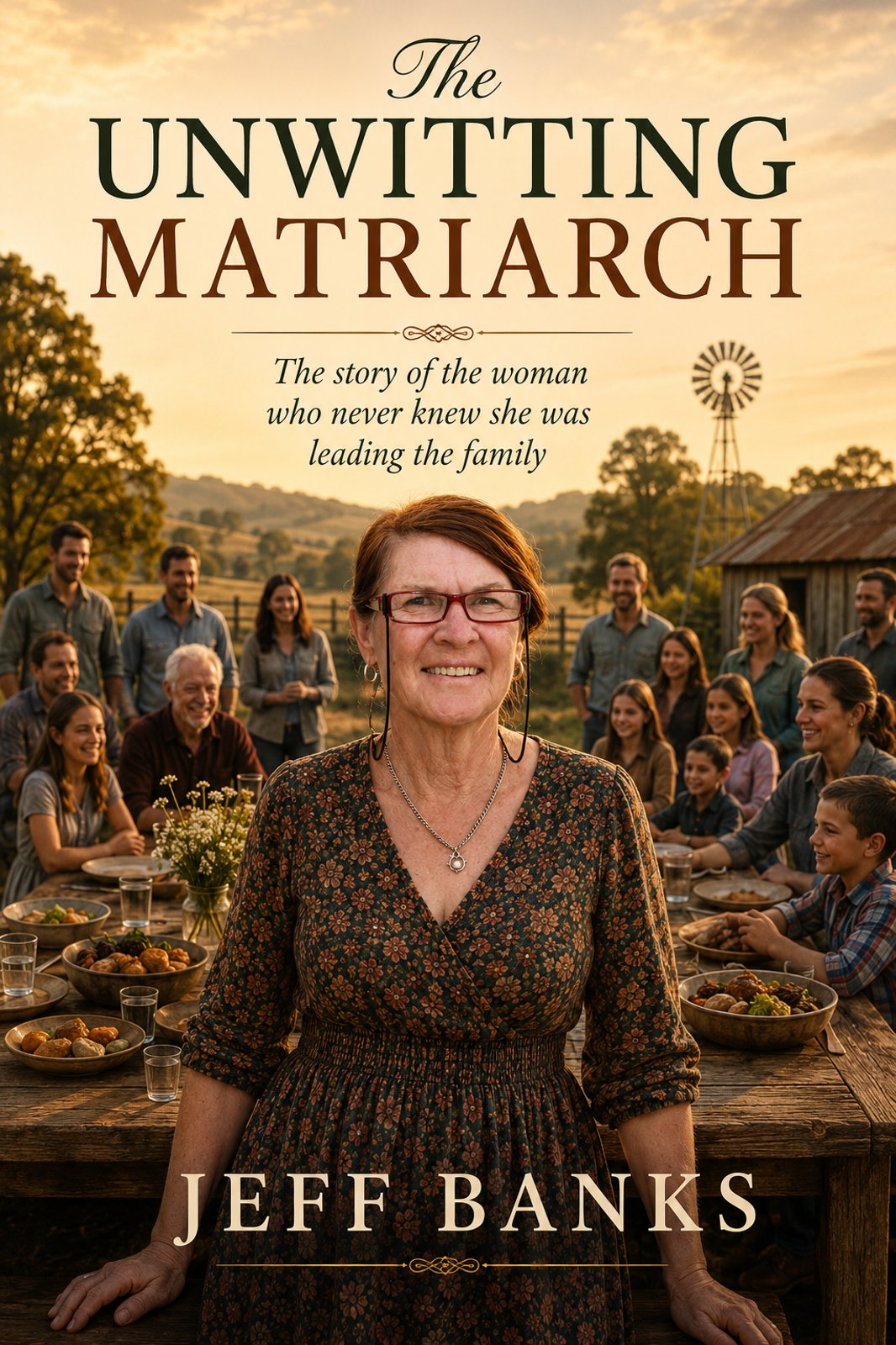
The Unwitting Matriarch Chapter 9 - Family Comes Home

The Unwitting Matriarch Chapter 9 - Family Comes Home | Travelling Around Australia with Jeff Banks

Together, Kerre and Lionel achieved something they probably never consciously set out to create. Their intention was simply to build a life and raise a family. Yet in pursuing those goals they also created a place that became woven into the identity of everyone who spent time there. Little Prairie gradually transformed from a property into a shared point of reference.

THE UNWITTING MATRIARCH

She never asked to lead. She simply never stopped showing up. 

Chapter 9 — Family Comes Home

People often think a home is finished when the last nail is hammered in, the final coat of paint dries or the furniture is carried through the front door. The older I become, the less I believe that is true. A house can be built in months, but a home often takes decades to fully emerge. The difference lies not in timber, bricks or roofing iron, but in the memories that slowly attach themselves to a place.

By the time Little Prairie was properly established, Kerre and Lionel had already endured most of the difficult years. They had survived the uncertainty that accompanies building a life from scratch, stretching every available dollar and solving problems that city people rarely encounter. The stories from those years certainly mattered, but they were not the stories most often retold. The memories that seemed to endure revolved around visitors, family gatherings and the gradual realisation that Little Prairie had become something larger than a family property.

The transformation happened so slowly that nobody appears to have noticed it occurring. Looking back through the conversations and stories, however, the change becomes obvious. Early memories focus on creating the place. Later memories focus on people coming to enjoy it. Without anybody deliberately planning it, Little Prairie was evolving into a destination.

One of the recurring names that appears throughout those years is Janice. Alongside Ron, she became part of the steady stream of family members who seemed drawn to the property. Sometimes they arrived for holidays. Sometimes they arrived for weekends. Occasionally they arrived for reasons that probably sounded sensible when they left home but became secondary once they reached Little Prairie. The destination itself was often the real attraction.

That says something important about the place Kerre and Lionel had created. People do not repeatedly travel significant distances merely because a property is attractive. Rural Australia contains countless attractive properties. What draws people back time and again is the feeling associated with a place. Little Prairie was becoming one of those rare locations that made people feel they belonged there.

Kerre played an enormous role in creating that atmosphere. Hospitality came naturally to her, although it rarely resembled the polished version celebrated in magazines or television programs. Nobody arrived to find elaborate table settings or carefully staged entertaining. Instead, visitors found food on the table, a bed if they needed one and an immediate expectation that they would become part of whatever happened to be occurring at the time.

That arrangement suited most people remarkably well. If there was firewood to collect, visitors helped collect it. If a gate required repairing, visitors found themselves holding tools. If someone was heading to the river, visitors climbed into vehicles and joined the adventure. Nobody remained a guest for very long because Kerre’s definition of family included participation. The quickest way to belong was to lend a hand.

There is something distinctly Australian about that philosophy. Many rural families operate according to an unwritten understanding that contribution creates connection. People who help become part of the story. They stop being visitors and start becoming participants. Looking back now, it is easy to see why so many people enjoyed spending time at Little Prairie. They were not simply observing family life. They were becoming part of it.

The fishing stories perhaps demonstrate this more clearly than anything else. Like most Australian families, the Banks family, my family, not unlike the Ferguson’s possessed a seemingly limitless capacity to discuss fish. Actual fishing occupied only a small portion of the overall experience. The remainder involved preparation, travel, storytelling, speculation and endless debate regarding what should have happened had someone listened to somebody else’s advice.

Nobody appears to have worried excessively about factual accuracy. In truth, accuracy often seemed to be viewed as an unnecessary obstacle to a good story. A cod that weighed ten pounds one year might weigh fifteen the following year. Another fish gradually increased in size every time it was mentioned. By the time some stories reached their fifth or sixth retelling, the fish involved appeared capable of swallowing small boats and possibly a family sedan.

The Murray cod occupied a particularly important position within those stories. Throughout rural Australia, cod have always possessed an almost mythical reputation. Every river allegedly contains giant specimens lurking beneath submerged logs. Every fisherman claims to know somebody who once landed an enormous fish. Every community contains at least one expert willing to explain the correct technique despite producing surprisingly little photographic evidence of their own success.

The cod stories at Little Prairie fitted comfortably within that tradition. One person would describe a fish that escaped at the last moment. Another would explain how they had seen something enormous moving beneath the water. A third would offer advice nobody had requested and which nobody intended to follow. Before long, the conversation had evolved into a performance where entertainment mattered considerably more than precision.

Kerre particularly enjoyed recalling the stories surrounding the old drum nets, known locally as square hooks. She would usually begin laughing before she reached the punchline because she knew exactly how ridiculous the whole thing sounded. The nets themselves were illegal, although that seemed to concern nobody very much at the time. Rural Australia often operated according to a set of practical rules that occasionally bore only a passing resemblance to legislation. If a method worked, had always worked and put food on the table, there was a good chance country people would continue using it regardless of what some distant authority might think.

What fascinated me about the story was not the fishing itself but the picture it painted of family life. Kerre described her sister Beverly and my mother Janice sitting beside the riverbank, a flagon of plonk between them, keeping an eye on the drum nets while the afternoon slowly drifted by. The image was presented as though it were completely ordinary, just another afternoon beside the water, but the more I listened to her tell it, the more I realised she was describing something far more significant.

By this stage of their lives, the women were carrying responsibilities that seemed to multiply every year. There were children to raise, houses to maintain, meals to prepare and bills to worry about. Life had a habit of closing in around women of that generation. Their worlds often became defined by what needed doing next, and there was always something that needed doing next. A few hours sitting beside a river with a sister, a drink and no immediate demands may have looked like fishing from the outside, but it was probably one of the few opportunities they had to simply breathe.

The drum nets provided the excuse. The river provided the destination. What they were really collecting was time for themselves.

Kerre never framed it that way. She laughed about the fishing and the stories that followed. Yet underneath the humour there was an obvious affection for what those afternoons represented. The women were escaping, if only temporarily, from lives that could often feel confining. Beside the river there were no washing baskets, no school lunches, no expectations and no schedules. There was only conversation, laughter and the comforting presence of people who understood exactly what life felt like because they were living it too.

Of course, the story endured because eventually something extraordinary happened. One afternoon the drum net trapped a cod so large that it could not actually fit back through the neck of the net. The fish had entered when it was smaller or had somehow forced its way in, only to discover that getting out was no longer an option. When the net was finally hauled from the water, the cod was wedged so tightly that extracting it became an event in itself.

The excitement that followed was apparently enormous. In country communities, particularly during those years, news of a large cod travelled almost as quickly as bad news. Before long everybody seemed to know about the fish. The story grew with every telling. The size increased. The difficulty of landing it increased, probably increased by the amount of “plonk” consumed at that time. The expertise of those involved improved dramatically with each retelling. For a brief period, catching that cod brought a level of prestige completely disproportionate to the act itself.

Kerre always told the story as though the fish was the centrepiece. The laughter, the bragging rights and the absurdity of a cod too large to fit through the trap all made for excellent entertainment. Yet even while recounting the tale, she invariably drifted back toward the people sitting on the bank. The fish may have provided the headline, but it was never really the heart of the memory.

What remained important decades later was not the cod. It was Janice and Beverly sitting beside the water sharing stories. It was the laughter floating across the river. It was the temporary freedom found in a few stolen hours away from responsibility. The fish was simply the proof that they had been there.

What is striking about many of those fishing stories is how rarely the fish themselves appear to have been the point. The real value came from the time spent together beside rivers and creeks. Hours sitting quietly waiting for fish to bite created opportunities for conversation that seldom occurred elsewhere. Without distractions, people talked. They discussed family, work, frustrations, dreams, childhood memories and the futures they imagined for themselves and their children. The fish merely provided a convenient excuse.

Looking back now, I suspect Kerre understood that better than anyone. The cod was memorable. The drum nets were colourful. The story was funny. What she treasured most, however, were those moments when sisters sat together beside a river and, for a little while, life loosened its grip enough to let them simply enjoy each other’s company.

That pattern appears repeatedly throughout the recollections associated with Little Prairie. Activities brought people together, but relationships were what kept them returning. The fishing trips became repositories for family history. Stories passed between generations. Old memories resurfaced. New memories were created. Long after details about individual catches had been forgotten, people still remembered who had been there.

The shooting trips followed a remarkably similar pattern. Modern readers sometimes forget how commonplace firearms once were throughout rural Australia. Hunting was viewed less as a specialised activity and more as another part of country life. For many families, shooting trips provided opportunities to spend time together outdoors while sharing experiences that became stories for years afterwards.

Once again, the activities themselves rarely occupied centre stage in the memories. Instead, people recalled the preparation, the travel and the inevitable mishaps that accompanied any group excursion. Somebody always forgot something important. Somebody inevitably packed too much. Directions were occasionally misunderstood. Vehicles became bogged. Equipment failed at inconvenient moments. The actual shooting often seemed to occupy less space in memory than everything surrounding it.

That tendency reveals an important truth about how families remember their lives. Events themselves frequently fade into the background. What survives are the emotions attached to them. People remember laughter, embarrassment, triumph and companionship. They remember the people who were present far more clearly than they remember the practical details of what occurred.

Family holidays added another layer to the growing mythology of Little Prairie. Nobody speaks about expensive accommodation, luxury resorts or lavish spending. Those things were never central to the experience. Instead, the stories revolve around campfires, shared meals, fishing expeditions and evenings spent talking long after darkness settled across the property, fighting the endless flies, mosquitoes and the inability to rise once the alcohol took effect on some.

In truth, many of the most treasured memories had very little to do with holidays at all. They revolved around gatherings. Throughout the Ferguson family there existed an almost instinctive tendency to gather around food. It did not matter whether the occasion was important or completely ordinary. If people were coming together, there would be a meal. If there was a meal, there would be conversation. If there was conversation, there would eventually be laughter, arguments, storytelling and somebody reminding everyone of something embarrassing that had happened twenty years earlier.

The tables themselves often became part of the event. One table was rarely enough. Two tables would be pushed together and then another added on the end. Chairs would appear from bedrooms, verandahs and wherever else they could be found. Children sat wherever there was room while adults squeezed themselves into spaces that seemed physically incapable of accommodating another person. Somehow everybody fitted and, more remarkably, everybody appeared happy to be there.

Looking back, those gatherings resembled organised chaos. Conversations travelled in every direction at once. One end of the table might be discussing family history while the other debated football. Somebody would be telling a joke while somebody else corrected a story that had already been exaggerated beyond recognition. The older generation would occasionally shake their heads at the younger generation while the younger generation pretended not to notice. Meals could stretch for hours because eating was never really the primary purpose.

The meal was simply the excuse. The real purpose was connection. Food brought people together, but it was the stories, laughter and companionship that kept them sitting there long after the plates had been cleared away. Looking back now, it becomes obvious that the family understood something many people miss. The value of a gathering is rarely measured by what is served. It is measured by who is sitting around the table.

That same spirit extended well beyond meal times. Card games became a regular feature of family gatherings and, on the surface, they appeared fiercely competitive. Voices became louder. Rules were debated. Accusations of cheating were thrown around with alarming frequency. Victories were celebrated enthusiastically while defeats were met with dramatic complaints about bad luck, or suspiciously fortunate opponents.

The remarkable thing was that nobody ever seemed particularly concerned about the actual result. The competition was genuine enough, but winning was secondary to participation. The card game provided an activity around which people could gather. It gave structure to the conversation and created another excuse to spend an extra hour together. Looking back, I suspect many participants could not have remembered who won most games by the following morning. What they remembered was who had been there.

Even the simple act of sharing a cup of tea carried significance within the family. Visitors arriving unexpectedly would almost immediately hear the familiar question asking whether they wanted a cuppa. The question was less a request than a declaration of intent. Refusing generally triggered further encouragement until acceptance became the easiest option. The tea itself mattered very little. The invitation mattered enormously.

That tradition stretched back long before Little Prairie. One story from the Alldis Street days became family legend and was still being retold decades later. My father, attempting to be helpful, decided to clean the kettle sitting permanently on the wood fired stove. To most people, cleaning a kettle would seem an entirely sensible thing to do. To the Ferguson family, however, he had unknowingly committed an act bordering on vandalism.

The kettle had been in constant use for years. Countless handfuls of Bushells tea had passed through it, which was the point of cleaning it, it was full, gradually building a rich dark coating inside. To outsiders it may have appeared stained. To the family it represented something entirely different. It was history. It was tradition. It was evidence of thousands of conversations shared over cups of tea. When Dad proudly presented the newly cleaned kettle, expecting gratitude for his efforts, the reaction was not what he anticipated.

According to family lore, he received a severe dressing down. The story was always told with great delight because his mistake was so innocent and yet so catastrophic in the eyes of those involved. Handful after handful of Bushells tea reportedly had to be brewed through the kettle to restore its proper colour. The family reacted as though an irreplaceable heirloom had been damaged. Looking back now, the humour lies not in the kettle itself but in what it represented.

The tea never really mattered. The people drinking it mattered. The kettle was simply the centrepiece around which conversations occurred. It sat ready for neighbours dropping by, relatives calling in or friends arriving without notice. It symbolised a standing invitation to stop for a while, sit down and become part of whatever conversation happened to be unfolding.

That lesson appears to have been learned very early and carried forward throughout the decades. Little Prairie eventually became another version of exactly the same tradition. The campfires replaced some of the kitchen tables. The fishing trips replaced some of the afternoon visits. The property itself became the gathering place rather than a house in Alldis Street. Yet the underlying principle remained unchanged.

People came together because they genuinely enjoyed being together. Nobody needed an elaborate reason. Nobody required a special occasion. Sometimes a fishing trip was enough. Sometimes a card game was enough. Sometimes a cup of tea was enough. The activity mattered far less than the opportunity to gather.

By contemporary standards, some of those holidays and gatherings might appear remarkably simple. Yet simplicity often creates stronger memories than extravagance. Children remember adventures rather than expenditure. Adults remember companionship rather than comfort. Looking back across decades, very few people can accurately recall the cost of a holiday, but they can often remember exactly who sat beside them around a campfire, who partnered them in a card game, who shared a laugh over a cup of tea and who occupied the chair beside them at one of those long tables stretching across a room full of family.

Perhaps that is why those memories endure so powerfully. The holidays, the meals, the card games and the endless cups of tea were never really separate events. They were all expressions of the same family instinct. The Ferguson family gathered because gathering was simply what Ferguson families did. Whether around a kettle in Alldis Street or a campfire at Little Prairie, they understood something that many people spend a lifetime chasing.

The greatest luxury was never the destination and it was never the meal. The greatest luxury was the people waiting there when you arrived, ready to pull up another chair, pour another cup and make room for one more person at the table.

Little Prairie offered something that increasingly seems rare. It provided room for people to simply exist together without pressure or expectation. There was always something happening, but there was never any requirement to perform. Visitors did not need to impress anybody. They could simply arrive, participate and enjoy being part of the family.

Much of that atmosphere came directly from Kerre. She was not sentimental in an obvious or theatrical way. Expressions of affection were generally practical rather than verbal. Meals appeared when people were hungry. Beds were organised when visitors stayed overnight. Problems were addressed when they arose. Her care revealed itself through actions rather than speeches.

Looking back through the stories, it becomes increasingly difficult to separate Little Prairie from Kerre herself. The property reflected many of her qualities. It was practical, welcoming, resilient and unpretentious. Visitors felt comfortable because the people who lived there made comfort possible. The land may have provided the setting, but the relationships provided the warmth.

Lionel contributed in a quieter manner. Like many country men of his generation, he rarely felt compelled to dominate conversations or draw attention to himself. Instead, he offered something equally valuable. People knew where they stood with Lionel. They trusted him. They relied upon him. Those qualities rarely generate headlines, but they create foundations upon which families are built.

Together, Kerre and Lionel achieved something they probably never consciously set out to create. Their intention was simply to build a life and raise a family. Yet in pursuing those goals they also created a place that became woven into the identity of everyone who spent time there. Little Prairie gradually transformed from a property into a shared point of reference.

Every fishing trip contributed another story. Every shooting weekend added another layer. Every holiday produced memories that would later be retold around different tables in different towns. The accumulation occurred slowly, but it never stopped. Year after year, the property became more deeply embedded within family history.

Eventually Little Prairie ceased belonging solely to Kerre and Lionel in an emotional sense. Legally it remained their property, but family members carried pieces of it wherever they went. Children grew into adults who told stories about weekends spent there. Grandchildren heard tales about giant cod, impossible adventures and family gatherings that seemed larger than life. The property existed simultaneously as a real place and as part of family mythology.

That may be the highest achievement any home can accomplish. Buildings eventually age, ownership changes and circumstances evolve. What survives are the memories attached to those places. What survives are the stories people continue telling long after the events themselves have passed into history.

Looking back now, it seems clear that Little Prairie crossed an invisible threshold during those years. The house remained in the same location and the paddocks looked much as they always had. Yet something fundamental had changed. The property was no longer simply where Kerre and Lionel lived.

It had become where family gathered, where stories were created and where memories accumulated. More importantly, it had become the place people thought about when they wanted to come home. That distinction transformed Little Prairie from a successful family property into something far more enduring, ensuring its place not merely in the landscape but within the history of the family itself.

Author

Menu