

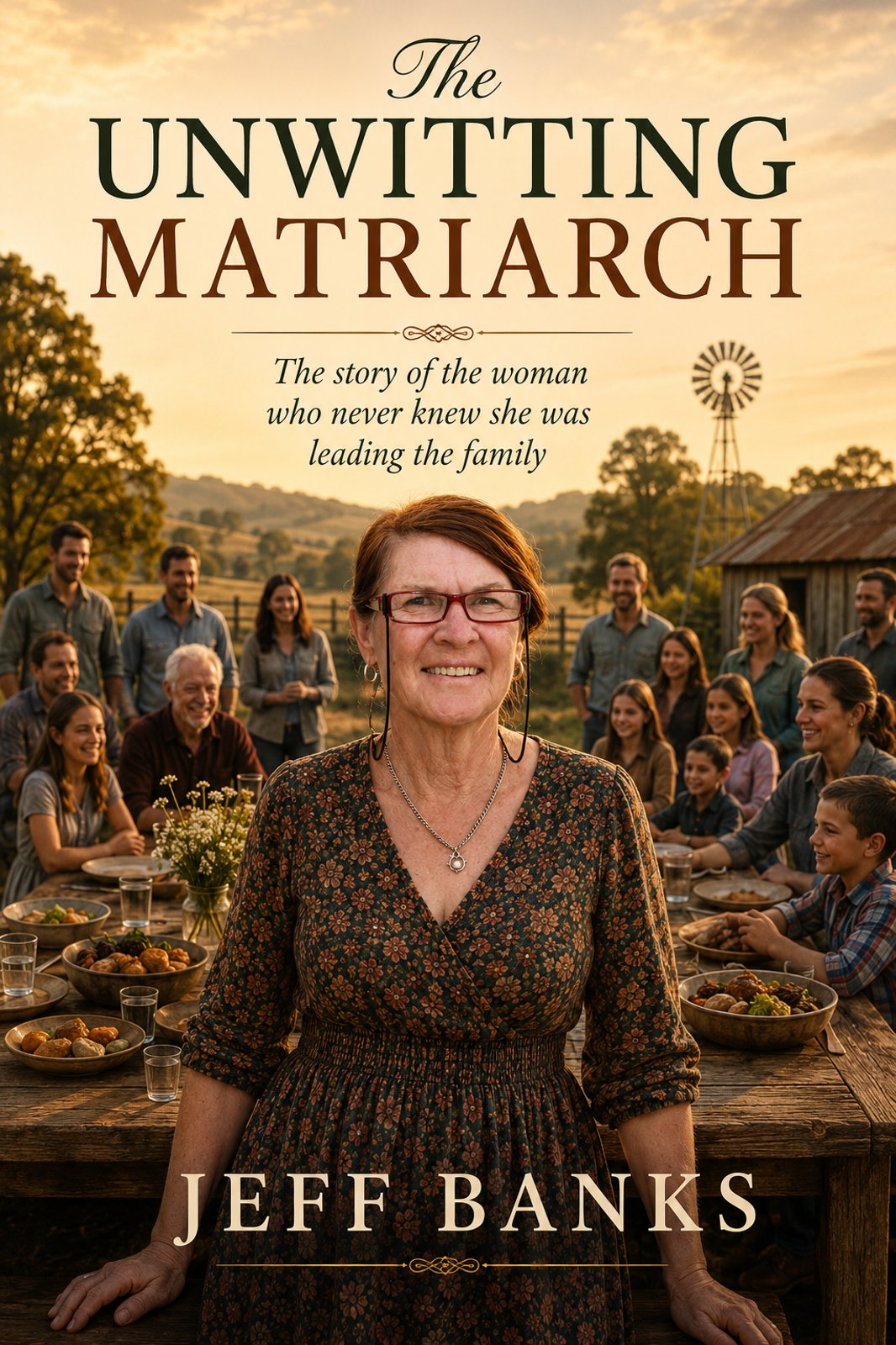
The Unwitting Matriarch Chapter 8 - The House That Shouldn't Exist

The Unwitting Matriarch Chapter 8 - The House That Shouldn't Exist | Travelling Around Australia with Jeff Banks

Kerre may never have described herself as ambitious in the conventional sense, yet she possessed a powerful instinct for permanence. Throughout her life she demonstrated a desire to establish things that would endure, whether those things were friendships, traditions or expectations. Once something became part of Kerre's world, she generally expected it to remain there and grow stronger with time.

THE UNWITTING MATRIARCH

She never asked to lead. She simply never stopped showing up. 

Chapter 8 — The House That Shouldn’t Exist

If there is a single place that sits at the centre of this family’s history, it is not Kiacatoo, the school, the shearing sheds or the little towns that drift in and out of these stories. It is a property that, by all reasonable measures, should never have existed at all. At least that is how the story was always told to me whenever conversations turned toward the place that eventually became the heart of the family.

The older I became, the more I realised that Little Prairie was not simply a house built on a piece of land. It was the result of hundreds of decisions, sacrifices and risks that sensible people might well have avoided. It was born from optimism, stubbornness, hard work and a refusal to accept that something could not be done simply because it looked difficult.

Every family has stories about where they lived and the houses they called home. This family has stories about creating the place where they would live. There is an important difference between inheriting a home and building one, because the act of construction becomes part of the family history itself and becomes woven into every story that follows.

By the time Lionel and Kerre started talking seriously about building a home of their own, they were already discovering the realities of married life. The excitement of courtship, at times “living in sin”, had gradually been replaced by practical concerns such as money, employment and future plans. Like most young couples of their generation, they quickly learned that dreams were one thing and paying for them was something entirely different.

One of the stories that surfaced repeatedly during our conversations concerned the weekly rent. The figure itself sounds almost unbelievable today. Forty-five dollars a week was enough to put a roof over their heads, yet that forty-five dollars became the centre of a much bigger discussion about the sort of future they wanted to create.

Kerre looked at the rent and saw waste. Every Friday another forty-five dollars disappeared, and the following Friday it disappeared again. In her mind, they were working hard simply to make somebody else wealthier while they remained exactly where they were.

The argument seemed perfectly logical to her. At the end of twelve months they would have paid thousands of dollars and owned nothing to show for it. The house would still belong to somebody else, while their future remained dependent upon continuing to hand over money week after week.

Lionel viewed the situation through an entirely different lens. He did not see wasted money so much as he saw certainty. The rent might have been frustrating, but it was manageable, predictable and carried very little risk.

Like many country men of his generation, Lionel had been raised to think carefully before taking on debt. He understood what happened when people borrowed more than they could comfortably repay. Rural communities were full of stories about families who had been caught by drought, illness, unemployment or unexpected expenses, and he had no desire to become one of those stories himself.

Neither of them was wrong. They were simply looking at the same problem from different directions. Kerre was focused on what they could gain, while Lionel was focused on what they could lose.

The conversations apparently resurfaced time and again. They were not dramatic arguments marked by raised voices or ultimatums. Instead they were the sort of discussions that take place around kitchen tables throughout Australia, quietly returning every few weeks until eventually a decision is reached.

Kerre would come back to the same point. If they could afford to pay forty-five dollars a week in rent, why could they not afford to pay forty-five dollars a week toward a loan of their own? The logic seemed impossible to ignore because every payment would bring them one step closer to owning something rather than merely occupying it.

Lionel would respond with the practical concerns that sensible people often carry. What if work became scarce? What if interest rates increased? What if they started building and found themselves unable to finish? Every possibility seemed to carry consequences that could affect not just them but any family they hoped to raise in the future.

What makes the story interesting is that both of them were ultimately pursuing exactly the same objective. Both wanted security. Both wanted stability. Both wanted a future that was better than the present.

The difference lay in how they defined security. Kerre believed security came from ownership because nobody could take away something that belonged to you. Lionel believed security came from caution because a family that avoided unnecessary risk was less likely to lose everything they had worked for.

As I listened to the story, it struck me that this small disagreement revealed much about the partnership that would define the rest of their lives. Kerre was often the one looking over the next hill, imagining what might be possible if they were prepared to take a chance. Lionel was often the one making sure they had enough fuel, enough supplies and enough common sense to survive the journey.

Eventually the discussion began to change. The question stopped being whether they should build a house and gradually became how they might build one. That shift may sound insignificant, but it represented the moment a dream stopped being a dream and started becoming a plan.

Once the decision was made, the future suddenly became tangible. Conversations about possibilities gave way to discussions about blocks of land, building materials and finances. Ideas that had previously existed only in their imagination began finding their way onto paper and into action.

Of course, making the decision to build a home and actually building one were two entirely different matters. Like many young couples with more ambition than money, Lionel and Kerre quickly discovered that dreams are often constructed in stages. Before they could enjoy the comforts of their own home, they first had to endure the realities of getting it built.

That meant continuing to live with Lionel’s parents.

In fairness, there were advantages to the arrangement. Every week they remained there was another week they could save money rather than spend it. Every dollar not devoted to rent or unnecessary expenses became another small contribution toward the materials, fittings and countless unexpected costs that seemed to accompany every stage of construction.

The practical benefits, however, did not necessarily eliminate the challenges. Any family that has ever attempted to fit multiple generations under one roof understands the delicate balancing act involved. Everybody may love one another dearly, but affection does not magically create extra bedrooms, extra bathrooms or extra privacy.

The stories were never told with bitterness. In fact, most of the memories are recounted with laughter these days. Even so, there was an underlying understanding that the arrangement worked best because everybody involved knew it was temporary and because everybody was working toward the same goal.

For Kerre especially, the experience must occasionally have tested her patience. She had already spent much of her life living according to other people’s rules, whether those rules belonged to parents, employers or circumstances. Like any young wife eager to establish her own household, she wanted a kitchen that was hers, decisions that were hers and a front door she could close on a life that belonged entirely to her own family.

Those frustrations were balanced by the excitement of watching progress unfold. Week after week, the dream slowly emerged from the paddock. What had once been lines on paper gradually transformed into foundations, walls and rooms. Each completed task made the inconvenience of temporary living arrangements a little easier to tolerate because they could physically see what they were working toward.

The actual construction became a family effort in the truest sense of the word. Lionel and his father undertook much of the building themselves, investing not only money but countless hours of labour into the project. In an era before specialised contractors seemed available for every conceivable task, people often relied upon determination, borrowed knowledge and a willingness to learn as they went.

Kerre was hardly a passive observer throughout the process. Like many country women of her generation, she simply did whatever needed doing. Whether carrying materials, assisting where she could, organising meals or helping keep the project moving forward, she became part of the construction story as surely as Lionel and his father.

The house itself did not appear all at once. Instead it emerged in stages, each stage bringing them incrementally closer to independence. The first objective was not perfection or luxury. The first objective was simply to create something that was livable.

Looking back from today’s perspective, the early version of the home might have appeared modest. There were undoubtedly compromises, unfinished sections and a long list of improvements still waiting for future attention. Yet none of those shortcomings mattered very much because the most important feature had already been achieved.

It was theirs.

The walls may not have been exactly as they wanted. The rooms may not have been as large as they would eventually become. The fittings may not have reflected the vision they ultimately held for the property. None of that diminished the sense of achievement that came from standing inside a structure built largely with their own hands.

For the first time, Kerre and Lionel were no longer dreaming about a future home. They were living inside the beginning of it. What existed on the property was not merely a house under construction but physical proof that sacrifice, patience and persistence had been worthwhile.

The irony is that nobody looking at that modest first stage could possibly have understood what it would eventually become. They saw a young couple moving into a simple country home that was still very much a work in progress. What they could not see was that they were witnessing the first chapter in the creation of Little Prairie, the place that would eventually become the centre of gravity for an entire family.

Looking back now, knowing what Little Prairie would eventually become, it is difficult not to appreciate the significance of that forty-five dollars. What appeared to be a simple weekly expense became the catalyst for one of the most important decisions the family would ever make. Entire generations of memories can sometimes be traced back to surprisingly small beginnings.

Had Lionel’s caution prevailed forever, Little Prairie may never have existed. Had Kerre’s determination eventually faded, the idea may have remained nothing more than a pleasant conversation. Instead, somewhere between Lionel’s conservatism and Kerre’s optimism, the impossible slowly began to look achievable.

That was the moment the house that should not have existed first came into being. It did not begin with concrete, timber or bricks. It began with two people sitting around a table, looking at the same forty-five dollars and imagining two very different futures until they finally found a way to build one together.

Their first years together did not begin in a spacious country home surrounded by paddocks and family memories. Instead, they lived with Lionel’s parents while they tried to establish themselves and save enough money to take the next step. Such arrangements were common at the time and rarely attracted the attention they might today, because practicality usually carried far more weight than personal preference.

Modern readers sometimes struggle to appreciate how different life was in regional Australia during that era. Independence was certainly valued, but it was not worshipped in the way it often is today. Families helped one another because there were few alternatives, and young couples frequently accepted temporary sacrifices if they believed those sacrifices would eventually lead to something better.

Living with Lionel’s parents provided security and support, but it also highlighted an unavoidable truth. No matter how welcome a young couple might feel, there remains a deep desire to create a place that belongs entirely to them. The dream was never simply about walls and a roof, but about creating a future that carried their own identity and reflected their own values.

Kerre may never have described herself as ambitious in the conventional sense, yet she possessed a powerful instinct for permanence. Throughout her life she demonstrated a desire to establish things that would endure, whether those things were friendships, traditions or expectations. Once something became part of Kerre’s world, she generally expected it to remain there and grow stronger with time.

That tendency explains much about what happened next. A temporary arrangement was never likely to satisfy somebody whose instinct was always to build rather than merely occupy. At some point the discussions shifted from vague dreams into practical plans, and the possibility of building their own home began to feel achievable.

What sounds straightforward when told decades later was anything but straightforward at the time. Money was limited, resources were limited and experience was limited, yet determination seemed to exist in endless supply. Looking back, it is difficult not to admire the confidence of young people who often knew just enough to begin but not enough to fully appreciate the scale of what they were attempting.

The process of building the house became one of those family stories that grew larger with each retelling. Different people remembered different details, with some focusing on the construction itself while others remembered the setbacks, delays or moments of good fortune. Despite the variations, every version of the story shared a common theme, which was that nobody involved appeared especially interested in being told why the project could not succeed.

That may well have been their greatest advantage. People who fully understand every obstacle often convince themselves not to start. People who possess just enough confidence to begin sometimes accomplish extraordinary things simply because they refuse to stop.

Author

Menu