

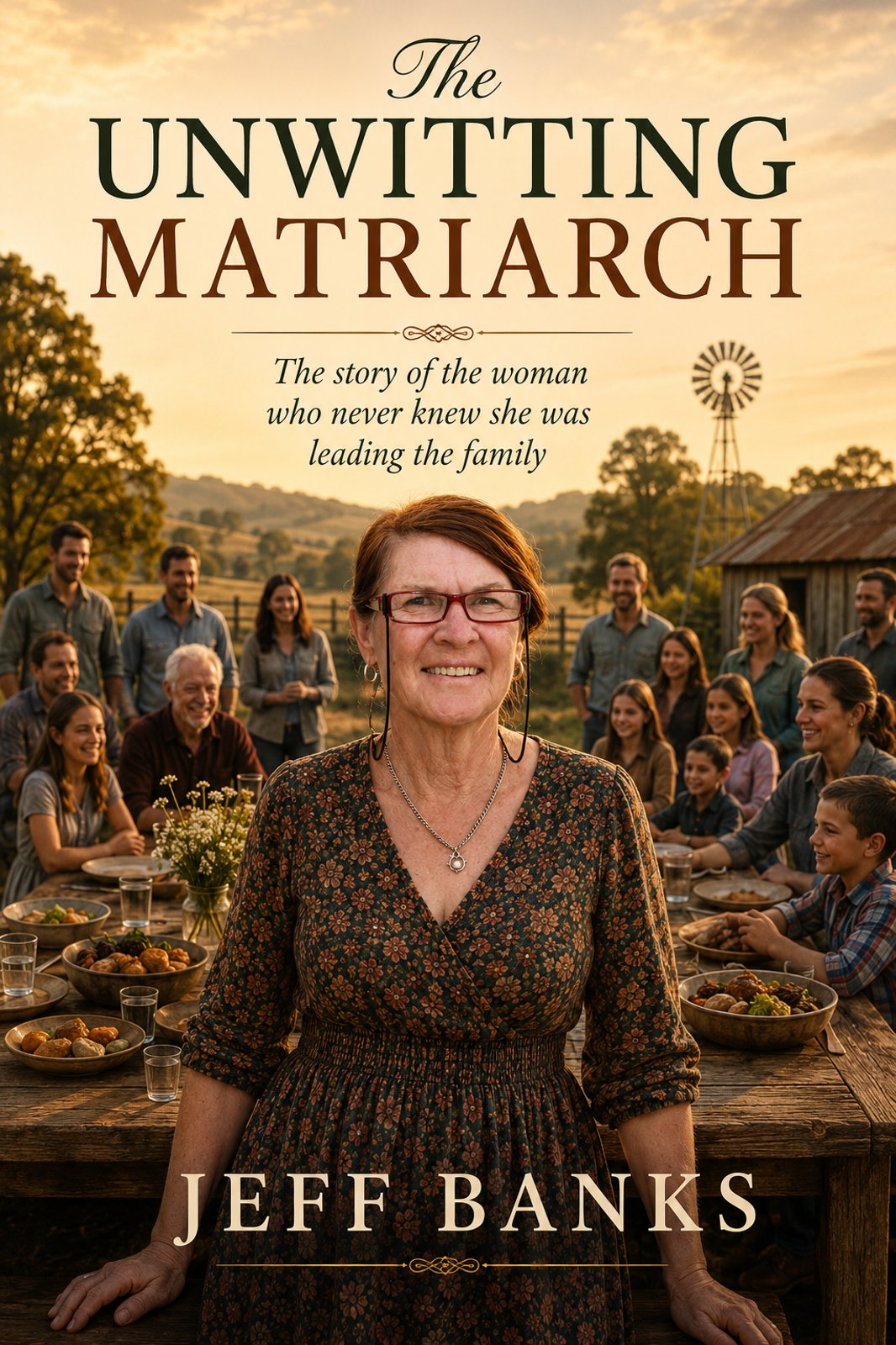
The Unwitting Matriarch Chapter 7 - Sheep, Foxes and Babies

The Unwitting Matriarch Chapter 7 - Sheep, Foxes and Babies | Travelling Around Australia with Jeff Banks

The result was an environment where belonging felt assumed rather than negotiated. Nobody needed an invitation to be family and nobody required formal approval to participate in family life. The expectation was that people would help where they could, contribute what they had and leave the place a little better than they found it. At first glance these appear to be stories about sheep, foxes, shearing sheds and farm work. Look more closely and a different picture emerges. What Kerre was really describing was the construction of a family culture. Every muster, every visitor, every shared meal and every day spent working alongside one another added another thread to the fabric.

THE UNWITTING MATRIARCH

She never asked to lead. She simply never stopped showing up. 

Chapter 7 — Sheep, Foxes and Babies

By the time Kerre and Lionel arrived at Kiacatoo, she was already developing the reputation that seemed destined to follow her throughout childhood. She was the girl who wandered off when everyone else stayed put, the child who seemed entirely comfortable in situations that caused adults considerable anxiety, and the young person whose curiosity routinely outran her common sense. Fortunately for her, Kiacatoo was exactly the sort of place where curiosity could survive and even flourish.

Many of the stories Kerre told me about those years were not dramatic in the way modern audiences might expect. There were no grand tragedies, no remarkable fortunes won or lost, and no life-changing revelations delivered at exactly the right moment. Instead, there were sheep, dust, dogs, horses, machinery, weather and work. Looking back, it becomes apparent that rural Australia rarely educated through speeches. It educated through participation.

Kiacatoo was not merely where the family lived. It was where life happened. The property itself became both playground and classroom, creating experiences that would shape Kerre’s view of family, responsibility and resilience for decades to come. Many of the lessons she carried into adulthood were first learned there, often without anyone realising they were teaching them.

One of the stories that surfaced repeatedly involved mustering sheep. To many modern Australians, the idea sounds almost romantic because popular culture has conditioned people to imagine sweeping landscapes, skilled horsemen and some kind of cinematic rural adventure. The reality, according to Kerre, was considerably less glamorous and considerably more exhausting. Mustering involved long hours, dust, noise and constant attention to detail.

Sheep demonstrated a remarkable ability to move in exactly the wrong direction at precisely the wrong time. Gates that needed to be open were closed. Gates that needed to remain closed somehow found themselves open. Dogs developed opinions of their own and horses occasionally shared those opinions. Human beings spent large portions of the day attempting to convince hundreds of animals that moving from one paddock to another was somehow in everyone’s best interests.

The remarkable thing was that children were simply expected to be part of it all. Nobody seemed particularly concerned about whether an activity was suitable for children or whether someone might become tired, dirty or uncomfortable. If work needed doing, children found themselves involved. That attitude was not viewed as unusual. It was viewed as normal.

Looking back through modern eyes, some of the situations sound as though they would trigger immediate intervention from several government departments. At the time, however, they were simply part of everyday life. Nobody considered them extraordinary because everyone around them was living exactly the same way. Rural families did what needed to be done with the resources they had available.

One story that became family folklore involved Tammy. As the story was told to me, Tammy spent part of her earliest years riding around in a basket attached to farm machinery while work continued around her. Nobody seemed to view this arrangement as particularly extraordinary because the adults needed to complete the task at hand and the baby needed supervision. The solution was not to stop work. The solution was to bring the baby along.

The image remains wonderfully Australian and perfectly captures the practical nature of rural life. There is something almost comical about imagining a small child bouncing across paddocks while adults concentrated on stock movements, fences and machinery. Yet beneath the humour sits a deeper truth about farming families. Everybody participated because everybody mattered.

Children were not separated from family life and placed into some protected category of existence. They were woven directly into the fabric of daily living. From the moment they could walk, they became observers of work, responsibility and cooperation. Before long they became participants as well. The distinction between family life and working life barely existed.

That philosophy created bonds that are often difficult to explain to people raised in more structured environments. The city frequently divides life into compartments. There is work time, family time, recreation time and social time. Rural life often ignores those distinctions altogether and allows them to merge into one continuous experience.

Children learned responsibility not through instruction manuals or carefully planned educational exercises but through observation. They discovered that contribution mattered because they watched it matter every day. They learned that everybody had a role and that family survival often depended upon everyone doing their part. Those lessons became ingrained long before they could fully understand them.

The fox hunting stories reveal a similar reality. Modern audiences often hear the phrase and immediately picture sport or recreation. The people who lived through it generally viewed the matter differently because foxes represented a genuine threat to livestock. They were not abstract environmental discussions or political talking points. They were predators capable of causing real financial damage to farming families already operating on narrow margins.

As a result, dealing with foxes became another ordinary part of life. Kerre’s recollections suggested that the excitement often had less to do with the fox itself and more to do with the adventure surrounding the hunt. Horses, dogs, rifles, vehicles and neighbours frequently became involved. What began as a practical necessity often evolved into a community event.

Like many rural activities, fox hunting served several purposes simultaneously. The practical objective involved protecting stock and preserving income. The unofficial objective involved strengthening relationships between neighbouring families. People who worked together regularly found reasons to spend time together, exchange stories and share information.

Children formed friendships while adults exchanged news. Information travelled across properties long before mobile phones and social media made communication effortless. Local events, family developments and community concerns were often discussed during these gatherings. The hunt became merely the excuse that brought people together.

The shearing sheds occupied a similar position within the rural landscape. To outsiders, a shearing shed is simply a workplace where wool is removed from sheep. To those raised around them, they were something much more significant. They functioned as gathering places, information exchanges and social centres that connected entire districts.

Stories travelled through shearing sheds. Rumours travelled through shearing sheds. Community history travelled through shearing sheds. People arrived carrying news and departed carrying even more. The sheds became an informal communication network long before anyone dreamed of the internet.

Kerre often spoke about the atmosphere as much as the work itself. The smell of wool, the constant movement, the noise of machinery and the endless conversations combined to create an environment unlike anything found in urban Australia. Children drifted in and out of adult discussions, absorbing fragments of information and developing an understanding of community long before they appreciated what they were learning.

The sheds taught another lesson that would remain with Kerre for the rest of her life. Nobody cared very much about status. The person owning the property, the shearer, the rouseabout and the neighbour dropping in for a conversation all occupied the same physical space. Respect came less from titles and more from competence.

People quickly developed reputations based upon whether they worked hard, kept their word and contributed when help was needed. Those values would remain with Kerre long after she left Kiacatoo behind. They help explain why she was never especially impressed by credentials alone and why she judged people primarily by their actions rather than their promises.

One of her favourite Kiacatoo stories illustrates that attitude perfectly because it combines practical knowledge, stubborn confidence and the very Australian pleasure of eventually being proven right. It is also one of those stories that still made her laugh decades later, partly because of what happened and partly because of who it happened to.

At the time, Robbie Cheatham managed Kiacatoo and had become a close family friend, while they lived and worked on the property. Lionel had established a reputation for being capable with machinery and regularly operated the station’s bulldozers and heavy equipment. Clearing country was a major undertaking in those days, involving enormous chains stretched between two bulldozers which were then driven across the landscape, ripping out scrub and timber. Vast areas of rough country could be transformed into productive farming land through sheer mechanical power and determination.

According to Kerre, Lionel and Robbie were moving one of the bulldozers from one paddock to another. The route required crossing an old creek bed that had probably carried water countless times over the years. Looking at the ground ahead, Kerre casually asked a question that seemed perfectly reasonable to her. She wondered whether the bulldozer might become bogged if it attempted the crossing.

The response was immediate and delivered with complete certainty. Both Robbie and Lionel assured her that bulldozers did not bog. After all, this was not some lightweight vehicle likely to become stuck in a puddle. This was a massive machine, a D8, fitted with tracks, carrying enormous weight and specifically designed to work in difficult terrain. From their perspective, the suggestion appeared almost laughable.

Kerre, however, remained unconvinced. Whether it was instinct, observation or simply the practical wisdom that comes from spending years around the land, something told her the creek bed might have other ideas. She did not argue the point for long because there was little purpose debating men who were absolutely certain they knew the answer. Instead, she simply watched events unfold.

What happened next became family folklore.

The bulldozer entered the creek crossing and immediately began sinking. At first there was probably little concern because heavy machinery often settles slightly into soft ground. The problem was that it did not stop settling. The machine continued dropping lower and lower as the weight forced it deeper into the mud. Before long it was obvious that Kerre’s question had been far more insightful than anyone had given her credit for.

The bulldozer eventually sank so deeply that the nose of the machine was buried almost to the radiator cap. Every attempt to free it only seemed to worsen the situation. The tracks churned the mud. The machine dug itself deeper. The harder they worked to escape, the more securely trapped the bulldozer became.

A series of increasingly ambitious rescue attempts followed. Railway sleepers were tied to the tracks in the hope of providing additional grip and traction. Engines roared, machinery strained and men applied every solution they could imagine. None of it worked. The bulldozer appeared entirely committed to becoming a permanent fixture within the creek bed.

As Kerre told the story, the spectacle became almost comical. Here was this enormous machine, operated by experienced men who had confidently declared it impossible to bog, disappearing deeper into the earth with every attempt to rescue it. The land was delivering a lesson in humility and doing so with considerable enthusiasm.

Eventually the situation became so serious that larger equipment had to be brought in. Massive tractors and two D9 bulldozers were called upon to recover the stranded D8. What had begun as a routine movement between paddocks evolved into a major operation involving significant machinery, considerable effort and no doubt a fair amount of embarrassment for those who had originally dismissed Kerre’s concerns.

When the bulldozer was finally extracted, dirty, battered and thoroughly defeated, Kerre enjoyed the moment she had earned. She had not spent the day reminding everyone she had been right. She had not argued endlessly before the crossing. She had simply watched events unfold and allowed reality to make her case for her.

Only afterwards did she deliver the line that became the punchline to the entire story. Looking at the men responsible, she was able to ask with complete satisfaction whether a bulldozer could still not be bogged. By then there was very little room left for debate.

The story reveals something important about Kerre because it was never really about the bulldozer. It was about the quiet confidence that would become one of her defining characteristics. She possessed an instinctive understanding of practical realities and an ability to spot potential problems before others recognised them. She was not interested in proving herself smarter than everyone else, but neither was she intimidated by people who believed they knew more than she did.

Perhaps that is why the story remained one of her favourites. Beneath the humour sits a lesson she would encounter repeatedly throughout life. Confidence is useful, experience is valuable and expertise certainly has its place, but common sense remains a powerful thing. Every now and then the person asking the simple question turns out to be the person who understood the situation best all along.

Kiacatoo also introduced another recurring feature of family life. Visitors appeared regularly throughout many of Kerre’s stories, particularly members of the Banks family. Some arrived for work, some arrived for social visits and some appeared to arrive for reasons that nobody entirely understood. What remained consistent was the sense that family connections extended well beyond immediate households.

People came and went with a freedom that seems almost foreign today. Accommodation was found, meals appeared and conversations unfolded. Children gained new playmates and fresh opportunities for mischief while adults settled into discussions that could continue long into the evening. The practical challenges of hosting visitors never seemed sufficient reason not to welcome them.

Listening to those stories, I often found myself reflecting on how different family life has become, especially given I was a part of some of the stories. Modern families frequently require calendars, invitations and electronic reminders before gathering together. Many of the relationships described in Kerre’s stories operated through a much simpler system. People simply turned up and the family adjusted accordingly.

The result was an environment where belonging felt assumed rather than negotiated. Nobody needed an invitation to be family and nobody required formal approval to participate in family life. The expectation was that people would help where they could, contribute what they had and leave the place a little better than they found it.

At first glance these appear to be stories about sheep, foxes, shearing sheds and farm work. Look more closely and a different picture emerges. What Kerre was really describing was the construction of a family culture. Every muster, every visitor, every shared meal and every day spent working alongside one another added another thread to the fabric.

The unwitting matriarch was not being formed through dramatic events or life-changing moments. She was being shaped through ordinary days and ordinary responsibilities. The sheep needed moving, the foxes needed chasing, the sheds needed working and the babies needed carrying. Nobody involved imagined they were building a philosophy for life, yet that is exactly what they were doing.

Long before Kerre became the woman her family would rely upon, long before she became the steady centre around which generations would eventually orbit, Kiacatoo was quietly teaching her lessons she would carry forever. Family was not something that existed only in words. Family was something demonstrated through actions, obligations and shared experiences. On a dusty property filled with sheep, foxes, babies and endless work, she was learning that lesson one day at a time.

Author

Menu