

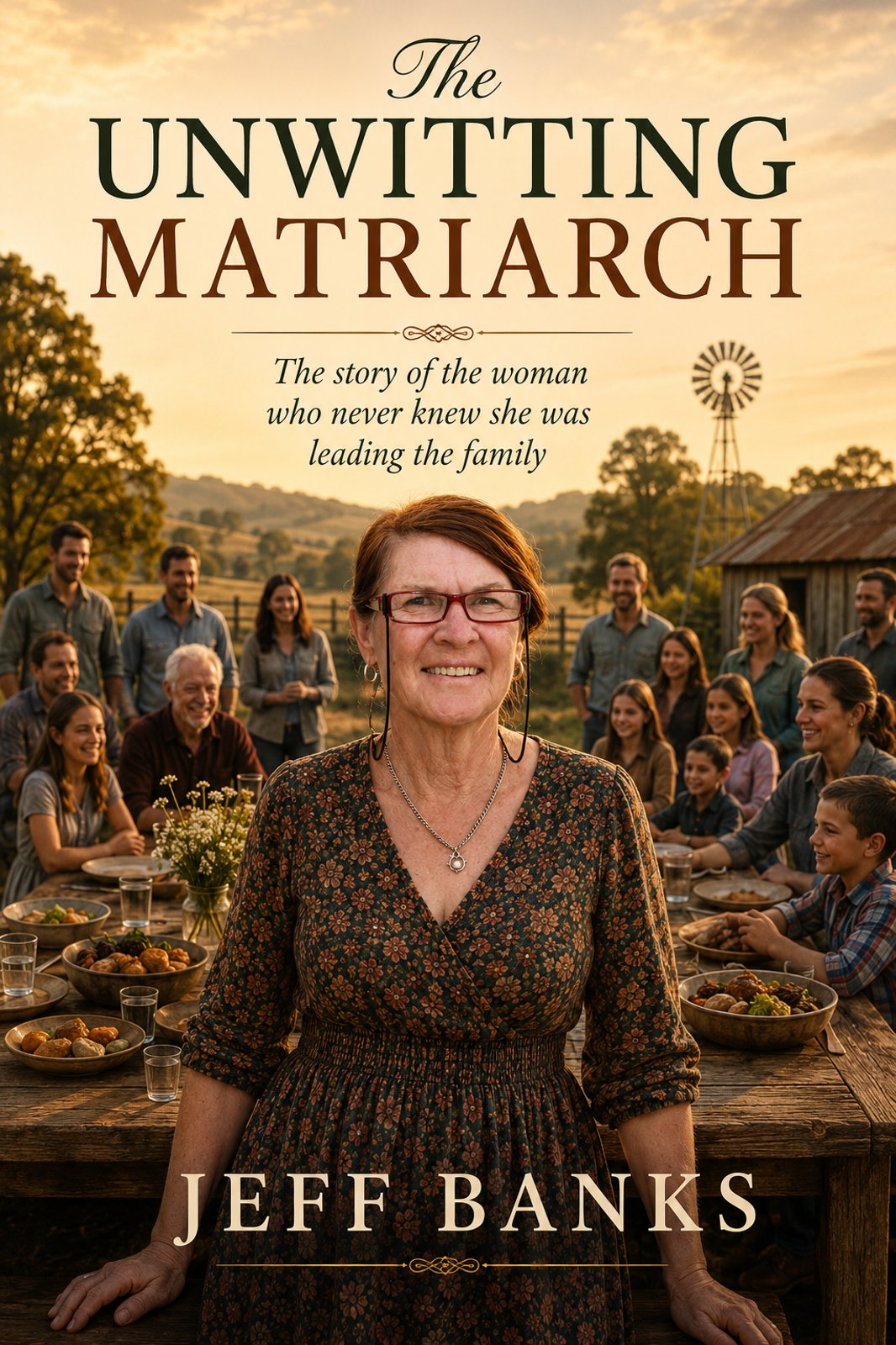
The Unwitting Matriarch Chapter 21 - Family

The Unwitting Matriarch Chapter 21 - Family | Travelling Around Australia with Jeff Banks

Somebody has to do it, Kerre told me. For most of her life, that somebody was her. Her greatest hope now is that somebody else will continue when she no longer can, because the real inheritance of the Ferguson family has never been land, money or possessions. The real inheritance has always been the willingness to show up, to care and to remain there for each other.

THE UNWITTING MATRIARCH

She never asked to lead. She simply never stopped showing up. 

Chapter 21 — Family

By the time I reached the end of my conversations with Kerre, I found myself asking questions that seemed simple enough on the surface. Why had the family survived so much? Why had so many people remained connected when other families drifted apart? Why did people continue turning up at Little Prairie, at reunions, at funerals, at birthdays and beside hospital beds, decade after decade? Most importantly, what was the secret that appeared to bind everything together?

I expected an answer that would neatly explain it all. I expected a story about a defining moment, a family tradition or some lesson handed down through generations. What I received instead was a shrug and a smile.

“I don’t know.”

The funny thing about knowing and interviewing somebody for long enough is that eventually you realise the most truthful answers are often the shortest. People can tell stories for hours. They can remember names, dates, arguments, celebrations, disasters and triumphs. They can recall who did what, where it happened and who was present. Yet when you ask why, the answer often becomes remarkably simple.

At first that response frustrated me. Writers like explanations. We like causes and effects. We want turning points and defining moments. We want to discover the hidden lesson that explains everything that came afterwards. We search for meaning because that is what storytellers do.

Kerre never really worked that way. The more we talked, the more obvious it became that she had spent most of her life doing what needed to be done without stopping to analyse it. She never seemed particularly interested in examining her own motivations. The task existed, so she completed it. Somebody needed help, so she helped. Somebody needed support, so she provided it.

That approach surfaced repeatedly throughout her stories. When family members struggled, she helped. When somebody was sick, she did far more than simply visit. In some cases she became a constant presence, sitting beside hospital beds, attending appointments, making phone calls, relaying information and carrying responsibilities that gradually became too heavy for others to manage alone. When somebody needed organising, she organised. When there was a funeral, she attended. When there was a crisis, she turned up, often before anybody had formally asked.

The most profound examples appeared in the stories surrounding her sisters as dementia slowly tightened its grip. Those experiences went far beyond occasional visits or expressions of concern. Kerre became one of the principal respondents to the silent calls for help that dementia creates. Long before doctors, facilities or paperwork became involved, there were confused phone calls, forgotten conversations, repeated questions and growing fears that somebody had to absorb. There were moments when frightened sisters could no longer properly explain what was wrong, yet somehow still expected Kerre to understand. More often than not, she did.

Dementia is a cruel disease because it steals people a little at a time. It rarely announces itself dramatically. Instead, it arrives in fragments, taking memories, confidence, independence and eventually identity itself. Throughout those years Kerre remained present. She watched sisters she had laughed with, fought with and grown up beside slowly fade into versions of themselves that became increasingly difficult to recognise. She witnessed the heartbreak of seeing familiar faces remain while familiar personalities gradually disappeared.

Yet she stayed. She answered the phone. She made the visits. She helped make decisions that nobody ever wants to make. She became the person others turned to when they were uncertain, overwhelmed or exhausted. The burden was often invisible to outsiders, but it was enormous nonetheless. It required patience, resilience and a willingness to keep showing up even when there was little hope of improvement.

None of it appeared extraordinary to her because it was simply what happened. Family needed her, so she was there. In Kerre’s world, that was never considered exceptional behaviour. It was merely what family did for family.

The question itself almost seemed strange. Why wouldn’t you do those things? Why would you not help somebody you cared about? Why would you not turn up when somebody needed you? To Kerre, the alternatives appeared harder to understand than the actions themselves.

As our conversations continued, another phrase kept appearing. “We’re just there for each other.”

Again, it sounded almost disappointingly simple. There was no grand philosophy attached to it. There was no complicated explanation or elaborate family doctrine. Yet perhaps that simplicity was the answer I had been searching for all along.

Modern society spends enormous amounts of time discussing connection while often investing surprisingly little effort in maintaining it. Families become fragmented by distance, careers, disagreements and competing priorities. People become experts at explaining why they cannot attend rather than finding reasons why they can. Relationships become conditional upon convenience.

The Ferguson family seemed to operate differently. Nobody signed a contract. Nobody established formal rules. Nobody sat down and agreed upon a family constitution. They simply remained present in one another’s lives. They stayed connected because that was what they had always done.

The more I listened to the stories, the more I realised that this was not a conscious decision made by one generation. It was a behaviour inherited from the generations that came before. It was how they were raised. It was how they watched their parents behave. It was how brothers and sisters looked after one another when times were hard. Long before anybody spoke about family values, they were living them.

That sense of connection survived despite geography doing its best to pull people apart. Fergusons scattered across New South Wales, Queensland, Victoria and beyond. Careers, marriages and divorces, children and retirement carried people in different directions. Distances that once would have seemed enormous became part of everyday life. Yet somehow the family remained connected in ways that often surprised outsiders. News travelled. Problems were shared. Successes were celebrated. When something important happened, word somehow found its way through the family network with remarkable efficiency.

Part of that came from people like Kerre and her siblings. They became the custodians of connection without ever describing themselves that way. They were the ones who remembered birthdays, knew who was unwell, understood which cousin was struggling, and maintained contact with relatives who might otherwise have slipped quietly from view. They became the living bridges between branches of the family tree. Because they remained connected, everybody else found it easier to remain connected as well.

What fascinated me was that none of them appeared to view this as work. They were not implementing a strategy. They were not preserving a carefully designed family culture. They were simply continuing the example they had been shown. Each generation watched the previous one make the phone calls, organise the gatherings, attend the funerals and support relatives through difficult times. Those behaviours became normal because they were always present.

In many ways, that is the philosophy of the Ferguson family distilled into its simplest form. We stay in touch because that is what we do. We help because that is what we do. We turn up because that is what we do. There is no mission statement hanging on a wall somewhere. There is no handbook explaining the rules. There is simply a collective understanding, passed from one generation to the next, that family matters and that maintaining family requires effort.

Perhaps that is why Kerre struggled to explain it whenever I asked. To her, there was nothing unusual about it. The behaviour was so deeply ingrained that it felt as natural as breathing. It was how they had been brought up. It was how they had been led by those who came before them. It was how people like Kerre, Bill, Helen and the many others who quietly carried responsibility helped keep the family together while life continually tried to pull it apart.

The remarkable thing is not that the family remained connected when everybody lived close together. The remarkable thing is that they remained connected after decades of distance, changing circumstances and the inevitable pressures of modern life. That does not happen by accident. It happens because generation after generation chooses to continue a tradition that was never formally created, yet somehow became one of the family’s strongest inheritances.

That did not mean they always agreed. Listening to the stories, it became obvious there were arguments, disagreements and occasional periods when people became frustrated with one another. They were human beings, not saints. Like every family, they experienced conflict, controversies and misunderstandings.

What seemed different was that disagreement rarely became abandonment. Family remained family. The connection remained intact even when people occasionally drove one another mad. They argued, then continued showing up. They disagreed, then attended the next gathering anyway. That distinction may have been one of the family’s greatest strengths.

Throughout the conversations I repeatedly heard stories involving hospital visits, unexpected phone calls, emergency accommodation, childcare, transport, financial assistance and practical support. Very little of it appeared planned. Most of it simply happened because somebody needed help.

Looking back, it becomes obvious that many of those acts were never viewed as sacrifices by the people providing them. They were responsibilities. The distinction matters because sacrifices imply a choice, while responsibilities imply an obligation. One is optional. The other is simply accepted.

For much of her life, Kerre appeared to operate from the second category. She did not seem to spend time weighing up whether she should help. If help was required, the decision had effectively already been made. That mindset emerged again and again throughout our discussions.

That reality became most obvious whenever the conversation turned toward the role she had played within the family. Whenever I suggested she had become a central figure, she would usually dismiss the idea. Yet the evidence pointed elsewhere. People rang her. People sought her advice. People informed her when things happened. People expected her to know what was going on.

The position appeared to have developed gradually rather than deliberately. There was no ceremony. Nobody elected her. No official title was ever bestowed. The responsibility simply accumulated over time until one day everybody seemed to assume Kerre would know the answer.

Eventually I asked her how it happened.

“It fell to me.”

There was something profoundly revealing in those four words. Not “I wanted it.” Not “I chose it.” Not “I was the best person.” Simply, “It fell to me.”

Leadership often arrives disguised as inconvenience. Many people imagine leadership as authority, recognition or status. In reality, it often looks like extra responsibility that nobody else particularly wants. Somebody has to make the phone calls. Somebody has to organise the visits. Somebody has to remember their birthdays. Somebody has to know which hospital room somebody occupies. Somebody has to keep track of who is where.

Somebody has to connect generations that might otherwise drift apart. Somebody has to maintain the invisible threads that keep a family functioning. Over time, that somebody became Kerre. Not because she demanded the role, but because she accepted it.

Throughout the interviews I became increasingly aware that much of what made Kerre extraordinary was invisible. The dramatic stories were memorable. The floods, the horses, the family gatherings, the droughts and the adventures all made wonderful anecdotes. Yet those stories sat on top of something deeper and far less obvious.

Beneath them existed decades of administration. There were decades of checking on people, remembering details, making arrangements, providing transport, offering accommodation and ensuring nobody was forgotten. There were decades spent quietly maintaining the machinery of family life while everybody else simply enjoyed the benefits.

Most people never receive recognition for those things. Many never seek it. Kerre certainly never did. When I suggested she had carried a great deal of responsibility, she offered another response that appeared repeatedly throughout our conversations.

“Somebody has to do it.”

Again, there was no self-congratulation. There was no demand for appreciation. There was no sense of martyrdom. There was simply a statement of fact delivered with the same practicality that had characterised her entire life.

Perhaps that sentence explains more about the Ferguson family than any other. The family was filled with people who saw necessary jobs and simply completed them. Whether it involved feeding people, organising events, helping neighbours, delivering hay, supporting relatives or caring for children, the attitude remained remarkably consistent. If something needed doing, somebody did it.

Not because they were paid. Not because they expected recognition. Not because they anticipated a reward. They did it because it needed doing. The task itself was justification enough.

The world would probably function much better if more people adopted that philosophy. Too often people wait for permission, recognition or instruction before acting. The Fergusons seemed to understand that responsibility is rarely convenient. If everybody waits for somebody else to act, eventually nothing happens.

As our conversations moved toward their conclusion, the discussion inevitably shifted toward the future. Families change. People age. Generations pass. The roll call becomes shorter. The people who once carried responsibility eventually become the people requiring assistance.

That reality weighed heavily on Kerre at times. Not because she feared growing older. She had long since made peace with that. What concerned her was continuity. Would the connections remain? Would younger generations maintain the relationships? Would the family continue gathering? Would the stories survive?

For perhaps the first time during our conversations, I detected uncertainty. Not fear. Not pessimism. Simply hope mixed with the knowledge that some things are beyond any one person’s control.

“I hope they stay together.”

The statement lingered with me long after our conversation ended. Everything else in the family’s history suddenly seemed connected to those five words. The horse stories, the flood stories, the drought stories, the weddings, the funerals, the reunions, the children, the grandchildren, the long drives and the endless phone calls all appeared part of the same larger purpose.

The stories themselves mattered, but perhaps not as much as the people telling them. Eventually every family reaches a point where memory becomes inheritance. One generation becomes responsible for carrying stories into the next. The Ferguson family has always excelled at that process because stories are how they preserve identity.

They tell stories. They repeat stories. They laugh at stories. They occasionally improve stories in the retelling. Most importantly, they preserve them. Through those stories, people know where they belong because they know where they came from.

As I reflected on everything Kerre had told me, I realised I had spent much of the project searching for a grand explanation. I wanted a defining principle, a family motto or a secret formula. I wanted something profound that explained how one woman became the centre of so many lives without ever intending to.

Instead, I found something far simpler. People matter. Family matters. Showing up matters. Being available matters. Doing what needs to be done matters. The philosophy of the Ferguson family was never written down because it never needed to be.

It was demonstrated every day through actions rather than words. It existed in visits, phone calls, gatherings and acts of support. It existed in quiet decisions to place family before convenience. It existed in the countless small moments that never made headlines but ultimately shaped generations.

Perhaps that is why Kerre struggled to explain it. Fish rarely describe water because they have spent their entire lives swimming in it. The Ferguson family never consciously developed a philosophy. They simply lived one.

If there is a lesson hidden beneath all the stories, all the laughter and all the years, it is that family survives not because people always agree with one another. Family survives because people continue choosing one another. They choose one another again and again through good times and bad, through disagreements and reconciliations, through celebrations and grief.

Somebody has to do it, Kerre told me. For most of her life, that somebody was her. Her greatest hope now is that somebody else will continue when she no longer can, because the real inheritance of the Ferguson family has never been land, money or possessions. The real inheritance has always been the willingness to show up, to care and to remain there for each other.

Author

Menu