

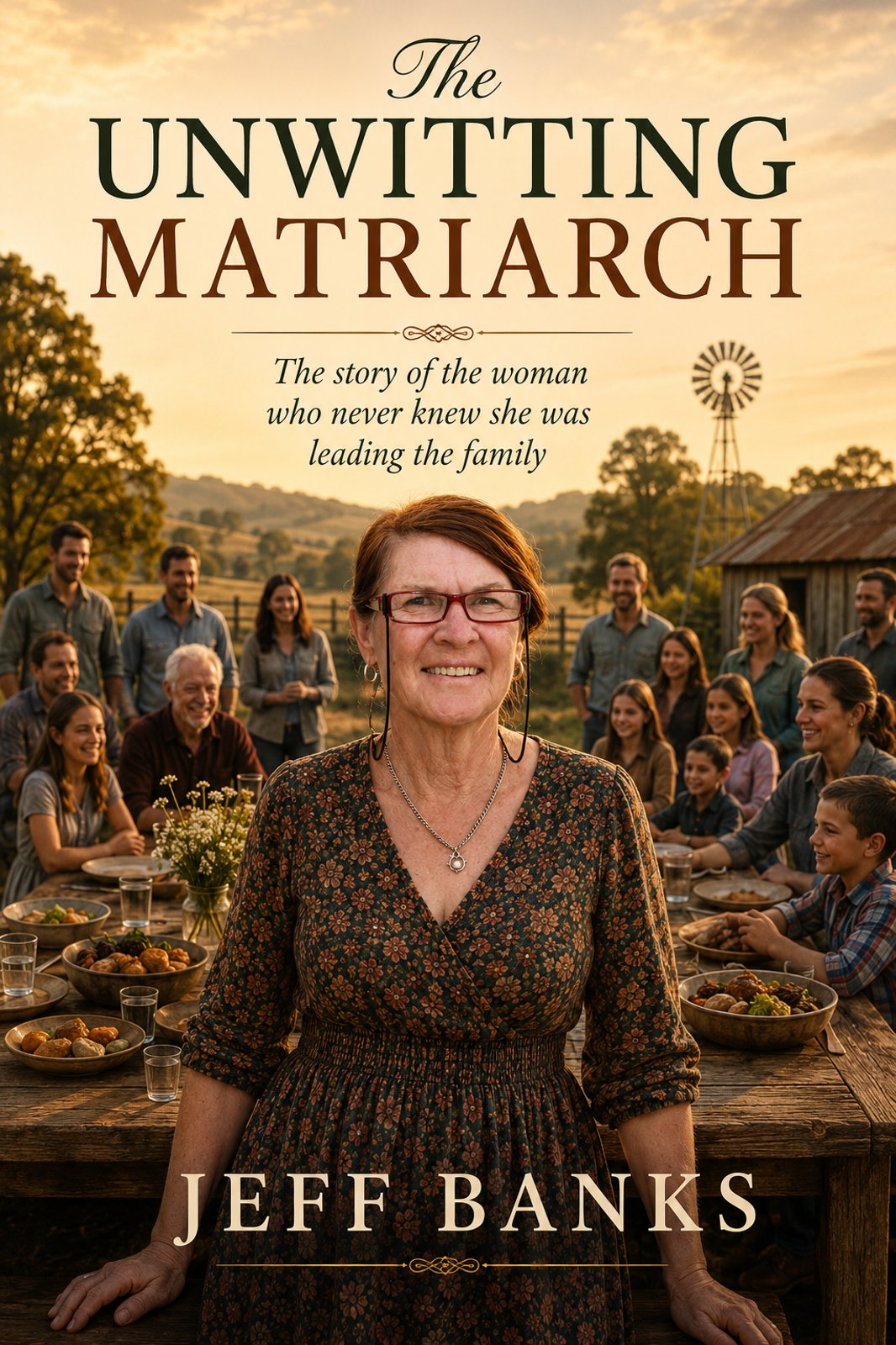
The Unwitting Matriarch Chapter 20 - We Have Enough

The Unwitting Matriarch Chapter 20 - We Have Enough | Travelling Around Australia with Jeff Banks

The modern world constantly encourages people to want more. Every advertisement, every sales pitch and every algorithm seems designed to convince individuals that happiness sits just beyond the next purchase. The message is relentless because it is profitable. If people ever become satisfied, somebody stops making money. Kerre had become increasingly resistant to that message. Perhaps it was because she grew up with very little and understood the difference between needs and wants. Perhaps it was because decades of hard work had shown her that accumulation alone rarely delivers fulfilment. Perhaps it was because she had attended enough funerals to recognise what people ultimately value when life reaches its conclusion.

THE UNWITTING MATRIARCH

She never asked to lead. She simply never stopped showing up. 

Chapter 20 — We Have Enough

Of all the conversations I had with Kerre over the years, one topic seemed to surface more frequently as she moved into retirement and began reflecting on the shape of her life. It was not a discussion about illness, although there had been plenty of those. It was not a discussion about ageing, although that inevitably crept into many conversations. More often than not, the subject that emerged was money and what role it was supposed to play once a person reached the stage of life where there was no longer anything left to prove.

What always struck me was that Kerre never spoke about money with excitement. She did not view wealth as a scorecard and she certainly did not regard it as a measure of personal worth. The older she became, the less interested she seemed in the endless pursuit of accumulation that occupied so many people around her. Instead, she found herself asking a question that appeared deceptively simple but proved surprisingly difficult for most people to answer. How much is enough?

The modern world seems uncomfortable with that question. Society is built around the assumption that more is always better. Bigger houses are considered improvements over smaller ones. Larger investment portfolios are celebrated more than modest ones. Retirement is often portrayed as a destination that can only be reached after accumulating a sufficiently impressive pile of assets. The finish line is never fixed because somebody is always moving it further away.

Kerre had watched that happen throughout her life. When she and Lionel were young, the dream was to own a home. Once the home was acquired, the dream became paying it off. After that, attention shifted toward improving the property, acquiring another one, building additional security and creating options for the future. At every stage there was another target waiting just beyond reach. Looking back, she could see how easily people spent their entire lives chasing the next milestone without ever stopping to acknowledge what had already been achieved.

One afternoon we were talking about retirement and she made an observation that stayed with me. She said that for years she had imagined security as something that would arrive one day. It would appear after the mortgage was gone. It would arrive once the savings account reached a certain level. It would emerge after another property had been purchased or another debt eliminated. Yet every time one goal was achieved, another appeared to replace it. Security remained stubbornly positioned somewhere in the future.

Eventually retirement arrived and she discovered something unexpected. Security had not been waiting at the end of the journey at all. It had quietly existed throughout much of her life. It had been sitting in the relationships she had built, the family she had raised, the friendships she had maintained and the community she had contributed to. It had never been entirely about money. Money helped create choices, but it was not the source of the security she had spent years searching for.

That distinction became increasingly important as conversations turned toward pensions and retirement planning. Some people speak about the pension as though it is a prize. Others discuss it as though it represents some form of personal failure. Kerre regarded both views as missing the point entirely. To her, the pension was simply one component of a retirement plan. It was neither a badge of honour nor a source of embarrassment. It was merely one of several tools available to people who had spent a lifetime contributing to society.

Her view reflected the practicality that had guided most of her life. She had never been interested in appearing wealthy. She was interested in being secure. Those two things are often confused but they are not the same. Many wealthy people live in a constant state of anxiety because they are terrified of losing what they possess. Meanwhile, some people with comparatively modest means enjoy a level of contentment that money alone could never purchase.

Kerre had observed that contradiction countless times. She knew people who owned multiple properties but still worried constantly about acquiring another. She knew people with substantial superannuation balances who spent every conversation discussing markets, interest rates and investment returns. She knew people who postponed happiness until some future financial goal was reached, only to discover another goal waiting immediately beyond it.

The irony never escaped her. Many of those people possessed considerably more wealth than she did, yet they often appeared far less comfortable with their lives. They were financially successful but emotionally restless. Their accumulation had not delivered the peace they expected.

Property was an interesting example. Property had certainly played an important role in Kerre and Lionel’s life. It had created opportunities. It had provided security. It had generated income and given them options they might not otherwise have enjoyed. She was never dismissive of the role property played because she understood its value better than most.

At the same time, she never confused property with happiness. Property could reduce financial stress but it could not eliminate grief. Property could create comfort but it could not manufacture meaningful relationships. Property could assist family members but it could not replace them. The longer she lived, the more obvious those truths became.

Funerals have a habit of teaching lessons that nobody wants to learn. By this stage of her life, Kerre had attended far too many. Parents had gone. Brothers and sisters had gone. Friends who once filled family photographs and reunion gatherings had gradually disappeared. Every loss reinforced a reality that became increasingly difficult to ignore.

Nobody stands beside a coffin discussing investment portfolios. Nobody reflects on a person’s superannuation balance. Nobody remembers someone because they owned an additional rental property. The stories people tell at funerals are always about kindness, generosity, humour and family. They are about the moments shared rather than the assets accumulated.

That observation profoundly shaped the way Kerre viewed money in her later years. Money was important, but only because of what it allowed a person to do. Its value was found in usefulness rather than ownership. It was a resource rather than a destination.

Perhaps nowhere was that more evident than in the way she viewed helping family. Throughout her life there had been occasions when children needed assistance, grandchildren required support or relatives found themselves facing difficult circumstances. Sometimes help came in the form of money. Sometimes it involved accommodation. Sometimes it meant practical support, transport, childcare or simply being available when somebody needed guidance.

What struck me was that Kerre never spoke about those things as acts of generosity. She saw them as responsibilities. Family members were not projects to be managed or problems to be solved. They were simply family. If somebody needed assistance and it was possible to help, then helping was the natural thing to do.

That philosophy removed any sense of transaction from the process. She was not keeping score. She was not creating obligations. She was simply doing what families are supposed to do when they function properly. Looking back, that approach explains much of why so many people eventually came to rely upon her.

The same practical thinking emerged whenever discussions turned toward wills. Many people avoid conversations about wills because they require confronting mortality. Kerre never seemed especially troubled by that reality. By the time people reach their seventies, death is no longer an abstract concept. It has already introduced itself repeatedly through friends, relatives and neighbours.

For Kerre, preparing a will was not really about distributing assets. It was about reducing confusion. She regarded it as one final administrative task designed to make life easier for the people left behind. The objective was not deciding who deserved what. The objective was ensuring nobody was forced to untangle unnecessary complications during an already difficult period.

She had seen enough family disputes to understand how quickly grief could become conflict. Arguments rarely centred upon the items with the greatest financial value. More often they revolved around sentimental possessions that represented memories rather than money. People were not fighting over objects. They were fighting over emotional connections disguised as objects.

That understanding reinforced her belief that communication mattered far more than inheritance. Families who discussed difficult subjects openly generally navigated those transitions successfully. Families who avoided uncomfortable conversations often discovered problems after it was too late to resolve them.

As the years passed, I noticed something else. Whenever Kerre discussed legacy, she almost never framed it in financial terms. She did not talk about balances, valuations or investment returns. Instead, she talked about people. She talked about Tammy. She talked about Mitch. She talked about grandchildren and future generations. She spoke about values, stories, lessons and memories.

Property occasionally appeared in those conversations, but only as a supporting character. Family always remained at the centre of the story. The houses, investments and savings were merely tools designed to support the people who mattered most.

Perhaps that perspective explains why she eventually arrived at a place many people spend their entire lives searching for. She discovered contentment. Not excitement. Not endless ambition. Not the constant pursuit of more. Genuine contentment.

Contentment is rarely celebrated because it lacks drama. It does not produce impressive headlines. It does not generate social media attention. It does not encourage endless consumption. In many ways, contentment is almost rebellious in a society that depends upon dissatisfaction.

For Kerre, contentment meant something very simple. It meant being able to sit quietly and recognise that there was nowhere else she needed to be. It meant understanding that her value as a person was not determined by the size of a bank account. It meant appreciating what already existed rather than obsessing over what might still be acquired.

The modern world constantly encourages people to want more. Every advertisement, every sales pitch and every algorithm seems designed to convince individuals that happiness sits just beyond the next purchase. The message is relentless because it is profitable. If people ever become satisfied, somebody stops making money.

Kerre had become increasingly resistant to that message. Perhaps it was because she grew up with very little and understood the difference between needs and wants. Perhaps it was because decades of hard work had shown her that accumulation alone rarely delivers fulfilment. Perhaps it was because she had attended enough funerals to recognise what people ultimately value when life reaches its conclusion.

Whatever the reason, she eventually reached a conclusion that sounded remarkably ordinary but carried enormous wisdom. She believed they had enough. Not enough to buy everything they might ever want. Not enough to eliminate every challenge life might still present. Not enough to guarantee perfect health or unlimited time.

They simply had enough.

Enough security to sleep comfortably at night. Enough memories to fill countless conversations. Enough family to ensure life remained meaningful. Enough stories to pass down. Enough laughter to soften the difficult days. Enough love to make the journey worthwhile.

For a woman who spent most of her life quietly solving problems, carrying responsibilities and supporting others without seeking recognition, that conclusion represented something far more valuable than wealth.

It represented peace. In a world obsessed with accumulation, peace may be the most valuable asset of all.

Author

Menu