

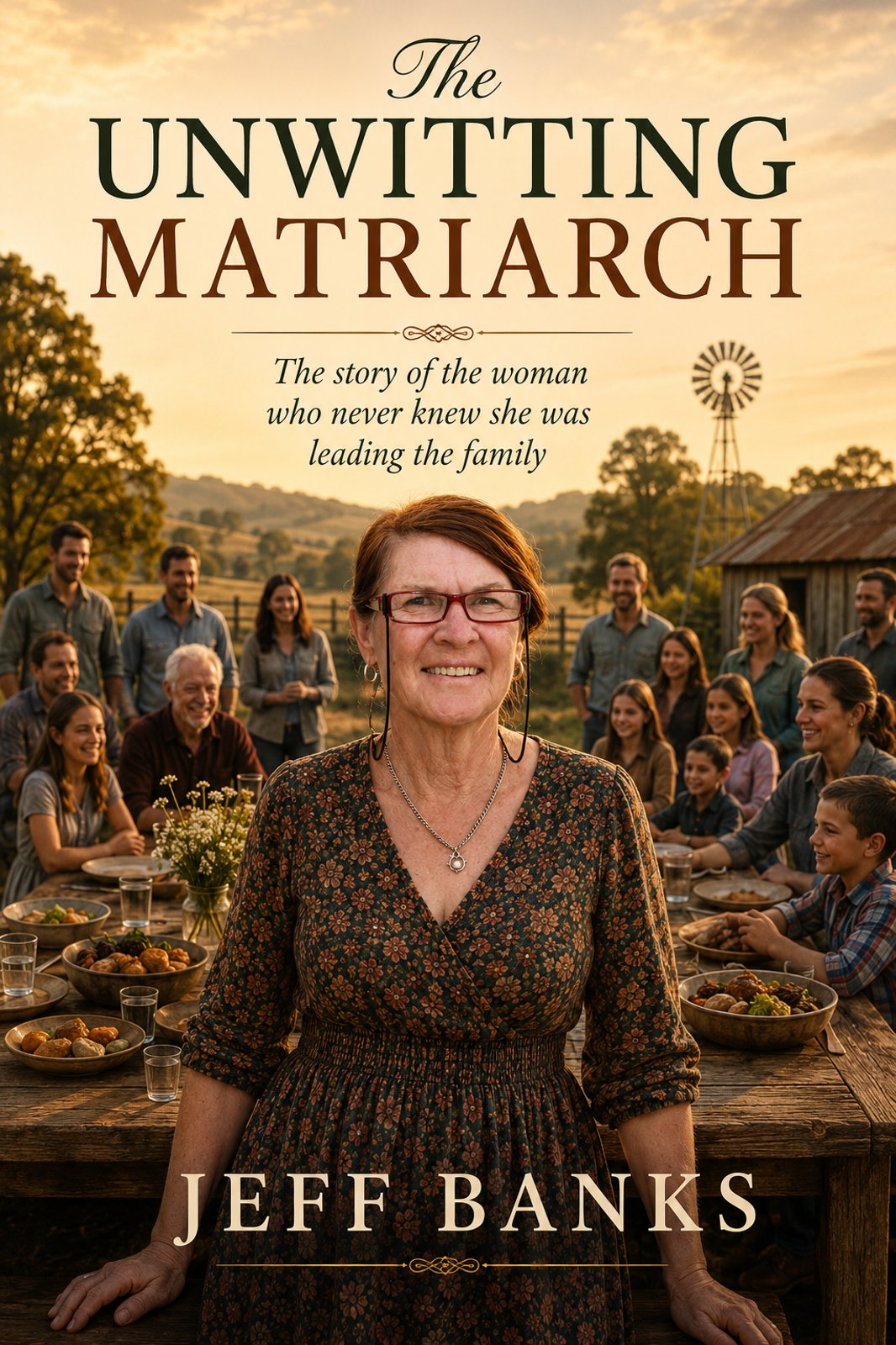
The Unwitting Matriarch Chapter 19 - Lub-da-Bus

The Unwitting Matriarch Chapter 19 - Lub-da-Bus | Travelling Around Australia with Jeff Banks

Looking back now, the significance of Lub-da-Bus becomes easier to understand. The vehicle arrived during a period when many people began reducing their worlds. They stop travelling. They stop exploring. They begin organising life around limitations rather than opportunities. Kerre did the exact opposite. The bus allowed her world to become larger rather than smaller.

THE UNWITTING MATRIARCH

She never asked to lead. She simply never stopped showing up. 

Chapter 19 — Lub-da-Bus

By the time most people start talking seriously about retirement, they usually imagine slowing down. They picture smaller days, fewer responsibilities and a gradual withdrawal from the parts of life that once demanded so much energy. They talk about putting their feet up, taking things easy and finally resting after decades of work. Retirement, in the popular imagination, often looks suspiciously like surrender disguised as relaxation.

Kerre never saw it that way. Perhaps she was incapable of seeing it that way. The women who had survived childhood poverty, raised children, worked multiple jobs and spent decades holding families together rarely possessed an off switch. They might change direction, but they seldom stopped moving entirely. The habits that had carried them through hardship were too deeply ingrained to be switched off simply because a government form declared somebody old enough to retire.

For Kerre, retirement was never going to be about withdrawal. It was going to be about freedom. The freedom to wake up without a roster. The freedom to decide what came next. The freedom to follow curiosity wherever it happened to lead. While other people saw retirement as an ending, Kerre seemed to view it as permission to begin something entirely new.

That freedom eventually arrived in the shape of a bus. It was not a glamorous luxury motorhome featured in travel magazines and it was certainly not purchased as a status symbol. It was simply a bus that represented possibilities. What excited Kerre was never the machinery itself. What excited her was the idea that every road stretching beyond the horizon had suddenly become an option.

Somewhere along the way the vehicle acquired a name. Like many family stories, nobody can now say with complete certainty who first said it or exactly why it stuck. The explanations shifted slightly over the years depending upon who was telling the story. What never changed was the affection attached to it. Before long the bus was known simply as Lub-da-Bus, and that was what everyone called it from then on.

The naming of things has a strange effect. Once something acquires a name it somehow develops a personality. Family members stopped asking how the bus was going and instead asked how Lub-da-Bus was travelling. It ceased being a vehicle and became a companion. Like all great travelling companions, it would eventually provide both wonderful memories and unexpected headaches.

What followed were years of adventures spread across the Australian continent. The bus became a passport to places many Australians spend their entire lives meaning to visit but never quite reach. Kerre and Lionel found themselves travelling through landscapes so vast that the distances seemed almost impossible to comprehend, with every journey producing another story and every story eventually finding its way into family conversations.

Australia reveals itself differently when viewed through a windscreen. Aeroplanes leap over the country and tour buses rush through it, but travelling by road forces people to experience the spaces in between. Kerre loved those spaces. She loved the little towns that never appeared in tourism brochures, the roadside bakeries, the country pubs, the local museums and the conversations with strangers who always seemed willing to share a story if someone was willing to listen.

The interesting thing, however, was that while many travellers spend their lives chasing spectacular scenery, Kerre was often far more interested in the people standing in front of it. The red deserts were impressive. Uluru was magnificent. The gorges, mountain ranges, beaches and endless horizons all provided moments of genuine wonder. Yet if you asked Kerre years later about a particular trip, she was often more likely to tell you about the woman who ran the caravan park, the publican who stayed open late to feed weary travellers, or the retired stockman who sat outside a country store and talked about seasons long gone.

For Kerre, landscapes provided the backdrop. People provided the story.

A mountain remains a mountain no matter how many times you look at it. A sunset eventually fades into darkness. Even the most breathtaking view becomes a photograph stored away in an album. Human beings are different. Every person carries a lifetime of experiences, opinions, triumphs, disappointments and memories. Every conversation offers the possibility of discovering something unexpected. That was what fascinated Kerre most.

What made their travels unusual was that they were never entirely tourists. While the trips certainly provided the freedom they had worked so hard to achieve, Kerre possessed a lifelong inability to ignore work that needed doing. It was part of that deeply ingrained Ferguson philosophy of “see a need, fill a need.” To Kerre, if somebody was struggling, overwhelmed or simply short of a pair of hands, standing by and watching was never really an option.

As a result, there were times when their travels unexpectedly evolved into something resembling temporary employment. Not because they needed the money and not because they had planned it that way, but because opportunities to help seemed to follow them wherever they went. One conversation would lead to another, one introduction would lead to another and before long they would find themselves becoming part of a community they had only intended to visit for a few days.

Following major events such as the Finke Desert Races, when accommodation providers and local businesses were stretched beyond capacity, Kerre and occasionally Lionel would find themselves helping clean motel rooms, preparing facilities for incoming guests or assisting wherever the workload had become overwhelming. At other times it might involve lending a hand around a pub, helping with cleaning duties or tackling jobs that many travellers would simply walk past without a second thought.

Most people travel to escape responsibility. Kerre seemed to carry a remarkable ability to collect it. Yet there was never any resentment attached to these detours because, in many ways, they became the highlight of the journey.

Working alongside motel owners, publicans and local residents opened doors that ordinary tourism never could. Instead of merely passing through a town, Kerre became part of it, even if only briefly. She heard stories that would never appear in guidebooks. She listened to accounts of droughts and floods, family triumphs and tragedies, local heroes and local rogues. She learned about communities through the people who lived in them rather than through plaques mounted on historical buildings.

The result was that many of her strongest memories had very little to do with geography. Family members would sometimes expect stories about famous landmarks, only to find themselves hearing detailed accounts of somebody she had met along the way. There would be the widowed motel owner trying to keep a business afloat, the elderly couple travelling Australia before age caught up with them, the publican who knew every customer by name, or the Aboriginal elder willing to share stories about country and culture with those prepared to listen respectfully.

That was where Kerre found the real Australia. Not in the postcards, but in the people. Not in the scenery, but in the stories. Not in the destinations, but in the relationships formed between one destination and the next.

Looking back, those experiences revealed something important about both Kerre and Lionel. Retirement had given them freedom, but freedom did not change who they were. They remained people who believed that if there was work to be done and they were capable of helping, then helping was simply what you did. The bus may have allowed them to roam across Australia, but wherever they parked it, they still carried the values that had shaped their entire lives.

Perhaps that explains why so many of their travel memories revolve around faces rather than places. The landscapes were magnificent and the distances extraordinary, but those things were never the real treasure. Long after the photographs faded and the routes became difficult to remember, Kerre could still recall the people. She could remember their names, their stories, their humour and their struggles. In the end, the greatest souvenir she collected from travelling Australia was not a collection of destinations. It was a collection of human beings.

Those conversations became one of the great joys of travelling. Kerre had always possessed the ability to speak comfortably with almost anyone. She could sit beside a stranger for ten minutes and emerge knowing their family history, where they had lived, what they did for work and probably the names of their grandchildren. It was a gift she carried throughout her life and travelling around Australia gave her endless opportunities to use it.

The travels were not always purely recreational. Like many things in Kerre’s life, practical considerations often travelled alongside adventure. Various opportunities for work emerged as they moved around the country. Temporary employment, odd jobs and opportunities to contribute appeared in unexpected places. Rather than seeing retirement as a period of inactivity, Kerre simply approached these opportunities as another way of remaining connected to the world.

That attitude revealed something important about her character. She had never been especially interested in doing nothing. Even during holidays she tended to find something productive to occupy her attention. Sitting still for long periods appeared almost physically uncomfortable for her. Movement, activity and engagement were simply part of who she was.

Of course, no Australian road story is complete without mechanical trouble. Eventually Lub-da-Bus decided to remind everyone that machinery has a personality of its own. The engine failed. One moment everything was operating perfectly normally and the next moment it was not. The details changed slightly depending on who told the story, but the central fact remained the same. The bus had stopped and there was no immediate solution in sight.

Mechanical failures have an extraordinary ability to reveal character. Some people panic immediately. Others become angry and begin searching for somebody to blame. Some surrender to frustration before the problem has even been properly identified. Kerre approached the situation exactly as she had approached every other difficulty throughout her life. She assessed the problem, considered the options and started looking for solutions.

The breakdown also revealed something else. It revealed the remarkable generosity that still exists across regional Australia. During the years since, Kerre often spoke far more about the people she met than the inconvenience itself. Strangers appeared with advice, assistance, tools, contacts and encouragement. Nobody was obligated to help. Nobody expected payment. They simply saw fellow travellers in difficulty and offered whatever assistance they could provide.

Those encounters left a lasting impression. The kindness of strangers reinforced something Kerre had always believed about people. While the world often appears divided and complicated, most ordinary people are fundamentally decent. They are willing to help when somebody genuinely needs assistance. They are willing to share knowledge, time and effort simply because it is the right thing to do.

When Kerre later told the story, she rarely focused on the breakdown itself. Instead she remembered the names, faces and conversations of the people who had helped. That tendency says a great deal about the way she viewed life. Many people remember the crisis. Kerre remembered the helpers. Many people remember the inconvenience. Kerre remembered the kindness.

Eventually the bus was repaired and the journey continued. More roads unfolded ahead. More towns appeared on the horizon. More stories accumulated. Lub-da-Bus carried them through countless adventures and became woven into the fabric of family history. It represented far more than transport. It represented possibility.

Looking back now, the significance of Lub-da-Bus becomes easier to understand. The vehicle arrived during a period when many people began reducing their worlds. They stop travelling. They stop exploring. They begin organising life around limitations rather than opportunities. Kerre did the exact opposite. The bus allowed her world to become larger rather than smaller.

Perhaps that is the real lesson hidden inside the story. Retirement is often described as stepping away from life. For Kerre it became an opportunity to step further into it. She had spent decades caring for family members, supporting communities, working jobs and meeting responsibilities. The bus represented a stage of life where some of those responsibilities finally loosened their grip and allowed room for something else.

The roads travelled by Lub-da-Bus stretched across Australia, but the more important journey was internal. It was the journey from obligation to choice. It was the journey from surviving circumstances to creating experiences. It was the journey from doing what needed to be done toward doing what was genuinely wanted.

That is why Lub-da-Bus remains such a powerful family story. It was never really about a vehicle. It was about freedom. It was about curiosity. It was about proving that retirement does not have to mean retreating from life. Sometimes it simply means that, for the first time in decades, you are free to choose the direction of the road ahead and follow it wherever it leads.

Author

Menu