

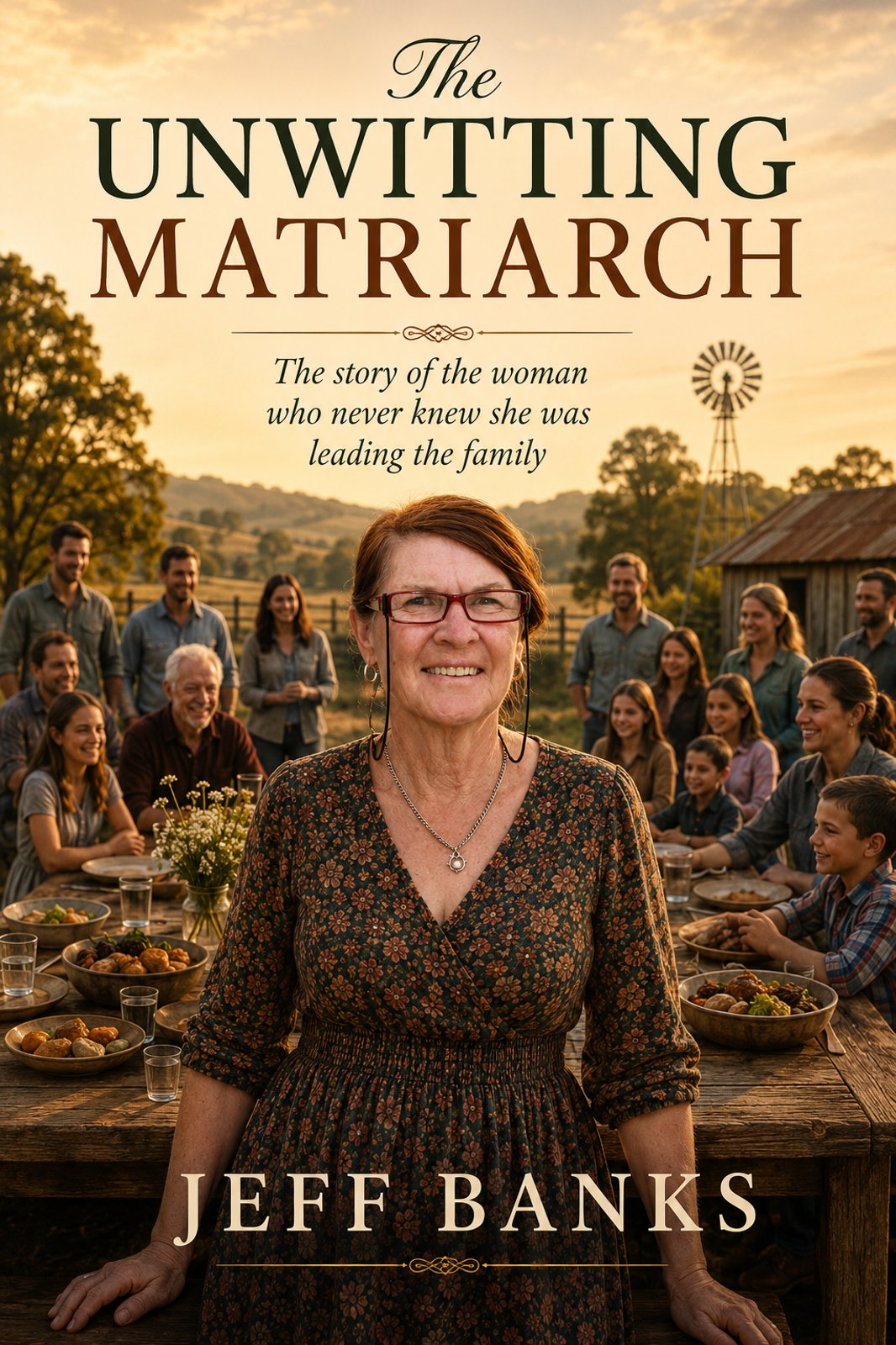
The Unwitting Matriarch Chapter 18 - The Hay Story

The Unwitting Matriarch Chapter 18 - The Hay Story | Travelling Around Australia with Jeff Banks

The lesson hidden within the story is surprisingly simple. Kindness leaves footprints, even when the person creating them never notices. Kerre spent decades planting seeds without ever expecting a harvest.

THE UNWITTING MATRIARCH

She never asked to lead. She simply never stopped showing up. 

Chapter 18 — The Hay Story

By the time the drought arrived, Kerre had already spent most of her life helping people. The thing about helping people is that very few people ever notice it while it is happening. They see the individual acts and remember the lift into town, the spare bedroom made available during difficult times, the meal delivered after a funeral, the babysitting done at short notice, the money quietly lent when somebody was struggling, or the endless phone calls spent solving other people’s problems.

What they rarely see is the accumulation of those moments. They do not see thousands of small acts slowly building into something much larger than any one favour. They do not see the quiet reputation being built year after year until it becomes part of the fabric of an entire family.

Kerre certainly never saw it that way. As far as she was concerned, she was simply doing what needed to be done. If somebody needed help, then you helped, and if the family was struggling, then you stepped in.

There was never any expectation attached to those actions. She did not keep score and she did not maintain a ledger of favours owed. The idea that one day those countless acts might somehow come back to her would probably have seemed absurd.

Yet that is exactly what happened. The drought that swept across the district was one of those relentless Australian droughts that seem determined to test every person connected to the land. The grass disappeared first, then the dams began shrinking, and before long dust seemed to settle over everything.

People who have never lived through drought often imagine it as merely a lack of water. Farmers know better because drought is really uncertainty dressed up as weather. It is waking each morning and calculating how much longer feed will last while hoping that tomorrow’s forecast might finally be right.

For Kerre, those conversations eventually centred on her ponies. To outsiders they may have looked like horses, but to her they represented years of memories, responsibility and companionship. Horses occupy a peculiar place in rural families because they become part livestock, part friend and part family member.

Many people later assumed the drought was the reason one of the ponies was sold. Certainly it played a role. Feed was becoming harder to source, costs were increasing and the practical realities of caring for animals during a dry period could not be ignored. Yet the drought was only part of the story, and perhaps not even the most important part.

What many people failed to understand was that Kerre had already begun looking at life differently. As retirement settled in and the years accumulated, she had started asking herself the same questions many older Australians eventually face. How much responsibility do you continue carrying? How much maintenance do you willingly take on? At what point do possessions, animals and commitments stop providing freedom and begin demanding it?

The decision to sell the horse was not made lightly. Like many difficult decisions throughout her life, Kerre approached it with practicality rather than self-pity. The drought may have accelerated the timing, but the deeper motivation lay elsewhere. She was beginning the gradual process of simplifying life, reducing obligations and ensuring that neither she nor those around her would be burdened by responsibilities that no longer made sense.

That reality is often lost on people looking in from the outside. They see a drought and assume the drought caused the decision. They see rising feed costs and assume it was purely financial. In truth, the sale represented something much larger. It marked one of those quiet moments when a person begins letting go of things they love, not because they love them less, but because they understand that every stage of life requires different choices.

Word spread quietly through the family after the decision was made. One relative mentioned it to another, somebody else passed it on to a cousin, and before long people scattered across different towns all knew what was happening. Everyone understood that the sale represented far more than a simple financial decision.

The ponies carried memories with them. Children had ridden them, visitors had admired them and countless family gatherings had unfolded around them. Their departure felt like the closing of a chapter that many people had shared.

What happened next remains one of the most remarkable family stories ever told about Kerre. Nobody seems entirely certain who first suggested helping, which is often the way with the best family legends. Different people remember different conversations, but everyone remembers the feeling that sat behind them.

Kerre had spent her life helping everyone else. She had solved problems, offered support and carried burdens without ever asking for recognition. More and more family members began reaching the same conclusion that perhaps it was finally time for everybody else to help Kerre.

The conversations started quietly and remained deliberately secret. A closed facebook page was created. Siblings spoke to cousins, cousins spoke to friends and phone calls multiplied across the state. Nobody wanted praise and nobody wanted credit because the focus remained entirely on Kerre.

Money began arriving from unexpected places. Some contributions were large while others were modest, but nobody cared about the amounts involved. The willingness to participate was what mattered because every contribution represented gratitude.

People remembered old kindnesses that Kerre herself had long forgotten. They remembered meals delivered during difficult periods, children cared for when life became chaotic and practical support provided without hesitation. Over many years those memories had quietly accumulated and now they were being returned.

The fundraiser gathered momentum with each passing week. Every new contributor seemed to remind another person of a story involving Kerre and her generosity. Before long the project had taken on a life of its own.

Throughout all of this, Kerre remained completely unaware of what was happening. Keeping a secret in a large family is usually impossible because somebody always talks. Yet somehow everyone understood that the surprise mattered and the secret survived.

Eventually enough money, in excess of $2,000, more than enough so we actually had to call a stop, had been raised to make a genuine difference. The solution was hay, and not merely a token amount intended as a symbolic gesture. Truckloads were organised because the family wanted to solve a problem rather than simply acknowledge it.

The logistics became a major operation. Hay had to be sourced, transport had to be arranged and deliveries had to be coordinated across considerable distances. “Volunteers” appeared from all directions because everyone wanted to play a part.

When the day finally arrived, it became one of those moments that family members still talk about years later. Some remember the trucks pulling in while others remember the conversations that followed. Almost everyone remembers the tears.

As fate would have it, I happened to be in the area at the time, returning from one of our trips and close enough to be present when the hay arrived. Because so many of the contributors were scattered across the country and unable to witness the result of their generosity firsthand, I found myself becoming, by default rather than design, something of the family’s spokesman for the occasion. Armed with a camera and an understanding of what had taken place behind the scenes, I was able to record the arrival of the hay and capture a moment that many of those involved would otherwise never have seen.

What unfolded was far more emotional than anybody expected. This was not simply a truck delivering fodder to a property. Every bale represented a phone call, a contribution, a memory and an act of gratitude. As the hay was unloaded, it became impossible to separate the physical delivery from the deeper meaning behind it. What sat on the back of those trucks was not merely feed for horses. It was decades of appreciation compressed into something tangible.

Part of my role that day became ensuring the people who had contributed could share in the experience. The photographs and video footage allowed family members hundreds of kilometres away to witness Kerre’s reaction for themselves. They could see the surprise, the disbelief and the overwhelming emotion that accompanied the realisation of what had occurred. For many contributors, watching that footage later became almost as powerful as being there in person.

The remarkable thing was that nobody involved was seeking recognition. Most contributors would have been perfectly happy remaining anonymous because the purpose was never to draw attention to themselves. The entire exercise had been motivated by gratitude rather than acclaim, and that spirit remained evident from beginning to end.

Adding another layer to the story was the fact that the hay itself came from the very supplier from whom Kerre had recently been purchasing feed. In hindsight, it seems almost impossible that the secret remained intact for as long as it did. Orders had to be organised, deliveries coordinated and conversations held, yet somehow the supplier and Mitch managed to keep remarkably tight-lipped about everything that was unfolding behind the scenes. Neither gave away so much as a hint that a much larger plan was quietly taking shape.

That silence became part of the magic. Looking back, Kerre could probably identify moments that should have raised questions, conversations that seemed slightly unusual or arrangements that perhaps deserved a second thought. At the time, however, there was nothing to suggest that anything extraordinary was happening. The supplier simply appeared to be doing what he had always done, while Mitch carried on as though he knew nothing more than anyone else.

As a result, the first delivery arrived with all the power of a genuine surprise. There had been no clues, no accidental disclosures and no gradual realisation of what was coming. The hay simply appeared, accompanied by the revelation that an entire network of family and friends had been working quietly in the background. When subsequent deliveries followed, the story only became more remarkable because each arrival reinforced the scale of what had been organised without her knowledge.

Yet there was something profoundly satisfying about allowing the contributors to witness the outcome of their collective kindness. After weeks of secret phone calls, planning and fundraising, they were finally able to see the result of their efforts. Through photographs, videos and shared stories, they could watch the surprise unfold and witness the emotional impact of what they had achieved together.

They could also see something even more important. They could see that their effort had mattered. The hay fed the horses, but the gesture nourished something much deeper, reminding Kerre that the kindness she had spent a lifetime giving away had never gone unnoticed and had certainly never been forgotten.

Looking back now, the footage captured much more than the arrival of hay. It captured a family revealing itself. It captured the moment decades of quiet kindness were returned to the person who had spent her life giving it away. Most importantly, it captured something that words alone struggle to describe: the look on Kerre’s face when she realised just how many people loved her.

The reason for those tears had very little to do with hay. The hay represented gratitude, appreciation and decades of accumulated love arriving all at once. It represented hundreds of moments that Kerre had given away over a lifetime suddenly returning to their original source.

For perhaps the first time in her life, she found herself standing on the receiving end of the very thing she had spent decades providing for others. She received practical support, genuine love and the strength of family wrapped together in a way that could not be ignored. Most importantly, she received proof that her life had mattered.

People explained what had happened and who had contributed. They described the secret conversations, the planning and the fundraising that had taken place behind the scenes. They also made it clear that this was not charity because charity was never the point.

What Kerre received instead was gratitude made visible. Most acts of kindness disappear into history without acknowledgement because life moves forward and people become busy. The hay story created a rare moment when decades of appreciation could finally be expressed.

The lesson hidden within the story is surprisingly simple. Kindness leaves footprints, even when the person creating them never notices. Kerre spent decades planting seeds without ever expecting a harvest.

The drought revealed what had been growing all along. The pony sale appeared to expose it and the hay deliveries confirmed it beyond doubt. A lifetime spent helping others had created an army of people determined to help her when she needed it most.

That is why people still become emotional when the story is told. They are not crying about drought, horses or hay because those are only the vehicles through which the story is delivered. They are crying because every now and then life offers proof that kindness matters.

Most people never get to see that proof for themselves. Kerre did, and that is what makes the story unforgettable. For one extraordinary moment she was allowed to witness the harvest from a lifetime of generosity.

Author

Menu