

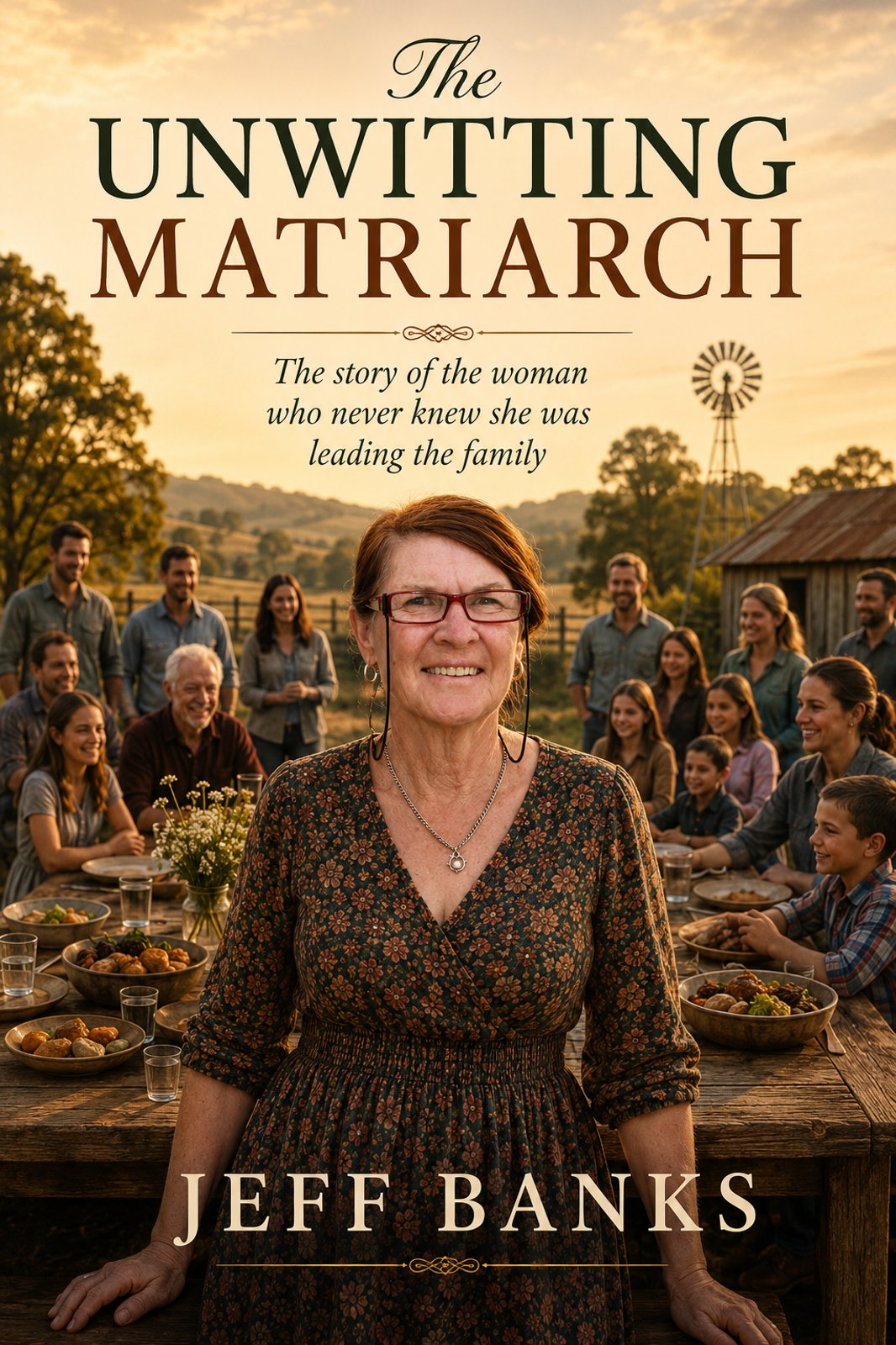
The Unwitting Matriarch Chapter 16 - The Roll Call Gets Shorter

The Unwitting Matriarch Chapter 16 - The Roll Call Gets Shorter | Travelling Around Australia with Jeff Banks

The three sisters remained with her through the night. Eventually Kerre convinced Carolyn to go home and have a shower while she stayed at the bedside. During Carolyn's absence, Mert quietly took her final breath. Kerre was there. The passing was peaceful. The moment was gentle. Yet even years later she admitted carrying guilt about the decision they had made.

THE UNWITTING MATRIARCH

She never asked to lead. She simply never stopped showing up. 

Chapter 16 — The Roll Call Gets Shorter

The more I listened to Kerre talk about the people who were gone, the more I realised this chapter was never really going to be about death. Death is only the final event in a much longer story. What mattered to Kerre were the lives that came before it, the conversations that lingered afterwards and the way families quietly reshape themselves around the absences left behind. The names themselves mattered, but what interested me more was what those names still represented decades later.

One of the strangest conversations we ever had involved two people she had never actually met. We were discussing family history one afternoon when she casually mentioned the twins. I assumed she was talking about somebody else’s children until she laughed and explained she meant her own brothers. What followed was one of those moments that perfectly captured how previous generations dealt with grief.

Kerre told me she did not even know her mother had given birth to twins until she was probably thirty years old. Nobody had ever mentioned them. Nobody had sat the children down and explained what had happened. Nobody had shared the story. One day somebody simply said something in passing and suddenly she discovered there had once been two more boys in the family.

Even now she could not tell me exactly what had happened. She knew there had been names, Barry and Larry, or perhaps Laurie, but beyond that the details had disappeared into time. She did not know whether they had been stillborn, whether they had survived for a period, or whether there had been some other tragedy involved. What remained was the realisation that there had always been two empty places in the family long before she even knew they existed.

The more I thought about it, the more those twins seemed to symbolise the way grief operated in families of that generation. Pain was not discussed. Trauma was not analysed. People simply carried it and moved forward. Sometimes they carried it so effectively that the next generation never even knew the burden existed.

The same silence surrounded her father. I had always assumed Kerre knew the circumstances of Cyril’s death from childhood. It seemed impossible that something so significant could remain hidden. Yet the truth emerged in a way that was almost more shocking than the event itself.

At sixteen years of age she was attending a country dance. Like countless country teenagers before her, she was enjoying the music, meeting people and having a good time. During a conversation a man casually mentioned that he had known her father. Naturally Kerre asked what he remembered about him and the response changed her understanding of her own family forever.

The man told her everybody knew her father had shot himself. Kerre stood there stunned. Nobody in her family had ever told her. Nobody had prepared her. Nobody had even hinted at it. She returned home and confronted her mother, only to discover the stranger was telling the truth and the family had deliberately hidden it from the children because they believed they were protecting them.

Listening to that story, I was struck by how much of Kerre’s life involved discovering family truths years after everyone else already knew them. The losses were real enough, but often the silence surrounding them left scars of its own. There is something profoundly unsettling about finding out a fundamental piece of your own history from a stranger at a dance hall rather than from the people who love you.

The first loss she spoke about with genuine raw emotion was Bette. Even after all these years she struggled to describe exactly how she felt. The details of the funeral had faded. The practicalities had faded. What remained was the memory of watching her mother attempt to survive the loss of a child.

Her own children were only small at the time. Life was busy with all the demands that accompany young families. Then suddenly Bette was gone and everything changed. Yet when Kerre spoke about it, she rarely focused on her own grief. Her attention immediately shifted to her mother and the impossible burden she was carrying.

“We are not put on this earth to bury our children,” she told me. That single observation explained more about her feelings than any lengthy description could. In her mind the true tragedy was not simply losing a sister. It was watching a mother endure something that no parent should ever have to experience.

Denis created a different sort of sadness. The loss of a nephew always feels somehow out of sequence. Parents are supposed to go before children. Grandparents are supposed to go before grandchildren. When the order changes, families struggle to make sense of it.

Kerre immediately began talking about Robyn and Arthur and the hardship they endured. She reflected on football, on young lives cut short and on the cruel randomness of tragedy. Yet, as was often the case, she also found herself focusing on what happened next rather than what had been lost.

She talked about Peter arriving at roughly the same time and described him as compensation for Denis. She did not mean replacement because nobody can replace another person. What she meant was that life has an extraordinary ability to continue even while grief is unfolding. Families cry at one end of the house while welcoming new life at the other. Somehow both realities coexist.

The conversations about Edna were far more complicated because they involved suffering as much as loss. Kerre remembered the pain. She remembered Edna desperately seeking relief and trying every avenue available to obtain medication that might make the cancer more bearable. The disease had stripped away so much that pain management became the dominant issue in her final years.

Yet even while discussing Edna’s suffering, Kerre’s focus drifted toward Adam and Tony. Adam had attached himself to her almost as a second mother. Tony had gravitated toward Julie and Joyce Kendall. It was a pattern I would see repeatedly throughout our conversations. Whenever somebody died, Kerre instinctively started thinking about who remained and what they would need.

That observation may explain more about her eventual role within the family than any other single story. Most people see a death and think about the person who has gone. Kerre saw the people left behind and immediately began worrying about how they were coping. Responsibility seemed to flow toward her whether she invited it or not. Each loss created another small vacuum and she quietly stepped forward to help fill it.

The story of Mert sits at the emotional centre of this chapter because it contains all the complexity that accompanies real family decisions. Mert had spent a decade in the village and loved living there. She never wanted to progress to the dementia wing and become completely dependent upon others. Like many fiercely independent country women, she wanted to maintain control of her own life for as long as possible.

A urinary infection eventually landed her in hospital and dramatically altered her condition. Kerre remembered finding her trying to leave, confused and frightened, unable to work the door but determined to get home. It was one of those moments families never forget because it signals that a loved one is beginning to slip away from the world they once knew.

When the doctor suggested inserting a catheter, Kerre, Beverly and Carolyn made a decision together. They understood exactly what the likely outcome would be. They understood what their mother feared. They understood the reality of what awaited her if she survived only to move permanently into high-care dementia accommodation.

The doctor disagreed with them, but the daughters remained firm. They chose to let nature take its course. It was not an easy decision. It was not a comfortable decision. It was simply the decision they believed their mother would have wanted.

The three sisters remained with her through the night. Eventually Kerre convinced Carolyn to go home and have a shower while she stayed at the bedside. During Carolyn’s absence, Mert quietly took her final breath. Kerre was there. The passing was peaceful. The moment was gentle. Yet even years later she admitted carrying guilt about the decision they had made.

The guilt remained until one ordinary day when she delivered meat to the retirement village. Walking through the door she saw an old rival of Mert’s, Kath Collins, sitting there in the condition that Mert had always feared. The realisation struck instantly. Her mother never wanted that future. The daughters had honoured her wishes. In that moment the burden she had been carrying quietly lifted from her shoulders.

The final story belonged to Drac and perhaps explains better than any other why Kerre became the person everyone eventually relied upon. Drac was not perfect. He battled alcohol. He battled depression. He repeatedly sabotaged opportunities to improve his life. Yet despite all of that, Kerre loved him fiercely and never abandoned him.

She laughed while telling stories about ringing him late at night and asking him to shear sheep. He would be drunk when she called, promise to be ready by dawn and somehow still arrive capable of doing the job. There was frustration in the stories but also affection. Country families often accept contradictions that would confuse outsiders.

When Drac reached the point where everything he owned fitted inside a black garbage bag, Kerre and Lionel took him in. They gave him somewhere to stay, somewhere to regroup and somewhere to feel human again. They could not cure his depression and they could not conquer his alcoholism, but they could ensure he was not facing those battles entirely alone.

His death hit hard. The practical realities began immediately. Somebody had to identify the body. Somebody had to support the boys. Somebody had to make decisions. Kerre once again found herself helping carry the emotional load that others were struggling to bear.

What stayed with her most was the advice given by the undertaker. Adam and Tony wanted to view their father. The undertaker quietly advised against it because the condition of the body would leave memories impossible to erase. Kerre listened carefully and then persuaded the boys not to go. Instead she encouraged them to remember the man he had been rather than the circumstances of his death.

As I listened to all of these stories, the pattern finally became obvious. The roll call was indeed getting shorter. The twins, Cyril, Bette, Denis, Edna, Mert and Drac all represented different kinds of loss. Yet each absence also left behind responsibilities, memories and relationships that somebody needed to carry forward.

By the time I met Kerre, that process had been unfolding for decades. Every funeral left another gap. Every tragedy created another need. Every empty chair quietly transferred a little more responsibility to the people who remained. Little Prairie became the spiritual home of the Ferguson family not because Kerre sought leadership, but because life kept pushing people toward her whenever they needed somewhere safe to land.

That is the hidden cost of being one of the ones left behind. You do not simply lose people. You inherit parts of them, their stories, their obligations and their place within the family. Long before anyone consciously recognised it, the accumulation of those responsibilities was slowly transforming Kerre into the matriarch. One loss at a time, one empty chair at a time and one remembered story at a time, the family reorganised itself around the person who remained willing to carry them all.

Author

Menu