

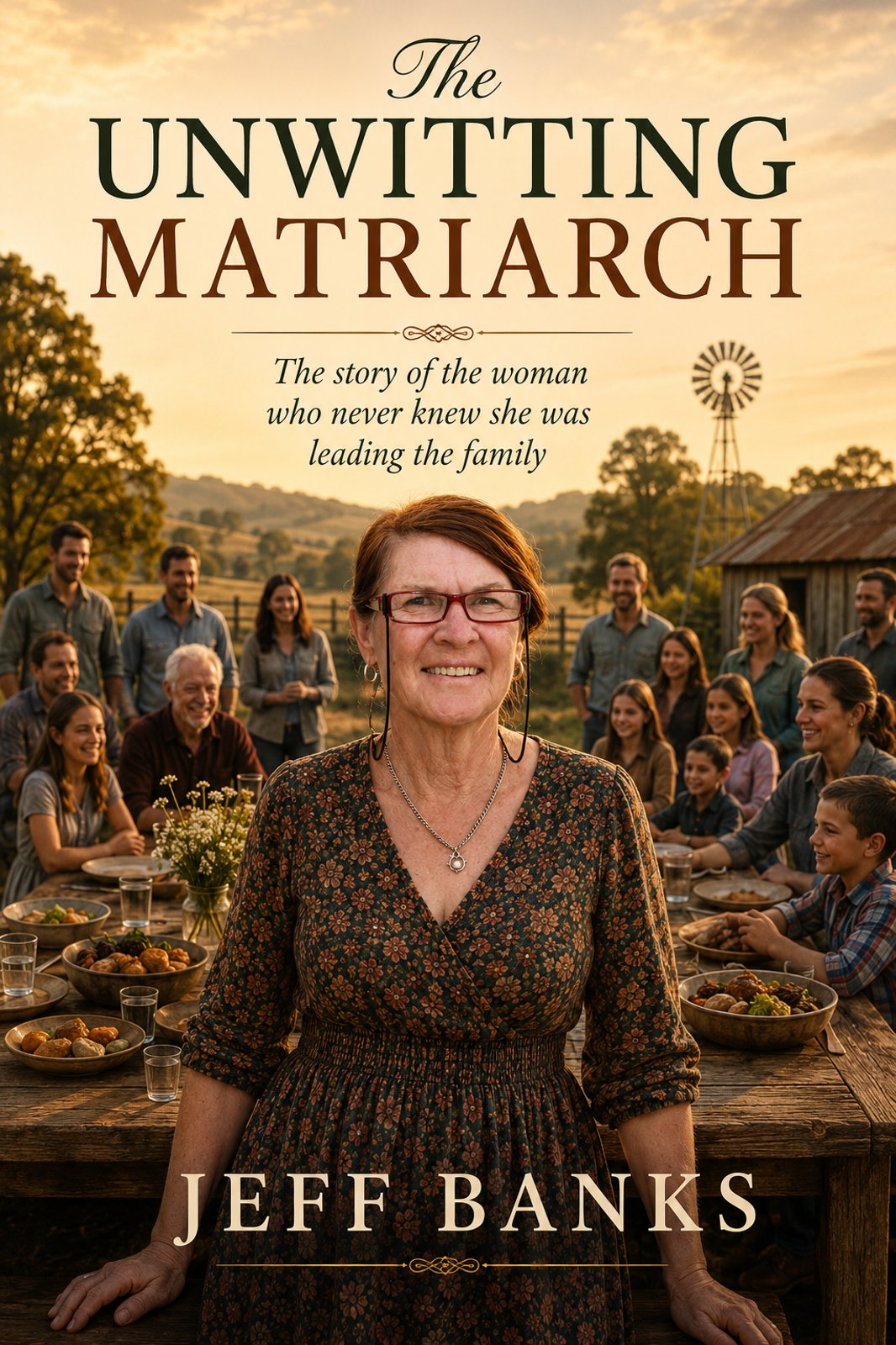
The Unwitting Matriarch Chapter 15 - FergFest

The Unwitting Matriarch Chapter 15 - FergFest | Travelling Around Australia with Jeff Banks

Large families inevitably contain strong personalities, differing opinions and occasional disagreements. They also contain varying levels of success, different life experiences and diverse perspectives. Humour provides a mechanism for navigating those differences without allowing them to become divisions. Laughter reminds people that relationships matter more than individual disagreements. Kerre understood that instinctively, even if she never expressed it in those terms. She recognised the value of creating spaces where people could gather, relax and enjoy one another's company. Little Prairie became one of those spaces. Through no deliberate ambition of her own, she helped create an environment where family traditions could flourish.

THE UNWITTING MATRIARCH

She never asked to lead. She simply never stopped showing up. 

Chapter 15 — FergFest

One of the great misconceptions about large families is that they somehow remain connected through sentiment alone. People like to imagine that blood relationships naturally hold everybody together, as though shared ancestry is enough to overcome distance, time and the competing demands of modern life. The reality is usually far messier than that. Families stay connected because they create traditions, collect stories and develop reasons to keep returning to one another. In the Ferguson family, humour became one of the most effective tools for achieving exactly that outcome.

Looking back through the stories Kerre told and the stories others told about Kerre, it becomes apparent that laughter occupied a far more important place than anybody consciously acknowledged. The family certainly experienced its share of hardship, uncertainty and disappointment. They worked hard, worried about money, raised children, buried loved ones and dealt with all the ordinary struggles that accompany life. Yet somehow, through all of it, they retained an extraordinary ability to laugh at themselves and at one another.

That ability revealed itself particularly well during two separate gatherings that have since become part of family folklore. The first was a major Ferguson family reunion. The second was what eventually became known as FergFest. Although the two events are often remembered together because of the stories they generated, they were distinct occasions that demonstrated different aspects of what made the family special.

The family reunion was organised around the idea of bringing people together. Relatives arrived from different places carrying different experiences, different children and different memories. Some had not seen one another for years, while others maintained regular contact, but the gathering created an opportunity to reconnect with a broader family network that stretched well beyond immediate households. It reminded everyone that they belonged to something larger than the individual lives they had built.

Naturally, because it was a Ferguson gathering, somebody decided entertainment should form part of the proceedings. That decision probably seemed sensible at the time. After all, every family contains singers, storytellers and people willing to stand in front of a crowd. What nobody fully considered was that the Ferguson family also contained individuals who possessed confidence vastly exceeding their actual talent, a combination that often produces memories far more valuable than polished performances ever could.

Brolga quickly emerged as one of the driving forces behind the entertainment. He approached the task with characteristic enthusiasm, locating amplifiers, microphones and enough equipment to transform a family gathering into something resembling a community concert. Once microphones appeared, however, restraint disappeared. The availability of amplification encouraged participation from people who might otherwise have remained safely seated amongst the audience.

Music became a central feature of the reunion. Justin contributed songs, drawing upon the confidence and experience that came from performing before crowds. Kirsten brought a different dimension through her saxophone playing, adding a level of musical discipline and polish that contrasted beautifully with the more spontaneous performances occurring around her. The combination worked surprisingly well because nobody seemed concerned about whether the acts matched one another stylistically.

Other family members found their own ways to contribute. Max’s children delivered a performance that became memorable not because it was technically perfect but because it captured the spirit of the occasion. The audience responded warmly because the event was never about judging talent. It was about participation, courage and the willingness to become part of the collective experience.

As the evening progressed, songs drifted through the gathering. Familiar favourites emerged, including Folsom Prison Blues and other numbers that encouraged audience participation. Before long, spectators became performers and performers became spectators, with people moving effortlessly between the two roles. The distinction hardly mattered because everybody understood that the real purpose was shared enjoyment rather than polished presentation.

The reunion demonstrated something important about the Ferguson family. Participation mattered more than perfection. Nobody was expected to possess professional skills. Nobody was required to deliver a flawless performance. The only real expectation was that people would have a go and, in doing so, contribute to the atmosphere that made the gathering memorable.

That willingness to participate reflected a broader family philosophy. Belonging was not earned through achievement, status or expertise. Belonging came through involvement. People became part of the family story by stepping forward, taking part and accepting that they might occasionally become the subject of good-natured laughter.

Several years later, or perhaps simply at a different stage in the family’s evolution, FergFest emerged as something entirely different. Whereas the reunion focused on reconnecting relatives, FergFest centred around Little Prairie and the growing recognition that the property had become a destination in its own right. People were no longer simply gathering because they happened to be related. They were gathering because Little Prairie had become the natural place to do it.

By this stage, Kerre’s property had acquired a significance that extended well beyond its physical boundaries. Children, grandchildren, cousins and friends all seemed drawn toward it. Cars arrived carrying people, food, camping gear and expectations. The gathering developed its own traditions and rituals, many of which revolved around food, storytelling and opportunities for mischief.

Because FergFest often coincided with Easter, the Easter Bunny inevitably became involved. Unfortunately for the Easter Bunny, involvement with the Ferguson family rarely guaranteed dignity. What began as straightforward Easter activities frequently evolved into elaborate practical jokes that entertained the adults at least as much as the children.

Children searched enthusiastically for hidden eggs while adults quietly manipulated events from the sidelines. Clues became increasingly ridiculous and hiding places progressively more improbable. The children often suspected they were being set up and, more often than not, those suspicions proved entirely justified. The adults seemed to derive almost as much pleasure from watching the confusion unfold as the children derived from finding chocolate.

The Easter Bunny stories endured because they captured the spirit of the gathering. Nobody remembered precisely how many eggs were hidden or who found the most. What remained memorable was the laughter, the playful deception and the collective enjoyment that accompanied the annual ritual.

Entertainment again became part of the proceedings, although FergFest approached the concept from a slightly different direction. Family groups were encouraged to provide performances, creating opportunities for both genuine talent and spectacular foolishness. Unsurprisingly, the latter category often generated the strongest memories.

Bruce Parnaby secured his place in family folklore through a performance that defies easy description while remaining impossible to forget. Faced with the requirement to entertain, he apparently concluded that conventional approaches lacked sufficient impact. The resulting talking bum routine entered family mythology almost immediately, ensuring that his contribution would be remembered long after more polished acts had faded from memory.

Stories like that demonstrate why humour functions so effectively within large families. Nobody remembers a competent but forgettable performance. Everybody remembers the moment somebody committed fully to an outrageous idea and carried it through regardless of the consequences. The willingness to risk embarrassment often produces the strongest family memories.

The Sockettes represented another perfect example. Led by Ian Beddie and involving participants including Two Dogs and his brother, the group delivered a rendition of Swan Lake that could hardly be described as traditional ballet. Dressed in green work singlets, work shorts and work boots, they crossed the lawn with a level of commitment that more than compensated for any technical shortcomings.

The visual image alone guaranteed immortality. Family members who witnessed the performance could still picture it years later. The contrast between classical ballet and rural work attire created exactly the sort of absurdity that thrives within family mythology. More importantly, the performers embraced the joke completely, understanding that commitment matters far more than credibility when attempting to make relatives laugh.

The Sockettes had apparently performed before, which only strengthened their legendary status. Repetition transformed the act from a one-off joke into a recognised tradition. People began anticipating the performance, and anticipation became part of the entertainment itself. The audience laughed not only at what they were seeing but also at the knowledge that certain family traditions had become wonderfully unavoidable.

Then there was Tim’s shorts.

Like many great family stories, the precise details shifted slightly depending upon who happened to be telling it. Some versions emphasised the circumstances leading to the event. Others focused entirely upon the aftermath. What remained constant was the fact that Tim’s shorts ended up being burned and that the incident generated enough amusement to ensure permanent inclusion within family folklore.

The shorts themselves disappeared long ago, but their destruction achieved a form of immortality. New family members eventually heard the story. Younger generations learned the details. The incident became another thread woven into the broader tapestry of Ferguson family history.

Looking at these stories collectively reveals a deeper truth about Kerre’s world. Humour was never merely entertainment. Humour performed an essential social function. It created connections between generations, eased tensions, encouraged participation and transformed ordinary gatherings into lasting memories.

Large families inevitably contain strong personalities, differing opinions and occasional disagreements. They also contain varying levels of success, different life experiences and diverse perspectives. Humour provides a mechanism for navigating those differences without allowing them to become divisions. Laughter reminds people that relationships matter more than individual disagreements.

Kerre understood that instinctively, even if she never expressed it in those terms. She recognised the value of creating spaces where people could gather, relax and enjoy one another’s company. Little Prairie became one of those spaces. Through no deliberate ambition of her own, she helped create an environment where family traditions could flourish.

That may ultimately explain why both the reunion and FergFest remain so vividly remembered. The performances themselves were enjoyable. The stories certainly became legendary. The laughter was genuine and abundant. Beneath all of those things, however, sat something even more important.

People kept coming back because they felt they belonged.

The songs, the Easter Bunny, Bruce Parnaby’s outrageous routine, the Sockettes dancing Swan Lake in work boots and the burning of Tim’s shorts all served the same purpose. They created shared experiences that strengthened connections and generated stories worth retelling. Every family requires those stories if it hopes to remain connected across generations.

For the Fergusons, humour became one of the load-bearing walls holding the entire structure together. It carried weight that might otherwise have fallen upon individuals. It softened difficult times, amplified good times and created reasons for people to keep returning. In the end, that may be the most important lesson hidden within both gatherings.

Families survive because they learn how to laugh together.

Author

Menu