

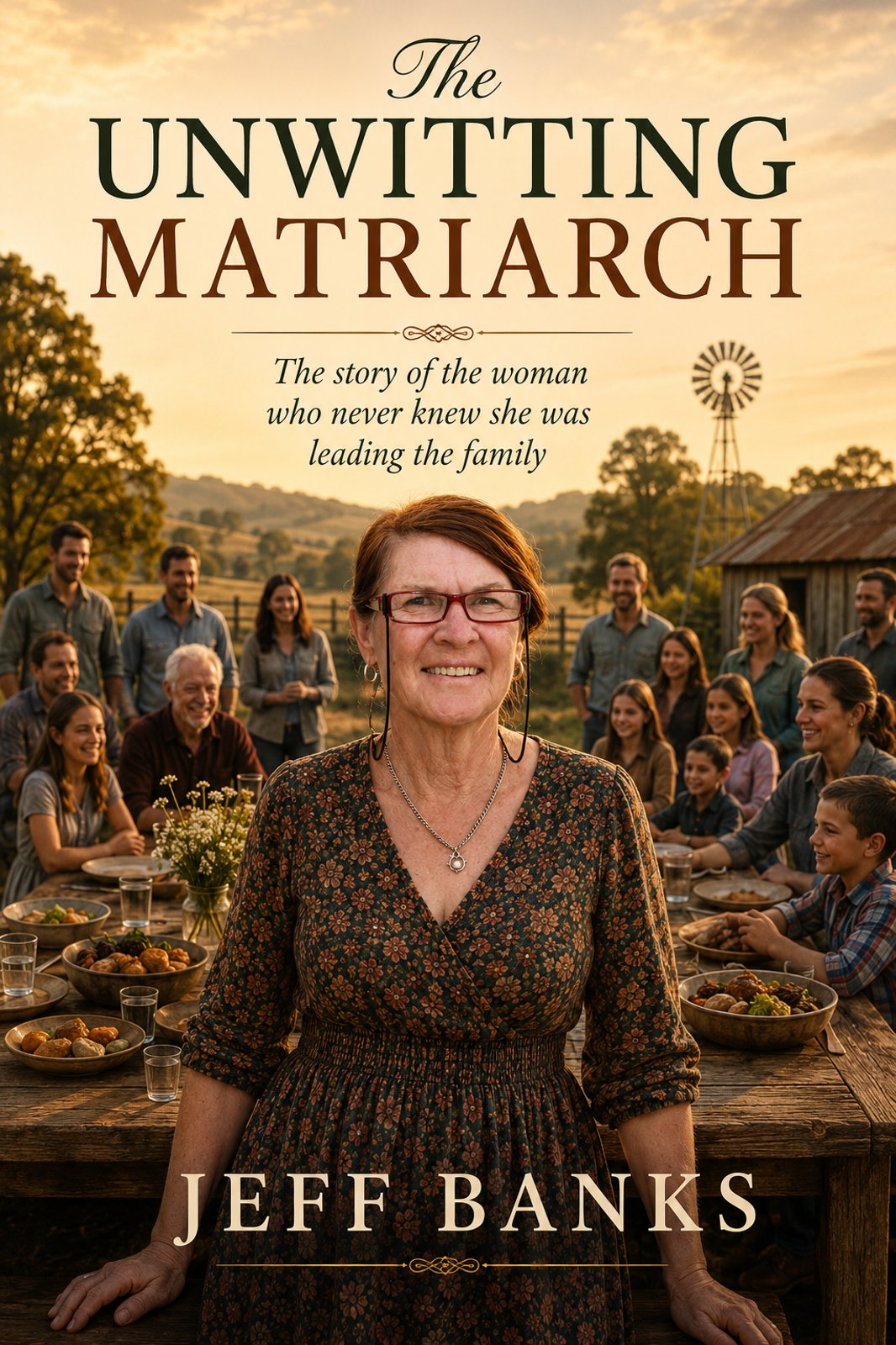
The Unwitting Matriarch Chapter 13 - Discovering Ferguson

The Unwitting Matriarch Chapter 13 - Discovering Ferguson | Travelling Around Australia with Jeff Banks

For Kerre, the revelation was never about claiming an identity that did not belong to her. It was about understanding an identity that had always been there. The pieces that appeared so surprising to others simply completed a picture she had been glimpsing out of the corner of her eye since she was a young girl standing behind a screen door, watching three unfamiliar men arrive and wondering why their visit seemed to make everyone so uncomfortable.

THE UNWITTING MATRIARCH

She never asked to lead. She simply never stopped showing up. 

Chapter 13 — Discovering Ferguson

There are some discoveries that arrive like a thunderclap. A person learns something and immediately understands that life will never look quite the same again. Then there are other discoveries that creep quietly into the room and sit patiently in the corner until enough pieces accumulate for the truth to become impossible to ignore.

The Ferguson story belonged firmly in the second category. By the time Kerre began learning more about her family history, most of the people who could have explained everything properly were gone. Some had passed away, while others had spent entire lifetimes avoiding certain conversations. Like many Aboriginal families of their generation, silence had become a survival skill rather than a personal choice.

The strange thing was that the clues had always been there. Nobody had really hidden them and nobody had gone to great lengths to erase them. They had simply never been discussed in any meaningful way, and because they were never discussed, they slowly faded into the background noise of family life.

Kerre often spoke about Lionel’s family and her own family as though they occupied two different worlds. Lionel’s people were farmers, horsemen and bush workers whose stories seemed straightforward and easy to follow. Her own family carried stories that felt older, deeper and somehow less complete. There were references to relatives scattered throughout western New South Wales, family gatherings where unfamiliar names kept resurfacing, and comments that seemed important but were never expanded upon.

As a child she accepted all of it without question because that is what children do. Adults tell stories, families create traditions and certain subjects become part of everyday conversation while others remain untouched. A child naturally assumes this is simply how the world works and rarely stops to wonder why certain questions are never asked.

Looking back decades later, Kerre would realise that entire sections of family history had been sitting in plain sight all along. Nobody had deliberately concealed them and nobody had gathered together to keep secrets. The pieces were scattered everywhere, but nobody had ever taken the time to connect them.

The first hints emerged through conversations involving Lionel’s brothers and the wider network of relatives. Family gatherings produced names and connections that seemed important even though nobody appeared interested in explaining why. One relative would mention an uncle, another would mention a cousin and someone else would casually refer to a family connection that appeared significant but was left hanging without context.

Over time the names accumulated like pieces of a puzzle spread across a kitchen table. Eventually one particular name began appearing more frequently than the others. That name was Ferguson, and at first it meant very little to Kerre.

Australian families are full of surnames that seem ordinary until somebody starts asking questions. Ferguson sounded no different from countless other names scattered throughout family trees across the country. It was simply another branch of a large extended family whose significance was not immediately obvious.

The importance of the name would only become apparent years later. When it finally did, it changed the way Kerre understood both her family and herself.

One of the most fascinating aspects of this story is that it unfolded during a period when many Aboriginal families were still carrying the scars of government policies that had encouraged silence and caution. Modern Australians often discuss the Stolen Generation as though it belongs to a distant chapter of history. For families like Kerre’s, however, the consequences remained alive within living memory and continued influencing behaviour long after the policies themselves had changed.

Parents and grandparents had learned through experience that drawing attention to Aboriginal ancestry could create serious problems. Children could be removed, opportunities could disappear and authorities could take an unhealthy interest in family affairs. Entire communities learned that blending into the background was often safer than standing out and attracting attention.

People adapted in whatever ways they believed necessary. Some changed how they spoke, some changed where they lived and others changed what they shared with their children. None of this required formal discussions or deliberate plans because it simply evolved into a practical strategy for survival.

The result was that many descendants grew up knowing fragments of the truth without ever receiving the complete story. Kerre was one of them. She inherited pieces of knowledge without inheriting the explanations that made those pieces meaningful.

The breakthrough came through a combination of family research, conversations and reconnections with relatives who carried information that earlier generations had never fully shared. Each discussion revealed another fragment. Each family gathering uncovered another clue. Slowly, the picture became clearer.

Then came the Dubbo reunion, which would become one of the most significant moments in Kerre’s understanding of her family’s story.

Family reunions have a remarkable ability to compress generations into a single place. People arrive carrying photographs, memories and stories that have travelled with them for decades. Cousins who have not seen one another for years discover shared experiences, while elderly relatives suddenly become historians preserving knowledge that might otherwise disappear forever.

The Dubbo reunion did exactly that. For perhaps the first time, Kerre found herself surrounded by people who each possessed different pieces of the same story. Names were compared, relationships were explained, photographs were examined and questions were finally asked that previous generations may never have felt comfortable asking.

What emerged from those conversations was something much larger than a family tree. What emerged was an identity that had always existed but had never been fully understood.

The Ferguson connection gradually revealed itself as something profoundly important. The family was connected to William Ferguson, one of the most significant Aboriginal political leaders in Australian history. Here was a man who had dedicated his life to fighting for the rights of Aboriginal Australians during a period when such advocacy required extraordinary courage and determination.

William Ferguson challenged governments, institutions and deeply entrenched attitudes that many Australians accepted without question. His efforts helped lay foundations for changes that future generations would often take for granted. Discovering that connection left Kerre feeling both excited and unsettled at the same time.

The excitement came from understanding that her family possessed a direct link to an important chapter of Australian history. The discomfort came from an unavoidable question that naturally followed. If this connection was so significant, how had nobody ever talked about it?

The answer lay with the generations that came before. Those earlier generations had lived under circumstances that younger Australians often struggle to imagine. They had experienced discrimination directly, watched opportunities denied and witnessed children removed from families. Through painful experience they had learned that visibility could sometimes carry consequences.

Understanding that reality changed the way Kerre viewed their silence. It became clear that silence was not necessarily a sign of shame. In many cases it was an act of protection carried out by people who believed they were safeguarding their families from harm.

It would have been easy to look backwards and become angry about what had not been shared. It would have been easy to question decisions made by parents and grandparents. Instead, Kerre found herself developing a deeper appreciation for the circumstances those generations had faced.

People make decisions based upon the world they inhabit rather than the world future generations might wish had existed. The world they inhabited was often harsh, suspicious and unforgiving. Judging them without understanding that context would have missed the point entirely.

As she learned more, family stories that once appeared disconnected began making sense. Incidents that had seemed random suddenly acquired deeper meaning. Attitudes that once appeared unusual became understandable when viewed through the lens of history.

Many Aboriginal families developed a powerful emphasis on discipline, respectability and staying out of trouble. They often felt they had little margin for error because mistakes that might be overlooked elsewhere could attract unwanted attention in their communities. Children learned quickly, parents worried constantly and entire households operated according to rules that sometimes seemed strict until the historical reasons behind them became visible.

In many ways, the irony of the Ferguson discovery was that Kerre already knew the answer long before the rest of the family began assembling the pieces. She may not have possessed the names, the dates or the historical connections, but she carried an instinctive understanding that there was something different about the family’s story. It sat quietly in the background of her childhood, surfacing occasionally in moments that made little sense at the time but became increasingly significant when viewed through the lens of adulthood.

One of those moments occurred when she was still a teenager. Like many family stories, the details had softened around the edges with time, but the memory itself remained vivid. One day there was a knock at the door and standing outside were three Aboriginal men she had never seen before. Their arrival seemed entirely ordinary to them, yet it caused an unease within the household that young Kerre immediately recognised, even if she did not fully understand it.

The conversation that followed was polite enough. Nobody raised their voice and nobody appeared openly hostile. Yet there was a tension in the air that lingered long after the visitors had left. Questions were asked. Explanations were offered. Certain names surfaced and then disappeared again. As was often the case in families carrying hidden histories, the discussion ended before the real discussion ever began.

At the time, Kerre simply accepted what she was told. Children are remarkably good at sensing when adults are withholding information, but they are equally good at convincing themselves that the missing pieces must not matter. Looking back years later, however, she would realise that she had witnessed one of those moments where the truth briefly stepped into the open before retreating once more into silence.

There were other clues too. Her father, known universally as Snow, stood apart from many people’s expectations of what Aboriginal ancestry was supposed to look like. The family knew that Snow was what older generations referred to as a throwback, carrying white pigmentation despite his Aboriginal heritage. In an era when people often judged identity solely by appearance, that created its own complexities.

The story that circulated through the family was both tragic and revealing. Margaret Gowings, Snow’s mother, had been raised on a large property near Darlington Point. By all accounts she was intelligent, educated and capable. She could read and write at a time when many Aboriginal women were denied opportunities for education, and that alone made her stand out.

Family lore tells of a terrible event that changed the course of generations. Margaret was allegedly assaulted by a group of men associated with the property. Whether they were station hands or workers passing through has been lost to time, but the consequences remained. Snow was born as the result of that assault. Nobody ever knew with certainty who his biological father was, and perhaps nobody ever would.

The remarkable part of the story came afterwards. Along came William Ferguson, who accepted Margaret and accepted Snow as his own. Rather than turning away from a difficult situation, he stepped towards it. Together they built a family and raised many more children, creating the Ferguson line that would eventually spread throughout New South Wales and beyond.

For much of her life, Kerre knew fragments of that story without understanding its broader significance. She knew there was Aboriginal ancestry. She knew there were connections that people spoke about cautiously. She knew there were stories that seemed to stop halfway through. Most importantly, she knew there were moments when older family members appeared to be navigating a conversation they did not entirely wish to have.

The rest of the family would eventually discover documents, family links and historical connections that confirmed what had previously been rumour and instinct. Kerre’s journey was slightly different. She had lived with the feeling long before she had the evidence.

That is perhaps why the Ferguson discovery felt less like learning something new and more like finally receiving confirmation of something she had always suspected. The family history was not being created. It was simply emerging from the shadows where previous generations had felt compelled to leave it.

For Kerre, the revelation was never about claiming an identity that did not belong to her. It was about understanding an identity that had always been there. The pieces that appeared so surprising to others simply completed a picture she had been glimpsing out of the corner of her eye since she was a young girl standing behind a screen door, watching three unfamiliar men arrive and wondering why their visit seemed to make everyone so uncomfortable.

The resilience that ran through generations of her family no longer seemed accidental. The fierce independence that characterised so many relatives no longer felt unusual. The determination to endure difficult circumstances appeared linked to a legacy that stretched far beyond any individual family member.

Perhaps the greatest irony was that none of this required discovering a hidden document or uncovering some long-lost secret buried in an archive. The evidence had always existed. The family had always carried the connections and the names had always been present.

The truth had simply been hiding in plain sight. Like many important truths, it remained invisible until somebody finally looked closely enough and asked one more question than previous generations had asked before.

Today, when Kerre speaks about these discoveries, there is a sense of quiet pride rather than resentment. She understands why earlier generations remained cautious and she understands the fears that influenced their decisions. Most importantly, she understands that survival often requires compromises that later generations may never fully appreciate.

At the same time, she recognises the importance of reclaiming those stories. Family history is not merely a collection of names and dates. It is the framework that helps people understand where they came from, why they became who they are and how the past continues to shape the present.

The Dubbo reunion did not simply reconnect relatives who had drifted apart over time. It reconnected a family with itself and provided context for stories that had lingered unanswered for decades.

The discovery of Ferguson did not alter the course of Kerre’s life overnight because she remained the same practical woman she had always been. She still valued common sense over grand declarations and experience over theory. She still preferred action to rhetoric and results to symbolism.

What changed was her understanding of the road that had brought her to that point. For decades she had carried an identity she could feel but could not fully explain. Through family stories, conversations and the patient assembly of forgotten pieces, she finally found the missing parts of that story.

The remarkable thing was that they had been there all along. They had been waiting quietly among old names, family memories and half-finished conversations, needing only somebody willing to keep asking questions until the full picture finally emerged.

Author

Menu